
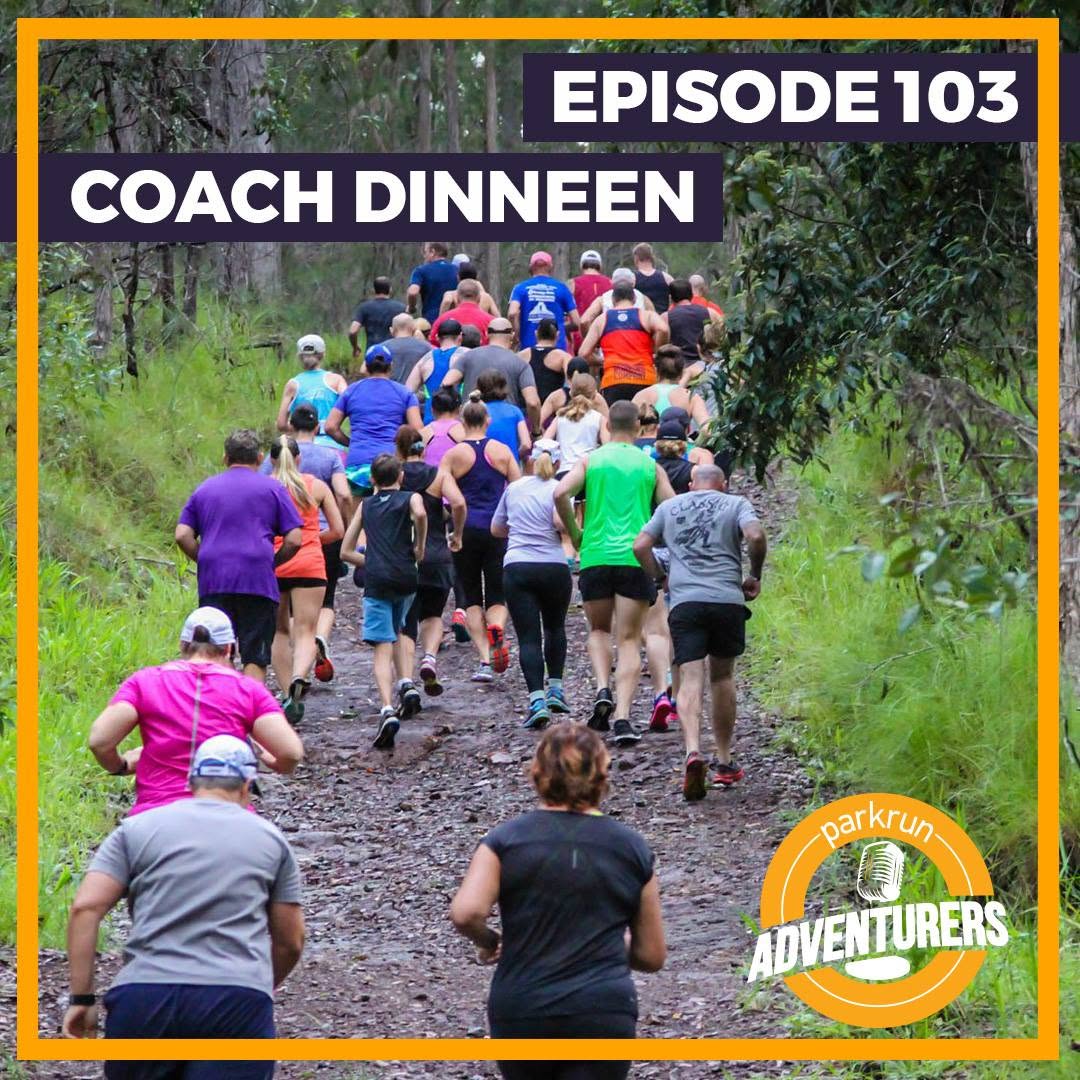
Speaker names appear where they could be established with confidence. Others are shown as “Unidentified speaker”. Sounds that are not speech — music, laughter, people talking over each other — are written in [square brackets].
Episode 103 · 2018-03-15
Enhanced transcript — Produced by an automated editing pass — speakers named, sound described, segments marked. NOT yet checked by a person.
Speaker names appear only where they could be established with confidence; others are shown as “Unidentified speaker”. Non-speech sound is in [square brackets].
Source: https://log.5kadventures.net/transcripts/ep103.html · The Adventurers Log · An independent project, not affiliated with or endorsed by parkrun.
Welcome
Scott Trickett: It's time for another episode of the parkrun adventurers with Scott and Mel. Welcome, Mel.
Melissa Erbacher: Thanks, Scotty.
Scott Trickett: How are we feeling this week? Fresh and ready to tackle another episode?
Melissa Erbacher: No, not fresh. Ready to tackle another episode, yes, but I'm tired. I'm just tired.
Scott Trickett: Is this more baby tired or is this run-the-date tired?
Melissa Erbacher: It's a combination of the two. I think possibly more run-the-date than baby this time, though. Okay. It's hard.
Scott Trickett: Well, tell me more.
Melissa Erbacher: I should be really careful about what I just casually throw out there on the podcast. That sounds like a good thing. I could do that. One minute for each of the dates of the month does not sound like an overly arduous task. In the first three days, no, it's not. But I think I mentioned last week when I got to day four, I was really seriously considering what I had done. And it's just empty, upping and upping and upping and I did day 14 yesterday so we're recording on day 15 I haven't been out for my run yet today 14 minutes in a row and my feet felt like they were lead lead lined or something I don't know it could be because day 13 was super um what's the word wet
Scott Trickett: That's a word.
Melissa Erbacher: That's a word. That's a word. They were super wet. I had to change my shoes because the shoes that I wore the day before got saturated and I didn't realise that I must be running in the lightest pair of shoes that I own for most of the time. And so I was wearing heavier shoes yesterday and it just, it felt harder. But then I looked at my time afterwards and I actually ran faster for the whole way. So that probably contributed to it. But you would think day 14 out of 31, that's on the cusp of halfway there. But no, it's not. Because I added up the minutes, okay? I added up how many minutes there are if you run one in time with the date. And there are 496 minutes to be run this month, which is like almost eight and a half hours of running. And so far, up to and including day 14, I've done 105 minutes, which is not even a quarter.
Scott Trickett: Well, I think Rowan touched on this when we talked to him, that the bulk of the load is in the last few days. And let's take us back because when you just said you'd do it, I knew you didn't think it through because you just said it off the top of your head. And I thought, oh, let's hold Mel to this. Let's get her to commit. But hey, look, let's call it halfway because you're getting fitter, Mel. You're getting fitter, so it should get easier.
Melissa Erbacher: Am I or am I just getting tighter?
Scott Trickett: Maybe a combination.
Melissa Erbacher: Yeah, maybe a combination. But look, it's certainly given me a whole bunch of other opportunities. I got to run with another person last weekend, which I felt a bit uncomfortable about it at the start. And I said to him, look, because this guy, Jerry, he's great. But he's fast. So he runs parkrun, you know, 18, 19 minutes if he feels like it. And that is like my pace, eight minutes on a good day is like a walk for him, literally. And so I said to him, because he had a long run to do on Saturday afternoon and we'd been out and about with a bunch of other friends and I wanted to run, you know, in that area because it was different, from running at home I'm getting a bit bored of all the footpaths around here and he's like oh I'll run with you for the for the first 10 minutes because I was up to 10 minutes that day and I said no that's okay you just go because I'm you know you're not I'm not going to slow you down that much that's just ridiculous he's like no I'll run with you I'll run with you and I was like okay And he did. And we sort of chatted for about the first four minutes till I ran out of breath. And then mostly he chatted for the rest of the way. But it was really lovely. I have forgotten what it's like to actually run with a person who doesn't run, you know, five metres in front of you or you're not running at the same time. Somebody who's keeping pace with you and you're just both of you, you know, turning the legs over. And it was really nice. So I'd forgotten what that was like. So thanks, Jerry. I know he probably doesn't listen to the podcast, but that's okay.
Scott Trickett: I bet those 10 minutes went by a lot quicker.
Melissa Erbacher: They did. It was over fairly quickly. And I have been finding that I get toward the last little couple of minutes and And when I click over on the time, I do have more. I could keep going. But I'm stopping because I'm also one of those people that once I've done a certain level of something or a certain amount, I can't go backwards. So if I did 20 minutes today, irrespective of running the date, tomorrow I would have to do at least 20 minutes, if not 21 minutes. So I'm very aware of my own weird brain mechanizers, mechanations. So I'm just sticking to that actual time. And then in my warm down, if I feel like it, I'm running a bit more or I'm taking longer and doing more of a distance exercise. and just leaving the run the date as a separate thing. But what else I'm discovering is that when I was having a particularly bad day and I had had a rough night with Wes the night before and I just felt like having a nap. I didn't want to go for a run. I really didn't want to go for a run. And I just thought, all right, what can I do that's going to change things, that's going to help me get through this however many minutes it was that day. I think that was like a 12-minute day. And I took my music. I haven't run with music in a long time either because I just haven't been running. And it was amazing. It was like, Once again, running with old friends. I still have my running playlist, my long run playlist and my other run playlist on my iPod. And listening to my songs again, you know, I was smiling while I was running. And that was another day. We've had a lot of rain on the Sunshine Coast of late. And that was another day that ended up in pouring rain. And I was a little bit concerned that I was going to kill my iPod with all the water, but it was okay. It was fine. And yeah, my good old friends, Eye of the Tiger was playing. That was keeping me company. And then a whole bunch of other songs that just, your feet remember and your legs remember. And so they just start, there was a bit of Eminem going on. He's got a great beat to run to. It was just good. And I'm getting glimpses again, Scotty, of why I loved running. And I didn't realise that I had probably lost my mojo a bit just because I hadn't been running for a long time. But I'm starting to remember.
Scott Trickett: Well, everything you're describing is just running. So you're just falling back in love with running. You've been away for so long. And I think I'm hearing an open invitation to anyone on the Sunshine Coast to come and run with you.
Melissa Erbacher: No, that's not what I was saying either.
Scott Trickett: You misinterpreted that.
Melissa Erbacher: Well, there is still a little bit of pressure involved with running with other people. And I'm sure there are certain people who genuinely wouldn't mind running at my pace and that would be fine. One of my other challenges is trying to fit it in around work and around... bedtime for Wes and whether or not I take him with me. And so some days he comes out in the pram and other days my mum is still here or he stays with Adam and those sorts of things. So it's difficult for me to plan ahead. For somebody else who might be able to run because literally I don't know from day to day what time I'm going to run. So that's challenging.
Scott Trickett: Talk to me about this weather because all I see every time someone from Queensland posts something on social media is that it's raining at the moment.
Melissa Erbacher: Yeah, well, it's the late wet season. Normally, it's quite wet during the summertime and we didn't get it until pretty much the first of March ticked over and then it's rained every day since. I've gone through so many running clothes and I had to dry out shoes and things like that repeatedly. But I'm enjoying it because I do enjoy running in the rain and it's certainly much more comfortable than running in the humidity or the hot weather. So it's all working out well for me.
Scott Trickett: How many pairs of shoes have you got in the rotation?
Melissa Erbacher: I've just been rotating between two at the moment. I have other pairs of shoes but they aren't, like I'll get blisters from some of them or other ones eat socks and things like that. So I'm just rotating between the two and hoping that they get dry enough.
Scott Trickett: We're about to talk to the coach, and maybe this is something we'll ask him, but I'm working on a new theory and technique of rotating through multiple shoes to avoid injury.
Melissa Erbacher: That's interesting. I actually want to talk to him about injury too, because I know I'm upping my training a little bit faster than I should be, technically. That whole 10% rule out the window when you're running for the date.
Scott Trickett: Okay. Well, good. Okay. I won't say any more. Let's save it for the coach who's coming up. I want to quickly also touch on JT, our oldest parkrunner to get to 250 runs. Yes. And we got to see you on Facebook Live. Just quickly give us a brief recap of the whole morning and how it went down.
Melissa Erbacher: It was a great morning once again the weather turned it on for us in the wet respect which was a bit disappointing because I know some runners stay away on wet days however enough people knew that he was running his milestone that they still showed up and on a day which would have probably normally dropped between 80 and 100 runners because it was wet, they were all still there. So I was very impressed by the community rallying around to come and cheer him on. It was a great morning. He... I hadn't because I wanted to Facebook live him finishing and I hadn't properly prepped myself with him about what he anticipated finishing at I'd looked at his previous run times but I think the adrenaline of the day and the fact that he knew people were waiting for him at the finish line spurred him on so he actually finished a bit quicker than I was expecting almost missed it but I didn't so I If anyone wants to go see him finish and a little chat that I had to him very quickly afterwards, it only goes for about three minutes, that's on the parkrun Australia Facebook page. But it was a great morning and he had a really lovely time, which is, you know, the main thing about milestones is that the person running them feels the full potential, you know, appreciation for what they have accomplished and I'm pretty sure he did.
Scott Trickett: Oh, fantastic. Fantastic. I, of course, had my own milestone on the weekend.
Melissa Erbacher: You did. Happy, arbitrary, was it 200 this week?
Scott Trickett: Well, it was 200 and I was put in my place very firmly by my wife. Oh, really? A lovely thing. My mum came out because she thought it was a milestone.
Melissa Erbacher: Yeah.
Scott Trickett: Because she's been listening to the podcast and I mentioned that it's my 200th. So she came and visited Studley and she was there. And Yvonne told her, no. And the Event Director at Studley said, no, it's not a milestone. He's just running 200.
Melissa Erbacher: Did they send her home? Tell her to come back in 50 runs?
Scott Trickett: No, no. She stayed around, which was lovely as well.
Melissa Erbacher: Hello, Scott's mum. I'm so happy you still listen to the podcast.
Scott Trickett: Yeah, and mum, if you could come to parkrun again this week, that'd be great because I'm walking around Studley with Kasia and we'd love some extra company.
Melissa Erbacher: Yes, do it. It'll be fun.
Scott Trickett: It is fun. Guaranteed. Speaking of guaranteed fun, shall we talk to the coach?
Melissa Erbacher: Yes, it's time. I've got a question. I think we've got a listener question for him this time, so let's get him on.
[music]
On the Couch with Coach Steve
Interview Steve Dinneen — Running coach ("Coach Dinneen"), Melbourne-based; recurring podcast coaching guest
Scott Trickett: The coach is back with us this week and the coach is back in celebration mode as well because he's just completed his 1,000th consecutive day of running. Welcome back, Coach Dinneen.
Steve Dinneen: Thanks for having me. Good to be back and good to get the 1,000 days out of the way as well.
Scott Trickett: Okay, so any suggestion that you were going to rest leading, getting close to those 1,000 days? You must have been getting tired.
Steve Dinneen: No, I wasn't getting tired. I almost... Had to miss a day, two days out because I went down to the beach and played beach boot with my nephews. And unfortunately, I actually hit my foot with the bat and I thought I broke my foot at one stage. I thought I was going to fall two days short. But I iced it and by the afternoon, I was able to go out and do about an 8k run, no problem. So, no, I think the hardest time was probably about maybe, you know, two months ago. I didn't actually think I'd get to 1,000 days until I got to about 900 because at 900 days, I still had three months to go. So everyone said to me, at 800 days, do you reckon you'll get to 1,000? I said, that's still six more months of running. So if I do, I do. If I don't, I don't. So it wasn't until I got to 900 days that I thought I'd better get to 1,000. And yeah, maybe about halfway through that, I thought I was getting tougher now. But in the end, the last month was easy.
Melissa Erbacher: 1,000 days is almost three years. Is this something that you decided to do three years ago, like on day one? Or is it something you just sort of noticed looking at your Strava? It's like, oh, I've just been running for the last three months without a break. Maybe I'll keep doing this and I'll get to 1,000.
Steve Dinneen: I got to, maybe about four years earlier, I got to 500 days straight. I hadn't had a day off. And it's not because I hadn't been sick, I hadn't been injured. I got to about 530 days. I had a bit of a sniffle, took a day off, and then I ran another 300 days straight. So for me, it was never about trying to have done 1,000 days or 500. It's more along the lines of, well, if I'm not injured, then I'm getting better. I'm not sick. I look after myself. I don't know why I need to have a day off. So, yeah, the goal was never to get to 1,000 days. It probably shifted to get to 1,000 days maybe when I got to 900. I thought, I've got to get to the last three months to do that. But up until then, if I had got a bad enough cold or a sore enough leg, I would have taken a day off. It wasn't so much about getting 1,000 days. It's more that I think in the last seven years, I think I've missed 30 days. Oh, no, maybe 40 days. And that's all been with colds, no injuries. So it's more about management. That's what I'm more happy about. I haven't been running when I've been sick as a dog or injured. I haven't forced it. It's just come naturally.
Scott Trickett: It's impressive to stay uninjured for three years. Now, I mentioned in the intro, I'm working on this theory. You're a Brooks man. You always run in Brooks shoes. But do you rotate regularly? number of different shoes because that's what I'm doing at the moment I've got about five different pairs five different brands and I'm almost rotating them through each run and my theory is that this is going to prevent me from being injured is this is this is there any basis in my theory no definitely so there's two things behind that for me I
Steve Dinneen: I rotate the shoes. The Brooks are perfect for me. I've worn them for now, I said, over seven years. I haven't missed a day from an injury. They've been great. But what I do is when you run a lot in your shoes, they compress, the actual rubber. So the idea is at least a cycle between two pairs of shoes every second day so the rubber has a chance to expand. The second thing I do is I use probably five different types of Brooks shoes. And so some are the heavy runners, some are light, some are cross trainers, some are free. So my feet are always light, slightly adjusting to the different shoe um I only wear neutrals or very very slight pronated but not really um so the shoes types are similar but different and allows my feet to adjust so I think yeah my feet are always adjusting but I'm always in a good pair of shoes and that's why I don't have any problems is this something that you recommend the runners that train with you do because I've inadvertently done that this week just because I ran in the rain the other day and my shoes didn't get a chance to dry before the next day so I had to wear different shoes which felt like
Melissa Erbacher: They were super heavy just because they were different. But by the end of it, I actually realised I'd run faster anyway.
Steve Dinneen: Yeah. And that's a good thing too is I tell my runners, yeah, definitely change the shoes, vary between them. Initially, it's a bit hard because you've got to buy two pairs of shoes when you start running. You're like, well, there's $200 each. But what you don't realise is because you're rotating them, they still last as if you bought one pair than the other, if not more. So I think initially people worried about the hip pocket cost initially. But once you buy two pairs of shoes, you just rotate them. And then what I tell people is when you've got an old pair on the go, you buy a brand new one, you wear the new ones for your longer runs and you're sort of the older shoes you wear for your shorter runs. And then by the time the old ones go out and the new ones become older, they go to the short ones, new pair comes in for long runs. So you kind of cycle it that way as well.
Scott Trickett: Okay, now let's crack on to some questions. We had a listener question this week, Steve. It's from Ryan. Ryan wants to know about his training load. So he wants to know what his week would look like. I'm paraphrasing here, Ryan, I apologise. What his week would look like if his only goal is a 5K PB. So how many days should he be running and how many kilometres should he be running? If his only goal is, he's not doing a half marathon marathon, He just wants a parkrun PB.
Steve Dinneen: Perfect. And 5K is a perfect event. And when you're looking at how far you should run for 5Ks, remember there are Olympians out there that are actually, their event is 5K. They run 140Ks a week to run the fastest 5K they want. So I'm assuming you don't want that. The second part of it is, so you look at how fast you want to go and how much you want to put time into that. The second part of that is your time. How available? Can you run seven days a week? Do you want to run seven days a week? Do you want to run three days a week? But for the average parkrunner that just wants to get out there and do a 5K and do their best, I'd probably recommend, obviously, the Saturday, do the parkrun. I'd recommend another run during the week where it's a little bit longer than 5K. So maybe get up to 7 to 10 Ks and go to a bit longer. Great. That's a bit of overtraining, a bit of endurance. So when you go to the 5K, you're a bit fitter. And then you'd want probably at least one other run where you do some slightly faster work. So you might be doing things like, you know, 2K warm-up, 3 or 4 1K efforts or 5 500-metre effort, something like that. And then you want to do a cool-down. So that's for your third run. And if you had time, you'd do a fourth or fifth run, and it would just be a small, small jog, 3Ks, 4Ks, or 5Ks. So to sum that up for him, I'd do a minimum of three runs for the week, a longer one, a session, and a parkrun. And if you can do any more, a couple of easy jogs.
Melissa Erbacher: Is there any recommendations, Coach, for like the order that he should do them in? Because assuming that he wants to get the PB at parkrun on the Saturday, like if he ran the 10K on the Friday, wouldn't his legs be a bit too sore to pull that off?
Steve Dinneen: Spot on. So the way you're planning out, let's say the parkrun's on the Saturday, therefore you want to do probably a longer, easier run either on the Sunday or the Monday. And then I'd recommend him probably on a Tuesday to have a jog,
Scott Trickett: Wednesday I'll do what I call the session and then any other run on the Thursday Friday would be a jog next now we've got a question from the host this is from Scott in research he absolutely trashed himself a couple of weeks ago running hills and would love some advice about running uphill but more importantly some advice on techniques running downhill how do we run faster going uphill but how do we also let ourselves go running downhill
Steve Dinneen: Okay, so the way I look at this is when you run uphill, because you're going uphill, you're going to get your knee lift up, but the steps should be shorter because you're going up the hill. In order to control your strides going up the hill, you want to shorten your arms. So running up a hill, you want to have a slight lean forward, chest up, short arms swinging, and run to a rhythm. A lot of people, when they do parkruns or other runs, they get used to running off their watch. You know, what am I doing per K rate? You can't go by K rates doing hills and trails. You just go by feel. So the idea, up tall, run to the top, and your arms dictate what your legs do. And that's quite simple. Running downhill, the trade-off is, yes, you can run quicker. You've got two problems with that. One, it can be more dangerous because if you start going downhill too quick and go out of control, people don't know how to stop, and that's how you get injured. And the second part of that is when you go downhill, a lot more load goes through your joints like your knees. So you've got to be careful. So often I tell people when you are practicing up and downhill, you do it in training, especially running down the hill, but don't do it all the time. So when you go on your long, easy runs, don't sprint down the hills all the time. Just work on it in the odd session so you're confident running downhill. The way you run downhill, again, your arms dictate what your legs do. Going downhill, you'll probably want to land on your midfoot to your toes, but how quick you go depends on your arms. Your arms are like a handbrake. The more you bend your arms, the slower you're going to go, the more you lower your arms, the faster you're going to go. So if you want to go quicker, just drop your arms, so increase the elbow angle, and you'll run faster, and you don't want to be leaning back. You want to be leaning slightly forward so the gravity rolls you down. The last tip with running downhills, if you're going to go quick, I don't know if anyone's ever seen soccer players run, they have their arms low and wide, whereas normally a track runner has their arms running up and down their sides. To get balance and stability, you actually run downhill with your arms low and wide, That way your balance is better. And then when you get out of control, you just raise your arms up. Does that make sense?
Scott Trickett: It does. Have you got any tips for overcoming the fear of falling? So you're saying widen your frame to get more balance. But how do you let yourself go to just run down the hill?
Steve Dinneen: So it's a confidence thing. It's like driving a car. If you're not confident, you're going to have trouble straight away. So what I'd recommend people do is go to a small hill with a big grass area. So if you do go out of control, you're not going to hit a tree or roll your ankle. You're not going to break anything too bad. So it's about accomplishing. Go out to an area where it's a small grass downhill and practice that. Lower your arms, get a technique right. And as you feel like, yeah, I'm getting better, I can actually understand by lowering my arms and go quicker, raising my arms and go a little bit faster, practice that. Then go to a steeper hill. Then you might want to go to a hill with a bit of a trail where it's a little bit harder. And you just progress that way. If you jump straight onto a really hard trail where it's a single trail and it's turned around a corner and it's downhill, you're going to hit something or break something. So for me, I just ease your ways into it. You know, get out in the open. So if you do manage to get it wrong, well, you're not going to hurt yourself.
Melissa Erbacher: I think I have a natural ability for running downhills because I'm pretty sure I look like a windmill with both my arms going all akimbo. However, I think it's because... You know, I've got the trust in my legs that they'll be able to find the right foot places. But also that I've got the balance. And I think part of that's being loose. Would you say being relaxed would help, Coach?
Steve Dinneen: If you're really, really stiff, you're going to get into a lot of trouble. So if you're really stiff and rigid, you're not going to be able to do too much. So, yeah, it's about being nice and loose, relaxed. And that comes back to competency. When you're not confident in where your foot's landing or you're not confident in your pace, you end up hurting yourself. So, yeah, you can stay nice and loose and relaxed. It's easy. When I was over in Kenya training for a few months, the Kenyans called downhill running free running because what they say is you don't have to waste any energy. You just lean forward, drop your arm, and gravity takes you. And that's what it's like. When you're confident, you just lean forward and you just float. So, yeah, definitely if you can get the confidence up and be nice and loose and relaxed and land on that middle of your foot, you'll be fine.
Melissa Erbacher: You also mentioned that people don't know how to stop. And generally speaking, I just let myself go because I know eventually the ground is going to flatten out and I'll be able to stop when I get there because I'll just slow down when the gravity and the angle of the ground changes. Do you have any tips for actually stopping if you need to stop otherwise?
Steve Dinneen: Yeah. So if you go on a trail, though, a lot of the trails will go straight down a hill and do a sharp turn. Or there's a really famous track in Melbourne, the Tan Running Track. If you run down Anderson Street, when you get to the bottom, you've got a right-angle turn, really. So you've got to be able to control yourself because if you're relying on the ground to flatten out or if someone's in front of you, you're going to clean them up. And it's your arms. You don't actually worry about your legs. What you do is you literally bring your arms up towards your chest so they're really short angles. And it's like pulling up a handbrake. It will slow you down.
Scott Trickett: Great tips. I'm going to try it out. Now Mel is doing run the date coach where she's going from one minute up to 31 minutes. We've talked in the past about managing the 10% rule when you're coming back to running. Should this apply to Mel this month or is she safe to continue running one minute a day?
Steve Dinneen: Yeah look it's fine. It's about increasing your endurance and strength and that sort of level is fine. The 10% rule only applies to a certain degree. And what I mean by that is if you start running and you've done one minute, 10% is another 10 seconds. You don't want to apply that a week. You'd be, you know, a long time until you get through it. So I think that 10% rule is a rough guide. So by now going from one minute to two minutes, no issue. Three, no problem. She'll only start to find it hard when she gets towards about 20 minutes, then goes 21, 22. And for that week, the accumulation tiredness, you know, if you keep on top of your massage and your stretching, she'll have no problems at all.
Melissa Erbacher: Massage, that's what I've got to do. I'll have to put in for some massages. So the load, what you're saying is, Coach, that when somebody's starting out, that whole 10% rule doesn't necessarily need to strictly be applied?
Steve Dinneen: No. If you look at, you know, for beginners, one of the most famous things they do is that couch to 5K. The 10% rule isn't there because they go from running zero metres to 5K, kilometres within us you know I think a certain amount and I only end up doing a minute jog the first time so based on that it should take them almost six months but they're doing about you know six weeks so yeah it it's gonna be taken with a grain of salt when you're running sort of you know 40k's a week 50k's a week then the 10% becomes more relevant because then it's you know it's got about 5k's a week but you know as I said if you're trying to get off the couch and you go for 100 metre jog or you and then you walk a bit and do that, going to 110 is not going to do much. You can probably find at certain stages people there will go up by 100% in a week, and that's fine. And as I said, if you stretch and stay on top of it and look after it, you should be fine. So when you get to the bigger Ks, it will make a big difference, 10%.
Melissa Erbacher: Okay, so basically at the moment I ran my 14 minutes yesterday and I got to 1.8k before I stopped at that 14 minute mark. So I'm thinking by the end of the month I should be around 3.5k or something like that. So it's not too fast for me to build up to that even though day after day after day I'll be doing that.
Steve Dinneen: More of a concern if you're in six months of that because then you start getting towards doing 45 minutes one day, 46, 47 and that starts to affect you more.
Melissa Erbacher: Definitely won't be doing that. You said when I get to about 20 minutes, I might start struggling. I was struggling at four minutes. So I am lamenting the fact that there are no rest days, but I'm trying also to space the runs out so I'm not running in an evening and then doing it again first thing in the morning. Like I'm trying to give my body that full 24 hours. just to recover as much as possible before the next one. Apart from massage and stretching, is there anything else that you can recommend that I do just to not get injured?
Steve Dinneen: So the most common place you're going to get sore is running. So you want something like a spiky ball under your feet, loosen the arches of your feet. You want a foam roller across your quads, loosen the quads, probably a spiky ball into the glutes. So more like your glutes, your quads, your calves, under your feet, just spiky ball and foam roller would be good. A little bit of massage, some heat through it. So, you know, I know you're up north where it's not that cold, but in Melbourne we love jumping in hot baths or spas and that to sort of get the heat and relax into the muscles with some Epsom salts. So, yeah, you just want to be kind to the muscles. And the last thing you need is probably look at your hydration and diet because if you are doing a lot of running, you're going to be depleting all your sort of minerals and that. So make sure you've got a lot of good food coming in, iron levels are good, all that as well.
Melissa Erbacher: A hot bath with Epsom salts sounds amazing, but as it is at the moment, I'm lucky if I've got time to wash my hair once a week with Wes. So I think that could be a little bit of a challenge. I'll see if I can arrange some babysitting to do it once a week or something like that, though.
Steve Dinneen: Yeah, do that. Another thing, too, is like you said, like with the spiky ball and foam roller, you can just do it, you know, spiky ball standing up, you can just do it while you're there. So Yeah, that's the thing. When you've got family and work and other commitments, you've just sort of got to cut corners and manage the best you can.
Melissa Erbacher: Absolutely. All good advice. Thank you for joining us again this week, Coach. We always love having you on and I know I personally always take a lot away from it. So really appreciate you coming and sharing your knowledge.
Steve Dinneen: My pleasure. And like with all my squad at the moment, I think most Saturdays they're going out doing parkrun. And so, you know, again, parkrun's doing a great job and I'm just glad to join and help contribute to something in some way.
[music]
Launches and anniversaries"Where is the cake?"
Scott Trickett: Well, let's get stuck straight into our launches this week because we announced one last week and it didn't happen.
Melissa Erbacher: No, another victim of all the rain that's been going on. Cardwell in Queensland got cancelled due to flooding.
Scott Trickett: Yes.
Melissa Erbacher: Extensive flooding around the area.
Scott Trickett: But they're ready to go this week, we hope. So we are recording this on Thursday. Things change, so always check the local event pages for any late cancellations. But we hope Cardwell's launching this week, as are Coombs in the ACT. That's their first trail run. So I think they're a bit excited about that.
Melissa Erbacher: I'm sure they are. Is that their first launch for 2018 in the ACT? Yeah.
Scott Trickett: Now, the ACT have a big presence. Their events do really well, but they actually don't have a lot of events compared to around the country.
Melissa Erbacher: Well, they are a little bit of a small territory. They are.
Scott Trickett: They are.
Melissa Erbacher: And they do pretty well. So have fun this weekend at Coombs, guys. And if you're in Queensland, we also have a second launch. We've got Forest Lake happening in the sort of southeast Queensland Brisbane area, which is a bit exciting. It's a big month for launches in southeast Queensland this March.
Scott Trickett: Well, all around the country, if you check the calendar, there's just new events. You remember when you'd look at the calendar and there was maybe like three or four and you'd get excited?
Melissa Erbacher: Yes, and mostly it was anniversaries anyway, like launches now. It's just amazing how many are happening.
Scott Trickett: But speaking of anniversaries, we have anniversaries at Campbelltown in New South Wales, Maylands Peninsula in WA.
Melissa Erbacher: Rocky, Rockhampton in Queensland, and Yamba, also in New South Wales.
Sign-off
Scott Trickett: Okay, so now where are you headed this week, Mel?
Melissa Erbacher: This week I am – where am I headed this week? Oh, go on, a parkrun. We are having a Cheers for Volunteers run.
Scott Trickett: Cheers for Volunteers, good.
Melissa Erbacher: Yeah, we're celebrating our volunteers. Everyone's going to wear purple.
Scott Trickett: That's a nice –
Melissa Erbacher: Yeah, we're going to give all the volunteers some much-deserved kudos.
Scott Trickett: Good. So we've stopped this silly competition we had chasing new events because it's been a while for me that I've visited a new event.
Melissa Erbacher: Did we stop it so much as you stopped looking?
Scott Trickett: Maybe a combination, but I think it's for the best.
Melissa Erbacher: Okay.
Scott Trickett: We lay it to rest and let it be what it was.
Melissa Erbacher: I think we've both of us got a busy year coming up for adventures. It's already been a busy start to the year for some of us. There's going to be some international adventures on the horizon. I know you're headed overseas in the middle of the year. I'm headed overseas in April. That'll be my first international one.
Scott Trickett: Yeah, yeah.
Melissa Erbacher: It's exciting times.
Scott Trickett: It is, it is. And we're going to keep podcasting throughout.
Melissa Erbacher: We are. We're going to podcast from all over the world.
Scott Trickett: Yeah, nothing is going to stop us this time. That's the commitment anyway.
Melissa Erbacher: It is. And it'll be good fun. But you mentioned earlier that you're headed back to Studley and you've invited your mum along. More fun close by? Is there a particular reason you're going to Studley this weekend?
Scott Trickett: Another milestone? No, no milestone. I just like going to Studley. So I'm going back there.
Melissa Erbacher: That's an excellent reason to go. It is.
Scott Trickett: It is. Yep. Just enjoying parkrun for parkrun at the moment and just getting ready for next week because that's going to be a big one.
Melissa Erbacher: Next week. Oh, next week. I just had to think there for a second. Now, everybody, we have to let you know that we had a very close call this week. One of the venues... at which we were hoping to have a fancy dress theme for dinner on Saturday night, has a dress code apparently. And it was looking like we weren't going to get dressed up or we weren't going to be able to get dressed up if we went there. And thank you, big gratitude to Brendan's Gallery. He has negotiated with the proprietors of the venue. And we are allowed to wear fancy dress as long as we don't wear anything that covers our faces or exposes our midriffs. So I know this is going to be a big disappointment to you, Scotty, because the whole midriff thing, that's kind of key to a lot of your costumes. It is. How are you going to cope?
Scott Trickett: Well, tops off was my costume planned for the listener meetup.
Melissa Erbacher: It's okay. A whole weekend? It's okay.
Scott Trickett: I've got a backup plan.
Melissa Erbacher: Yeah, it's okay. Okay.
Scott Trickett: It's okay. Good to know. But we will have one more podcast next week, but then the following podcast will be live from Shellharbour.
Melissa Erbacher: Well, recorded live. Yeah. It'll be released, not live, but recorded live, which is really exciting, actually.
Scott Trickett: Is it? Because you're not organising the technical side of it.
Melissa Erbacher: The technical side of it. Yeah, well, I don't have to worry too much about that. No, it's true. You told me you'd take care of it. You sounded very confident when you said so.
Scott Trickett: Yeah, well, that's what I do, Mel.
Melissa Erbacher: You sound confident.
Scott Trickett: Yeah, and then freak out and try and figure it out.
Melissa Erbacher: In the privacy of your own head.
Scott Trickett: Yeah, yeah. But wheels are in motion there as well, so that's going to be lots of fun.
Melissa Erbacher: Yeah, the whole weekend is going to be lots of fun. Heaps of activities, a bunch of freedom runs, parkrun, of course, catching up with a whole bunch of other parkrun adventurers from all over the place. It's going to be amazing.
Scott Trickett: So something to look forward to. Nice short and sharp episode this week. A little bit of feedback that people don't mind a shorter episode because their commute might not be an hour. So we're serving many, many different types of listeners this week. So thanks, Mel.
Melissa Erbacher: You're very welcome, Scotty. Thank you.
Scott Trickett: Have fun at Kawana. Cheers for volunteering. And I'll speak to you next week.
Melissa Erbacher: Cheers.