
 — open the full-size cover
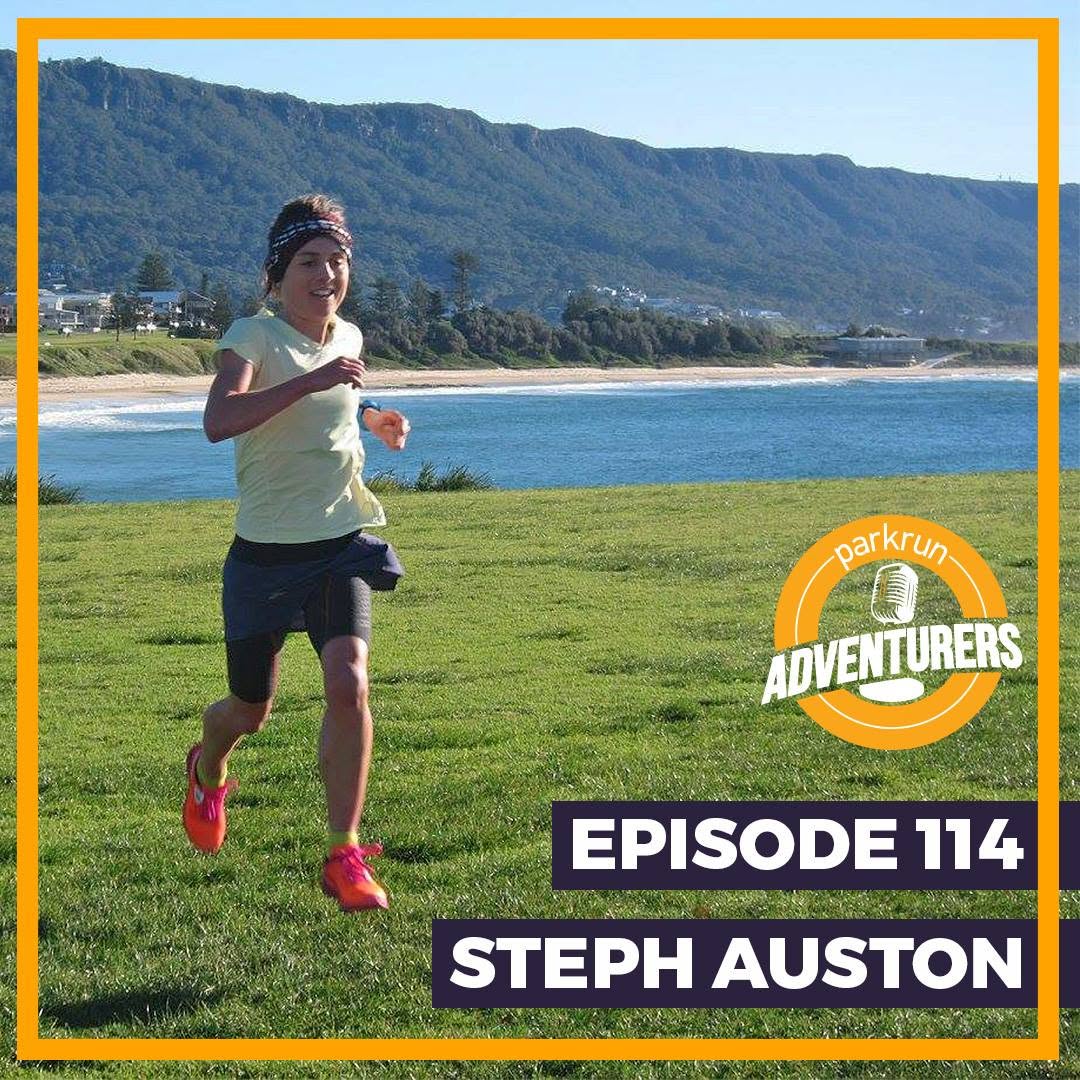
Episode 114 - Steph Auston
Episode details · · 174 speaker turns · sound cues from context
Enhanced transcript
Speaker names appear where they could be established with confidence. Others are shown as “Unidentified speaker”. Sounds that are not speech — music, laughter, people talking over each other — are written in [square brackets].
Episode 114 - Steph Auston · 2018-05-31
Enhanced transcript — Produced by an automated editing pass — speakers named, sound described, segments marked. NOT yet checked by a person.
Speaker names appear only where they could be established with confidence; others are shown as “Unidentified speaker”. Non-speech sound is in [square brackets].
Source: https://log.5kadventures.net/transcripts/ep114.html · The Adventurers Log · An independent project, not affiliated with or endorsed by parkrun.
Welcome
Unidentified speaker: Thank you.
Melissa Erbacher: It's time for episode 114 of the parkrun adventurers. It's going to be a good'un. We've got the ever affable, ever excited, always wonderful Scotty Trickett here on the virtual podcast couch. How are you doing, Scotty?
Scott Trickett: Thanks for the pump-up in the intro there, Mel. I've never been described that way, but I'm going to take it this week. And I love it that we're doing episode 114 this week. Care to explain why?
Melissa Erbacher: Do you love it because you managed to skip a whole week of doing the intro and I had to do it two weeks in a row?
Scott Trickett: Well, that's one reason. I fear that's going to backfire on me eventually. But this should be episode 113. Yeah.
Melissa Erbacher: Well, yes, it should, but as it turns out, your superstitions are founded in reality and it seems that episode 113 was a little bit cursed. After two attempts to get some wonderful guests on the show, we've failed two weeks in a row due to circumstances beyond our control, beyond their control. They do still want to join us, so maybe we'll... rekindle the 113 in the future but for now we're just going to write it off as a bad job and skip straight to 114 okay like I said I like it I like it we're doing things differently than every other podcast that just goes who's that person who decided that things have to go up in numerical order anyway exactly and in podcasts like who really cares I think we should say, yes, we've just released episode 400 of the parkrun adventurers. We don't need to tell everyone that there weren't 400 episodes to get there. Maybe that could be our number next week.
Scott Trickett: But you still went on your adventure this weekend. I did. We didn't skip over that. The weekend really happened. So tell us about it. You went where?
Melissa Erbacher: We went to Darwin last week.
Scott Trickett: That's correct. I remember now.
Melissa Erbacher: Yes. It was good fun. My second trip to the Northern Territory, which was nice. You know what I really love? I think I've mentioned it before, but I do super love it, so I'm going to mention it again. When you go on an adventure, a parkrun adventure, to a place that you're not normally sort of visiting or anything like that. And you get to experience, you know, the local community and you get to do some tourism things or some not so touristy things. And, you know, it just extends into the rest of the weekend. It satiates the travel bug in me to be able to do not only a new parkrun but new places and see new things and introduce my family to them.
Scott Trickett: Speaking of family, so did Wes notch up another parkrun on his unofficial count?
Melissa Erbacher: He did not. Well, he went along, but we had the kind offer from Mark to look after him while we were running this week for both of us to have a run, and Adam decided he would like to do a parkrun in Darwin without pushing a pram. It was quite humid. And it was quite warm also. So the extra resistance or resistance, as we like to call it, he was happy to do without. So Wes played quite happily with Mark while we went for a bit of a run. And he has not notched up an unofficial event in the Northern Territory. So we might just have to head back for him to do that at some point in the future.
Scott Trickett: Was he unofficially volunteering?
Melissa Erbacher: No, he was just officially playing like a little boy. Very unusual. Yeah, I think, you know, he's going forward in leaps and bounds lately and for the first time he's interested in parks. So I see the dawning of a new age at parkrun where we're going to be those people who, you know, we do the parkrun and then we – We spend some quality time in the post-parkrun park with Wes climbing on all the kids' jungle equipment and all those sorts of things because he's getting interested in that and interested in other kids and exploring those things.
Scott Trickett: Now I'm going to spring this on you Mel because we hadn't talked about this but you've gone from one extreme to the other because you're quite the jet setter. You're actually in Melbourne with me tonight as we record this. It's pouring down with rain and it's about 5 degrees. I'm guessing that wasn't the temperature you experienced in Darwin on the weekend.
Melissa Erbacher: No, it was not. It was much warmer than that in Darwin.
Scott Trickett: But it's good to have extremes in life. You never want to operate in the grey. You always want to be in the black and the white. But I want to go back to what you said about Wes playing in the park. Because one of the reasons you're down here... Well, tell us. Tell us why you're in Melbourne. Because I think this is quite interesting and I reckon our listeners would want to hear more about this.
Melissa Erbacher: Okay, well, I'm in Melbourne to attend a conference that's been hosted by La Trobe University and the Australian Sports Commission on a new draft survey. Well, it's not so new. It was released originally in 2016, but it's still in draft form because they're consulting with as many stakeholders from the industry that it will affect, i.e., sport and recreation, clubs, education professionals and things like that. And it's all about physical literacy, which is a very
Scott Trickett: big vague almost term um not not one that's easily understood without a bit more description probably so should I describe it a little bit better dumb it down for me I'm not I'm not a I'm not a smart bloke as we've established many times so physical literacy what does that actually mean that's just a fancy term that they came up with in the universities surely
Melissa Erbacher: Well, I don't know if it was coined by academics, but it's certainly referred to in the industry when they're talking about it. So physical literacy is like a holistic approach to... movement and people's ability and their capability to function in the physical space, in the outdoors with movements such as, you know, walking, running, jumping, climbing, all those sorts of things. But it also deals with a lot of their competencies in terms of skill levels at each of those things and accuracy and strength and fitness, mobility. But it also deals with the psychological aspects of that, the social aspects of that and the cognitive aspects of that. So how we function socially with exercise and the psychological effects that exercise has on us, all those sorts of things. It's a very integrated approach to basically getting people out and active.
Scott Trickett: And so this is where I want to take it and link it, because the cognitive side, so you've got Wes out and about playing outdoors and getting his hand in the sand, I'm guessing, in Darwin, but in the dirt and in the grass and smelling the outdoors.
Melissa Erbacher: Testing out all his new motor skills that he's just starting to develop and realise he's got hands and he can do things with his hands, realise he's got legs and they have a function and he can control them to a certain extent.
Scott Trickett: And this is all really important stuff, do you not agree? And it's something that I fear maybe our younger generation have lost a little bit that maybe you and I had a lot more exposure to. And where I want to go is because, as you know, I launched Junior parkrun on the weekend. And in my role, I've got to think of dealing with the media and explaining why we want to launch Junior parkrun to the kids of Australia. And one of the reasons we want to is because we want to get our kids outdoors to get away from this indoor generation and experience what it's like to be in a park and And my daughter and 145 other kids definitely got to experience that on Sunday at Westerfolds.
Melissa Erbacher: 146 participants at your first Junior parkrun.
Scott Trickett: Yeah, I'm pretty happy with that. I know we talked about it on this podcast, but outside of that, there wasn't a great deal of publicity around Junior parkrun coming to Melbourne. So 146, it was a lot of local parkrunners. It was a pretty savvy parkrun audience, I've got to say. I think there were a lot of experienced parents that brought their kids along. But I also think there were a lot of kids there that were experiencing parkrun for maybe not the first time, but maybe the fourth or fifth time because they just don't dig the 5k version that much.
Melissa Erbacher: And so, takeaway thoughts, like, what were your impressions? How did the morning go?
Scott Trickett: It went really well. It went smoothly. Everybody had a good time. Nothing went wrong. And, you know, was it a parkrun highlight for me? Like, overall, it was pretty damn close. Like... We did the warm-up. I was unusually a little bit nervous, too, I've got to admit. I called all our volunteers together early, and I was the Run Director on the morning. And I have these 10 to 12 adults staring intently at me, waiting for me to deliver this really important briefing. But I just froze a little bit. I felt like I didn't have enough energy, important stuff or stuff of gravitas to tell them because they were so intently listening because all I really wanted to tell them was that your job is to just look out for the kids, look out for the safety, make sure everybody's having a good time and that everybody's doing it safely. And, um, so I froze a bit there. I think I was a bit, I fumbled my way through the, uh, the general briefing because again, it's a little bit different. It's not parkrun. There's a few more things you have to think about. And I'm so ingrained just doing the usual parkrun spiel that, um, I was taken out of my comfort zone a little bit, but then we sent the kids off. We do the warmup Mel. We've talked about it, so I don't want to go on about it, but I'll admit that I got a little bit emotional, um, just watching cause it's pure joy. And, um, It was just awesome. The kids were happy. The kids were so into it. And we hadn't even started the run part of it yet. So it was an awesome morning. I can't wait to do it again here. I wasn't sure if I'd be excited to have parkrun on Saturday and Sunday and as Event Director be committed to doing it every Sunday. But I can tell you now, sitting here midweek, I can't wait for Sunday to come around again. And our volunteer roster is full. Everybody's embraced the extra components around getting your Working with Children Check. And like all the parents at the moment, parents and families seem really committed to supporting Westerfolds Juniors.
Melissa Erbacher: Well, you've got my face hurting from smiling. That's awesome news. I'm glad you had such a good time. But most importantly, what did Kasia think of it?
Scott Trickett: Kasia loved it, which was the cherry on top of the cake. I said that she was looking forward to it, and she generally was. She wasn't rapt with the 6.30 start. Because one thing I wanted to do is I wanted to be prepared. I wanted to make sure everything was ready to go. So I did force my beautiful family to get up a bit earlier and get down to the park in the dark and meet a couple of my other committed volunteers. as we set up the course in the dark. But Kasia did stay in the car and sleep a little bit extra. But then she got out. And the beautiful thing is, and this links it back to what you're doing with physical literacy, is that then Kasia played with her parkrun friends. And the playing outdoors in person is so much different than playing indoors with so many distractions around you, like your iPad and your phone or the TV, or even just toys. in general. When the kids are outdoors, they just run. They just run. We've got a playground at Westerfolds right next to us. And so they're either just running between the playground or running back towards the shelter. And again, it's that pure joy that every parent loves to see their kids experience. Couldn't have been better, as I said. parkrun highlight for me today. I can't really remember back to Westerfolds' one that well, but I think I'll remember Westerfolds' junior one pretty well. I hope so anyway. I am getting old.
Melissa Erbacher: And you told us last week that she was having no choice but to run on her own, that's because, you know, you and Bonnie were both volunteering. Did she enjoy running on her own? She did. Like being old enough to get out there and be supervised on the course by the Marshals?
Scott Trickett: Absolutely. There was no problems there whatsoever. And she did a handy time. Like she did 10 minutes something, so... She was running five minute k's.
Melissa Erbacher: She could have gone back for seconds.
Scott Trickett: Which is pretty good. And I saw her across the line and her face was red and she was, you know, like she'd put in an effort. But I also think that she was also proud that she did finish in the whole 2k. And she ran the whole k, the whole distance. And she ran it all by herself. So I think there was a lot of pride, internal pride for Kasia. And again, as a parent, that's all you want. You want your kids to have fun and be proud of themselves.
Melissa Erbacher: Well done, Team Trickett.
Scott Trickett: But I encourage other parents, if they're on the fence, please don't. Please embrace your junior parkruns if you've got one near you and bring your kids down. And I know that I got a couple of messages. I asked kids for some reviews and I only got 10 out of 10 reviews. I did get one. 100 out of 10 review, which I was pretty chuffed with. I then spoke to a few parents and they said, we love it, but it's an hour away. So there's a few people that travelled a bit to get to the first event, but I feel like they're stuck now because the kids loved it and they might have to come back.
Melissa Erbacher: They might need to make it perhaps once a month or come to some sort of compromise with their kid.
Scott Trickett: Yeah, yeah.
Melissa Erbacher: All bodes well for the future though.
Scott Trickett: I think so. I think so. I think we're on a winner.
Interview Steph Auston — Run Director, Merimbula parkrun; Salomon-sponsored ultra/trail runner and physiotherapist
Scott Trickett: Our next guest is making quite a name for herself in the long stuff and she is literally on the road returning from a massive trip over to Europe for a long bumpy run over in Spain. So to tell us all about it, welcome to the parkrun adventurers, Steph Auston.
Steph Auston: Hello, and thank you for having me.
Scott Trickett: So we pounced at the opportunity to get you fresh off your adventure in Spain. I'm not even going to have a guess at how to pronounce the event that you were running in, but I saw a video during the week. Do you want to tell us what you got up to over there? Because it looked a bit crazy.
Steph Auston: So there's a brand that I'm sponsored by, Salomon, that has launched this Golden Trail series and it is five races and this is the first race in the series and it's about trying to get the best ultra runners to race each other and then have them in the grand final. So I just pitched my bets. I was like, oh, this is an awesome thing. that they're starting. I'd love to be part of it. I watched a YouTube clip of the first, Zegama, in the Basque region of Spain, and it's meant to be the most famous and the most supported, and it looked amazing on the video. It looked very hard, but I was like, ah, you know, let's see if I can get to that. It was just after Australia's 50th year, but I thought that a good recovery shouldn't be too bad. But yeah, it was a very sad lineup. Initially I was hoping for the top 10, but after they named 24 athletes to watch, you know, then it was a really sad feeling. So I ended up getting like 21st or 22nd, and we all ended up being really happy. It was 40 k's, I think 5,000 metres of elevation change, so I think we did two and a half thousand cases of verticals and lots of it was dribbling like on hands and knees and technical running across like the top of a mountain. And the crowd, there was like 10,000 people like all over Spain that came and watched and it was like the most amazing thing I've ever been a part of. It was deafening going up one of the climbs, like it was just the crowd and they were pushing, like physically pushing kids to go up the hill. And yeah, so, It was an amazing, but yeah, the most difficult race of our time, but also the most amazing experience I've ever had. So I've just flown back in and yeah, I'm driving home at the moment. So yeah, it was a pretty, very eye-opening experience in Spain, but certainly, yeah, lots of fun, of what I want to do in the future and how I can transfer that back in Australia as well.
Melissa Erbacher: I've seen the video too, Steph. In terms of cheer squads, they certainly do get behind the runners there. I imagine that the elevation that people are running up while they're cheering them along It looks ridiculous, but they are just screaming and they don't stop clapping for all the runners. How much does that play into people not stopping to walk up those inclines and just to keep running through all the burning of the legs?
Steph Auston: Well, I think all of us, including the ones that we end up hiking at the end, like hiking the really steepest, just because... It's like over 30% gradient and it's that deep. But you just try to do as big as possible. And you do try to run for the crowd. They're just so passionate. And here's the Tour de France of trail running over there. So the crowd made such a difference. Like I was pretty cooked. But you're just like, they're so passionate. They've been out there all day just camping on this mountain. And they have so much energy and it is contagious. So it certainly helped me get to the top of the mountains, not that quickly, but probably quicker than if they weren't there. But yeah, it was amazing.
Scott Trickett: You've been pretty busy. So you mentioned there that you did it off the back of UTA in the Blue Mountains. You did pretty well there. Were you happy with how you ran there?
Steph Auston: Yeah, I was really happy with that race. Like, it was a true race. Me and the girl... Celia from Houston, an Italian runner. We were like neck and neck, really the whole, I think, for 45 kilometres. So 30 passes, just about 10 times. And I like to race, so it was quite exciting to really push. And I tried to jump from one of the stands, and then she'd catch me in on the climb. And it was a true race, which I think brings out the best in you. I popped her with about five Ks to go. And really, yeah, sort of crawled home and managed to hold on for a second. And you did that on the back of Wings for Life down here in Melbourne. Yeah.
[22 seconds of audio that could not be transcribed]
Steph Auston: That was the most random thing that happened. I'd always wanted to do Wings for Life, but I didn't think it was going to work for my schedule because it was like this year. But I did do the competition on Sharma, just like any competition, just not thinking I'd win. But I actually randomly got my name pulled out of a drawer and they flew me to Melbourne to run in the actual Wings for Life run. And I'm a physio, so I work with people with spinal cord injury and definitely I was quite close to home, so I was like very keen to experience it. I tried to be a bit more controlled. I didn't know how I would go and I was trying to be sticking with UTA and then come out at the end of the month and not to go too crazy. If I went to do a marathon, which is good, but I think the car caught me at 43 and a half kilometres, but It was such an amazing, like, thing to be a part of with all the lights. And then when the car comes, you try to, like, outrun it again. And it was a very, I guess it was one of those other, just like Zegama, the crowd and the cause definitely pushed you to go that little bit further, which is really good.
Melissa Erbacher: I don't know how you've got anything in the legs to still push harder at 43 kilometres, even if there's a car chasing you down. Steph, how do you manage? Like, these are big races. There's a lot of distance in there, and I imagine, of course, there's training in between as well. How do you cope with that kind of level of Ks? You must be doing heaps of Ks every week.
Steph Auston: Yeah, I do. I've built up my kilometres over a very long period of time, and I sort of sit at the final level. I have done quite a few races, and now that I'm back in Australia, I'm going to take it easy for a couple of weeks just to let the legs recover. Yeah, they do get sore, they do get tired, but I just generally love running and I'm very lucky that my body is holding together. I haven't really had any injuries at all, so I've been very fortunate that way and I like to run, I run soft surfaces, I mix up my terrain and I try for training and I think all that kind of stuff just helps. And I know, I just generally love running. I'm one of those people who want to run loudly, you know, breaking that 80 plus year old parkrun record in the future with a wheelie walker or something. But yeah, I just think it's such a, running is just something that I will always do, whether it be competitive or not. It's not really a chore. It's something I look forward to even each other because sometimes I get more tired.
Melissa Erbacher: I love your attitude and your goals. Those are very lofty goals to have.
Steph Auston: Yes.
Melissa Erbacher: Now, you've got more plans for more adventures coming up in the not-too-distant future, though, not waiting until we're on the wheelie walkers. What's happening later on this year for you?
Steph Auston: So I'll be in baseball, just for a bit of training in Australia for the next little bit. But I'm going to go over to France and do the OCC, which is a part of the Ultra-Trail du Mont-Blanc running festival. It's the shortest distance, but it's still like 50 something kilometres. So I'm going to do that in August. And then in September, I'm going to be part of the sky running team for Australia, and I'll be able to race over in Scotland. I'm very fortunate that running is set in some pretty cool places so that's the, I guess they're the goals for the future. Oh and then Melbourne, I'd like to do another marathon this year. I didn't have a very successful marathon earlier in the year so hopefully might do Melbourne marathon and try to definitely better my PB because I think it should be much quicker.
Scott Trickett: Steph, you're having a lot of success lately. Where has your running background come from? Because have you just sort of appeared on the scene in the last few years? Were you running a lot in your childhood, or what's your running background?
Steph Auston: I always did lots of, like, sport as a kid, and I'd always do cross-country at school. I did... I remember I didn't really live anywhere, like, school was very important, so I didn't really do, I guess, Little Athletics or do any... coach and then when I started to do Not Too Bad, I was just about 15, I got picked up by the triathlon crew and they tried to, I got picked up by the national talent identification and I ended up doing tri's for the next six years so not much running and lots of swimming and bike which at the time I enjoyed and I think looking back it's given me a huge engine which has been, I think probably one of the reasons why I've remained But I was very lucky to have had really good coaches through that time. But it got to a point where I guess just for uni, I didn't want to do this. I did half Ironman and I was like, I don't want to do it anymore. And I was like, oh, I just like running and uni and work. I've got a few videos. So I'm like, oh, it's so easy to run. It's what I like the most. So yeah, that is why I've been focusing a bit more on running. Probably like about 20 I started parkrunning like that, which was really good. Me and my mum went along and yeah, since then just focused on running and I just, I always think that it's the longer stuff and now I didn't really know about the trail running world or I was always sort of the young to do a marathon, but now I'm sort of at an age where it's, yeah, I'm sort of hitting my prime of, or I guess for the next hopefully 10 plus years where I can be quite competitive over those things. Yeah, just making the most of it.
Scott Trickett: Well, and what we also love is that you're a genuine parkrunner. You've done, you just completed your 150th parkrun, but you're also on the run directing team at Merimbula. So you obviously love being part of parkrun.
Steph Auston: Yeah, I am. I owe a lot to parkrun. I remember going to my first ever online parkrun in 2014. and just thinking this is such a cool idea. Like I'd done the Newcastle cross country thing before, like when I was younger, but the fact that it was every week, it was always 5k, it was just, you know, really cool. And the community I was based in, I did some work there. I went out there, went arm and arm with my friends. But yeah, so I moved to Merimbula because it had a parkrun and it was like, oh, if I want to move anywhere to start my working career, I'd really like to be a parkrunner in his life, like make some fellow running friends, people to train with, and we'd be really fortunate to have moved to Merimbula. Since moving here, the Bega parkrun started up and the We've started a run club, the Sapphire Coast Runners, who now have, I think, over 100 members. We're very lucky to have quite a tricky little parkrun that goes along our boardwalk, and in the summer it can be quite crazy because we get so many people on our little boardwalk. But yeah, in the past year I've also picked up being a Run Director, just the idea of wanting to give back to the running community that's given so much to me. So I'm really lucky I live 400 metres away from our race start. So it was actually very stressful being a director because I was like, oh, I don't want to, you know, mess up the results. But now I've done enough times, I know what I'm doing, which is good. So, yeah, very lucky to have Bega parkrun that's so close by. And to be, you know, it's only 30 minutes away, so if I work at the hospital, I go there as well. I'm launching up the road very soon, so hopefully I'll be able to go. I'm not sure if I'll make it to the launch, it might be a bit, but um certainly there'll be another one close by to be able to do so yeah um every time I go anywhere I try to do a parkrun so one exception I've just been to is Hadley and we're up on Cradle Mountain on a Saturday so never got to do one there but I do hope to get to like you know at least 100 different locations before I'm 30 so I've got a couple of years to try to do that
Melissa Erbacher: You've got a good start, Steph. You're almost at 20. In fact, you might be over 20. Have you done any international events?
Steph Auston: Oh, not international parkruns. I'm trying to think. Oh, we did a pop-up parkrun. We did the Dubai Marathon earlier in the year and there was like a group of us runners in the Sapphire Coast. So we did our own pop-up parkrun the day after the marathon. So it was a very funny display of us eight runners hobbling around up and down this little street. I actually haven't done an official one yet, but I think hopefully when I go to Scotland later in the year, my barcode's apparently attached to my favourite set of shoes. So it goes wherever I go, so hopefully if there's a parkrun nearby, I'll be able to get a couple of international ones on the cards too.
Melissa Erbacher: Nice work. I love your commitment. Can you tell us a little bit more? We have spoken to Lucy Bartholomew about sky running a long time ago, but for the new listeners, can you tell us a bit more about sky running?
Steph Auston: Yeah, it's a bit crazy. It's just lots of going up and down, I guess. I'd never seen a vertical kilometre before. That's something I got to see when I was in Spain, which is pretty much, a race where you have to go 1,000 metres of vertical gain over your three or five kilometre circuit, which, as you can imagine, is very steep. And sky running is just a certain amount of vertical gain over the distance. So in the race, it was 42 kilometres, and we had, I think, 2,600 metres of gain, so that puts it in that category. In Australia, like the Buffalo Stampede, it's another... classified as sky running events. So essentially just, you have to do a certain amount of up. I don't know the exact number, but the certain amount of up over a distance. So yeah, it's just a really cool concept that is very European, and I hope that we get some more in Australia, because it's, especially, I just watched something like the vertical kilometre. It was quite a novel idea, and it was amazing to watch, and I feel that we might not be able to get vertical kilometre in bits of Australia, but we could certainly have some pretty steep hill climbs that would be great spectacles to watch. I know we've got some of them in Sydney, but yeah, I think, yeah, sky running is exciting and it's hard, but it's, yeah, trail running's really taking off and all these different types of running's really taking off, which I think is really exciting. So I'll give everything a go, so...
Scott Trickett: It's good, but you mentioned it's hard. So I want to know, what's your approach to when it gets really steep and you've got those long sections uphill? Is that where you thrive? Is that where you tend to overtake people? Or are you good on the downhills? What's your approach to running uphill?
Steph Auston: I do really like going up, but I... I would say I'm probably a stronger going up than going down, especially if it's technical. But I'm very much a runner, so I like to be able to run up every hill and I struggle when it gets to that 30 plus percent that you have to sort of go into that power hike. But I think it's just, I do like the grind and like six foot track this year which I ran, I was really happy that they managed to run that entire race and I really enjoyed that second half which was all mostly uphill and just getting stuck into a bit of a rhythm and just, yeah, just chipping away. You feel like you're going really slowly but then you're still clapping people. Yeah, I do like the climbs. But then at the same time, there's nothing quite like Once you reach the top of the hill and you've got a really nice flowing descent or a single track, just really, I guess, open up to that a little bit and just let your legs go. So, yeah, I like both, but I couldn't, yeah, it would be very hard if you just didn't up. I think you wouldn't get the reward of going down again.
Scott Trickett: And I also want to touch on running fast. Now, I've run Merimbula parkrun. I went there once, and you mentioned the boardwalks. How do you approach that, running fast on those boardwalks? Because I wasn't going anywhere near your speed, but I definitely found it a bit dicey in sections.
Steph Auston: Definitely don't do crazy, like, crazy fast runs. I've done a couple of, I think I went to 1730 on that course, but I don't usually do a healthy moment, just with the people walking and we like to share it with the public and we're very careful because we want to keep our parkrun, our city parkrun, where it is. But yeah, we just go single file and I just get one of those runs where you just enjoy it. You still run hard in sections. I think sometimes it's sort of like a fartlek session because you sort of go, oh, if I go quick now, I'll be able to overtake that person and I'm going to duck in for a little bit. Yeah, it's probably not one to be doing lots of PBs on, but I think the scenery makes up for it. And I do like running on the boardwalk surface because the tide makes it quite, when the tide is quite high, it's going to be a bit slow, but when the tide is low, it's all like a track. So it's, every run's different, which is really good. So yeah, it can be quite dicey running along the boardwalk with, um, I think our record is 180 people. So, yeah, those little wooden slats, hoping that they'll hold everybody up, and they have. That's a good thing.
Melissa Erbacher: Merimbula parkrun sounds more and more attractive. Every time I speak to somebody who's been there or run the course, it's also made it into a lot of people's top three parkruns, which is something that we haven't asked the guest in a while, Steph, but I wouldn't mind. Of all the parkruns you've visited, can you give us a top three? Merimbula can't be included because it's your home parkrun and you're a little bit biased there.
Steph Auston: Yes. Okay, I've done... Oh, okay. On it, from a hard point of view, which makes it sort of enjoyable, but in... in Newcastle because it's just so challenging. It's a really good one. I did like Orkney, which was along the cross over the Murray River. I found that one was really pretty. It was a nice white path. It was quite a quick one. So that was a good one. Torquay. I recently found Torquay. It was along an octagon and it was really gorgeous along the ocean. So Yeah, I'd say probably Blackbutt just because it's so unique and hard. Torquay just because it's pretty. And then there's Port River Dogger.
Scott Trickett: Great stuff. Steph, you're on your way back home to Merimbula. Thank you very much for making the time to chat to us after you've flown so far and driven so far. We did a survey last year and asked our listeners who they wanted to interview, and your name popped up a couple of times. So I'm really great that we've had this chance to chat to you, and good luck on all those upcoming adventures you've got planned.
Steph Auston: Yes, thank you so much. Thank you for having me on. I really do love parkrun and I owe a lot to it. And, yeah, it's been a delight to talk to you guys. I know it's quite late for you guys as well. But it's been good. I've stayed awake a million seconds a year now, which is really nice. But, yeah, thank you for having me. And, yeah, hopefully to see you guys at parkrun in the near future. I'll come down and bring you guys.
Roving reports & the Channel 5 News crew
Roving report Tony O'Connell — Highlands
Tony O'Connell: Howdy parkrunners, it's TOC reporting in for the Channel 5 News crew. I'm out at Highlands today where they're celebrating their fifth birthday with a Hawaii theme. I'm walking around with a crew of guys at the end of the field. We've got leis everywhere. We've got grass skirts. We've got all sorts of stuff going on out here. We've got floral bikinis. And it's just a sensational day out here. The course is a three lapper, runs around a lake, around one of the Stockland estates. Really great, great interaction between the runners as they go past. And today I'm walking with Rowan. Rowan's the ambassador for the area. Howdy Rowan.
Rowan: Good morning TOC, good morning everyone.
Tony O'Connell: So Rowan, what do you think about the Highlands course?
Rowan: It's a fantastic course. It's relatively flat on a beautifully well-defined path. Great for prams. And yeah, real mixed with the lake in the middle. A few boardwalks to go over, a couple of bridges and... Yeah, perfect on a morning like this, nice cool morning, lovely bit of sunshine.
Tony O'Connell: The team out here put on a really great show but I'm really impressed at the number of parkrunners that have embraced the Hawaii theme. We've got more floral skirts and leis and Hawaii shirts and stuff going on than I've probably seen at another parkrun.
Rowan: Yeah, no, Highlands is one of the original parkruns of Melbourne and Gary and Sue do a fantastic job. It's a really dedicated group of parkrunners, well established and yeah, it's just a fantastic event.
Tony O'Connell: And look, I've got to be suitably impressed, you know, after we went to Shellharbour and we had the things like the Trickett Bridge, I've got to put a plug in here. Gary's put a TOC turn in up on the wall. I'm pretty impressed with that.
Rowan: I know, it's fantastic. You've got your own turn. We've got a photo of you there. So, no, you're being well appreciated today. Quite nice.
Tony O'Connell: So now we're just trying to work out where we put Rowan's ramp in, or is it, how do we go with that one?
Rowan: I know, we've, yeah, I can't see Trickett's Bridge clearly labelled today, which is a bit disappointing, but no, it's great to have a turn named after you.
Tony O'Connell: Beautiful. All right. Well, we might call it a day there. We're about 4K into our leisurely stroll around the course. And as I said, sun shining, beautiful course. Ducks are everywhere. Get on down to Highlands. It's a great course to come to. I'm at the finish of Highlands. We're sitting here, we've got coffee, we've got cake. There's cakes, the TOC's happy, that's always a good thing. As I said before, glorious sunny day, beautiful lake to walk around or to run around if you're that way inclined. I walked today, it was great. I'm with Sue and John at the finish line. These guys both clocked over 100 volunteer efforts last year, which is just an incredible contribution. The community out here is great. And welcome, guys. Welcome to the podcast. Sue.
Sue: Yeah, thanks for having us Tony. You've just wrapped me here today. Number five? Can't believe it. It's been five years since we started.
Tony O'Connell: Yeah, it's a long time.
John: And Tony, you're out taking a lot of photos today out around the course. I do my best work just taking pictures of people and seeing people enjoying themselves, having a good time. And that's really what it's all about. It's just living life, keeping fit, meeting wonderful people. When I first came here, it was like I sort of came here with...
Tony O'Connell: okay we'll do it and see what it's all about and now it's just it's a part of our lives now just parkrun is a part of your life and you've got an incredible community out here I was talking to Rowan before on our walk and I said I haven't been to an event with a participation rate in people putting you know today's theme hawaii there is so many hawaiian shirts and grass skirts and that I haven't seen a participation rate like that that's incredible so you've obviously got a great community out here
Sue: Oh, absolutely. I think it's just really grown organically. We haven't done anything specific, have we, John? In fact, I'm not a runner, and I think that's part of the beauty of it. It's really been about community and everyone getting involved, and it doesn't matter what your ability is, everyone's welcome and everyone's cheered on.
John: We like to say we've got a secret weapon. We've got a Gary Murphy.
Sue: Yeah, we've got a Gary Murphy.
John: Yeah, Gaz's ace. It's just infectious. People come along and they... once they get to join in with what it's all about. Whether you come along to run, walk, just to socialise, get a little bit of exercise in the morning, it's a great environment and it rolls on from there. People just sort of join in with the activities that we do. It's all about community, it's all about getting to know people and enjoying life.
Sue: It's a really positive thing, isn't it?
John: Yeah, very positive atmosphere.
Tony O'Connell: Mate, you've got a great community out here and congratulations on the fifth birthday. And as I said, lots of cake. That's fantastic. I love cake.
Sue: Yeah, let's eat up and grab some beautiful coffee from the cafe and enjoy the day.
John: Well done, guys. And also, as well as the Gary Murphy, we have a Sue. She's absolutely awesome.
Sue: Thanks, John. Thanks, John.
Tony O'Connell: Well done. Thanks, John and Sue. Cheers. More familiar voices.
Scott Trickett: Well, to me anyway, out at Highlands. So thanks TOC for submitting a report for their Hawaiian themed anniversary. And I just wanted to touch on, so we're really appreciative of Steph. I know there was a few challenges with the audio there, but she literally was driving from Sydney airport to her home on some Backstreet's in the middle of the night. So it's getting late. I mean, are you still with us, Mel? I know it's been a long day too.
Melissa Erbacher: Yes, I have. I was up at four o'clock this morning to fly to Melbourne. So I'm hanging in there is the terminology. But you know what? There's still more to talk about. So I reckon we've got a few more minutes to go. Okay.
Scott Trickett: You know what we didn't do in the intro is you didn't tell me about Nightcliff because this was a new event and we don't know anything about it. And it's one more event that you've gone ahead of me on the most events list that we're not paying attention to anymore. But I just think it's relevant that we bring it up because when I do pass you, I'm going to bring it up every week.
Melissa Erbacher: For somebody who's not paying attention to it, you seem to be highlighting it a lot lately. I – the purpose, the main purpose for heading back to the Northern Territory was to reclaim the northern compass point that I lost when Nightcliff launched some 13 weeks ago. I didn't realise – and there's another auspicious 13 there. It was – uh event number 13 when I was there on the weekend so it's like all the stars were aligning it's a little bit eerie uh but should this be episode 113 forget everything we said at the start Nah, I don't reckon. Good, good. I still think the jinx is well enough. I mean, look, people aren't going to realise this because you are such a whiz in the editing suite. However, we took about five or six phone calls to get that interview with Steph because of all the little black spots she drove through into the middle of the night. So I think that little curse is following us along the way. Yeah. It's like it wants to be episode 113, but we're just not going to let it happen. So not yet anyway.
Scott Trickett: And don't forget we had a power blackout where I am. We did. And this could be a bit tragic, but I hear this massive thump and then I lose all power. Yes, we can't joke about that. We don't know what that thump was. This is all not relevant to Nightcliff. Nightcliff. It's late. It's late.
Melissa Erbacher: It is late. And we're possibly in zit with nightcliff.
Scott Trickett: No, that's next week, Mel. We're doing the accents next week.
Melissa Erbacher: Okay, sorry.
Scott Trickett: Too much of a wait.
Melissa Erbacher: I'm all off on the accents tangent. Yes, Nightcliff was awesome. It's a worthy successor to the northernmost compass point. It's actually – so you know how – well, maybe you don't know, but I think I've explained it in the past. At Darwin, you're pretty much running along cliffs. So the water, like the edge of the water where there are crocodiles and jellyfish and all the terrible, nasty things that will kill you, in the ocean, they're all quite far away because you're fairly elevated. Ironically, Nightcliff is right down on the water. There are cliffs somewhere along the course. However, we start and finish in the park there. You can actually walk straight out onto the sand. And there is a little bit of sign, a warning sign. It does not do with crocs. It has to do with asbestos. So they encourage you not to pick things up off the beach because they could be asbestos. What? And asbestos is pretty okay if you don't touch it. It's only when you disturb it that the fibres get loosened and things like that.
Scott Trickett: What's it doing at the beach?
Melissa Erbacher: Well, I think that's probably a relic of olden cyclone days where Darwin got flattened and all the buildings had asbestos in them and so all the pieces went everywhere. So that's my uneducated opinion, I think. It could be based a little bit on hearsay, but it's certainly not based on any actual research. Okay.
Scott Trickett: But there's a real sign, so it's a real research.
Melissa Erbacher: Oh, yeah, there's a real sign. There's a real warning sign there, which I went up to read because I was fully expecting it to be about crocodiles or jellyfish, and it wasn't. It was about asbestos. So anyway, but that's not on the course. You don't have to worry about that on the course. The course is beautiful, lovely wide paths meandering all along the coastline. There's a bridge, Scotty, a bridge to make you proud. I actually took runfies on the bridge to share with you. So I will send you some of those pics later on. It was a stunning sunrise as well. I don't know why, but we all had this expectation that because we were further north, the sun should be up earlier. But it's not. It's dark. It's dark up there in the morning. So it only just was rising as we got to start the run, which was really beautiful to see. We got to run with the sunrise. And, yeah, lovely course, awesome volunteers. It's got everything you want in a parkrun. So head to the Northern Territory. It was even a beautiful temperature when we were running, which was very surprising to me. It was much more comfortable than when I was in Darwin last. It was much more comfortable, according to Matty, than when he was there last. We both of us got Northern Territory PBs. That was always good. I ran the whole way. That was always also good, especially since I was rethinking that idea at about 500 metres and then a kilometre and then two kilometres and then four kilometres. I rethink running the whole way a lot actually lately.
Scott Trickett: Most people do, Mel. It's okay.
Melissa Erbacher: But then I'm always glad at the end when I have run the whole way. And look, I even sprinted the last 300 metres or what I classify as a sprint because I had the opportunity to get under 39 minutes and I was going to make that happen and I did. So I was very proud of myself.
Scott Trickett: Great effort. And was it good running with Adam?
Melissa Erbacher: I didn't run with Adam. We ran at the same time. Once again, he took the opportunity to not actually run with his wife. One day, one day perhaps, he will run with me.
Scott Trickett: I have to have a chat to that man.
Melissa Erbacher: I'm not going to hold my breath. For the running with me part, not the chat. You can chat to him all you like. I don't think it's going to help.
Scott Trickett: I'll try. We might not stay on topic, but I'll have a chat to him. Okay, well, that's great. That's a great recap of Nightcliff. And there was no sign of David Hasselhoff or KITT.
Melissa Erbacher: No, there was not.
Scott Trickett: Just to clear that up.
Melissa Erbacher: But it was still very cool. There was Le Tigre and Blue Steel getting about on the course. That was also very cool.
Scott Trickett: I don't understand any of that.
Melissa Erbacher: You don't understand any of that. That's fine. There was, but on the weekend, did you know that there were adventurers' bait placed at an anniversary which may or may not have had a roving reporter at it? Did you see that?
Scott Trickett: No. You didn't see the bait? Oh, yes, I did. I did. I know what you're talking about now.
Melissa Erbacher: Oh, not a bait so much as a lure, which I guess is a nicer word for saying bait.
Scott Trickett: Hey, on that, on that. So this is relating to our number one fan, Melissa Ellis, to get into the Channel 5 news crew. Now, I recall at the time I said, Mel, I think that's a bit tough. But you were adamant. You say, we're going to make her work for it. But we haven't heard from her for a few weeks.
Melissa Erbacher: No, well, she's starting to work for it now. She's putting out doughnuts and tropical pineapple chocolate at parkrun events to attract Mels and Scotties. I like that. I like the tactics she's using here.
Scott Trickett: Can we at least relax the rules a little bit that I could be one of the Scotties and potentially you could be one of the Mels? Because I was with her on the weekend. She came to Juniors. She helped me. And I'm pretty sure we could have found a Mel.
Melissa Erbacher: Well, I don't even really remember what the... The rules were. Was that one of the rules?
Scott Trickett: It was so long ago. This is my point. This is my point. Yes, I think you created the rule that it couldn't be either you or me.
Melissa Erbacher: Oh, I created it. I feel like there's a lot of blame happening here, and I'm not entirely sure that I am 100% responsible.
Scott Trickett: Well, go back and listen and prove me wrong.
Melissa Erbacher: Do you remember what episode it was in?
Scott Trickett: No, but I'm not singing again, so I'm not going to say anything more.
Melissa Erbacher: Ooh. Let's move on to… That's a great reason to go back and listen to Episode 99.
[music]
Launches and anniversaries"Where is the cake?"
Scott Trickett: …launches and anniversaries. This is a little segment that we do and we've been doing since Episode 1. Mel? So let's continue that tradition, at least.
Melissa Erbacher: Okay.
Scott Trickett: So do we have any launches this week? No.
Melissa Erbacher: We have one launch this week, and it's in the far-flung land of Tasmania.
Scott Trickett: Never been there, you know? Never been to Tassie, never been to the Northern Territory.
Melissa Erbacher: Dude, you need to get yourself along. I do. These are amazing parts of our country, absolutely stunning parts of our country.
Scott Trickett: I feel like all I do now is go to Queensland. I'm a bit over it. I'm going to start going to other parts of the country.
Melissa Erbacher: We'll do it. Stop talking. Let's talk more action.
Scott Trickett: Yep.
Melissa Erbacher: That's how adventures happen.
Scott Trickett: It's not going to be this week. I'm telling you now. But that's great. That's great for Tassie. Burnie parkrun's launching. Anniversaries?
Melissa Erbacher: Anniversaries. We've got them all over the place this week. We've got Ballarat in Victoria. Also... This is me prompting you, Scotty. Have you got a calendar open?
Scott Trickett: Yep, here it is. Berrinba in Queensland, is that right? Berrinba?
Melissa Erbacher: Yeah, that's correct. Bowen also in Queensland.
Scott Trickett: Canning River in WA.
Melissa Erbacher: Narrabri in New South Wales.
Scott Trickett: Sandon Point in New South Wales.
Melissa Erbacher: And West Beach in South Australia. That's a nice smattering right there, isn't it?
Sign-off
Scott Trickett: So where are we heading this week, Mel?
Melissa Erbacher: Ah, this week I'm on Sunshine Coast turf, but I'm not going to share with you where I'm going to be. Maybe we can have a chat about that next week. Are you going anywhere new? Are you going to try to start catching up to me? Because I'm streaking ahead here, Scotty.
Scott Trickett: I know, I know. So I'm, again, not sure. I'm going on a hot date. I've got a hot weekend planned with...
Sue: Hopefully your wife.
Scott Trickett: Well, I think she's accepted. I think she's coming.
Melissa Erbacher: You'll have to check your Google calendar to see if she said yes.
Scott Trickett: I invited her. So fingers crossed she shows up. But we're going to have a night away. And it might be near another parkrun. It depends if I'm allowed to go or not. But I think I will be.
Melissa Erbacher: Intriguing.
Scott Trickett: But I think I'll get another event up and I'm off on another adventure.
Melissa Erbacher: Well, I look forward to having you draw a little bit closer to me on the list, but not so close as to tie or overtake me.
Scott Trickett: And that wraps up episode 114, our 113th episode of the parkrun adventurers series. It's late. You've done well, Mel.
Melissa Erbacher: Oh, thank you, Scotty. It's actually now physically tomorrow. It is.
Scott Trickett: So we're recording on the day we're going to be releasing.
Melissa Erbacher: Well, there you go. That almost never happens.
Scott Trickett: So there we go. So thank you. I've just got an email. He sends emails at midnight.
Melissa Erbacher: I don't know the UK.
Scott Trickett: Yes.
Melissa Erbacher: It's not midnight where they are.
Scott Trickett: No, it's not.
Melissa Erbacher: Well, happy Thursday, UK. No, happy Wednesday.
Scott Trickett: It's still Wednesday.
Melissa Erbacher: It's still Wednesday. We live in the future. All right, parkrun adventurers, we're going to sign off now because we're just devolving into chaos here. Nothing good ever happened after midnight. Just ask Cinderella.