
 — open the full-size cover
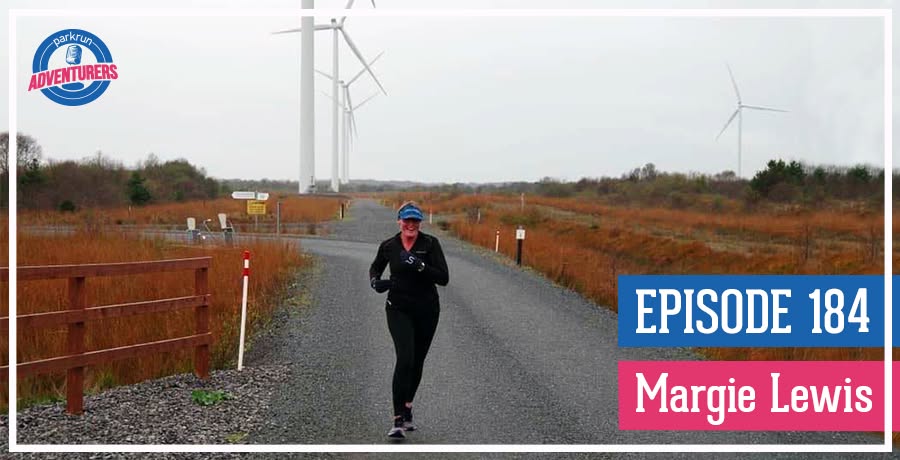
Episode 184 - Margie Lewis
Episode details · · 264 speaker turns · sound cues from context
Enhanced transcript
Speaker names appear where they could be established with confidence. Others are shown as “Unidentified speaker”. Sounds that are not speech — music, laughter, people talking over each other — are written in [square brackets].
Episode 184 - Margie Lewis · 2019-11-29
Enhanced transcript — Produced by an automated editing pass — speakers named, sound described, segments marked. NOT yet checked by a person.
Speaker names appear only where they could be established with confidence; others are shown as “Unidentified speaker”. Non-speech sound is in [square brackets].
Source: https://log.5kadventures.net/transcripts/ep184.html · The Adventurers Log · An independent project, not affiliated with or endorsed by parkrun.
Welcome
David Moss: Okay, and welcome to episode 184 of the parkrun adventurers coming from the, what, Erbacher Recording Studio in downtown Palmwoods. And hello, Mel.
Melissa Erbacher: Hello, Dave. How weird is this? You're in one end of my house and I'm in the other end of the house. This is what we're doing to overcome the technology this time.
David Moss: And it seems to be working. Anything to get the podcast out.
Melissa Erbacher: Exactly. You've got to do what you've got to do. And as much as it would have been nice to have been face-to-face, given we're in the same 20 square metres, I'm not quite technologically advanced enough for that. I can't figure out how to plug two microphones and two headsets into the one computer and not have everything explode. Hopefully, it all goes seamlessly. If you want, though, the toilet is halfway between the two of us. So if necessary, if you're not feeling comfortable down that end of the house, we can always move you into the toilet. Great acoustics. I know you've recorded there before.
David Moss: There's a very experienced Luddite. I probably can't help too much on the technical side.
Melissa Erbacher: Well, thanks for joining me again, Dave, on the pod. It's always great to have you around and I want to hear, what did you do at parkrun on the weekend? Where were you?
David Moss: Okay. Well, I managed to get to the beautiful parkrun at Mudjimba Beach and it's about a year since I was there. So this turned out – I was very happy actually. I was determined to get back. Last time I just got off a plane and probably suffering a little bit of jet lag. That's the excuse I'm using. Okay. And because I've been back for a couple of weeks on the coast, become acclimatised, very happy. I got a PB.
Melissa Erbacher: Well done you.
David Moss: It's just a happy new year. It's a bit sad, isn't it? When you first start a parkrun, you seem to get one PB after another, sort of. And after you've been doing it for a few years, they're as rare as hen's teeth.
Melissa Erbacher: Yes.
David Moss: But this one worked out really well, despite the heat, despite the crowds. It was a good day.
Melissa Erbacher: Well, I can't say I've had a PB since 2000. I think 2013 was the last time I had a PB. It's been a little while. I'm not sure. So what does it feel like? Was it a course PB or an overall PB?
David Moss: Oh, just a course PB. But it was one, yeah, I was quite happy with that. As I say, there were a lot of fast runners there as well. Mind you, it seems as though there's always a lot of fast runners in places. And I was actually damaged. There was a girl in front of me at the finish, a girl behind me there as well, and I couldn't have gone any faster. Completely knackered, actually.
Melissa Erbacher: Some girls run fast, Dave.
David Moss: Oh, they fly, yes. No, it did work out very well. It's also one of the days I'm very happy. One of the things that we get a lot of on our coastal courses is you tend to have showers near the beach.
Melissa Erbacher: Yes, as in not rain showers, as in we actually have showers.
David Moss: Not rain showers. I tend to be covered with sweat after these things, not a pretty sight. And it's great to just hobble over the finish line, stagger over to the shower, turn it on and just stand there and cool off that way. Mudjimba's got one of those. It was great. I loved it.
Melissa Erbacher: Excellent. I know in the past I've seen you also employ another trick to keep cool while you're running. Did you?
David Moss: I did. The dreaded Bunnings hat. Possibly not a status symbol, not something that's likely to catch on in the fashion stakes, but the Bunnings hat, wide brim, keeps the sun off. Absolutely brilliant. And you can put ice cubes in there. So yes, I had a hat full of ice. Well, it started off with a hat full of ice. By the end, there's one ice cube. Somebody else noticed that, yeah, the one ice cube falling out. So they've cottoned onto my trick. And in fact, I've done that out of two of the last parkruns. And for me, it works. I thoroughly recommend it. Great idea.
Melissa Erbacher: Do you think it's got something to do with the fact that it's a straw hat? So, you know, it allows a certain amount of airflow through it. Is it like the whole Yeah, olden days air conditioning kind of technology. Ice and wind and cooling.
David Moss: Right. If Burke and Wills had a Bunnings hat loaded up with ice in the top, I reckon they would have managed it straight across the country up to the Gulf and back in no time. I find caps don't really give me enough shade. And this was quite a warm day. The other one I did was two weeks ago down at Harris Avenue at Northern Brisbane. And that was quite hot and there was a lot of sun and not a great deal of shade. And the hat was absolutely brilliant. I do recommend people, especially Australian summer, keep your head covered if you can. The bonus, though, of having the ice in there, it really works. I know other people who actually grab a few ice cubes and just hold them. And I think it just cools the blood as it goes through their hands. And of course, it's non-polluting as well.
Melissa Erbacher: Well, I think it's an excellent tactic to use. And yes, agree with you, especially in the Southern Hemisphere, where we've got high UV index, that it's very important to stay covered and sun protected while we're participating as much as at the before and after parts of parkrun. Oh, well, great. Congratulations on your PB. I can take it wherever you can get it.
David Moss: A few and far between. But whereabouts did you end up last weekend?
Melissa Erbacher: Well, I headed off to Redland Bay parkrun, which is... The funny thing is we Googled how far it was driving time-wise on the Friday evening but I think we made the mistake of doing that during peak hour traffic on a Friday night and therefore Google doesn't tell you how long the traffic is going to take you at, like when you're trying to arrive someplace before seven o'clock of a Saturday morning. And so I think the drive time was about 20 minutes different than it was on Saturday morning. So we were there super early. We were expecting it to take two hours and five minutes and it only took an hour 45, which is fine. Great. I love the traffic when it's like that. We Probably could have had a bit more sleep instead of getting up at 4 a.m. It would have been nicer to stay in bed a bit longer, especially since I'd only gone back to sleep at 3.30 a.m. after a feed, these things happen that's all good uh I much prefer to be early than late anyway and we've had our fair share of late to parkruns or right on the wire um it was really beautiful and breezy it was a bit of a headwind on the way out I don't know have you done Redland Bay before Dave
David Moss: I did. In fact, I think I was there for the inaugural run.
Melissa Erbacher: Oh, there you go. Well, that would be almost three years ago now because there are up to 130 events. It was a while back, yeah. Which, incidentally, I needed for my Wilson Index. I didn't realise I needed it until I checked after the fact yesterday. It was a bit of a spontaneous trip for us. We found out last week that Adam's brother and sister-in-law are moving to New Zealand and they're going next week. So we thought, oh, well, we've been meaning to go and do Redland Bay. They live near there and catch up with them afterwards for literally years and just haven't done, you know, those things. We've seen them, but we haven't done parkrun beforehand. So we thought, well, we'll go – grab a little visit before they chuff off over the ditch and give us another opportunity to go do parkruns in another country.
David Moss: I was thinking what a wonderful bonus. Ah, yes, somebody over there.
Melissa Erbacher: Absolutely. We just need to wait for them to get a little bit settled.
David Moss: Oh, yeah, give them three days at least.
Melissa Erbacher: Yeah, get a house that's big enough for them to offer free accommodation. Yeah, so it was great. We caught up with my brother, Nicholas, and sister-in-law and niece and nephew as well, who came out to parkrun with us, which was great. It's always good to double up on visits, especially when you're down in the Brisbane area because it's a bit far for us to make the trip all the time, especially now that we've got the two little people in tow. Yeah, but so the course, I got completely distracted before the course. The course starts out as two laps around the oval that it finishes in and then it turns into an out and back, along the bay, which is very pretty, and lots of opportunity for shade along the way. And like I said, yeah, there was a breeze, which was a headwind on the way out, but it was lovely. It gave us a little bit of oomph on the way back. And funny, I've been very conscious of not trying to manipulate too much the stopwatch bingo, but I will look, when I usually have about 100 metres to go to see what time I'm up to, whether or not I'm going to be in the ballpark. And this time I didn't look until I was about five metres out and I was... literally going to be within seconds. I need a 14 and I need a 17. I thought, oh, I'm going to be smack bang in the middle of these two. That's a lie. I don't need a 14. I need a 13. And Lani had run off. This is my nine-year-old niece. She always makes a sprint for the finish line. So, of course, even though we'd walked the whole course, we had to run that last little bit to make sure she was within arm's reach. And so we're running to keep up with her. And I think I just overtook her at the finish line. And I thought, oh, that's pretty bad form of an auntie. So I let her take the token, which was the number higher than me. And then I had regret or potential regret about, oh, my goodness, what am I going to do if they give her a 13 and I get a 14? Yeah. And I need the 13 for the stopwatch bingo. Am I going to regret being polite to my niece all this time? As it turns out, we were given a time crossing the finish line together and we both got a 14. So I don't have to hold it against Lani for finishing ahead of me or for being polite. We both got chipped. No, we didn't get chipped.
David Moss: She's not playing stopwatch for sure.
Melissa Erbacher: Yeah, well, and look – The volunteers don't know. They're just being accurate. And it's not their fault that I'm not accurately getting the stopwatch bingo times. It's not the first time I've missed it by about one second. And I'm sure it won't be the last. So I'm getting used to it. I'm not precious about it. Just having fun, and it was a fun morning. I can say that much.
David Moss: I actually looked at my stopwatch bingo thing the other day for the first time in probably years, actually.
Melissa Erbacher: Oh, yeah?
David Moss: I think the only number I'm missing is one.
Melissa Erbacher: Oh, wow.
David Moss: Which I don't know if there's something odd about that, but yeah. But I had no intention of trying to manipulate the...
Melissa Erbacher: Not trying to pace yourself to a 20.01 or anything like that.
David Moss: No, by the end of the runs, I can barely see the watch, let alone the finish line, let alone the watch is probably a better way of putting it.
Melissa Erbacher: Oh, well. Now, Dave, we do have an interview coming up next and you weren't able to join me for this one due to some technological difficulties we've had. We rescheduled a couple of times to try and overcome these As it were, I was left on my own. I was the last co-host standing. So everybody, please bear with me. I hope you still enjoy it, even though the line of questioning only came from me this week.
Interview Margie Lewis — parkrun Australia volunteer Event Ambassador; founding Event Director, Taree parkrun (NSW)
Melissa Erbacher: This week, we have got a very special guest on the podcast. She has had...
Teresa: A massive adventure.
Melissa Erbacher: One of those big-time, lifetime memories just recently. She's back on Aussie shore, so it was an international adventure. She's big in the parkrun world in New South Wales, and her name is Margie Lewis. Margie, welcome to the parkrun adventurers Podcast.
Margie Lewis: Thanks, Mel. Thanks for having me.
Melissa Erbacher: Thank you for coming. Now... I want to jump straight in and hear first up all about your adventure. We'll go back in and listen to how you got into parkrun and everything like that. But this is one of my bucket list events and I want to hear all about you recently participated in a special marathon in Scotland.
Margie Lewis: I did. I did. I participated in the Loch Ness Marathon. I figured if I was going to do a marathon, it should be a spectacular one. So Loch Ness, we were in Scotland three years ago. I fell in love with the Scottish Highlands, particularly Loch Ness, and that's when I decided I would do it.
Melissa Erbacher: Sounds incredible. I too am a big fan of Scotland. I went there for three months and I ended up living there for three and a half years. I did visit Loch Ness, didn't see Nessie. You had 42.2 kilometres. Does the marathon, does it go around the lake? It goes around the loch.
Margie Lewis: No, not around it. It's so big, it's so long that you can only – the 42.2 kilometres is one side.
Melissa Erbacher: So the million-dollar question is, did you see Nessie?
Margie Lewis: No. I saw a few splashes. Could have been Nessie. Not sure. But no, I can't confirm that I did, unfortunately. Okay.
Melissa Erbacher: So what is the course like, 42.2 kilometres in Scotland, Loch Ness involved? What does that look like?
Margie Lewis: So it starts way up in the highlands just out of Fort Augustus with some sort of crazy elevation. I can't remember what the elevation was. And you run down for probably for about, I don't know, four or five miles. It's just downhill and fairly steep downhill. And then for the rest of the course, it's up and down and up and down and up and down. It's an absolutely stunning course, absolutely beautiful. But lots of – well, as they said in one of the signs they had on the course, just a wee bit hilly. I laughed as well.
[laughter]
Melissa Erbacher: Did it worry you that the whole first like five miles, this was downhill, thinking that that was going to be – do you run back uphill? Is it out and back in that respect?
Margie Lewis: No, it's a one-way course. So you start and you run downhill, back to the finish so there's no turnaround point so you start at one end and you run 42.2 kilometres to the other end so I knew I didn't have to go back up to that elevation which was nice and I've done UTA in the Blue Mountains a couple of times and last year when I did that or this year sorry I trained for downhill running so I was keen to get going on the downhill make good time yeah make good time so I did some good times probably for the first half of the marathon And then after that, I had a few sort of issues with my MS and, yeah, I slowed down a bit. But, hey, I finished it and I finished it smiling.
[crosstalk]
Melissa Erbacher: Oh, I bet you did. And pumping the air, I might add. And what was the atmosphere of the marathon like? Were the other participants friendly? Yeah.
Margie Lewis: It was amazing. There were people from all over the world, as you can imagine. Up at the start line, the fellow who was on the microphone was talking about saying, we've got people from America and people from Canada and people from all these countries. And I walked past him and said, and Australia. And he said, you've come halfway across the world. And I said, yep, just for this. And so he had a bit of a chat to me. People were dressed up. There was one fellow who was dressed up as Nessie. There were lots of people in kilts with tartan caps. Everyone was having a ball. I ran past one Aussie at one stage and everyone was supporting everyone else. As I said earlier, my MS was a bit of a factor and I was struggling particularly in the last few kilometres. And at one point I started walking and I heard a voice behind me saying, come on, you've got less than a parkrun to go. And I pricked up my ears and spun around because I measure things in parkruns. And I said to this fellow, oh my gosh, I can't believe it. You measure things in parkruns. That's amazing. And so he and I walked and ran the rest of the course. While we were talking, while we were running, he mentioned that I think I must have brought up my MS as being an issue. And he said he was actually running the marathon raising money for MS in England because his mate's mother had recently passed away from MS. So the two of us sort of had a connection. And just before the finish, he said, do you mind if I take off now? And I said, no, I'll leave my run until a bit later. So he took off and he said, I'll see you on the other side. And I thought, okay, that's lovely. It's the last I'll see of him. Oh, the other thing he did mention to me was he asked me if I knew Tom Williams. And I said, yeah, I was actually at a conference just recently and chatting to him. So the parkrun connection at the marathon was really great, evident as well anyway it's a small parkrun world isn't it very small parkrun world anyway when I crossed the finish line I was smashed I was absolutely smashed and I had my face in my hands and I took my hands away from my face looked up and there he was with his arms out ready to give me a hug it was amazing I know I cried I'm all choked up it was incredible and he's a mate of Tom's such a small world
Melissa Erbacher: Such a small world, but what are the chances, like, of all the marathons and all the people you can meet in the whole world? What a special moment.
Margie Lewis: Yeah, to meet a fellow who knows someone that I also know, but who was running for a cause that's dear to my heart. You know, it was, yeah, it was incredible.
Melissa Erbacher: And what is the bling? I'm assuming there's amazing bling.
Margie Lewis: There is amazing bling. It's a very heavy, very big medal with it's like the top of a running shoe and the shoelace is partly unthreaded to make it look like Nessie.
Melissa Erbacher: Very cool.
Margie Lewis: It's very clever. Yeah.
Melissa Erbacher: Well, what a way to make your marathon debut. I mean, I think most people do really well for the first half of their marathon and then toward the end, it peters off somewhat. But as you mentioned, you've got MS. So I'm not very familiar with MS or the kinds of symptoms that you would experience. What kind of difference does that bring to your running? Can you give us a little bit of an overview of that?
Margie Lewis: Yeah, sure. I'm coming into the time of year where my MS plays a big factor in my running. Whenever my core temperature increases and when it's really hot and I push myself, my symptoms flare up. And they might only flare up for half an hour or so, but it takes my legs from me a lot of the time. I actually, and I think it might have been just the trip over and being tired and that sort of thing, I went into a mild relapse when I got to Scotland. So I ran the marathon at not 100% fitness because I was just out of a relapse. So I knew that I should take advantage of the downhills and walk the uphills so that I could get to the finish.
Melissa Erbacher: That's a good strategy, definitely. And when you say it takes your legs from you, you need to sit down because, you know, otherwise you would fall down while you're trying to run or?
Margie Lewis: Yeah, it's really weird, Mel. Like at parkrun, for instance, two weeks ago when I ran parkrun, I pushed myself and it was hot and I got to the end and I was just standing waiting for my barcode to be scanned and my legs completely went and I actually dropped to the ground. That's what happens, yeah. Okay.
Melissa Erbacher: Wow, that's an incredible thing to live with. And you say that there's a particular sort of time of year where it's worse, and I'm assuming the heat just in general makes it worse. Yeah.
Margie Lewis: Yeah, that's right. MS doesn't like the heat. I spent 14 years living in Darwin, and I wasn't diagnosed until after I left Darwin, but I did obviously have MS. I'd had it for quite a few years before I was formally diagnosed, and I was wondering why I couldn't cope with the heat all of a sudden, and that was why.
Melissa Erbacher: It explains a lot when you get the diagnosis after that, I imagine.
Margie Lewis: Yeah, it's like, oh, that's why that happens. Yeah.
Melissa Erbacher: Were you a runner before you were diagnosed?
Margie Lewis: I was a runner back in my school days and cross-country, which hence my love of trails and distance now. I'm not really a speedster. Then I finished school, went nursing, got married, had kids, got MS, and running was never really on the agenda. It was always in the back of my mind, and a marathon was always in the back of my mind, but it was never really on the agenda, until I met parkrun.
Melissa Erbacher: And how does, I think we've been calling it MS the whole time, for the people who might not understand what the acronym is, it's multiple sclerosis. And you got diagnosed with it, you say, you know, you rambled off this list, or you got married, you had kids, you got MS. It sounds like something that you just went out and did, but obviously that's not exactly the case. And Can you explain for us what MS is, how it manifests for you?
Margie Lewis: So my immune system fights my own body. Okay. My immune system thinks it needs to fight stuff. It thinks that there's stuff going on in my body that it needs to react to. And when it does that, each time it kicks into this overdrive-type action, it causes scarring, which is the multiple scarring, multiple sclerosis, in my brain. At this stage, it's only in my brain. The other places it can occur is in the optic nerves, which would obviously cause vision problems, and in the spine. And so whenever the MS is active, it causes new lesions, and that's when my My symptoms are quite severe. I've been in a wheelchair and I usually have to use a walking stick when I'm in relapse. I've got one in my handbag all the time.
Melissa Erbacher: Wow, that's a big deal. And how do you cope when you get given this diagnosis?
Margie Lewis: So I've worked in the disability field most of my adult life. So when I was diagnosed, I just thought, well, it'll get me when I let it get me. That was the wrong attitude to have, but I had that attitude for a lot of years. I refused to go on medication. I refused to I guess I refused to acknowledge it. Like I told people I had MS, but I was obviously refusing to acknowledge it. And then when I moved from Victoria up to here, I saw a new neurologist and he said, what medication are you on? And I said, well, I'm not on any. And he said, why? I said, because I choose not to take them. He said, well, why are you wasting my time? I thought, well, I don't really know. So that was the end of that appointment. I got another referral and this neurologist said to me, I can guarantee you'll be in a wheelchair within 10 years if you don't start taking medication. And I thought, oh, all right.
Melissa Erbacher: He's speaking a language you understand.
Margie Lewis: Yeah, he pretty much slapped me over the head with a lump of four-by-two and said, wake up to yourself. You know, you will end up not being able to walk. So, I did wake up to myself.
Melissa Erbacher: Okay. Now, I know there's been studies that have shown that one means of managing MS is exercise. And have you found that to be your experience?
Margie Lewis: I absolutely have, the exercise like it's a knock-on effect the exercise um look I was I was exercising when I first had ms and then I would stop when I had a relapse and then I would start again then I would stop again and it was sort of a yo-yo and I was I was quite I carried a lot of weight and um and then like I said I met parkrun um and slowly but surely started getting involved in parkrun myself and um Then started realising that maybe I could go a little bit faster, maybe I could actually run, maybe I could actually jog some of it. And then I thought, well, maybe I need to develop some strength because all I was doing was trying to run. So I now go to the gym religiously at least three times a week to strengthen my weakened muscles and And that combination, along with changing some of the things that I eat, has completely changed my mental attitude. And I think that's one of the biggest changing factors for my physical well-being.
Melissa Erbacher: Sounds fantastic. And parkrun has played a little part in that at the very least. So let's go back there. How did you first find out about parkrun? How did you get involved?
Margie Lewis: I'd gone up to Brisbane. Both my girls live in Brisbane Northside, and I'd gone up there for a thing called the MS Moonlight Walk. And that was on a Saturday evening. And then my youngest daughter, Sarah, said to me that when we got home that night, come to parkrun. And I said, come where? What's that? So she explained what parkrun was. And I thought, oh, yeah, all right, I'll come and walk it. So I went to Sandgate parkrun. And I was absolutely blown away. I did parkrun with my walking stick that day. And I was, yeah, blown away with the fact that everyone stayed until I'd finished. I was supported. I was applauded. I was encouraged. And I thought, wow, this is incredible. I came home, looked for the closest parkrun to me, and at that stage it was Newy, and thought, oh, well, that's too far away, so there goes my parkrun experience. Then I did Sandgate the second time, for a second time, and thought, no, I've got to have this in my life. So starting parkrun here in Taree was for selfish reasons, really. It was so that I could get involved.
Melissa Erbacher: There's not a lot of people that will admit it's like their experience and their involvement in parkrun, especially from a volunteer perspective, is actually very selfish. I personally feel that way. You know, it's what I get out of it is why I do it. It's not actually for the other people. That's kind of a byproduct, just quietly. But I find it very satisfying. So I'm glad I'm not the only one.
Margie Lewis: Absolutely.
Melissa Erbacher: How did you find the experience of starting an event in Taree? Was the local council and the community supportive?
Margie Lewis: The local community, absolutely. We had the community behind us right from the word go. I must add too that just after I started undertaking the process to start parkrun, there was another lady who contacted parkrun Australia, contacted Tim to with interest and so Tim put Janelle in touch with me. So Janelle Jeffries and I were partners in crime for starting Taree. The community was behind us 100%. The council not so much. They were suggesting that other things that were already happening would do. So I ended up going to one particular councillor, and got her on side, and she got council on side. But from woe to go, it was three months.
Melissa Erbacher: Oh, that's an incredibly fast turnaround. Well done, you. You must be very persuasive.
Margie Lewis: Can be.
Melissa Erbacher: When you really want something, I'm sure.
Margie Lewis: I have a skill of making people think that things are their idea. And if they think it's their idea, then they're on board, aren't they?
Melissa Erbacher: They are. That's an excellent skill to have. Okay. So you've started Taree parkrun and everyone was supportive of it. It happened relatively quickly. Was it everything you had hoped it would be?
Margie Lewis: And more, yeah, and more. We had no idea. Taree is not particularly huge. We had no idea what the numbers would be like. And for the first couple of years, you know, the numbers ranged between 50 to 100. Now, four and a half years on, pretty much every week we exceed 130 participants per And the numbers of walkers have probably trebled. We've got people who have disabilities. We've got a fellow who pushes himself in his wheelchair. It's just, yeah, far exceeded what I thought it might.
Melissa Erbacher: And that's not where the parkrun story stops for you. You have recently handed over the ED ship to somebody else, and when I say recently, it's, you know, the last year-ish, to become a volunteer event ambassador for parkrun Australia.
Margie Lewis: Yeah, I have. We got to the point in Taree where we had a team of 10 Run Directors who And, you know, they're absolutely amazing. That team run Taree parkrun. And I thought, well, I would like to support other events. There was a lot of other events that had started up around this area by that stage. And I knew there was potential for more events in the local area. And Sonia, who was our EA at the time, was two hours away. And it's difficult to support events.
[crosstalk]
Melissa Erbacher: events when you're that far away so um I'll put up my hand well like attract likes you're talking about your team being amazing I I think people attract those sorts of people to them when they are of that ilk to start with parkrun Australia is very lucky to have you how have you found the experience of being an ea have you enjoyed supporting the event teams around you
Margie Lewis: I absolutely have. I already had relationship, like I knew the teams and the event teams and EDs that I look after now. So, you know, that part was easy. And I'm currently supporting two prospects. One of them looks like they'll be launching hopefully in January, and the other one in February, and that's been really exciting. You know, I was a little bit anxious about that to start with, but it's been great working with someone else to start up a parkrun because I know how that feels when you get to launch day.
Melissa Erbacher: And you get to live vicariously through them and all their excitement again, don't you?
Margie Lewis: That's right.
Melissa Erbacher: Does it bring back memories? Yes.
Margie Lewis: It does. It does. I was talking to the ED of the one that's launching in January and she said, oh, you know, it'll probably be fairly quiet on our launch day. And I said, uh-uh. No, it won't.
Melissa Erbacher: Well, I'm not going to ask you the names of those events or where they are because I'm sure the local communities will be behind them and that's all that needs to happen really. But I would like to ask, we kind of skipped all the way from your marathon to here without me asking you about your other adventures while you were overseas. So let's go back to the adventuring because I love to hear about the parkruns that happen overseas and what you experienced. So where did you get to while you were away?
Margie Lewis: So my first one was in Ireland. We have family who live in Dublin, so we docked there when we first flew over. And then we drove over to the other coast, to the west coast, and I wanted to do a beach parkrun over in Ireland. So I did Inch Beach parkrun, which is on the Dingle Peninsula. I think there were 32 people.
Melissa Erbacher: And was it actually on the beach?
Margie Lewis: It was actually on the beach. But the beaches over there, as you would know, the sand's packed down and it's pretty hard and it was like running on a soft running track, I guess. So it wasn't hard going in the sand. And it was great. It was out and back. It was wonderful. Awesome. It was cold.
Unidentified speaker: Windy, a little bit windy.
Margie Lewis: Yeah, a little bit windy. But I took the shoes off and went for a paddle in the ocean, as you do, at the end of it. And, like, we were welcomed. I checked their page just before, probably on the Wednesday, and they were still calling out for volunteers. So while I ran, Glenn volunteered.
Melissa Erbacher: Oh, awesome. A little bit of international volunteerism. Yeah.
Margie Lewis: Can't beat it. So that was my first one. Then my second one was in Inverness the day before the marathon.
Melissa Erbacher: So jealous.
Margie Lewis: And in comparison to the 32 people, there was, I don't know, 600 and something people.
Melissa Erbacher: Is that their normal kind of crowd or was that because of the marathon weekend?
Margie Lewis: It's because of the marathon, yeah. In the run brief, they made a comment. They said, look, nobody knows the course today. We've got marquees up because of you people. So their normal course, yeah, had to be changed obviously because of the marquees that were put up for the finish line in the event village. So it was just – I don't know, they did an amazing job. It was just around and through this two ovals. It was incredible. There were people everywhere. It was all organised. It was amazing.
Melissa Erbacher: What's the vibe like in Ireland and Scotland at parkruns? You know, you've got the awesome accents for starters. Yeah. But does it feel like parkrun...
Margie Lewis: home away from home except a little bit colder it does it totally does um complete with coffee and brekkie afterwards um It all, like I go up and introduce myself and I said to them that I was an event ambassador from Australia and you're treated like you're part of the family. How easy is it? You just turn up. It's the same as it is here. You use the same barcode as you do here, same distance, different time, 9.30. It's a little bit hard waiting until that late in the day.
Melissa Erbacher: Isn't it a funny way? It's a way like you can have a sleep in and then you can have breakfast and they're still like looking at you, what's going on? I've got all this time.
Margie Lewis: It's still not time. But yeah, absolutely amazing.
Melissa Erbacher: Very cool. But that wasn't the only, those weren't the only two, were they? There was a third event that you managed to sneak in before you came home.
Margie Lewis: Yeah. Which one was that? I can't remember which one that was. Mount Lucas. Oh, Mount Lucas. Of course. So Mount Lucas, we were staying with our family's family at Edenderry and Mount Lucas is about 15 kilometres out and it's a wind farm. And I thought, well, this is interesting. So we went out to the wind farm and it was windy. But the whole thing's been set up for parkrun. So there's a little hut there. and in that just a little wooden hut with three walls and in that hut there are hooks for you to hang your coats and your hats and there's a little shelf above it for you to put your keys on and it's got a sign saying parkrun meeting place. And then around the course are exercise, pieces of exercise equipment. So initially I thought it was set up for parkrun and then I realised that it's set up for people to be active. And there were other people who were not participating in parkrun who were just walking their dogs or using the equipment. It was amazing. And you're in amongst all these wind turbines.
Melissa Erbacher: And – because wind turbines aren't small. They're very big. And did you – I feel like that must be a very surreal experience running around among those because we have a few of those sorts of farms in Australia and you can drive past them but you don't tend to get too close but it always seems something very alien to me. Yeah.
Margie Lewis: It was a surreal experience because usually in Australia there's fences around them or they're on someone's property and you can't get close. And these didn't even have little fences around the bases. Like it had a sign saying don't climb up on the little fence that they were on. But, yeah, it blew my mind the fact that we were – and it's in the middle of a bog and it's obviously a working bog. So there's a little – As we drove in, we had to cross a little train track and that's the bog train or the peat train that collects the peat from the bog and brings it in to power the rest of the wind farm, to power the clear lines. So it was just a surreal experience and that's why I selected that one because I thought it was unique.
Melissa Erbacher: Yeah, absolutely. I would have had a really long finish time because I think I would have just been Taking photos. The whole time of the wind turbines.
Margie Lewis: I will add it was freezing that day and I took a couple of photos but then I thought, no, I just kept thinking about Glenn back at the start and I thought, I've got to get back, it's cold.
Melissa Erbacher: Well, that's fair enough too.
Margie Lewis: Yeah.
Melissa Erbacher: Well, Margie, thank you so much for joining me and having a chat about all things parkrun and your personal experience with your first marathon. Congratulations. It is on my bucket list to do Loch Ness Marathon, although the elevation, I'm not sure about that.
Margie Lewis: Yeah, you've got to do it. You'll love it. You'll love it. Like the ups and downs, it was like the back of Nessie. It was sort of undulating. None of the hills were too nasty. It was just that downhill at the start.
[crosstalk]
Melissa Erbacher: um with the rain and that sort of thing I was worried it would be a bit slippery but it wasn't too bad you would love it well maybe you can come back with me Margie and we can go do it again together absolutely three years time we'll be back there Mel three years time what's what year is that 2022 yes okay I reckon my boys are old enough to cope with some international travel by then
Margie Lewis: Well, while the marathon is on, there's also the 10km, like it's a running festival, there's 10km and there's also the Wee Nessie event.
Melissa Erbacher: Ooh, the Wee Nessie event.
Margie Lewis: And the Wee Nessie is for the wee ones.
Melissa Erbacher: That sounds too cute.
Margie Lewis: It sounds like it should be a date, Mel.
Melissa Erbacher: I think so, Margie. I'll see you there.
Margie Lewis: Okay. Bye.
[16 seconds of audio that could not be transcribed]
Roving reports & the Channel 5 News crew
Roving report Cameron Drake — Champion Lakes parkrun
Cameron Drake: Good morning parkrun adventurers it's Cameron here reporting from the bright beautiful and sunny Western Australia today. Now I have come not only to chase my NENDY but also to sail in one of the seven seas at Champion Lakes parkrun. What a name Champion Lakes. I'm starting to think WA has some of the best parkrun names in the state. Okay so what do we know exactly about Champion Lakes parkrun well it is event number 217 today and just looking at their stats the average run time was 33 minutes and 34 seconds and the total hours run is 333 days wow that's interesting So while I was looking up interesting information about the Champion Lakes parkrun, I happened across an email I'd overlooked in my inbox, and it went a little something like this. Dear Cameron, thank you for your application to join the roving reporters on the parkrun adventurers podcast, Channel 5 News Crew. Unfortunately, your application at this time was unsuccessful since you have not completed the challenge set out. Please try again at a later date and resubmit your application. Yours sincerely, the parkrun adventurers. Challenge. Challenge? Oh, a challenge. That's right. I remember there was a challenge. Okay. Oh, what was it? All right. It doesn't matter. I'll work it out as we go, okay? See you out there. G'day everyone, I'm here with the Run Director today, Richard. Richard, how are you going? I'm good, thanks. How are you? I'm very well. Very excited to be here at Champion Lakes. Haven't been around this way in ages. It looks absolutely beautiful out there. Yeah, we have a special course. We're lucky you can't get lost. As long as the lake is on your left, you'll get round. Oh, fantastic. And so how long have we been up and running here at Champion Lakes? Well, this is event number 217, so it's about two and a half years, I guess. Oh, brilliant. Oh, we're heading out. Well, let's head on over. Ah, post-run report for Champion Lakes parkrun. Like always, went far too fast out at the start. And then lo and behold, they tricked me. I thought it was just a flat, long, very PB-worthy course, but I was slightly wrong in that the huge long back straight is all into the wind. And then at the very end, when you turn the corner at the end of the back straight, it's full of lovely little flying insects to give you extra protein while you run for people like me who run with their mouths wide open. But it was a good track, good day out. Let's see who else I can get to talk to. Well, I found someone else interesting to talk to. What's your name and where are you from and how did you get started in parkrun?
Wendy / Tricia: Hello, my name is Wendy. I started in parkrun four years ago. It was the second week that Champion Lakes started and I'm a big ambassador and advocate for parkrun for a huge amount of reasons. I just love it and wherever I go I do parkrun.
Cameron Drake: Okay, so you do some of the social prescribing to friends and family and whatnot?
Wendy / Tricia: Yes, and I encourage anyone I can to come down and always go for coffee afterwards at Hidden Cafe. Don't miss coffee and go to Melbourne and I've done a few in Melbourne. I've done Darwin, Kalgoorlie and that's about it for me.
Cameron Drake: Oh, fantastic. I'm so jealous. I did so many parkruns before I worked out, hey, there's other ones around Perth and suddenly started finding them. It's brilliant.
Wendy / Tricia: That's exactly right. And the other thing I've done is seven parkruns in one day, which is 35 kilometres, which takes in a lot of parkruns, which is an interesting event as well. Oh, wow. Non-parkrun, but we do all the parkruns.
Cameron Drake: Oh, I think that's brilliant. What an achievement.
Wendy / Tricia: Yes, and wherever you go on holiday, you look for a parkrun. First thing you do.
Cameron Drake: I'm trying. I'm trying to convince my wife to go to Adelaide at some stage next year.
Wendy / Tricia: Oh, lovely. Christies Beach. I haven't done it, but Christies Beach is beautiful. Oh, right. And another beautiful parkrun is Kalgoorlie.
Cameron Drake: Oh, okay. I haven't been out there. It's a bit of a drive.
Wendy / Tricia: And Nightcliff in Darwin is absolutely stunning as well along the beachfront.
Cameron Drake: Oh, I heard Nightcliff was really good.
Wendy / Tricia: Yeah, so well worth it.
Cameron Drake: Excellent. Hey, just a bit of an out there question. Would you happen to be a listener of the parkrun adventurers podcast?
Wendy / Tricia: I will now. Oh, excellent. I haven't actually listened to any podcasts yet. I'm a bit in the dark ages.
Cameron Drake: I'll listen out for it. It's really good. Hosted by the lovely Mel Erbacher. And we've got people like me around Australia and around the world sort of visiting parkrun events, talking to people, having fun times, all sorts of good stuff.
Wendy / Tricia: Great. I shall be a listener from now on. Oh, fantastic. Well, lovely to talk to you, and I hope to see you again soon. Thank you.
Cameron Drake: G'day, everyone. I'm here with Anne. Anne was one of the original Event Directors at Champion Lakes parkrun. G'day. How are you going?
Anne: Very well, thank you. Yeah, Teresa and I started up, and we're neighbours, and we do everything together. Oh, lovely. She's even got me into bike riding as well. That's why I did it very slowly today. Oh, excellent. Yeah, and we're a real close bunch here. We do a lot of things together at this parkrun. There's a lot of large-ish girls that come down here that have been running and have made really fantastic headway in their running and walking. And there's some of them that are now, even though there are larger women that are doing marathons tomorrow. Oh, wow. So they're doing very well and they feel accepted at this parkrun.
Cameron Drake: Well, that's what parkrun's all about, isn't it? It's all abilities.
Anne: Yeah. Yeah, and they're doing very well with their abilities here. As a Champion Lakes parkrun, a lot of our runners will go to, say, Masters tomorrow or another event. And there's usually about 20 of us all in a group that will compete in events. And we also compete for Heart Kids. Okay, what's that about? Heart Kids is about children that have had heart disease and it's a support group for their parents and the families of children with heart disease. Oh wow. So we support them at this particular parkrun because a few of our families have had children with heart disease and we run in red and red tutus and red so if you see a whole lot of parkrunners wearing red Usually from Champion Lakes. Oh, okay.
Cameron Drake: I'll keep an eye out.
Anne: Yeah, and also tonight a lot of runners here are very good musicians.
Cameron Drake: That's right.
Anne: They're classical musicians.
Cameron Drake: There's a concert tonight?
Anne: Yes, there is a concert tonight. Not only are they classical musicians, but we also have people of many diverse talents. We have a few authors here, that write and write poetry, those two people over there are published authors. And also we have artists and all sorts of talents and we support these people in their endeavours. Lovely. Yeah, so it's quite, when you go along to a classical concert and you see 20 runners sitting in a row, it's quite unusual.
Cameron Drake: Sounds like Champion Lakes is the cultural precinct of the parkrun world in Perth.
Anne: I wouldn't like to put it that way, but there's some interesting characters amongst us, that's for sure. And we do support each other a lot, and there's all other things that we do as well. Yeah, and a lot of us are mature age people that when we started it up, they used to call us the old lady parkrun. Now, when we've got a few world-class runners here that have competed in the Tokyo Marathon and things like that, they don't call us the old lady marathon runners. Some very fast ones, and as you see, some very slow ones. We do have a lady that competes with a Zimmer frame here. Right. And she comes in at about an hour and 20 seconds.
Cameron Drake: Oh, right.
Anne: Well, that's really well done. She does long-distance walking. And since she's been coming, she's been able to reclaim her driving licence now she's been walking. She's only young, but things like that, it makes a huge difference to some people's lives because they can get fit enough to do things that they want to do.
Cameron Drake: Well, Anne, it's been so nice talking to you. Thank you so much.
Anne: Yeah.
Cameron Drake: And I hope to see you around again sometime.
Anne: Well, everyone's welcome here.
Cameron Drake: And you're welcome to come down and visit Tamworth.
Anne: I will. All right. Well, thank you so much. And I'll see you around. Yeah, see you around. Go to the coffee shop.
Cameron Drake: Okay. G'day everyone, I'm here with Teresa who's helped out as one of the original Event Directors. G'day.
Teresa: Hello, how are you?
Cameron Drake: I'm wonderful, how are you today?
Teresa: Yep, really enjoying it. It's another day down with the parkrun family and that's always good.
Cameron Drake: Oh and it's a beautiful day to do it as well. I couldn't think of better weather or a better day or even a better place to come do this on Saturdays. So how did you get started down here at Champion Lakes?
Teresa: Well, we originally started with Claisebrook Cove, went there a couple of times before they opened up the Canning River parkrun. We went to the Canning River parkrun and we stayed there until they opened Pioneer Park. Then we went with Jeremy over to Pioneer Park and we assisted as Run Directors and any other volunteer position that we could, as well as running whenever we could. And then one day the cheeky little mite said, you know, we're looking for some people who aren't quite seen as runners in the community to start a new parkrun so that we can appeal to a broader range of people. So my girlfriend Anne and I decided that we'd take on the challenge and Anne decided she would be the Event Director and I would be her assistant. So that worked out for us. So three and a half years ago we started Champion Lakes parkrun and it's one of the best things that we ever did because we've got such a magnificent group of people who come down here every week and join us. We've really got a lot of people who've made some really good friendships down here.
Cameron Drake: Yeah, I've got to say you're a super friendly bunch.
Teresa: Thank you so much.
Cameron Drake: I felt very welcome from the moment I got here. Except the moment I got here, I went in the wrong direction and then I eventually found here.
Teresa: Well, we have two right places to be. Say what? Yeah, absolutely. You can make a choice here at Champion Lakes. So you can either meet under the tree, near the toilet area, in the car park area there, or you can come over here. Both are okay because we'll take you over to the start line.
Cameron Drake: So I was right the first time. You were, absolutely. Interesting. What's the deal with this hidden cafe? Why is it hidden? Is that just a name or is it part of their shtick or something? What gives? I mean, I'm a parkrunner. I need coffee. It should not be hidden.
Teresa: It should not be hidden, no. Well, that was the first cafe in the street where Anne and I lived. And it was originally set up as a bike, riders cafe and because it wasn't on Albany Highway they called it hidden and yeah we've been supporting it ever since so there wasn't a cafe local to Champion Lakes we tried coffee vans the other things that you do but yeah uh the operators weren't interested in staying there the amount of of money that we could give them so yeah we've been to hidden they've they've embraced our vegan runners they've embraced our dairy free runners so they they give you a bit of a choice yeah and they do excellent coffee oh
Cameron Drake: I'm seeing a lot more vegan and plant-based runners wearing t-shirts and vests and whatnot. It seems to be a growing thing where people are embracing veganism for running and their lifestyle.
Teresa: Absolutely, and with the years, differences are okay. And that's what I like about parkrun in general. And Champion Lakes parkrun. One of our runner walkers actually walks with a frame, a trolley. And so she walks around the lake with a trolley. It usually takes her an hour to an hour and a half to walk the distance. And we have people who run and walk, and we tell everybody that walking is fine, you know, if that's what they want to do, because it's achieving your personal best each Saturday. It's... Getting out and doing it for you, not about who comes, who's the first finisher. That's nothing to do with it.
Cameron Drake: No, I think it's just about getting out there and getting active and getting some of this beautiful sunshine as well.
Teresa: And when you look at our volunteers, we have Steve. We have Eve and Jim Parry. Steve was a runner here and he suggested to his mum and dad that maybe they'd like to come down and volunteer. They've done over 100 volunteers as photographer and marshal. Never run a parkrun.
Cameron Drake: I think their contribution is absolutely amazing.
Teresa: Absolutely. It's just we are very, very lucky with the diversity of people that we get down here. Very lucky.
Cameron Drake: I think what you've created is a wonderful event. Thank you very much and well done, and thanks for the chat.
Wendy / Tricia: You're welcome.
Cameron Drake: Hi, this is Cameron, and I'm very excited because I'm talking to someone who I don't know. What's your name?
Wendy / Tricia: My name's Tricia.
Cameron Drake: Tricia, lovely to meet you. Now, you said... What did you say to me earlier?
Wendy / Tricia: I know who you are.
Cameron Drake: You know who I am. And then you mentioned something about another C word. What C word was that again? Challenge?
Wendy / Tricia: Yes, challenge.
Cameron Drake: Oh, so would that make you a parkrun adventurers podcast listener?
Wendy / Tricia: It would, yes.
Cameron Drake: Now, I'm assuming that if you know the challenge and if you're a listener, you know that there's something else I need to ask you. Do you know what that is?
Wendy / Tricia: You'll have to refresh my memory, sorry.
Cameron Drake: I think it was something along the lines of, if you could name another roving reporter on the Channel 5 News crew team, then I would be allowed to be one of them from WA. Do you remember anyone's name?
Wendy / Tricia: I do. Mel. Melissa.
Cameron Drake: Melissa.
Wendy / Tricia: And TOC. And TOC. Anyone else? You.
Cameron Drake: Well, technically no, but maybe.
Unidentified speaker: That's it? That's it.
Cameron Drake: You've just made my day.
Anne: Yay! Thank you so much.
Melissa Erbacher: You're welcome. Well, well, well. Cam, Cam, Cam, filing a roving report from Champion Lakes parkrun as his submission, his entry request to the Channel 5 News crew. The only roving report that we're going to pop into the podcast this week, we do have two other excellent submissions, which for reasons of brevity, we're going to save for you to listen to until next week. I don't know about this one, Dave. There's some speculation happening, I think. I think we need to speculate. What did you think? Does this entry get him over the line?
David Moss: I think we could say he finalised his challenge with that.
Melissa Erbacher: I don't know.
David Moss: Are you thinking about it?
Melissa Erbacher: Well, here's the thing. The challenge was interview a pod listener, but it needs to be someone that he doesn't already know. And it's a bonus if the listener can name one of the existing news crew. So, Cam interviewed Tricia, who is allegedly, and I'm holding up my hands here, inverted commas, an existing pod listener. I checked the results and there is no Tricia in the results at Champion Lakes from last weekend. Is that suspicious, Dave?
David Moss: Oh, there's a possibility going through there.
Melissa Erbacher: Now, there are just a handful of unknowns showing up in the list. I did check the volunteer roster also. There was no Tricia on the volunteer roster. There was no Patricia.
Unidentified speaker: Okay.
Melissa Erbacher: Unless Tricia is adventuring under a pseudonym.
David Moss: Could it happen? Would it happen?
Unidentified speaker: I don't know.
David Moss: So you're not just thinking about drug cheats. You're thinking about people who may be using an alias for a name?
Melissa Erbacher: Well, yeah. I mean, does she even exist now?
David Moss: Okay, a forensic parkrun inspection might be a good idea. Are we going to go through the photos and try and identify each of the people?
Melissa Erbacher: Yeah, I don't know, Dave. Do we expect that this is an honour system and we'll take Cam at his word? He did sound so excited that he was going to be joining the news crew.
David Moss: I think it's worth it. Either that or you induct Tricia.
Melissa Erbacher: Tricia's done nothing. She's never submitted a roving report. However, if she does indeed listen to the pod. Hi, Tricia. Thanks for listening. We're very excited to have you around and identifying roving reporters. And bonus points. We did say that bonus points would go to Cam. If the listener knew one of the existing news crew, she knew two of them. She was able to name Mel Ellis and TOC. which is very impressive.
David Moss: I think it's superb. But I also think how could you say no to Cam with his enthusiasm?
Melissa Erbacher: Well, exactly. And the reports are getting better every time he submits one. So not to mention the fact that he's in WA. We've been trying to tap into that market for a very long time. I shouldn't call it a market. What should I call it?
David Moss: The far side.
Melissa Erbacher: The far side. We love West Australians and all right, okay, this is it. Cam, you made it.
David Moss: Well done. You're in. Welcome, Cam. You've done very well. And let's face it, if you put all that effort into cheating and getting somebody to pretend that they don't know you and still came up with the answers, I think it's worthwhile.
Melissa Erbacher: We reward cheats when they're elaborate and conscientious.
David Moss: We reward cheats if they don't get caught.
Melissa Erbacher: Well, is it really cheating if you don't get caught? I don't know. No.
David Moss: No, well done.
Melissa Erbacher: Anyway, yes, very excited to have you. And we will send you all the secret handshake information, et cetera, a little bit later this week. Now, speaking of stuff going out. This is a very loose segue here, Dave. I just want to remind everyone that if you have ordered an Ugly Christmas Singlet and have plans to celebrate International Ugly Christmas Singlet Day, the inaugural one with us this year on the 21st of December, the shipping will actually commence on the 4th of December. So keep an eye out on your letterboxes any time after the 5th if you're in like a major capital city, or, you know, one of those fast places that receives posts. Just bear that in mind.
David Moss: Very good. And another one that actually we should have mentioned this with Cam is one that we're a little bit interested in. We saw last week was the inaugural run of the Mundy Regional parkrun, which looks as though it's an extremely hard one over there in Western Australia.
Melissa Erbacher: Might be one that Cam will have to get to in the not too distant future.
David Moss: Hmm.
Melissa Erbacher: Yes, but my ears pricked up when somebody said, ooh, hard run, you know, potentially a contender for the most difficult parkrun in Australia. And I wanted to know more. I didn't. I can't help myself when it comes to hilly or difficult. You know, I'm always interested to know more. And it does sound like an absolute cracker, Dave.
David Moss: It does. It looks as though this is only with one event, but I think the person who came in first place was in, was it just over 21 minutes? which is quite a reasonable pace, but compared to most places, it's reasonably slow, which is a fair indication. And I think the average run time was, was it 41 minutes and 46 seconds?
Melissa Erbacher: Yes, yeah. And look, I mean, we don't know how fast that person who came in at 21 minutes usually passed, parkruns, perhaps we could have done some research. We might have been able to say, well, they're normally an 18-minute parkrunner, so it's added three minutes to their time. We didn't do that. But what we did do is we looked up the average run times for another couple of parkrun events in Australia which have a reputation for being difficult, those being Nambour parkrun and Ocean View parkrun. And yes, okay, Mundy Regional's only had one event and So it's not apples with apples. It's apples with oranges when you're making a comparison. But I was still interested to see that Nambour parkrun's average run time over the history of the event is 38.01. So they must have had their share of quicker participants as well. And Ocean Views was a little bit closer to the Mundy Regional mark in that they had 41.35. So they were only 11 seconds faster, their average run time. Interesting, interesting.
David Moss: I think we do need a few people to try out a number of the harder runs, and I'd love to see a report coming back from the Mundy Regional parkrun.
Melissa Erbacher: Not giving anyone any work or anything like that.
David Moss: No work. Just try running what was potentially the hardest parkrun in Australia, but no work.
Melissa Erbacher: Yeah, exactly.
David Moss: Excellent.
Melissa Erbacher: Well, it'll be on my list anyway to try out when next time I'm over in WA. Although my list is getting longer and I'm looking at different ways for extending my list these days, Dave. When you have so much choice, how do you just choose? Yes, we've got all the normal running challenges that are out there for everybody, all the unofficial clubs and things like that. But Do you try to mix it up a bit, even creating your own sort of bespoke challenges, as it were?
David Moss: To be fair, no, not really.
Melissa Erbacher: So what determines how you get to a parkrun of a weekend?
David Moss: Well, as you're aware, I've got a couple of friends who enjoy getting out to different courses. So that is one of the things. Overseas, I was usually looking for courses that appeal to me. So I quite like the ones that if they've got bridges, lakes, water, nice soft course for bare feet, that sort of thing that I'm sure everyone looks for.
Melissa Erbacher: Nice soft courses for their bare feet. I don't think everybody looks for that, Dave.
David Moss: Well, if you happen to do a bit of barefoot running, yeah, if it's got gravel, I will avoid something that has five kilometres of bindi.
Melissa Erbacher: Have you ever come across those in all your years parkrunning so far?
David Moss: There have been a few that I've managed to avoid because they, yeah, one of the ones you mentioned beforehand, Nambour. I have done that one barefoot, but once was enough. Yes, and you wouldn't recommend it. It's a bit on the rocky side. So, but as to where, no, normally I'm quite happy trying all sorts of different ones. It's really the people that make the place. And I'd say out of the hundreds of, well, no, it's over 100 different courses I've been to, it's the people you remember. As much as anything else, the happy, friendly parkrun is a good place.
Melissa Erbacher: Very interesting.
Teresa: I don't disagree with you, though, about the people. It is definitely all about the people in the end.
Melissa Erbacher: I am always just really interested in how people choose where they're going to go because we are spoilt for choice. There are more parkruns in Australia, let alone the world, than we can reasonably ever hope to complete. I think we're very lucky.
David Moss: So you find the challenges very useful to try and narrow down where you want to be on a particular Saturday morning.
Melissa Erbacher: Yeah, you've got to have some criteria to help you prioritise where you're going to head, especially when... I mean, I guess I'm fortunate that time and money are both contributing factors, as is having a pram and transporting a family and all those sorts of things. I mean, they help narrow the field down to a certain extent, but that still leaves a lot of scope for what you can do, which is part of the beauty of being an adventurer and part of the lure. You know, we have just so much variety out there.
David Moss: And you're right, it's great being spoiled for choice.
Sign-off
Melissa Erbacher: Dave, it has been a pleasure to have you join me once again and almost in person in the Erbacher Recording Studios this week. You've done a stellar job. And here's to many more parkrun adventures.
Unidentified speaker: Thank you.