
 — open the full-size cover
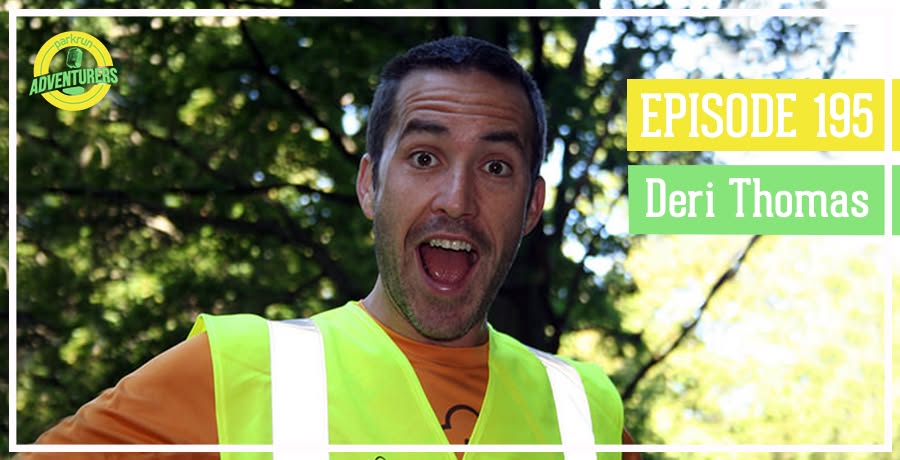
Episode 195 - Deri Thomas
Episode details · · 126 speaker turns · sound cues from audio analysis
Enhanced transcript
Speaker names appear where they could be established with confidence. Others are shown as “Unidentified speaker”. Sounds that are not speech — music, laughter, people talking over each other — are written in [square brackets].
Episode 195 - Deri Thomas · 2020-02-28
Enhanced transcript — Produced by an automated editing pass — speakers named, sound described, segments marked. NOT yet checked by a person.
Speaker names appear only where they could be established with confidence; others are shown as “Unidentified speaker”. Non-speech sound is in [square brackets].
Source: https://log.5kadventures.net/transcripts/ep195.html · The Adventurers Log · An independent project, not affiliated with or endorsed by parkrun.
[intro theme playing]
Welcome
Melissa Erbacher: Welcome to episode 195 of the parkrun adventurers podcast. My name is Mel Erbacher. I am co-host of this little unofficial podcast all about parkrun adventuring. And joining me this week for, I think it might be your third or fourth time out, is the wonderful Mark Scarborough. Mark, welcome back to the pod.
Mark Scarborough: Thanks for having me, Mel. It's good to be back in the podcasting chair. Are you keeping track of the numbers? Yes. I don't actually have a parkrun adventurers podcast spreadsheet running, but I think you might be right. I think this might be the third time behind the mic.
Melissa Erbacher: It might be time for a spreadsheet. You can never have too many spreadsheets. I think we've established that before.
Mark Scarborough: Yeah, I love lists and I love spreadsheets.
Melissa Erbacher: Me too. They're especially helpful when you're trying to figure out adventures and checking off milestones and challenges, et cetera, when you're chuffing off about the place. Personally, I have not had need for a spreadsheet in the past week. Sadly, in solidarity with the rest of the world that is suffering with coronavirus, or I shouldn't say the rest of the world, for those people in the rest of the world that are actually suffering with coronavirus. My house has been struck down with a similar, not that virus, but a similarly nasty bout of something germy and logical and not fun in any way, shape or form. So we didn't make it to parkrun day, but I'm not going to dwell on that for now. I'm going to jump straight to you, Mark, and ask you where you are so that you can carry the podcast this week with whatever fun and frivolity you had on the weekend.
Mark Scarborough: Well, on the weekend, we went back to our old home parkrun at Gungahlin, which was kind of nice to go back to our old home parkrun. We hadn't been back there since... October in the running capacity, we volunteered, uh, on Christmas day. Um, but yeah, it was good to get out there and run the lap of, uh, Yerrabi Pond again.
Melissa Erbacher: And how was that getting around Yerrabi Pond?
Mark Scarborough: That was good because, you know, like, I think that, um, you know, it's, it's good to kind of go back to, to, you know, a familiar parkrun and see familiar faces again. Um, I think one of the big shocks was, uh, to the system was just how many people are at Gungahlin. Like it was just a reminder of just how big the crowd is there. And, uh, and how small our Wagi Bridge parkrun community is at the moment. But yeah, it was good to be back. And I ran with my son, James, and actually paced him to a Gungahlin parkrun PB, which was good. He's actually got a slightly faster time at Wagi Bridge, which is interesting because Wagi Bridge is a little bit more undulating compared to a very flat Gungahlin. But yeah, so that was a nice little achievement for him.
Melissa Erbacher: Well done, James. Though I have to say, it always confuses me when people are surprised that they run faster over an undulating or a hilly course than they do a flat one. Because, I mean, yeah, you get to go much faster downhills, the going up might be a little bit slower than if you were on the flat potentially, but the fast more than makes up for it. In my experience on the flat, like I just, I just don't have the motor in my legs for them to just keep turning over. I need the downhill. I need the inertia of gravity to make me move any faster.
Mark Scarborough: Yeah. Look, I think that's one of the advantages of Wagi Bridge is that it is a challenging course, but you know, you do, you can make up that, that time definitely on the downhills. And, uh, build up some strength in your legs on the uphills. And I've been quite surprised with my times there when I've pushed myself.
Melissa Erbacher: And now I'm jumping all over the place. But I want to bring it back to running with James. So you paced him to a PB. Was that something intentional that you had kind of talked about doing, going out? When you run with your kids, do you have a game plan before you start or do you just sort of play it by ear or play it by leg, as it were?
Mark Scarborough: Yeah, no, I think it is a bit more see how it is on the day. Sometimes I'll talk to him and ask him if he's feeling fast that day. But it's also about listening to him during the run as well. So rather than actually just pushing him, if he wants to have a stop and walk, then we stop and walk. That's okay. And if it doesn't happen that day, it doesn't happen that day. The last time we ran at Gungahlin, we came close to running the sub 30, which is what we were aiming for, and he had a little bit of a fall towards the start. And, you know, we stopped and had a bit of a hug and cried it out and kept going. And we still actually end up with a PB that day, but didn't get the sub 30. And last week I just was kind of watching my watch and thought, oh, we could do this. And I didn't say anything to him, but, you know, it was only afterwards that I pointed out to him that it was going to be a PB for him. But, yeah, look, it's for us, it's, you know, we're not going out there to get a PB every week. It's just about, you know, getting out there and having a run and enjoying it and, you know, enjoying that one-on-one time in a way, you know, just cruising around a course.
Melissa Erbacher: I love that expression you used, feeling fast. You're asking if he's feeling fast. Do you remember the last time you felt fast before a parkrun?
Mark Scarborough: Oh, look, I think that sometimes, you know, in your mind, some days you feel you might be fast, but you've got to also see how it is on the day.
Melissa Erbacher: I love it. I'm going to use that. I'm going to start asking my boys every week, are you feeling fast? Should we go fast today and see whether or not that kind of positivity and motivation actually Cascades down into my own subconscious and maybe I could start picking up the pace a little bit.
Mark Scarborough: Yeah.
Melissa Erbacher: And so tell me a little bit more about your parkrun experience. How old is James? And I know you run on occasion with Elise as well.
Mark Scarborough: Yeah, so James is seven and, you know, he's been, Well, both the kids have been, and my wife, have been coming to parkrun more regularly over the last 12 months. It's been pretty much myself in the previous years to that. So it's been, for me, it's been nice having the family come out. You know, like when you're out and about and you see other families out and that connection and interaction, it's, you know, it's a very positive thing. But it has been a challenge getting everybody out of bed early on a Saturday morning after, you know, long weeks at school and work and things like that. But certainly I think the last year, the bug has started to settle in with the family and it's been good. So it's worked out nicely that Elise runs with Nicole every week and then James is running with me. And he's, you know, he's at a reasonable pace, you know, that, you know, he can keep up with me and I'm not pushing myself and I'm not pushing him too hard. And Nicole and Elise are quite evenly matched as well with their pace. So it's worked out quite well, quite nicely for all of us, really. And it's, it's been, you know, it's good. It's, it's, it's a nice commonality within the family and something we can, we can talk about, encourage each other in. And we look at the, the part, different parkrun challenges and talk about what we want to, you know, look for and achieve there. So we've, we've ticked off the, the Bee Gees club recently for them and, you know, kind of looking at the alphabet club as well, things like that. So. I think that that's a good thing for the kids, the gamification that the parkrun challenges brings into it.
Melissa Erbacher: It's one of those things that you forget about, I think, especially once you've been doing parkrun for such a long time and you tell your friends about it and you say, oh, yeah, you know, it's for everyone. It doesn't matter your age. You know, parents come with their kids. Three generations of a single family take part and all that sort of thing. You take it for granted that there really isn't opportunity in other physical activities, team sports and things like that, for you to play on the same team as your kid. You're both participating in the same event. You're both being timed by the same Timekeeper. Yeah, you've got your own age categories or whatever that you get filed into, but if you don't look at them, it doesn't matter to anyone. Do you treat it at all as... as an opportunity to check in? Like, do you spend a lot of the time talking about just life things in general or do you just mostly focus on what you're doing right now and things like breathing and pace and all that sort of thing?
Mark Scarborough: Yeah, look, I think for James and I, it is just the run, but I think both of us enjoy that. Like, it's that time spent together with no distractions. So whilst, you know, we're not having necessarily discussions deep and meaningful conversations I think that that one-on-one time I know it means a lot to me um you know and he's a bit of a quiet you know chilled out kind of a kid um yes I think I think he enjoys that and I think that I say it's just that one-on-one that exclusive one-on-one time in a way um that means a lot to to both of them with the respective parent um and then just the you know the conversation that comes afterwards about how is your run and how do you find it and talking about the achievement. You know, Elise has kind of come back from an injury that she had about a year ago. And so she's kind of having to build back up to running the full distance. And so, you know, talking to you about that and how she's kind of pushing herself through that, that's been quite pleasing. But yeah, for me, like I say, it is just that quiet one-on-one time that I'm certainly enjoying. And I think these are the things where kids get memories from as well. And like I say, there's not many opportunities where you do get to have that physical kind of sport or activity in that sense. And, you know, like last year, we had a playing AFL, like with Auskick, you know, we had a parents versus kids session with that. And the kids absolutely love it. There's something about that. I don't know, maybe it's a bit of equality on that field that, the kids absolutely thoroughly enjoy and they talk about forever.
Melissa Erbacher: And we're lucky at parkrun we get to do it every week.
Mark Scarborough: Yep.
Melissa Erbacher: I'm looking forward to seeing my boys as they progress through their parkrun journeys. They will absolutely be getting a barcode the week of their fourth birthday. I can guarantee you that. However, they will start participating on their own legs and to whatever distance they feel comfortable doing as and when they feel comfortable doing that or want to do it. No pushing is going to be happening from here.
Mark Scarborough: I'm actually quite interested to see what happens with this next generation and parkrun. The kids that um, I've grown up with it and do they, do they stick around and stay around with it? You know, do they talk about how their parents, you know, were part of, you know, setting up the, this, this parkrun and things like that. Like it's just, it'll be very interesting to see. Yeah. What happens over the next generation, I reckon.
Melissa Erbacher: Yeah I would agree with that especially with teenagers who at certain events you you're lucky to see a teenager however the ones that are coming through now that have been born into it and they've been participating since they were in prams and things like that it will be interesting to see whether or not you know they're already up to their 500 t-shirt and they just keep heading on towards a thousand by the time they get to their their early 20s.
Mark Scarborough: Yeah well that's right like Elise, she just hit her 50 milestone just a couple of weeks ago and in four weeks, James will hit his 50 as well. And I think it's quite good to see these young kids hitting these significant milestones because I think that's another inspiration as well for other parkrunners out there as well to see that. But it will be interesting to see where these kids end up with their milestones in a couple of years to come.
Melissa Erbacher: Speaking of milestones and seeing a new generation come through, It's a very exciting time for parkrun in the World with the launch of a new country coming up this weekend and I had both the fortune and the privilege to speak to somebody who knows a little bit about it. Let's have a listen to the interview now.
Interview Deri Thomas — parkrun Territory Manager for Europe
Melissa Erbacher: We have got a very special guest this week who is joining us all the way from Sweden. Those on the adventure spectrum know that a new country is launching on the 29th of February, launching in style with lots and lots of events. And here to tell us all about it is the Territory Manager for Europe, Deri Thomas. Deri, welcome to the parkrun adventurers podcast.
Deri Thomas: Thanks a lot. Good morning or good afternoon, Mel. Hi.
Melissa Erbacher: Very excited about the Netherlands coming on board. Do you want to just dive in and tell us how it all happened, Deri?
Deri Thomas: Yeah, absolutely. Yeah. Well, I started in my post in sort of like the late spring of last year and I at that point I've been looking after the well looking after Sweden and the nordic countries but as part of my um my new expanded role uh we we started looking at where else in Europe that we might want to um to to expand into into next really so um part of that process was to go back and look at all the expressions of interest that parkrun had received over the previous three or four years and it was massive we had I think we had nearly 500 requests from around Europe, from different places where people had got in touch with parkrun, knowing that there wasn't a parkrun in that country, but had been in touch asking to see if they could start one up. So we went back through all these expressions of interest and we contacted everyone again. And it came down to really two countries, Spain and the Netherlands, where the interest was really, really strong. And the Netherlands was strongest of all. So we had a discussion and we came to the conclusion that we were going to plan to launch in the Netherlands next. So yeah, we then went over in, I think we went over in, I think it was probably August, September last year was probably the first time we went over and got in touch and met up with some of the people and the groups of people in the cities in the Netherlands that had been in touch with us and met them and had a look at courses and talked to them about parkrun and we could see that there really was a great interest on the ground and some really, really good people and some lovely parks and other locations for events over there. And so it went from there and yeah, that was not really so long ago. I mean, we're talking, I guess, six, seven, six, seven months ago from the initial contact and now on Saturday we launch our first events.
Melissa Erbacher: Explain to us about the decision. So obviously there's been heaps of interest, as you mentioned. It was the top of the list for the most interest. I mentioned we're going to launch in style with multiple events in the Netherlands this weekend. Can you give us a little bit of insight into why it was decided not just one event, but multiple?
Deri Thomas: Yeah, I mean, there's a couple of reasons, I guess. I mean, one of the reasons is it's quite simple in the sense that a lot of events were ready. So it wasn't that we just had interest in one or two places and we needed to build on that. We really had a lot of interest from a number of places. And also there was, you know, there was some experience in those teams as well because Netherlands is so close, particularly to the UK. You know, we had quite a lot of Dutch people who had been living in the UK who had now come back to the Netherlands and really wanted to get involved and also expats in the UK living in the Netherlands. So it's been like a nice blend of those people who are often, you know, the early adapters and the people who want to get the initial events going. And then really the other reason as well is that, like I said, because of its proximity to the UK, we were a little bit concerned if we just had for example, one event starting in Amsterdam, that it could easily get overwhelmed on the first day. So we think that as well, spreading the load a little bit and launching in multiple locations probably means that we will, well, hopefully we won't get one event, which is inundated with hundreds and hundreds of people. We'll have to see obviously how it turns out, but I know you know, the size of inaugural events in the UK and I know increasingly in Australia is often, you know, it's becoming tough for new teams to cope with sometimes four, five, 600 people. So we wanted to avoid that scenario as well.
Melissa Erbacher: Makes perfect sense. How difficult though does it make your decision about where to parkrun on Saturday?
Deri Thomas: Yeah, well, luckily we've got a couple of people joining us. So we've... I'm going to the north of the country on Saturday. So I'm going to Groningen, a town in the north. It's called Stadspark parkrun. So it's city parkrun, you could say. But then we've also got, I work very closely with James Kemp, who's the global manager or assistant for parkrun global. And he is, on his way to a place called Nijmegen. And then we've got Jakob who helps to look after Poland and Germany, and he's on his way to Maastricht. And then we've got a couple of other people who are attending the other events as well. So we're trying to get sort of a little bit of experience at all the events across the country. Because it's a small country, to be honest. Although we are right at the north and right at the south, it's still probably only three or four hours from Maastricht right in the south to Groningen in the north. So it's fairly easy to get around.
Melissa Erbacher: It's a very exciting time for the whole parkrun population, I think, that a new country is coming on board.
[crosstalk]
Deri Thomas: It is, it is.
Melissa Erbacher: And as you mentioned, it has been a very fast turnaround time. I'm assuming, therefore, you haven't really come up against any particular challenges with launching a new country, launching Netherlands specifically?
Deri Thomas: Yeah, I mean... the one sort of question mark you maybe always have is um how it's going to go with in terms of permissions and um we've been really sort of pleasantly surprised how it's gone with with um in terms of getting permission in the Netherlands the um the landowners which has mainly been the local authorities have been really really positive they've they've um you know seen it as seen they've seem to have understood parkrun for what it is and think it's a really nice initiative. And there's very much the attitude that you're just a free activity in a park, so sort of like you're away you go basically. So that's, I mean, I think that's always the slight nervousness that it could prove to be really difficult to get permissions in some places. It took a little bit of time in Amsterdam and a little bit of time in Den Haag, The Hague, which we haven't announced the launch date for The Hague. That's going to be a little bit later. But generally, no, it's been pretty smooth. Yeah, some of the teams have got really, really big groups of people involved. You know, the cities are of a, really nice size when you think of places like Eindhoven or Utrecht or Rotterdam and Nijmegen they're they're I don't know the exact populations but I'm guessing sort of maybe you know 200 300 000 some of these places and that's um it's a really nice um exercise to get a good group of people involved from the start to get the parkrun up and running.
Melissa Erbacher: Absolutely. And so starting with a bang, but I'm assuming there's a lot more interest for other areas going forward. What do you anticipate is going to be the rollout of parkrun across the Netherlands into the future?
Deri Thomas: Yeah, I mean, it's going to be really interesting. So we've got these six events in the first week and then two the week after. Um, and then we do have a few more ready to start with, with, um, the dates haven't been released yet. And then, yeah, then we've got, um, we've got a bunch more interest. I mean, I think what's going to be interesting now is that, um, already since we've, since we've, um, announced you know since the website's gone live and since we've announced the initial dates we've we've already seen that that's generated um quite a few more new requests I think before then it was it had been a little bit quiet because I think the next phase is really going to be people um actually you know taking part in the events and and seeing what parkrun is up close and then wanting to get involved and bring parkrun back to you know where wherever they live so I think I mean that's going to be really interesting to see how that how that works um there's you know there's a there's a whole bunch of small to medium-sized towns um across the Netherlands where um I think it's going to be you know real real good opportunities to to get events started but I think you know I think it could take a little bit of time I think you always need a critical mass of people in those in those smaller communities. And until they've, until they've heard about parkrun and maybe gone to the one in the, in the neighbouring town, um, it's, uh, you know, maybe it takes a little bit of time before we, before we get an event in those, in those smaller communities. But, uh, but, but yeah, it's, it, it's, it feels, it feels really good. I mean, um, uh, I was looking, the Netherlands is, uh, you know, a country of, I think it's about 18 million people in and, um, So there's heaps of potential. There's some really good parks and, you know, Lakes and canals and waterways and it's some really, really lovely places to run. And very flat, of course. It's hard to find a hill.
Melissa Erbacher: That's always a bonus for a lot of participants.
Deri Thomas: Yeah.
Melissa Erbacher: What's the running culture like in the Netherlands? Have they got an existing big sort of running culture and are they very outdoorsy type people?
Deri Thomas: Yeah, there is a strong running culture there. There's a sort of, yeah, there is an existing infrastructure of running clubs, traditional running clubs. I think they are very outdoorsy as well, it feels like. Yeah, they're very... It's a very, it's a beautiful country. It's very, feels very prosperous and lots of open space. I mean, it is densely populated, but you don't really, you don't necessarily feel that it's just urban. You know, there's a lot of, there is a lot of green space and it's massive for cycling. I think that's probably what it is, best known for in terms of urban infrastructure, that there's just bikes everywhere. And bikes have priority in the Netherlands. It's very interesting. And that's something we really need to build in and consider when we're planning our events, because essentially, there are bike paths everywhere. And people, yeah. If you're a pedestrian and a bike, then the bike has precedence. So we have to be very careful when we're planning our routes. You know, if you're crossing a bike path and that's sort of a major consideration and you need to be really, really careful at a point like that. So we're trying to avoid that wherever possible. I mean, it's great for if you're in one of the cities, just the number of people that are on bikes and cycling. It's fantastic.
Melissa Erbacher: Presumably that's something that's really ingrained in the local population anyway, the rule that you give way to the bikes and things. So in the circumstances where they may come across some on the public paths and things like that, it shouldn't cause too much of a problem, you would hope.
Deri Thomas: Yeah, I think locals are pretty tuned into it and they're pretty switched on for bikes. I think we are cognizant that there could be other people tourists come or other people who aren't so switched on um that that it could cause it could cause issues so we we've also got like normally we have um in the events I've been involved with we normally just have caution runners signs as in signs for bikes and other people to alert them that there are runners in the park um we've now also got caution bike signs so to alert runners that there could be bikes so I think um with yeah and a couple of play I mean in most of the events it won't be an issue I know there's a couple of events where you know there's there's a couple of spots where we're definitely going to need some signs and a Marshal just to make sure there's no there's no collisions but I think you know as long as the as long as the uh visibility is good and you're not really crossing a bike path, which is also on a blind corner, then we're hoping that it should be okay and we're doing what we need to do to make sure that we're keeping events safe.
Melissa Erbacher: So what we really need all the adventurers and tourists to know is be aware that if you're going to parkrun in the Netherlands, that the bikes have right of way and don't mess it up for the locals, everyone. Absolutely.
Deri Thomas: Exactly. Exactly. Good advice.
Melissa Erbacher: And I anticipate this is also factored in when designing courses and looking for locations that there's plenty of bike parking at the start finish area or the meeting area.
Deri Thomas: Yeah. Yeah, absolutely. I mean, there's, um, yeah, people are, people are on their bikes the whole time. And, you know, a lot of events people have said to us, yeah, everyone's just going to come by bike. Um, so, um, It's really cool. It's great to see. I mean, it does help that the country is so flat and that makes it easy to get around. But a lot of people as well have, I don't know what you would call them in Australia, but we call them sit up and beg handlebars. You're just sitting up, um sitting up on the bike so they're not like races or anything they're very they're very just sort of getting about cruisers we call them crew cruisers yeah okay yeah those kind of bikes you know some people are just you just cruise around just cruising around yeah no exactly I knew you'd have a good word for it um yeah well you know we're very laid back over here so we're very cruisy very cruisy yeah they've all got those kind of bikes um Interestingly, they don't really wear helmets, which is quite interesting. So if you're in Amsterdam, for example, you see thousands of people on bikes, but hardly anyone wearing a cycle helmet. They mainly ride on these cruisers and just sort of, yeah, cruising around town, with no cycle helmets, which is strange to see coming from a culture where, you know, it's sort of ingrained that you need to wear a cycle helmet. But they don't usually do it.
Melissa Erbacher: I guess, I mean, they give me the impression as a country, and this is a massive generalisation, of just being really sort of a calm and happy people. And therefore, you know, everyone has space. And I don't expect there would be a lot of road slash bike rage happening over there.
Deri Thomas: yeah yeah no it doesn't seem to be I haven't seen it's all it all seems quite cordial um I guess time will tell but it seems it seems like there it seems like yeah like you say they're pretty pretty chilled our nation well that's good to hear I I can't wait to get over I have no immediate plans but it's it's definitely on the list to do absolutely
Melissa Erbacher: Now, Deri, I would actually like to find out a little bit more about your personal parkrun story because I did do a little bit of a Google of your results and noticed that your very first parkrun was way back in 2008. You did the last one of the year. Yeah. And then you didn't come back for four years to parkrun. What happened there?
Deri Thomas: I'd already moved to Sweden. So I'd run. I'd gone back to visit my dad, family living in south Wales so I I'm it's sort of lost in the mists of time when I actually I went on to Cardiff which of course is now a really massive event but back then was was um in its infancy I think it had been going for maybe six months so it was quite a yeah it was quite a small a small event I think I think there was about 30 30 35 runners that day um and very much very much a running event at that point you know I think I think the majority of people finished under 21 22 minutes um so it was like really really quick as well so I mean it was parkrun but in a slightly in its old form I guess you could say so um I just remember thinking it was a fantastic thing and a fantastic event and and I think um was it four years until I ran my next one
Melissa Erbacher: Yeah, 2008 until 2012. And you went back to Cardiff.
Deri Thomas: Yeah.
Melissa Erbacher: But, okay, it was three and a half years because it was the summertime when you went back. It was July.
Deri Thomas: Yeah, yeah. Yeah, no, it's interesting it was so long because, I mean, I remember like running a couple of times when I would go back to the UK and then – but I'd moved to Sweden already by 2005, so this was all when I was just sort of going back and seeing – seeing the family over Christmas or a different holiday.
Melissa Erbacher: Yep.
Deri Thomas: Yeah.
Melissa Erbacher: Well, it was another three years after that before you visited Barry Island. So you were a slow starter, we'll say. Not your fault because you're in a country that didn't have parkrun.
Deri Thomas: I think I'd already – because I contacted HQ in the sort of spring of 2015, it would have been, to – to ask them about whether there was parkrun in Sweden and would they like to start it up there. And if they did want to do that, then I'd love to be involved. So that was – so, yeah, I hadn't run much parkrun by then.
Melissa Erbacher: But this – so this was the – how shall we say – the seeds being sown for parkrun in Sweden then?
Deri Thomas: Yeah, no, absolutely. I mean, I loved what I – seen of parkrun and then you know and and I and I just understood obviously how it worked and everything and I'd been I'd been then sort of involved with doing uh in the sort of running scene or industry over in Sweden I've been working for a company where we we did sort of training um training with companies so training people's staff um and going out and doing some running coaching So I got to know quite a lot of people in the sort of running world and felt that, yeah, felt that parkrun would be a fantastic addition to sort of what existed in Sweden. A little bit like Sinton-Hewitt's original motivation, thinking that events cost an awful lot of money in Sweden and they really need to do that and And wouldn't it be great to have something like parkrun, which is free and accessible and inclusive and everything. And so, yeah, that was how it started.
Melissa Erbacher: And you've done a lot of volunteering since you got involved. Yeah. And it has kind of impacted your, I guess, progress through the traditional milestone clubs. You're on 49 parkruns at the moment. So are you actually going to be volunteering or will you participate and clock up that number 50 this weekend in the Netherlands?
Deri Thomas: Yeah, I'm saving my 50. I'm sort of saving my 50 too. I sort of feel I need to do it back in – what has become my home events where I'm still the co-ed at Haga in Stockholm so I'm sort of uh I'm saving my 50th I think so I'll probably help out at the weekend um tempted though I am I'll be running the course on on the Friday night in in Groningen and uh um but I'll probably I'll probably be helping around the finish I'd imagine um they look like they've got quite a lot of um they're closing in on 200 registrations already so um with four or five days to go so they're probably likely to be closer to 250 300 I would imagine which which sort of suggests that they could easily be over 150 at their first event we'll see what the weather turns out and stuff um so they could get a fairly decent turnout at the first event so I think um I'm sure they'll manage wonderfully, but it'll be useful to be around as well, just to give them a bit of a hand too.
Melissa Erbacher: I'm sure they'll appreciate your help. Now, you are also quite the adventurer in those 49 events that you've got against your name. You've travelled a bit here, there, and everywhere, and we were lucky enough to have you participate in Australia over the summer down this way just recently.
Unidentified speaker: Yeah.
Melissa Erbacher: Can you tell us about some of or any of the highlights of your adventures? It doesn't have to be in Australia. It could be any of the countries you visited.
Deri Thomas: Oh, well, Australia is fresh in the mind. So, yeah, I made the most of my opportunities to do as many parkruns as I could. So my wife's uncle lives in Gympie. So I managed to do the, I think, the two hardest parkruns in Australia, at least it felt like it.
Melissa Erbacher: At the time, yeah.
Deri Thomas: Yeah, the tougher ones. We've had – Oh, my God.
Melissa Erbacher: Yes, we've had one launch in WA, which has taken the crown from Nambour parkrun.
Deri Thomas: No, really? Oh, no.
Melissa Erbacher: Yeah, so you're just going to have to come back and see how it compares.
Deri Thomas: Nambour was brutal. I ran Nambour on Christmas Day, which was wonderful. It was very – dry there obviously um at the time um so there was there was no creek at the bottom to speak of but it was uh obviously just massively massively tough and hilly and then I ran around victory Heights um which was again really tough um around that when did I run that just before Christmas um and then we had then um Then I ran Ballina, Ballina Coast, is it? Yeah, because I think there's one in Ireland as well. Ballina. Anyway, that was a lovely event. We ran that as a family all together that day. And so I ran with Leo, my son, who's nine. And yeah, really, really enjoyed that lovely run. And then I did the New Year's Day double in Sydney. So we'd come back to Sydney by then. So, yeah, I looked up what was closest and I ran Rhodes and Parramatta there. Again, both really nice courses and a sort of healthy turnout on New Year's Day. And then we finished up with... Singapore and the New Year, which obviously the events aren't operating at the moment. So it was just before the coronavirus struck, really. So we ran East Coast Park there again with the family, which was pretty tough going for the kids in the morning heat there.
Melissa Erbacher: Yeah, the mugginess.
Deri Thomas: The mugginess, yeah. My daughter was finding it tough, but she was, she was, uh, she, she kept going the whole way. She did really well actually. So that was good. Yeah. Yeah. So I fit in six parkruns in my, in my little trip. So, um, well, big trip really. So it was, um, it was fantastic. And it was obviously, you know, it was, uh, it was, it was strange times in Australia with, with all the fires and, and, um, which we saw and it was, you know, incredibly, incredibly dry at the time. But, uh, yeah, we got a, we got a warm welcome at all the events and it was great to be able to, as always, you know, try out some different courses in different places.
Melissa Erbacher: No doubt the weather was, yeah, as you say, a stark contrast to the kind of weather that you would have been having back home at the same time.
Deri Thomas: Yeah, yeah. I mean, it's sort of a very nice time to go away. It's very dark. I mean, it's getting lighter here now. We're actually having an incredibly mild winter in Sweden. So, There's no snow on the ground here at all at the moment, and that's pretty unusual for this time of year. So it's been mild, but it's still not warm.
Melissa Erbacher: Deri, thank you so much for joining us on the podcast this week and sharing your adventures and all of the behind-the-scenes excitement in the lead-up to Netherlands launching this weekend. Will there be any leaps happening in the Netherlands on Saturday, the 29th of February?
Deri Thomas: I'm not sure. It's a funny day to be launching on the leap year. So...
Melissa Erbacher: Was this intentional so they'd only have an anniversary every four years and save up on cake?
Deri Thomas: Exactly. It's all been, it's all been carefully planned, carefully planned. Yeah. The next one's, what's the next leap year supposed to be? Or the next time Saturday falls in the leap year is?
Melissa Erbacher: 2048. So everyone's got 28 years.
Deri Thomas: There you go. Yeah. No, I wish, I wish I could say it was, it was, it was carefully planned, but it was more, um, wanted to get started sort of as soon as we felt that we were sort of probably turning the corner from uh potentially snowy icy weather so uh fingers crossed we're gonna avoid that the weekend it looks like it's gonna be I'm not sure we're gonna get a fantastic sunny day but it looks like it's gonna be uh plus degrees anyway which is probably the biggest thing that we um we need to worry about we've had some really bad storms in in Europe the last few weeks so the UK have been well, and the Nordic countries were battered on the weekend and sort of previous weekends as well. So hopefully there's not too much of a storm in the Netherlands either. So we get some decent weather for the first event.
Melissa Erbacher: Fingers crossed for something, yeah, more appropriate parkrun day weather this weekend.
[background music]
Deri Thomas: Yeah.
Melissa Erbacher: Best of luck. Thanks so much and have an amazing time.
Deri Thomas: Thanks a lot, Mel. Thanks. Thanks.
[13 seconds of audio that could not be transcribed]
Mark Scarborough: Well, it was great to hear from Deri about what's happening in the Netherlands. Six parkruns in one day. That's certainly going to be a massive undertaking for them and certainly wish them all the best of luck for this weekend and looking forward to hearing some stories coming out of the Netherlands.
Melissa Erbacher: I hear you are going on a little bit of a trip over to Europe later in the year, Mark. Are you planning on hitting the Netherlands up for a parkrun or two?
Mark Scarborough: Oh, you know what? The timing of their announcement of launching the Netherlands couldn't have come at a worse time. We pretty much had locked in our itinerary and it was like a week or two later that they're like, we're going to launch the Netherlands. And I've looked at that itinerary left, right, centre, every way to try and see if we can make it work. But unfortunately, it would mean us having to backtrack into the Netherlands to be able to tick off that country. So, unfortunately, it may just leave us having to try and do a Freedom Run or two while we're in the Netherlands around Amsterdam. So, yeah, but... maybe that's a good reason for us to head back to Europe one day to tick off that country.
Melissa Erbacher: Yeah, well, we're always all of us looking for another excuse to go to Europe, aren't we? Okay, so I'm assuming then, I don't know how long you're going to be away for, but you will be ticking off a couple of parkrun countries while you're away?
Mark Scarborough: Yeah, look, so we'll be passing through Singapore on the way there. And so, of course, we've structured our arrival and departure time in Singapore to tick off east coast there, which will be good because it will give us an E as well as the east for Compass. But, yeah, we'll be ticking off Germany. I did purposefully alter our itinerary to dip into Italy to be able to get a parkrun in on parkrun day while we're traversing that area. So we'll be going to Italy and France and, yeah, back into Germany and ticking off quite a few in Germany.
Melissa Erbacher: Four new countries, but more parkruns than that. That is an excellent use of your time in Europe, Mark.
Mark Scarborough: Yeah, no, look, I'm really looking forward to it. I think, you know, that's the beauty, I suppose, about parkrun is that, you know, it works the same way everywhere. So I'm really looking forward to it. And, you know, we'll of course be putting in a few parkrun adventure roving reports while we're there. There is just one Saturday while we're away that, Unfortunately, we don't get a parkrun in. We'll be in Belgium at the time where there's no parkruns there yet. So, yeah, that's the one Saturday we will miss out on. But, yeah, we'll never know. So where do you reckon that we'll see parkrun next in Europe?
Melissa Erbacher: Well, I think Deri might have given us a little bit of a tip off there in his interview. My money would be on Spain. And, oh, my goodness, would I be so excited if that was to happen.
Mark Scarborough: So we're racking up the excuses to go to Europe now, aren't we?
Melissa Erbacher: Yes, yes, we really are. Yeah, like I said, I don't really need excuses, but these are all very, very strong motivating factors to get over that way. And I just have to keep my eyes on my purse and save up the pennies and hopefully not too long until there's a bit of a European adventure in my future as well.
Mark Scarborough: So in other overseas news... We have been, of course, talking on the parkrun adventurers around cancellations and funny reasons for cancellations. I'm not sure this is a funny reason, though, but it's certainly an obscure reason. Did you see this one from South Africa?
Melissa Erbacher: The one about Westonaria or, you know, look, I got pasty, pasty, pasty wrong. Westonaria, bring it on, people. Let me know how you pronounce Westonaria.
Mark Scarborough: Jeez, I set that up well, didn't I?
Melissa Erbacher: You did, you did. You completely avoided the word altogether. Yes, but that is the name of the event, which was cancelled. And I'll let you tell everyone why it was cancelled.
Mark Scarborough: Well, there may have been a few PBs on the course if they had have gone ahead, but there was lions on the course.
Melissa Erbacher: That's pretty special. I agree with you. I don't think it's quite a funny reason. And look, I don't think the World Pasty Championships is a funny reason either, but it's not funny haha so much as it's unordinary. It's extraordinary. Maybe Lions being on the course at Westonaria is not extraordinary. Maybe that just happens all the time and it's, well, no, if it happens all the time, you wouldn't think they'd cancel. Maybe the Lions would get used to the Well, maybe the Lions are on the course because they want to catch some runners.
Mark Scarborough: Maybe. And it certainly would have been... Rough to be the Tail Walker that week, you know, maybe the last person standing.
Melissa Erbacher: Or not, as the case may be.
Mark Scarborough: Or not.
Melissa Erbacher: Yes. Look, if there's an understandable reason for cancelling, I reckon I would be on board with that. I'm quite happy for an event team to cancel if there are lions. And, of course, there were baboons running around in Sydney this week.
Mark Scarborough: There was.
Melissa Erbacher: Presumably got, you know, escaped from a zoo or something like that and not just the normal kinds of baboons that can get around in Sydney. But, yeah, also another reason, I think, legitimate reason, wild animals that can cause harm is a good reason to cancel an event. So good call, event team.
Deri Thomas: Yep.
Melissa Erbacher: Have you got any unusual adventures planned for the not too distant future then, Mark? Now that everything's business as usual again, following all the smoke haze cancellations that you guys had in the ACT?
Mark Scarborough: So we will be heading to Batemans Bay in a couple of weeks for an annual trip down there for camping. And we also... in a couple of weeks. We'll be returning back to Braidwood. We were there a couple of weeks ago after they reopened after 10 weeks of cancellations due to the fires that were impacting their area. So there's a group of us from Gungahlin parkrun and Wagi Bridge parkrun that have offered to actually do a takeover of their volunteer positions in a couple of weeks to basically let them run their own parkrun. You know, they've got small numbers out there and There's a core group out there that are regularly, you know, having to support their parkrun by volunteering. So we thought we'd take over and let them have a run at their own parkrun in a couple of weeks.
Melissa Erbacher: Oh, that'll be special. I love it when takeovers happen. I've never actually been part of a takeover before. I think I need to get in on that action. I should organise one.
Mark Scarborough: Yeah, it's the first time I've heard of it, you know, going this way, where like another event's taken over somebody else's event. Like we've, at Gungahlin, we regularly would have, you know, kids take over the volunteer positions, which always goes really well. I think this is something nice we can give to our Braidwood friends. Kelly there's an amazing Event Director. I haven't met anybody as friendly as her. She always remembers me when I go out there and cheers me along, which is really nice. When I was there a couple of weeks ago, she actually hit her 50 milestone. This will allow her to, yeah, like I say, get out there and actually run her own course, which I don't think she gets to do very often.
parkrun adventure challengelistener challenge
Melissa Erbacher: Sounds awesome. I think it's been a long time between adventures, as in challenges that we've thrown out to our adventurers. Perhaps this could be an appropriate time to bring it back and we should challenge everyone to organise, even if it's just one this year, organise a takeover at an event someplace with a group of other adventurers and tell them we sent you.
Mark Scarborough: Yeah, that's a good idea.
Melissa Erbacher: Well, thank you for joining me on the pod again this week, Mark. It has been fun having you. Will we have the pleasure of your presence at palm20?
Mark Scarborough: No. So, unfortunately, that is the weekend that we have our annual camping trip down to the south coast where, again, has been impacted by bushfires. So, we'll be down there camping and taking an empty esky down. And, no, we'll be at Batemans Bay parkrun. But, yeah, look, unfortunately – Can't be there for Palm this year, but wish you all lots of fun and enjoy those dress-up night and all those freedom runs you're going to get in.
Melissa Erbacher: We definitely will. And if there's a good reason to miss a palm20, having an adventure to support another community is definitely a good one. Thanks and have a great time.
Mark Scarborough: Thank you.
Sign-off
Melissa Erbacher: And that's it for another week on the pod. We're going to be taking a break next week in the lead up to palm20 as travels and other pre-pod organisational stuff for a live recording all gets planned and put into place. Also, I'm having a couple of days in the Barossa before Palm, so you know, priorities people hopefully that just means you're all very very hungry for the next episode when it comes to you recorded live from Mount Barker parkrun looking forward to sharing that one with you when it happens in the meantime happy adventures
[outro theme playing]
Unidentified speaker: Thank you.