
 — open the full-size cover
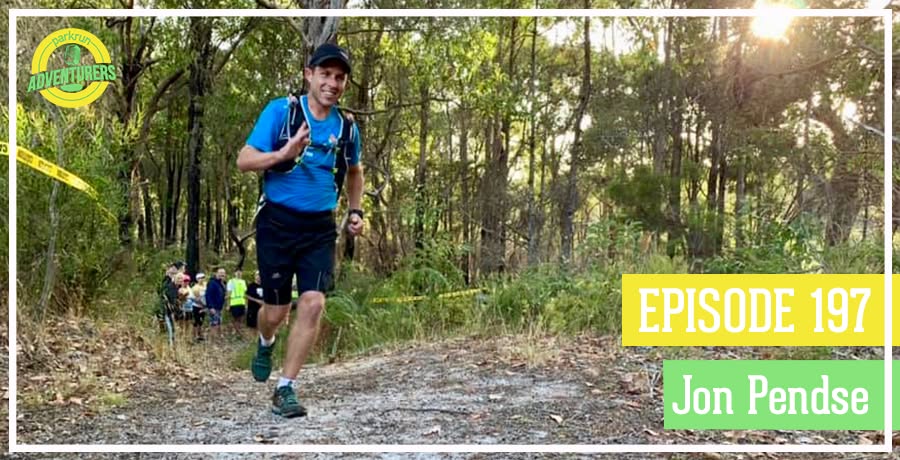
Episode 197 - Jon Pendse
Episode details · · 250 speaker turns · sound cues from context
Enhanced transcript
Speaker names appear where they could be established with confidence. Others are shown as “Unidentified speaker”. Sounds that are not speech — music, laughter, people talking over each other — are written in [square brackets].
Episode 197 - Jon Pendse · 2020-03-27
Enhanced transcript — Produced by an automated editing pass — speakers named, sound described, segments marked. NOT yet checked by a person.
Speaker names appear only where they could be established with confidence; others are shown as “Unidentified speaker”. Non-speech sound is in [square brackets].
Source: https://log.5kadventures.net/transcripts/ep197.html · The Adventurers Log · An independent project, not affiliated with or endorsed by parkrun.
Welcome
Melissa Erbacher: Episode 197 of the parkrun adventurers podcast is here. My name is Mel. I am coming to you not so live this time as I did last week from the studio in little old Palmwoods. And I'm joined this week by the effervescent Tony O'Connell. Toc, welcome back to the pod. Good evening, Mel. How are you today? Good. I think I'm like everybody, Toc. I think the term, the really proper expression for it is discombobulated.
Tony O'Connell: That's a very good word for it. And I think we're recording this on the Monday night, but Saturday morning was very much that. And I think there was an overwhelming sense of discombobulation across most of the world.
Melissa Erbacher: Yeah, absolutely. I think our whole global parkrun community, even though half of them were asleep at that time when we were getting up to not parkrun, to have our first un-parkrun day in 15 years or how many years has it been in Australia? nine, nine years in Australia almost. It's yeah, really weird feeling. Obviously we're jumping right into it. Everything. It seemed a little bit different last week because the episode was the live recording from palm20, which was down in Mount Barker, and it feels like such a long time ago. A completely different world, a completely different situation.
Tony O'Connell: It is, Mel, although I'm just trying to think of it as a bit of a parkrun intermission. It's just a short break before we're back on the air and the cinema's playing again.
Melissa Erbacher: Time to go get some popcorn and relieve yourself.
Tony O'Connell: Yeah, all those sorts of things. Go and make a cup of tea or whatever your choice may be. We still have our coffee option, although that's rapidly diminishing as well. We can still make a coffee in our own kitchens and, yeah, have a short intermission and, yeah, knowing that things will be back bigger and better and hopefully brighter and with more tutus than when we left.
Melissa Erbacher: Exactly. And obviously, if anyone is listening to this podcast, and we're hoping there's still a couple of you out there that have got time to fit us into your whatever it's quarantine or self-isolation schedules at the moment, you would be well aware, I would be very surprised if we had a single listener who wasn't aware that last weekend was parkrun Global was cancelled in 22 countries and this has never happened in the lifetime, I guess, of parkrun, of its existence, left more than just you and me, Toc, I think, feeling a little bit not sure where to go or what to do. But let's go back to that. So, lots of people did different things trying to find some normalcy or some kind of compromise to fill the void that has been left by a normal parkrun day. I call it un-parkrun day because it It reminds me a little bit or maybe I'm just feeling a little bit mad hatterish and I like to sing a very happy Unparkrun day to people. What did you get up to on Saturday? How did you fill the void that was left by not a parkrun in the world to attend?
Tony O'Connell: Well, Mel, it's almost we went through that big phase of we changed Saturday to parkrun Day. And unfortunately, for the next indefinite period, we're going back to Saturday. So we need to reinvent what our Saturday is for a little while. I went out for a bit of a run with a friend. She was entered in a race, and I was going to pace the last half of the race with her. She was entered in a 100-kilometre trail race. And it got cancelled, but the promoters gave all the runners the option that if you go out and run that distance on the day as a virtual race, they'll send you the medal and all the goodies. So we went out on a bit of an adventure and... She ran 100 kilometres. I went along for most of the journey. I only did 82K, but we... Only, he says. Ran a bit of a lap of Phillip Island, went and visited the penguins. We went to the koalas. We went all over the place. And we managed to start in daylight and finish in daylight. So overall, it was a pretty good day.
Melissa Erbacher: 82 kilometres, so that would be 16 parkruns plus some change.
Tony O'Connell: Plus a warm-up or a cool-down. Cool-down, I like cool-downs.
Melissa Erbacher: Has anybody sort of mentioned to you, Toc, that perhaps you may have been overcompensating just a little bit for no parkrun?
Tony O'Connell: Oh, yeah, but it was one of those days and it was one of those things. And our original plan was to get up early and drive down to Dandenong that launched a few weeks ago and go and run at Dandenong. And then I was going to jump in the car and drive the other direction a couple of hours and go and pace in the afternoon. Yeah, yeah, when we couldn't go to Dandenong in the morning, the longer run became a bit of an option.
Melissa Erbacher: Well, I can't hold it against you. And it sounds like you took in a huge amount of magnificent places to run, especially as it was a trail anyway, and you got to see penguins. Who doesn't need more penguins in their life? I know I do.
Tony O'Connell: We went to koalas. We saw a snake. We ran
Melissa Erbacher: Oh, I could do without the nope ropes. Danger noodles, not my thing.
Tony O'Connell: Yeah, no, it was only a little one. It was a happy one. It was a friendly one.
Melissa Erbacher: No such thing.
Tony O'Connell: And how about you, Mel? How did you fill in your formerly known as parkrun Day Saturday?
Melissa Erbacher: I got on board with the quiz, the big parkrun quiz. I was pretty excited. I'm a fan of quizzes. You may have noticed from the fact that we had a quiz, and we've always had a quiz at the listener meetup, and you did the scoring for the last one. Thanks, Schulze, for pointing out that Toc was a bit off with his maths, but it didn't change who won. So Scotty was very happy to see that he still won, but I digress. Yeah, so I took part in the big quiz and it was really fun. I'm not sure my brain was super sharp at 7 o'clock in the morning, but it never really is. However, the boys are going through a phase of being our personal alarm clocks at 5 a.m. or sometimes 4.30 a.m. at the moment. So we had been up for a little while anyway. Adam went out for a run. He took, which child did he take? I think he took Wesley. I can't remember, to be honest. You took one of the boys. Took one of the boys. And the other one obviously was quiet enough that I could continue with the quiz anyway while they were still around.
Tony O'Connell: See, that's the thing. Quite a lot of people missed the opportunity for the quiz this week because a lot of people went out and did their own freedom runs and not necessarily on parkrun courses. A lot of people just started at their front gate and ran 5k starting at around that 8 o'clock and everyone got home to find out there'd been a quiz.
Melissa Erbacher: Yes. Well, the fortuitous part about this is that the quiz will be back, I've no doubt. I'm not sure what times or days or if it's going to be every week, but people just need to keep an eye on the parkrun Australia socials or just the parkrun Global socials. They'll have information about the UK one and the US one if there's going to be more of those as well. Yeah. So that's something to look out for. It was fun. You know what, like I said, I wasn't super sharp on the brain and I only got seven out of 15 of the questions correct. Some of them were just wild guesses and I lucked out, but some of them I actually did use my brain. However, what I really enjoyed about it was the constant live stream of the participants having a chat in just the comments feed down the side of the screen, seeing some familiar names and, well, not faces so much, but names and people commenting and being able to interact with them. It was like... being at a virtual parkrun and catching up with some people that you didn't expect to see and others that you did expect to see and just having a chat while the questions were sort of going on as well in the background. So I highly recommend it. If anyone did miss it or didn't know about it and wants to check it out next time, definitely go and do it. It was a lot of fun and I will be back doing likewise again. I do like that so many people went out for virtual runs or, you know, just solo runs or non-flocking. That's a, I like the hashtag no flocking. It's a very good rule at the moment. And I also like to use the term physical distancing as opposed to social distancing because I don't think keeping our distance from people should mean we don't also socialise with people. It's not mutually exclusive. But you know what my hot tip is, Toc, in this whole mess that is the coronavirus?
Tony O'Connell: What's that, Mel?
Melissa Erbacher: People not getting to go to their normal parkruns or even if they were planning adventures, et cetera, and just, you know, choosing to run somewhere more local or just different and in different ways, shapes and forms. Lots of people are saying, oh, yeah, you know, there's going to be all these new babies in nine months' time. It's like, well, you know, we still have electricity. It's not like there's been a blackout. Yeah. And people have nothing better to do. Netflix still exists. So I'm not sure people are on the money with the babies thing.
Tony O'Connell: However... Let's see what happens when it comes to lockdown.
Melissa Erbacher: Well, yeah, we'll see. And I'm sure that's coming. But what I am predicting is that there are going to be new parkrun babies, as in there are going to be new events popping up out of this. People are going to run places and go, actually... why isn't this a parkrun course? This is really good. It's got this, this, this and this. And that's my hot tip. There's going to be new parkrun events.
Tony O'Connell: That'd be really cool to see something positive come out of it too, wouldn't it?
Melissa Erbacher: Absolutely.
Tony O'Connell: How cool would it be to see a whole range of new events that, like you said, people haven't even considered the course and people will jump in a car and drive to a parkrun and run it. And they're probably driving past some spectacular courses. So this might give people the opportunity to get out and explore a little bit and actually find a few new places. I certainly hope they do. And back on the quiz there, the funny thing I found about the quiz was with the three versions worldwide, there were people that were listening to it on the YouTube, but getting the question sheet from the
Melissa Erbacher: the wrong world event and so listening to the questions from one place and getting the answer sheet from the other and just it wasn't making sense and it wasn't gelling for them I did see that yes I obviously that was not a problem we had here in Australia because we started out while we're talking about UK uh Aussie differences and I know you mentioned Dandenong parkrun before Nicola mentioned Dandenong in the podcast in With Me Now podcast a few weeks ago. And I, gosh, I had such a giggle about it because she felt the need to use, to say it with the Aussie accent. And Nicola, if you're listening, you were bang on. And it gave me such a big grin and a giggle to listen to you saying it. So thank you for honouring the pronunciation of where the event actually is. And even though we both speak the same language to use the accent, I thought you did a great job.
Tony O'Connell: Keep it up. It was pretty cool, wasn't it? It was. And Mel, I know I did a reasonably long run on the weekend, but you've had a chat with a bloke from over in WA that's had an incredible adventure and his run makes mine look terribly short. Take it away with the interview.
Interview Jon Pendse — West Australian parkrunner; winner of the Delirious West 200 Miler ultra
Melissa Erbacher: I'm joined now by a parkrun adventurer who goes a little bit to the extremes on his commute to a parkrun. A couple of weeks ago, on the 22nd of February, he ran his slowest ever parkrun, but it was a new one. It was a first visit to Mount Clarence, and his name is Jon Pendse. Jon, welcome to the parkrun adventurers Podcast.
Jon Pendse: Thanks, Mel. Great to be here. And I really appreciate being able to share some of my experience and my warm up into my Mount Clarence parkrun. So although probably the slowest time I've run, it's quite an epic adventure, I guess, as to what took me to that place.
Melissa Erbacher: It was. So please, let's hear about your warm-up.
Jon Pendse: I guess, so the race that led to Mount Clarence was a 200-mile race, one of WA's newest ultra distances. As part of Ultra Series WA, they put on a race called the Delirious West. So the actual distance is about 350 kilometres. So in the ultra scene, I guess, they always add on a few extra kilometres, give or take. And in this case... about 30 kilometres extra on top of the 200 miles if that wasn't enough. So most of it's on the Bibbulmun Track, which is southwest coast of Western Australia, starting in a town called Northcliffe and then finishing up in Albany. So it's quite a long distance, I guess. And because the race started on a Wednesday at 7 o'clock in the morning, I did have the intention that as long as I finished in time by Saturday 8 o'clock, then that would mean I would be pretty much locked in to do the Mount Clarence parkrun being the closest parkrun to the finish line. So I guess that was the carrot dangling in front of me because the official race finish time was Sunday 3 o'clock in the afternoon. So just depending how the race unfolded. And I guess at one stage I did try and slow myself down to give myself the excuse not to make the start line at Mount Clarence. But unfortunately, I did get my running legs back and I did finish about five o'clock in the morning on Saturday. So no excuse not to turn up and do the local parkrun there, which Bill Irving's the director of.
Melissa Erbacher: So Bill Irvine is actually the race director of the Delirious West as well, along with Geoff Hansen and Sean Keisler, isn't he?
Jon Pendse: Yeah, so I guess the distance being such a logistical nightmare, 350 kilometres, Sean enrolled Geoff and Bill to help him along to manage the event and give them Bill's local finish line, the Albany. Bill knows all the ins and outs of the local race the local Bibbulmun track there and really adds just the professionalism for the overall event and the experience that they can put on for each race participant.
Melissa Erbacher: So let's talk about the track. What kind of terrain are we talking about here?
Jon Pendse: So the terrain itself, I was unsure exactly what I was getting myself into. I knew there was going to be a fair bit of sand, but the extent of the sand, I guess, was every colour you can imagine. And it didn't matter if you were close to the coastline or inland, there was just sand everywhere. So probably 95% of the whole track was just covered in sand. So soft sand, hard sand. You've got beaches, dunes. There was some wetlands, river crossings. You also run through the forest, the karri forest, giant tingle trees. You do the treetop walk. So it just changes. It's so diverse. And the whole 350 kilometres is always something different, I guess, that you're always keeping an eye out for. The snakes and the kangaroos. I never got bored by looking at the scenery, I guess. So I did have an intention at one point to listen to like an MP3 player, but never got it out of my gear, I guess. I didn't feel the need for it just because there was so much happening out there on the nature's paths. I guess that's part of the reason as well I entered, just that tranquility and the peacefulness of such a distance, just that inner calmness, I guess, which you really need to draw on if you're going to be running this sort of distance.
Melissa Erbacher: You talk about the tranquility. It took you a little bit over 70 hours to complete the event and you slept for less than four hours over that three days. Do you think part of the tranquility might have been brought on by the zen of not having slept?
Jon Pendse: A bit of both, really, I guess. I did talk to other people in the race and they had a lot less sleep than me, probably one or two hours. And some people were only having five or ten minute sleeps at a time. So I guess for those people, they were just in a constant fatigue state, uh spiral downward spiral whereas my sleeps were more like 45 minutes to just over an hour so I had four sleeps in total so roughly the four hours but each time I woke up from that one hour sleep basically felt like I'd gone through a whole um sleep cycle and once I'd woken up I was just refreshed ready to go again so I've sort of never got to that um hallucination stage, I guess, where you're just constantly having those micro sleeps along the way. So it wasn't unknown as to how much sleep I would need. But once I was out there doing it, sort of found what worked for me roughly every, probably every 15 or 16 hours, roughly about 45 minutes to an hour sleep for that 70 hours there.
Melissa Erbacher: All right, so you talk about unknowns and you've mentioned a couple of them so far. Coming into the race, what kind of preparation do you do to get ready? What's your longest distance, for example, and how do you actually prepare for something this epic?
Jon Pendse: Well, my normal week by week, training is just marathon-based training, I guess. So normally I run four or five marathons a year, and I'm sort of averaging around 130 to 140 kilometres a week. And because I do race so much during the year, my long run is basically a race, whether that's a marathon or maybe normally my ultra running is normally capped at around 50 kilometres or 100 kilometres, but I'd normally only race that couple of times a year so I guess the longest single distance I'd run going into the 200 mile was a 12 hour timed race probably Easter 2019 and in that 12 hours I'd covered 142 kilometres so that was a single single longest run I'd ever done to that point in time but I've done a handful of the 100 kilometre distances and they're probably another five or six 50 kilometres and I think I've done about 65 marathons over 15 years so I've got a lot of endurance base anyway and so leading into the 200 mile race I thought for me I don't need to do a lot of extra kilometres because 130 140 seemed to be pretty good distance and it was more about running on tired legs so I'd often run two or three times in a day and most of that those runs were just easy runs just getting used to time on feet and backing up every few hours or say the morning lunchtime afternoon so not that a few hours break in between each run and that was sort of the extent of my training I guess I did a couple of um longer blocks in the lead up to delirious so I actually had two overnight runs each was about 100 kilometres and then that one was in November and one was in December one was on the trails so a night trail run so it's quite different to running during the day So I wanted to do one trail run just to experience what it's like. And then my other set of training block was I did a five times 50 kilometres within a two day period. So I guess that was that was quite a brutal training session to get through that. But it really did set me up to what I could expect come the 200 mile race.
Melissa Erbacher: Okay, so the 5 by 50K within two days, that sort of makes sense to me. But just, you know, throwing it out there that you did a couple of 100K runs or whatever and that's still a massive jump to 200 miles. How is your headspace with thinking, okay, I just ran 100K, I'm absolutely knackered at the end of that, but I could just go do it two more times or do it – Well, yeah, two more times back to back essentially. It's just I cannot wrap my brain around it. How do you mentally prepare and how do you get in the mindset that that's physically doable even though you've not done anything close to that?
Jon Pendse: Well, I've been chatting to a lot of people over the last probably six to 12 months. I guess people have been there and done it before. And a lot of people had said running a 200-mile distance is actually easier than a 100-mile distance. So whether that's true or not, and I've never done a 100-mile race before, but from the people saying the 200-mile is easier, I guess the main point is that it's over quite a few nights. So whereas a hundred mile race, you sort of, I imagine you'd be doing it within a, probably a 24 to 35 hour period. Whereas the 200 mile race, it's over four and a half days for the cutoff. And I was expecting to finishing, probably just over two days, just depending how the race unfolded. But it is such a long way that you can't expect to run 100% of the time. So you do have to set yourself up to be prepared to put in some long hiking sections just to break it up, I guess. So some of the harder sections, you know, you're going to be substantially slower than what you might normally run at, I guess. So it's more a long hike, but having an endurance base behind you gives you the confidence knowing that you've done a lot harder, faster races. It just means you're gonna be having more sleeps. So I, I, I thought of it as more of a stage race, I guess, where each time you've had a sleep, then you're set up for the next stage. And so I sort of broke it down into probably a hundred kilometre segments. And so I didn't think of it as the full 350 kilometre race. I sort of tried breaking it up and just made it easier to, um, be able to get through it mentally, I guess, because that's probably 80% of the race is mental approach and how strong you are and what you can push through and your perseverance and how stubborn you are, I guess, that you're not going to give up and that you're just going to keep moving forward one step after the next. So mentally, you definitely have to have the right headspace in order to get through a race at this distance. And I guess over the years, because I've been running marathons for 15 years, marathon and just normal training is my everyday escape, I guess, where you can just zone out, you're chilled, you're just, um, relaxed in the moment. And then when you find your happy space, I guess hours or, um, time just flies by, I guess. I really wanted to find that place in the race and I was hoping it would come, but you're not guaranteed, I guess. So the points in the race hours would just fly by and, um, think I remember looking at my my watch and it was about probably about 25 hours and then I think the next time I looked at my watch is probably a good 40 or 45 hours so probably 20 hours have passed I guess without really giving it two thoughts except I'm assuming you charged your watch in that time well that was the one thing I had to make sure that I could record it as a single run I guess so on my uh Garmin Fenix I did have a power of bank that I carried and then I had to charge up four times during the run so the watch would get down to probably 25 plug it in just to the portable usb charger probably an hour later I'll get up to about 90 and then it was good for another probably 15 hours or so so I only had to charge up about four times and two of those times was while I was I was sleeping
Anthony: So twice while I was running.
Jon Pendse: But it did work out. And I got towards the end of the race and I wanted to ditch everything that I didn't need anymore. So the power bank was ditched. And then I did, it was a longer section, probably the last 50 kilometres. So I think I got down to about 15% battery life. And that sort of pushed me going to make sure I finished before it packed it in. So I just made it before the cutoff there and hitting the save button on the finish line.
Melissa Erbacher: Yeah, you don't want to lose the whole activity just because you're dropping some unnecessary weight. Did you chuck the MP3 out too, those extra 15 grams?
Jon Pendse: Yeah, well, that was with my support crew. So we had the car travelling along at the aid stations and I sort of had my essential gear that in a box, probably seven or eight boxes, I guess, just everything I could think of that I might need. And so that was in the car. And so it was just as I wasn't carrying that with me. So it never came on that I had to carry that, okay so you've got eight boxes in a car what is the randomest item that you took just in case but you didn't actually use oh okay first of all the one item that was random that I've never used that was probably the most useful item was a set of running poles so I had these um I won some running poles last year in one of the race I did Margaret River ultra um But they'd been sitting in my garage for 12 months and I'm normally a road runner. So I never really bring out, I'm never going to use poles, I guess. But I thought I'd better put them in the car just in case I need to use them. So probably hit about 270 kilometres into the race. And I'm thinking my legs are getting quite heavy. And my support crew actually pulled out a couple of stick branches off the side of the road. And he said, Jon, let's try these out first before you get your poles, just to try and get the technique down pat. Because at that stage, I didn't want to carry my poles and five kilometres later ditch them like... I didn't want to have to resort to be carrying them if they weren't helpful. So we practiced with the sticks and they were fantastic. So come the next aid station, it's like, all right, give me my proper running poles now. So the first time I'd actually used them was in the race. So that was one piece that I thought I wouldn't need to use. And they were probably the lifesaver in the end, just at that stage of the race. Something else probably that I didn't use, I probably packed 40 up and goes, like the milk drinks, and I think I probably only used about three or four of them. So that's probably, yeah.
Melissa Erbacher: So you're good for breakfast for the next couple of weeks.
Jon Pendse: The kids haven't, they're in the fridge, so I can't get rid of them now.
Melissa Erbacher: Okay, so we've been a little bit humble and we haven't actually mentioned yet that you've sort of alluded to podium finish, but you actually finished first, which is pretty all right, you know, for a little 200-mile jog slash walk slash hike slash run. How does it all start? What's the atmosphere like? What are the first few steps? How do you take those first few steps? I mean, you obviously didn't know necessarily that you would come first. I'm sure everybody who is on the start line has those hopes, those random hopes.
Jon Pendse: yeah definitely so there's probably at least 10 people on the starting line all different levels of experience as to all have the potential to win or podium the race I guess and looking back I guess for my race I started off at my 100 kilometre race pace which is comfortable for me I guess but come probably about 130 140 kilometres into the race my legs started getting quite fatigued I guess and I was starting to approach longer than my longest single run of 12 hours so probably hit about 23 24 hours into the race which is twice the amount of time my previous longest run and the body was starting to just give up I guess so I did have the intention to just run as well as I can and where I would end up would be as Depends how everyone else's races go as well. But looking back, the real race didn't start until day three, so probably about 50 hours into the run. And that's where the real race started unfolding, I guess, as to how people had positioned themselves and how people had set themselves up, knowing that they still had another probably good 20 hours left and probably another 100, 120 kilometres left to go in the race. So I guess... There was always about four or five people in contention, I guess. And when I had my rough patch during my extended walk break, I was probably down to the sixth or seventh place. But once my running legs came back towards the end of day two and the overnight section, I was starting to run people down. And I guess that's where my road running background came in, that I was quite strong and able to just get back onto a normal, like, my comfortable 100K race pace. So I was hopeful that I could run well, but I also came into the race with a slight knee injury. So that sort of pushed me back a little bit into more... I couldn't get all the training I wanted to get in. So whether that was a blessing in disguise, I guess, having about three, four weeks of rest time. So it was probably about two or three weeks before the race day when my knee came good that I wasn't having any tightness in the knee. And so that was one unknown, I guess, as to how the knee would hold up, as to how competitive I could be over such a long distance.
Melissa Erbacher: Okay, now ultras and trail runs in general have a real reputation for a completely different atmosphere to a lot of road running races. I understand this one had its own warm-up of sorts in the Bogan Keg Run. Can you tell us or explain a little bit how that works?
Jon Pendse: Yeah, sure. I guess part of the race itself attracts quite a few international runners. Well, the day before the race kicks off for all the support crew and there's a lot of paces that help support people. So the day before it's a social event where it's an Australian sort of tradition, I guess, and most people would have heard of the beer mile. But this one is slightly different, being the co... the beer keg run where you start off drink I didn't actually take part in this as well by the way but my um my support crew Peter he did take part in you know winning the race but basically you start off with a drink um can be alcoholic or non-alcoholic uh you neck it down as quick as you can and then you pick up an empty keg. Once you've finished necking your drink of choice, you then pick up the empty keg and you run 1.6 kilometres. So it's an out and back loop. When you get to the end point, you then drink another drink and then you drop your keg at that point. And you return back to the start line. And the other, probably just a slight twist, if you can choose not to start with a keg. So when you get to the end point, that you then have to return carrying a keg. So there are strategies involved as would you rather carry a keg on the way out or on the way back? So that was just a bit of lighthearted Australian humour, I guess, and just a good way to start the event on the night before the race or in the afternoon.
Melissa Erbacher: Get everybody excited for it.
Jon Pendse: Oh, definitely. So Sean, Jeff and Bill, the race directors, just get everyone worked up, I guess. And, yeah, it really kicks off the whole weekend or the whole race week. So it's definitely a tradition that will be continued.
Melissa Erbacher: let's go back to parkrun you have been parkrunning uh since 2014 so roughly roughly my first one yeah roughly about five years and you over that time you've done 72 different uh 72 parkruns at 28 different events so you're a bit of a an adventurer I notice you've been to the home of parkrun in Australia you've done Main Beach parkrun but the rest look like they might all be in wa
Jon Pendse: Most of them, I am trying to tick off all the WA ones. So I think I've got about three metropolitan ones left and then the regional ones as well. That's part of the reason why I did Mount Clarence, because it's probably a good five and a half hour drive from Perth. So I thought it's a good way to tick it off. Don't worry about the time. Just finish it and tick it off. So that was a high incentive for me to finish and then go and do that as well.
Melissa Erbacher: And you had your barcode packed in amongst those eight boxes in the back of the car?
Jon Pendse: Yeah, well, the barcode was attached on the car keys, I guess. So as long as we had the keys for the car, had the barcode so that was that I wasn't going to lose that one so I didn't want to carry it with me just in case I lost it but as long as the car was driving and we didn't look like my support group didn't lose the keys then we were good to go
Melissa Erbacher: Very glad to hear it. After such a long warm-up, it would have been a massive pity to have left your barcode at home. Jon, thank you very much for joining us this week and sharing all your adventures and congratulations on winning your very first 200 miler.
Jon Pendse: Thanks, Mel. It's been a pleasure. Thanks very much for taking the time out to have a chat.
[25 seconds of audio that could not be transcribed]
Tony O'Connell: Oh, Mel, that was an awesome interview with Jon. It was really interesting to hear it from someone at the pointy end. I know a couple of the people that I know that went over and did the same race, and it's interesting that there's a boat ride in the middle where if you miss it, you've got to wait for an hour, and that adds on to your run time. It's interesting. We had one of the Run Directors from Parkville, Nicole Vaughan, Running the events. There's a number of parkrun connections there. Really great to hear about a race. And that's just awesome. 340 kilometres. I'm tired even reading those numbers. So yeah, well done to everyone that finished.
Melissa Erbacher: Yeah, well, they all absolutely, especially Jon in particular, put me to shame because that particular weekend on the 22nd of February, we missed parkrun because we had a shocking night of not great sleep with the boys. However, Jon had just been running for X amount of hours over 340 plus kilometres and still managed to drag his...
Tony O'Connell: behind along to mount Clarence parkrun so I did feel a slight case of ashamed of myself it was only a couple of hours after he finished too like you'd finish that and you'd either be eating for a week or you'd be sleeping for a week
Melissa Erbacher: Yeah, I would be passed out. Absolutely. I'm not sure I'd have the energy for the eating part. Doesn't inspire me to want to do it. I'm getting very fond of sleep and I've gone without a lot of it for a very long time now. So when I eventually do get it back, I don't think I'll be giving that up anytime soon.
Tony O'Connell: Yeah, I think those sort of races, you listen to Kirsten Mapleston, who was the last finisher on the day, and she talks about hitting spiders' webs and that in the middle of the night and spiders on the face and seeing snakes everywhere and not wanting to lay down because there were snakes on the ground. I just... Yeah, no, I'll stick with what I do. Stick with parkrun. It's 5Ks and then you go have coffee and cake. How much better could you want? Exactly. And moving along, we've got a number of reports this week, Mel.
Melissa Erbacher: We do. Yeah, we've got quite the backlog, which sort of dates back to leap year day parkrun because... We had a live recording episode and I also took the week off in the lead up to that to travel down to said live recording location and get prepared for it. So all of a sudden we find ourselves almost four weeks later and yes, so we've got some roving reports that we still don't want to go without. So we're going to play them anyway.
Tony O'Connell: Let's jump into them and have a listen.
Roving reports & the Channel 5 News crew
Roving report Tony O'Connell — Bendigo Botanic Gardens parkrun
Tony O'Connell: Howdy, parkrunners. Toc reporting in for the Channel 5 News crew. Today we've ventured up to a town in central Victoria to what I'm calling the Harry Potter parkrun. This is the parkrun that must not be named yet. More details to come after our run. Cheers, guys. Howdy parkrunners. We've finished the Harry Potter parkrun and we can reveal its name now. It's the Bendigo Botanic Gardens parkrun in Bendigo. So it's one of the new soft launches that we're trying to achieve and it's gone off really well. It has been an absolute cracker of a day up here. I'm sitting here with Belinda. We're in the coffee shop afterwards. You can probably hear the coffee machine in the background and we're going to have a bit of a chat. So Belinda, what did you think of today? How did it all go? it went really well it was a really successful launch after the launches I've been to recently it's um I think you had 130 140 137 I think it was yeah it was just a perfect number for a launch it was a really good little close-knit crowd obviously a lot of people know everyone already but you had a good sprinkling of new people to parkrun as well yeah we did yeah there was quite a few new people which was great and tourists There's been rumours of a second parkrun in Bendigo now for about four years, so it's good to see it come up.
[other]
Belinda: Yeah, good.
Tony O'Connell: And give us a bit of a description of your course.
Belinda: Our course is a nice flat along the creek, out and back, with a slight incline.
Tony O'Connell: It felt pretty flat.
Belinda: Yeah.
Tony O'Connell: And for the listeners at home, you've got a bridge at the start that you cross twice.
Belinda: Yes, yes. You come out of the gardens, you turn left and up over the bridge, pedestrian bridge, and then turn right out to the turnaround point, come back, Turn left over the bridge, then right, back into the gardens and you finish in the beautiful Bendigo Garden for the Future.
Tony O'Connell: And it is a beautiful set of gardens and you've got every facility known to man at the gardens. You've got toilets, you've got shelter, you've got car parks, you've got everything. It's a beautiful spot for a parkrun.
Belinda: Yes, we do. It's a great area. You've got even an area in the middle for the kids to run around and play and they won't get hurt.
Tony O'Connell: And Belinda, how did you come to get involved in setting up a parkrun?
Belinda: No one else would do it, basically.
Tony O'Connell: The old roped in example again?
Belinda: Pretty much, no. We lived really close by and we could see the potential, so it was just a natural progression.
Tony O'Connell: And so you've had a little bit of involvement with parkrun, have you?
Belinda: Yeah, we went to the first Kennington Reservoir parkrun and we've been there ever since.
Tony O'Connell: And you guys in Bendigo, you're really great at launching parkruns on days with other parkrun launches in the state. So you get that smaller number. It's the second two for two so far.
Belinda: Yeah, we're doing well. Yeah. It's not planned.
Tony O'Connell: Not much. No, that was really good. All right, Belinda, we might wrap it up there, but we're sitting up here in the vibe.
Belinda: It's 3D.
Tony O'Connell: Street Eats. And I've just had breakfast and it's been one of the best breakfasts I've had. It was really yummy. The coffee's really great. So I think you've scored a parkrun with the lot. Well done.
Belinda: I think so. I think so. Thank you very much.
Tony O'Connell: Well, good luck with the ongoing success of Bendigo Botanic Gardens.
Belinda: Thank you.
Roving report Cameron Drake — Rockingham parkrun
Cameron Drake: Good morning everybody it's Cameron here from Bright and Beautiful WA and let me tell you it certainly is bright and beautiful today weather certainly has turned it on for us and it's a beautiful day for parkrunning. Now instead of telling you where I am then telling you all about it I'm going to tell you all about the place that I'm at today and see if you can guess where I am. Now I'll start with the most obscure clues first, work my way from there. This parkrun is where I started my very first parkrun back in late 2015 and as it so happened I was also very late to start. And since then I've completed over 100 parkruns here. What else? Ah, yes, this parkrun takes its name from the surrounding suburb in which it's in, rather than where it starts. So that's something interesting. I'm led to believe that this is the second oldest parkrun in WA, and averages somewhere between 300 and 400 people every week. So that's a pretty good turnout.
the K-Man: What else?
Cameron Drake: else ah yes there is an interesting pub in the suburb that takes its name from the suburb and puts a bit of a spin or twist on it and it's called the swinging pig and that's that pretty much gives it away to the locals but for everyone else playing uh if you sail the seven seas in wa or wherever you'll need one last arrrrr Yeah, that means it starts with R. All right, so for those who like to double check their answers, I am of course at Rockingham parkrun on the beautiful Rockingham foreshore. This parkrun is a two and a half kilometre out and back, which runs just about on the beach. You can literally throw something, even underarm it, just to the beach and it'll probably hit the waves, which is both good and bad because in winter, the whitecaps can actually sometimes get up on the path, which is really, really fun. Well, enough of my chin wagging. Let's go talk to someone else. G'day, everyone. I'm here with Eddie, who is the Run Director today. G'day. How's it going? Yeah, I'm good. Yourself? Yeah, not too bad. Apart from being run down under today at parkrun, it is also a leap day. What leaping festivities do we have planned at Rockingham today? We have lots of energetic dogs. Dogs? Yes. Who leap? Yes. And people? Hopefully. Maybe there's a few PBs to be had on the course today. Fantastic. Well, that is great to hear. Thank you very much, Ed, and I'll see you out on the course. Thank you very much. G'day, everyone. I'm here with a couple of people who end up at the pointy end of the field. What's your name and where are you from?
Mike: My name's Mike. I'm from Baldivis, but I'm originally from Swindon in the UK.
Cameron Drake: Oh, same here, except for the Swindon part.
Unidentified speaker: I'm Daniel from Shoalwater.
Cameron Drake: Cool.
Unidentified speaker: I'm Jeff and I'm from Rockingham.
Cameron Drake: Up to you, buddy.
Unidentified speaker: I'm Corey and I'm from Medina.
Cameron Drake: Cool.
Unidentified speaker: So, fellas, what's the secret to finishing first?
Mike: Anyone. Just hard work during the week for me. I like to do a lot of training if I can, so I started doing a bit of interval training, which really seemed to help and improve my time, so it seems to be paying off a little bit.
Unidentified speaker: Brilliant. How is it that you're so fast, sir? At the moment, I'm not doing too well at the moment. I don't know why. But, yeah, just running, running, running, running all the way through the week. That's it. You've got to keep running. That seems to be a common trend.
Cameron Drake: Now tell me, was it the shoes or was it all you, buddy? It was the shoes. It was the shoes?
Unidentified speaker: Yeah.
Cameron Drake: Seriously? I thought those spanky ones with the springs and the motors and the jet engines.
Unidentified speaker: Yeah. Without the shoes, I would be 500, 1500 metres back.
Cameron Drake: Yowzers. So that's at least a 35% improvement on performance. That's brilliant. I'm going to get me some of those. Do I have to mortgage my house for a second time for it? Yeah. Oh, God. Okay. Sir, what's the secret to going fast? Hard work, training. I was hoping for a different answer. No, that's it. Trading and having fun. Now, sandals. Tell me all about those. This guy here. He thinks he's Jesus.
Unidentified speaker: Okay, Jesus. What about the sandals? Well, you can get them from Kmart in Rockingham if you're interested. I've been there before, once. All you've got to do is cut off a bit of thong to Jack up the heel and that'll just propel you forward, like even better than those ones. Do you have to build your own spring into it or what? They should be in the leagues, even at our age. What? Spring in the legs. Oh, okay.
Cameron Drake: So no mechanical advantage on these bad boys. Well, there's a lot of airflow.
Unidentified speaker: Well, that's good. I mean, I need it. Do you feel that? How light is that? That's light.
the K-Man: That is light.
Unidentified speaker: That's brilliant.
the K-Man: It is.
Unidentified speaker: So Jeff is the best runner at Rockingham and he recommends them. Do you have to wear socks with them? I find that I tend to slip around a bit in socks, and they look a bit geeky. It's all about image. Unless you've got cool socks like me.
Unidentified speaker: Exactly.
Cameron Drake: I love the socks. I'm going to pair like that, except they're rainbow all the way out the top. Yes. They're cool. Well, thank you, everyone. Thank you. And I look forward to seeing you again some stage, maybe even at Baldivis.
Gorilla Tourism
Roving report Action Man — Tuggeranong parkrun
the K-Man: Hey, what up? It's the K-Man here with... Action Man!
Action Man: And it is... Gorilla Tourism!
the K-Man: Yes, we're at the Tuggeranong parkrun. It is a nice something degree day and... It's last day of summer. Last day of summer and it is the 29th, which is a bit of a celebration because you've got to wait what, like two... 28 years, I believe, is what we were told. Yeah, so 2048, where are you going to be?
Action Man: Saturn. I want to say Saturn. Hey, this is Action Man giving you some action here at Tuggeranong parkrun.
Unidentified speaker: Tuggeranong parkrun, talking to my good friend. Jonathan. Who is one of the volunteers. I'm marshalling this time. Yeah, I'm standing. Standing on a corner near the gorgeous Tuggeranong Lake, watching runners and walkers go by, having a beautiful time on a beautiful day. Just behind us, you might be able to hear some martial arts happening in the background, which is just creating that extra colour that you often need around a lakeside. Oh, here come some runners. Good running. Well done. Keep going.
[other]
Action Man: Power on. That's what we like to see. Thank you very much. Pleasure.
the K-Man: We need to go find some gorillas now.
Action Man: Quick. My next people to interview here at Tuggeranong parkrun. Anyway, we don't need your real names. You can just say, you know, Batman. That's cool. Or Batgirl. And Wonder Woman, right?
Unidentified speaker: Oh, yes. Taroja the Wonder Woman.
Unidentified speaker: Awesome.
Action Man: Awesome. How long have you guys been parkrunning for?
Unidentified speaker: Around six or a little bit over. Around six years.
Action Man: Six years. That's a good effort. And where are the different parkruns that you guys have gone to?
Unidentified speaker: Mainly Tuggeranong because I love it.
Action Man: Have you been to any others?
Unidentified speaker: Yeah, mainly in Tuggeranong because I live nearby.
Action Man: So you guys like to keep it local, keep the community up and running.
Unidentified speaker: Yeah, good job guys.
Action Man: What about volunteering? Have you guys volunteered much?
Unidentified speaker: Yes, about six times, six, seven times, yeah. A long six times.
Action Man: Do you guys always volunteer together?
Unidentified speaker: No, the first time. This is the first time actually we are doing it together.
Action Man: What is your favourite role in volunteering?
Unidentified speaker: The one we are doing now, tail walking. Me too.
Action Man: Awesome. All right. Well, I guess we'll leave you to continue tail walking, making sure everyone is safe. Thank you very much. How long have you been parkrunning for, sir? My last year. Me last year? Cool. Number 18. Number 18. Awesome. Lucky number 18, right? What is your, is this the only parkrun you've done? Two others. Oh, two others? In Canberra? Or, no? Adelaide. Adelaide? And Orange. And Orange. The infamous O. O's are hard letters to get on the alphabet score. That's a tip.
the K-Man: Go to Orange.
Action Man: That's your tip. Okay. What's your favourite thing about parkrun? Is this your home parkrun? Yeah. Yep. What's your favourite thing about Toblerone parkrun? The challenge. The challenge? All right. Good option. All right. Well, I think that's all our questions for today. Have a great day. How many parkruns have you done, Ewan?
Unidentified speaker: About nine. Nine? This is your 10th.
Action Man: Oh, this is your 10th? Yeah. Okay. And how many parkruns have you done more here at Toblerone?
Unidentified speaker: Yeah, I've done one in South Africa. South Africa? Which is really tough. International parkrunning superstar.
Action Man: Where are you at? Cape Town?
Unidentified speaker: Yeah. No, Morgan Bay.
Action Man: Morgan Bay? Awesome. Awesome. Okay, we've got to go. We've got a blockage. Oh, wait, no. Special K's got through. What is the hardest part about parkrun? Hardest challenge you've overcome?
Unidentified speaker: Getting through it. Getting through it? All right. All right. Cool. Thank you very much.
Unidentified speaker: Have a great day.
Action Man: What is your favourite thing about being a parkrun volunteer? Or actually being part of parkrun?
Unidentified speaker: I like seeing everyone run and how appreciative they are of everyone. Thank you for volunteering. Thank you.
Action Man: Oh, I see what we're saying.
Unidentified speaker: Yeah. Lots of thank yous. Cool.
Action Man: I like your rowboats.
Unidentified speaker: Yeah, they're nice. It's a nice view as well.
Action Man: I also like the Kung Fu.
Unidentified speaker: Yeah, that's good as you run past too.
Action Man: Alright, well, live long and prosper.
the K-Man: May the force be with you.
Action Man: Now we are finishing our time here at Tuggeranong parkrun. This beautiful parkrun day with the beautiful weather, beautiful people, beautiful boats, beautiful Kung Fu. There's very few things more beautiful than Tuggeranong. But we will see you next time when you watch us or when you listen to us here at Gorilla Tourism at...
the K-Man: Yes, yes, parkrun there, Action Man. Thank you so much. I am the K-Man.
Action Man: Action man over and out.
the K-Man: Indeed you are.
Roving report Tony O'Connell — Paradise Point parkrun
Tony O'Connell: Howdy parkrunners, Toc reporting in for the Channel 5 News crew. Today we've ventured up to sunny Queensland and we're visiting Paradise Point parkrun just north of the Gold Coast. I'm currently standing out on a jetty just before parkrun starts. It's beautiful up here, water's looking really good. I had a swim yesterday and it's fantastic. Fairly big crowd starting to gather around and it looks like we've got Greta up here so I might grab her shortly and we might have a chat and find a couple to talk to. Cheers, guys. Enjoy your parkrun, parkrunners, I'm here at the end of Paradise Point parkrun, and I'm with the ridiculously good-looking Glen and Chiaki. Chiaki, you just ran like the wind. You just set a massive PB. Well done. How do you feel?
Chiaki: Thank you. I'm feeling great.
Tony O'Connell: How much off of PB was it?
Chiaki: About a minute and a half.
Tony O'Connell: A minute and a half, 90 seconds off of PB, and you've come in at that pace. That is huge.
Chiaki: 30 seconds.
Tony O'Connell: 37.
Chiaki: No, no, 90. Claim the 90. It sounds better.
Tony O'Connell: It sounds much better. And is this the first time you've done Paradise Point?
Chiaki: Second time.
Tony O'Connell: Second time. So it's a PB on the course as well as an overall parkrun PB? Yes. And what do you think of the course?
Chiaki: It's a beautiful scenery, friendly people, and yeah.
Tony O'Connell: Obviously pretty fast if you can knock 90 seconds off a PB.
Chiaki: Yes, yes.
Tony O'Connell: And the out and back bit, how did you go around that little bridge that goes under the bridge?
Chiaki: I think it's great to see other people come and go. You get to see people in different places, which is great. I like that.
Tony O'Connell: Yeah, no, it's really good that out and back you get to see a few people a couple of times, which is really cool.
Chiaki: Everyone's trying their best, and it's great to see.
Tony O'Connell: Look, we've come to Queensland, and I'm looking out. It's nearly as sunny as Inverloch. It's not quite. You know, Inverloch's sunnier, but I'm looking and seeing clouds coming in. Glen, you're laughing at that. Come on, you're from Queensland. Stand up for the honour. I'm still saying we're the greatest state.
[laughter]
Glen: Well, I'm an expat here, so I'm south of the border. But you're right, mate. The last time I ran at Inverloch, there wasn't a cloud in the sky. And there's clouds here now, so I can't argue with that.
Tony O'Connell: Yep, yep. Historical evidence proves that.
Glen: Yeah, exactly. First time for everything.
Tony O'Connell: And see, Scotty's out here today, so we might grab him a bit later because I'm sure he'll defend the greatest state's honour as well.
Glen: I'm sure he will. No, I moved to the Gold Coast 12 months ago and it's my first time running Paradise Point. Certainly worth the wait, though. It's a fantastic course. And as Chiaki said, with those little out and backs in there, You pretty much see everybody a couple of times on the course. It's a cracker of a course, isn't it? Yeah, it's really good.
Tony O'Connell: All right, guys, enjoy the rest of your day. Thanks, Toc.
Roving report Greta — Paradise Point parkrun
Greta: Hi parkrun adventurers, it's Greta here and I'm at Paradise Point parkrun and I'm here with Anthony. And Anthony, you're the Run Director today. How are you going?
Anthony: Very well. We've just finished our event here. Had a great morning. Almost 300 runners on our beautiful flat track.
Greta: It's a big crowd.
Anthony: Yeah, we're very lucky. Numbers are building each week. We're getting up to around 300, which is great for the community.
Greta: Yeah, and it's a beautiful morning this morning. The sun is shining, the rain's holding off.
Anthony: Absolutely. We love a nice day. We've got fair weather athletes here. We like a bit of a cooling breeze, not a headwind. And they've all loved the conditions today.
Greta: And so is 300 about the numbers you would get for a parkrun on a Saturday morning?
Anthony: For us here, yes. We're generally between 200 and 300. Yeah, we've got over 300 a few times. But yeah, we enjoy the growth of it.
Greta: Yeah, it's lovely. And so for the listeners, can you tell us a little bit about your course here?
Anthony: We meet at the Paradise Point Parklands every Saturday. We start at 7 o'clock. We meet near the jetty, the tail end of the shops. And we run north under the bridges, along a boardwalk, back along the waterfront.
Greta: And the boardwalk is beautiful. I'll just interject there. That was lovely.
Anthony: Yeah, it's nice. We've got a beautiful spot. You're running along the water the whole time. You've got mangroves. We've got boardwalk. We've got clear pathways. It's a beautiful spot. Really flat, too.
Greta: Lovely views of the water.
Anthony: Absolutely. We're spoilt.
Greta: And then you come back through the start and you sort of go out the other way for a little bit, don't you?
Anthony: Yeah, you run north for about 1.6k, then you come back past the start-finish line, head south for around a k and a half. You double back past the finish line and do an extra 250 metres, which often causes a few sad faces out there, but you're running past the start line, which is a good psychological battle.
Greta: Yeah, yeah, that's great. And how long have you been Run Director here?
Anthony: I've been Run Director here for three years. We have eight Run Directors. We sort of roll it on a two-week-on basis. We take two weeks each. So I share the role with four others, or three others, I should say. And we love giving back to the community.
Greta: And what got you started in parkrun?
Anthony: participating first yeah um did you start here yes yeah yeah started at Paradise Point and most of my runs here I've done over 170 I believe something like that but when the opportunity came up to to help out I took it and I've been Run Director since yeah great great and before you started um running at parkrun were you a runner Running was a big part of my life, yes. I played other sports as well, enjoyed rugby. But once I started running and triathlons, it just was a great way to get a session with people. It's a lot easier to run with someone than by yourself. So it's a tremendous opportunity to do that. I've made a heap of friends doing that. And I've seen a lot of progress in my running since as well. So it's a great thing on many levels.
Greta: And you've got a fabulous community here. Lots of people standing around chatting, laughing, talking. It's wonderful.
[laughter]
Anthony: Definitely. We've really built up a good community. They support the event well. We go for a coffee. We support the local shops as well. So it's a real win-win in our opinion.
Greta: Great. And do you visit other parkruns? Is that sort of part of something that you do or do you find that you're always here?
Anthony: I definitely visit other parkruns when I can. I do have work before I get to parkruns, so it's not always that simple. But whenever I'm travelling, I've done Tamworth and I've gone to Wales and the UK a few times. I've done a few runs over there, but most of my runs are here. But I think it's a great idea to go and support other runs and check out other courses and challenge yourself there.
Greta: Well, I have really enjoyed visiting your parkrun today. Thank you so much for having us. It's been an absolutely wonderful day and thank you for everything that you do for parkrun.
Anthony: It's our pleasure. Thanks for your support.
Greta: Thank you.
Anthony: Have a great day.
Melissa Erbacher: So, Toc, there was a bit of a familiar voice there. I noticed that you happen to be at a couple of events along the way, Bendigo and Paradise Point. Thank you for submitting those roving reports. Good to see that you're still out there adventuring, or you have been in recent weeks at any rate.
Tony O'Connell: It was really cool. We caught up with Greta after catching up with Greta at Mount Barker, which is her home run, to catch up with her in Queensland the week later. So that was pretty cool for a couple of the team to get together a few weeks in a row.
Melissa Erbacher: Yeah, and neither of you in your home state either. That's a proper adventure. And it was also great to hear from the K-Man and Action Man when they were at Tuggeranong doing their gorilla adventuring or roving reporting. I know how it's supposed to be spelt. However, I still can't shake the idea of gorillas doing the reporting out there. So hopefully one day we do get some imagery from the guys and they're in full gorilla outfits because that would absolutely make my day.
Tony O'Connell: I think there's got to be a costume in that somewhere.
Melissa Erbacher: Yeah, we're coming into the wintertime.
Tony O'Connell: And we finished off with Cam and a bit of guess location work. Good on you, Cam. Cam running at Rockingham.
Melissa Erbacher: Yeah, always good to hear from the regulars. Speaking of regulars and everything being uncertain into the future, Toc, I mean, who knows what we're going to be chatting about next week. We will be chatting next week, though. I would like to let everybody know that the pod is here. We're going to be here for you, especially when there's no physical parkrun to be had. There's going to be a physical podcast, even if you only hear it in your physical ears.
Tony O'Connell: I think that'd be great too, Mel. Let's keep the contact with everyone and keep it rolling along. Let everyone have their little slice of parkrun without the runs.
Melissa Erbacher: Speaking of adventures, Toc, because that's what we're always doing, I hope you enjoyed listening back to the live recording of palm20 when it got released last week. I certainly enjoyed – well, the edit took a long time, but I did enjoy – I had a lot of giggles along the way reliving palm20, which was just an awesome weekend. And, of course, the recording came from the Saturday morning, so it didn't even encapsulate – Any of the other Freedom Runs that happened across the rest of the weekend or the highlight for me, which was the fancy dress dinner on Saturday night. Did you enjoy the episode?
Tony O'Connell: Yeah, Mel, that was one of the things I really enjoyed about the episode was just the catch up. And probably when the episode was recording, it seemed to be so quick. It only seemed to take 10 minutes. I know we were there for a while, but it was really great to listen to it and pick up different bits and pieces that happened. And the whole weekend, though, it was just meeting those friends at four different parkruns that we ended up doing and going out for breakfast and managing to fit four meals out together with parkrunners in a weekend, you know, how good is that? It's just one constant parkrun overload. It was brilliant. And it was really great just to catch up with people. I know for myself, there's quite a few, like Janet from South Australia, you know, who I've spoken to on Facebook quite regularly. And it was just so good to be able to meet her in person. And, you know, she still bounces me messages when I'm on Facebook and tells me off for being on Facebook too much. But... Just to be able to put a face to the names and that, it's one of the highlights of it because there are so many great people out there in parkrun world. If you can catch up with them at things like this and just relive those experiences over and over, it's, yeah, that was a really great weekend. I loved it. Can't wait for next year's Palm 2021. Rumours are that it's going to be somewhere north, but, you know, No dates, no locations unless you want to spill something now, Mel.
Melissa Erbacher: A bit early. It'll be in Queensland. It's going to be in Queensland. I can confirm that.
Tony O'Connell: So we just scraped it in really this year because… Yeah, so if we had have been that two weeks later, we'd have no flights, border crossings that would be difficult and, yeah, we just got it in in time.
Melissa Erbacher: Yeah, it would have been a misadventure big time.
Tony O'Connell: And how great was it to get that weekend in without the all the Corona overlay over the top to be able to get it in, have a great relaxing time with friends before all this hit. It was brilliant.
Melissa Erbacher: Yes, we've been very fortunate. And I've, you know what I realised when I was editing and I didn't pop it in because I didn't want to take away from the live recording, but it would be remiss of me not to mention it this week. I thanked a massive bunch of people at the end of the pod and, who had contributed to either the morning or the whole weekend or the podcast itself over, you know, the last six months, as it were. And I completely forgot to thank Scotty.
Unidentified speaker: Whoops. Oh, no.
Melissa Erbacher: Scotty, thanks, buddy. Here's your thank you now. I'm sorry. You probably noticed that it was absent, the fact that I just didn't thank you. You're probably sitting there just waiting for it, waiting, waiting. Or maybe it'll be after this guy. No, maybe it'll be after this lady. No, sorry about that. Yeah, it was a big weekend and I did make notes so I wouldn't forget anyone and you were the most obvious person, which is probably why I forgot you. So I'm sorry, and I didn't mean to, and thank you.
Tony O'Connell: And how good was it that Scotty just happened to rock up with a wireless headset?
Melissa Erbacher: I know, right? It was meant to be.
Tony O'Connell: And how good is it to hear his voice on the pod again too? That was great, yeah.
Melissa Erbacher: Yeah, it always brings a smile to my face when he can cameo. Hopefully it's not going to be too long before he might pop back in. Who knows? Who knows? I did, you know, as you will have noticed, he is difficult to work with. What can you do? But yes, next year it will be in Queensland and certainly I hope we are going to be well and truly clear of this whole COVID-19 malarkey and that the world will find a new normal, a new happier normal by then and lots and lots of adventurers can come and celebrate with us.
Tony O'Connell: That would be great to see a whole new crew as well as the old crew there too because it is a really great opportunity to have that you know, basically a three-day parkrun and how good is that instead of parkrun being that two hours in the morning or if you happen to be at Mount Gambier where their parkrun seems to go till two in the afternoon at the local bakery, yeah, how good is it that we can get parkrun in three days?
Melissa Erbacher: Certainly not too much. I think you can't have too much parkrun of a weekend in my opinion.
Tony O'Connell: No, not at all. Not at all and you can't have too many adventures either.
Sign-off
Melissa Erbacher: Toc, thank you for joining me on the pod this week. It was lovely once again to have a chat to you. It is always lovely to have a chat to you.
Tony O'Connell: Yeah, no, it's been great to have a chat, Mel, and I'll look forward to the next one.
Unidentified speaker: Thank you.