 — open the full-size cover
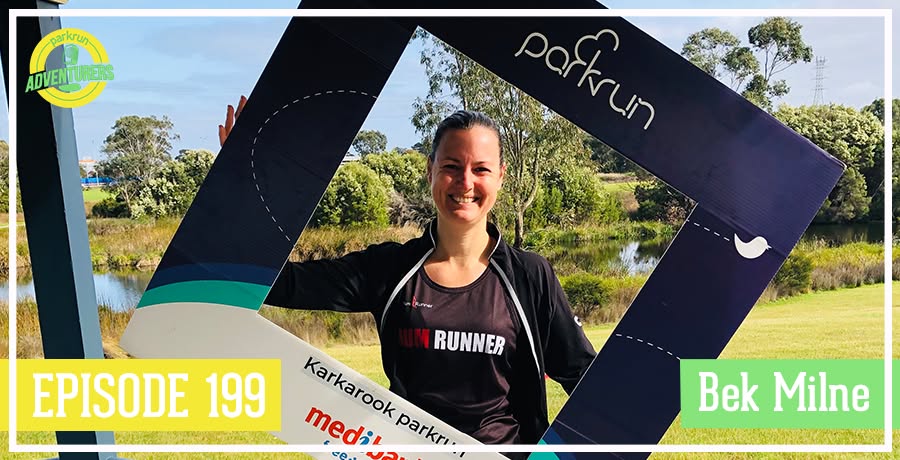
Episode 199 - Bek Milne
Episode details · · 144 speaker turns · sound cues from context
Enhanced transcript
Speaker names appear where they could be established with confidence. Others are shown as “Unidentified speaker”. Sounds that are not speech — music, laughter, people talking over each other — are written in [square brackets].
Episode 199 - Bek Milne · 2020-04-24
Enhanced transcript — Produced by an automated editing pass — speakers named, sound described, segments marked. NOT yet checked by a person.
Speaker names appear only where they could be established with confidence; others are shown as “Unidentified speaker”. Non-speech sound is in [square brackets].
Source: https://log.5kadventures.net/transcripts/ep199.html · The Adventurers Log · An independent project, not affiliated with or endorsed by parkrun.
Welcome
Melissa Erbacher: Welcome to episode 199 of the parkrun adventurers Podcast. It's quite a beautiful number, really, when you think about it. At least I'm fond of it anyway. Joining me this week, we have got the wonderful Mr. Scott Watkins. Scott, welcome back to the pod.
Scott Watkins: Thank you, Mel. I'm stoked that I got a repeat invite to come back and host. It's a pleasure to be back here and get to talk about parkrun because we're all missing it. So an opportunity to reflect on it and talk about it is very much welcomed. Thanks for having me.
Melissa Erbacher: You're welcome. I figure, you know, we can have you at least once a year and I already had you for 2019. So may as well have you on board for 2020. You did a good job.
Scott Watkins: Okay, I better make it a good one. This is my go for 2020.
Melissa Erbacher: Yes. Well, if you want another go, you better make this one a good one. Anyway, no pressure. Okay, no pressure.
Scott Watkins: Well, it's really great to be back here. So how have you been since we spoke last week?
Melissa Erbacher: Oh, it's, well, you may have noticed that there was a bit of a gap between episode 198 and 199. I did mention in the last episode that the pod wouldn't be weekly. It would be a little bit more sporadic or ad hoc, as it were, as things came up. I'll be honest with you, Scott. I actually had a pretty average week, less than average week last week. actually. And I was not in my normal happy-go-lucky, feeling positive, want to chat about parkrun kind of mood. Not because of parkrun or anything in that respect, but just I wasn't in a good place with all the other events of the world going on, I guess, at the moment. So because I wasn't in that frame of mind. I didn't want to bring everybody else down with me. So I figured not having a pod last week would probably be the best avenue to take.
Scott Watkins: Well, I think a lot of people out there can empathize with how you're feeling. I think there's a lot to be worried and down about at the moment, unfortunately. So I think people can understand where you're at. But there is an opportunity to try and bring a little bit of sunshine and a little bit of regularity to people. And I know as a listener, I look forward to these. So I'm sure, without a doubt, there'll be people that will be happy to hear your voice again. So this is great.
Melissa Erbacher: Well, I hope so. And yeah, look, it's nobody can be one of those happy people who's always up all the time. That's not sustainable. It's not probably healthy. Sometimes you just need to be in the feelings and get through those feelings and not try to put them all under rugs and whatnot. And yeah, that's just where I was last week. I just had to be in the feelings. And I am happy to be here though. I'm looking forward to having a bit more of a positive conversation about things in general. I know lots of people are always focusing on silver linings. And to be honest, especially given the fact we're in a global pandemic and you do get sick of all the bad news and the death counts and all the terrible things happening. And I appreciate some people are always just like, oh yeah, but Look at all the wonderful things that are happening and being all zen about it. And to be honest, I can find that almost equally annoying as all the doom and gloom stuff. There needs to be a nice, happy or, you know, sometimes up, sometimes down, medium. Not necessarily a happy one, but, you know.
Scott Watkins: Yeah, and different people react in different ways and also at different times. All of us, I think, at some points are a bit more down and sometimes might need some of that relaxing stuff, but it changes. So I think it's really great for you to acknowledge that, yeah, you weren't in a great place last week, but that this place you are in a better one. So well done.
Melissa Erbacher: Yeah, and I don't want anyone to be worried or anything like that, you know. That's not where we're going with this. But, yeah, just wanted to put it out there that sometimes it's not all happy. Anyway, I feel like I'm going around in circles. So you know what we used to do.
Scott Watkins: We're going to talk about some parkrun things now. And what did you used to do, Mel? Yeah.
parkrun news bulletin
Melissa Erbacher: You may remember back in the day, Scotty and I used to have this segment which was about the news, and I would delight in finding the most random things from the running world to use in the news briefs. And it was short-lived. It was only a few months that we did the news because, as it turned out, that was a lot of work every week for me to do, to write and present the news. So we stopped at any end. But this week I kind of delegated a little bit inadvertently by saying, hey, if you've got any ideas for the podcast, Scott, just bring them on down. And you did. You've collated some news from around parkrun Australia.
Scott Watkins: I did indeed because I used to enjoy that segment too. So, yes, when we talked about this, I thought I'm going to report back on what's been happening around the trap. So... we cue intro music and here's some news from around parkrun yeah I'm gonna have to get some kind of and put it in well that was pretty we'll see if we'll see if I can manage so Our friends over at Mount Barker parkrun in South Australia, who get a lot of mentions on this show, by the way, they've been hosting an Un-parkrun Day bingo video show each Saturday. In Victoria, Karkarook parkrun have still been publishing their regular news reports with lots of updates from locals and what they're doing and where they're running. A little bit further across Melbourne, Chelsea Bicentennial parkrun. They did an iSpy activity and they were asking people who they will look forward to seeing when parkrun comes back. So it was things like that guy in red who always beats me home or something like that. Heading up the coast, Newy parkrun. They've started on their Facebook page what looks like a popular series of profiling videos the other events in their self-proclaimed region of runners. So they're putting a bit of a description of the course and the history of the event and then getting people to share their recollections of visiting it. Heading back down again to Victoria and Albert Melbourne parkrun, where I may have had some involvement in making what was a very challenging crossword that no one could actually solve, but it did take a lot of time for some people and I think they enjoyed it. Following on from that idea, back up in New South Wales, Dubbo parkrun did a crossword as well. but theirs was much more accessible. So if you're wanting to ease yourself into parkrun crosswords, check out Dubbo's Facebook page. Now, also on Facebook, there's the Aussie tourism page and people there have been doing the sign challenge. So they've been taking photos of street signs and spelling out words with the first letter of the street name. So spelling out things like parkrun or their event name. So a bit of running around and photo taking. And also on that tourism page, there's been a bit of activity where people have been posting random photos from events and getting others to name the course. So they've got to guess where that photo is from. And that's pretty, pretty popular too. And I think in reviewing them, there's definitely a lot of courses running beside water. So it can sometimes be a little bit confusing. Then moving internationally, international parkrun news parkrun has enabled the customisation of some of the parkrun apricot event shirts up to this point they've been limited to you had to choose the the name that went underneath parkrun as as one of the existing events but now instead of just being limited to actual events you can make up your own so there's uh people out there putting you know my home parkrun or my backyard parkrun or things um Now, unfortunately, the stocks of the international shirts are very limited at the moment. So parkrun Australia hasn't been promoting this heavily, but do keep an eye out for it if that improves. But I have seen some pretty interesting ones out there already where a few people have been quite inventive. And one of the ones that really took my eye was Missing parkrun. And I think we can all feel that at the moment. So that's the news from around the parkrun world. Mel?
[other]
Melissa Erbacher: I'm going to give you, I'm rating this. I'm sorry. I didn't mention that I was going to rate this before you started, but I'm going to give you a solid seven and a half out of 10. You lost points for not using a news voice. You've got an excellent voice for broadcasting and elocution and all that sort of thing, but you didn't there's something nasally about newscasters where they talk through their nose a bit more and you didn't do that okay yeah lost points for that um yeah pretty much those are the only points you lost good wrap up there I a lot of those things that I did know were happening not all of them though I'm keen to learn more about this I spy activity and I thought that was a nice way you know for people pretty much just to tag everybody that you miss her in parkrun and have a bit of a tag-a-palooza. So well done to Chelsea Bicentennial for that. I have been tuning in to Mount Barker's Un-parkrun Day Facebook Lives. Every week I get it wrong what time it's going to be because they're half an hour ahead of us or behind us.
Scott Watkins: Behind now.
Melissa Erbacher: See, I can't even get it right now.
Scott Watkins: Yeah, it's gone. Well, it's changed now.
Melissa Erbacher: Every week I've been showing up at 10 a.m. in Queensland and going, oh, no, that's right, it's 10.30 here. But at least I've been half an hour early and not half an hour late. Yeah, anybody wants some proper parkrun day warm fuzzies, head along and tune into that at 10am South Australian time on Saturday mornings.
Scott Watkins: For the international listeners, the problem with Queensland and South Australia is that one does daylight saving and the other doesn't. So South Australia actually moves from behind Queensland to in front of Queensland in time, which is quite a weird thing to happen. One of the... the sort of quirks of Australia's lack of solidarity with regards to daylight saving.
Melissa Erbacher: Yeah, it just messes with my brain. I'd like to talk a little bit more about the apricot because I have purchased an apricot, a new apricot. I already had one with my home parkrun on it.
Scott Watkins: What did you get?
Melissa Erbacher: I don't know if I want to reveal it until it arrives. Maybe I want to reveal it in all its apricot glory. People can have a guess at what I might have put underneath parkrun on my apricot. So I'm going to leave that as a surprise for future revelation. But so you've seen one that says missing parkrun. Did you order an apricot, Scott?
Scott Watkins: Well, it was actually quite a funny story because it was early one morning a couple of weeks ago when I woke up and I grabbed my iPad and I was flicking through Twitter, as you do, and I noticed the UK tweeting about that these were available and they said that the international sizes were limited. So I quickly clicked through to the store and had a look and saw that there were sizes that were... both myself and Joanne would select. But this was still 7am and suddenly I said to Joanne, I'm waking her up and I'm like, Joanne, Joanne, you've got to wake up. And she's like, what? And I said, you've got to choose your imaginary parkrun name. And she's like, What are you talking about? You've got to choose the name. We've got to get it on the shirt. She's like, I don't understand. What are you talking about? And for those of you that know Joanne or know of Joanne, mornings aren't her thing. So she was very confused. And I was like, what are you going to have? and then she just sort of thought for a little bit and then she just said keep left and uh and which I thought was very clever because again if you know Joanne she's is somewhat known at um at Albert Melbourne for using her ability to project very loudly to encourage people to keep left and yeah so she went for keep left And so I then went for what my dream imaginary parkrun is, which I've mentioned here before, and I wrote Seoul underneath it. And that was me being wishful about there one day being a parkrunner in Korea.
Melissa Erbacher: I don't think that's wishful. I think that's an exercise in manifesting right there, you know yeah you you are putting it on a shirt it's going to exist one day and you are going to be the person who had the first shirt that had it although it probably isn't going to be called Seoul parkrun no I mean a city of 25 million people
Scott Watkins: But the way things are going, it might be the only country in the world where you can go for a group run soon anyway. So, yeah, but then we sort of got up and I realised through the process, like as it is with ProDirect, the postage is part of the price. So there's no... extra postage with additional orders and then I Joanne and I were talking and we thought oh we thought of some more to do and um and so we actually ended up ordering five because we got a little bit carried away so um so we both got one with our with our name on it Joanne got one with um Joanne has her own podcast that she it's a podcast for english um high school students about about texts and things and her her podcast is called call me Watkins and so she got a call me Watkins one under that and then I I had the idea that I was like I wrote Seoul in English and I should write it in Korean so I I went back in and ordered another one with Seoul written in Korean underneath. And that one took a little bit longer to process. I actually only got the order confirmation for that today because I thought maybe they're like, oh, no, we have to get the extra dies out of the machine or something like that to be able to print Hangul.
Melissa Erbacher: If they don't understand what the language is, they might have had to check that you weren't writing anything rude.
Scott Watkins: Yes, that's a good point. I didn't think of that.
Melissa Erbacher: Very cool. And so now you've practically got one for every day of the week.
Scott Watkins: Well, we already had short and long sleeve ones with Albert Melbourne on them. So, yeah, we do. We'll have, I think, like about eight parkrun personalized shirts between the two of us now or something. So, yeah, we did have one extra idea, but we drew the line at placing another order.
Melissa Erbacher: You can never have too many.
Scott Watkins: Yes.
Melissa Erbacher: You know, all the apricot range is supporting parkrun as well. So you're doing parkrun a favour.
Scott Watkins: We are, we are. So we've got an interview this week where we can actually talk about parkrun and some of the parkrun stories. So why don't we head on over now, open up the phone lines and talk about parkrun.
Melissa Erbacher: Before I introduce our guest, I'd just like to give everyone, in particular our international listeners, a little additional context as to why having her join us this week is particularly special. This coming Saturday, the 25th of April, is Anzac Day. For those listeners not familiar with Anzac Day, here's a super brief overview with information I've taken straight from the Australian War Memorial website. And if it piques your interest and you want further info, I would strongly encourage you to head to the site, which is www.awm.gov.au. So... Anzac Day, 25th of April, is one of Australia's most important national occasions. It marks the anniversary of the first major military action fought by Australian and New Zealand forces during the First World War. Australians recognise the 25th of April as a day of national remembrance, which takes two forms. Commemorative services are held across the nation at dawn, the time of the original landing, while later in the day former servicemen and women meet to take part in marches through the country's major cities and in many smaller centres. Commemorative ceremonies are more formal and are held at war memorials around the country. In these ways, Anzac Day is a time at which Australians reflect on the many different meanings of war. Now, like many, many things at the moment, the COVID-19 pandemic has of course disrupted plans for Anzac Day ceremonies that would have been held across Australia and New Zealand. And as the 25th of April falls on a Saturday this year, it was also going to coincide with parkrun Day, which of course in the current circumstances is also not going to hit. While the majority of parkrun events would likely have gone ahead as normal, it is worth noting that a number would actually have been cancelled, out of deference for Anzac Day ceremonies to be held at parks in or around their courses. Ultimately, very sadly this year, neither is to be.
Interview Bek Milne — Queanbeyan parkrunner; serving member of the Australian Defence Force with 20+ years'…
Melissa Erbacher: Our special guest is Bek Milne. She's a Queanbeyan parkrunner and she is also a fifth generation member of the military with more than 20 years of service under her belt. Bek, welcome to the parkrun adventurers podcast.
Bek Milne: Hello.
Melissa Erbacher: Thank you so much for joining us. It's a big week and as well as continuing to claim parkrun as a casualty, the COVID-19 pandemic is impacting on our Anzac Day this year. So things are all a bit different, but we wanted to have you along to find out, you know, what you might be doing, what other military people and vets might be doing and what you might encourage other people to be doing this Anzac Day, because it's sort of a similar boat to parkrun in that it's not going to be normal.
Bek Milne: I think it's going to be a different year, but I think as Aussies we're pretty resilient and we'll just come up with a new plan for this year. I think we're all a bit disappointed. It's our first Saturday parkrun on an Anzac Day, so it was going to be special, but I think we'll make it special in our own way.
Melissa Erbacher: I think we will, definitely. So now let's take it back to the start of the story a little bit. We don't have to go into this in too much detail, but you're a fifth generation military, so I'm assuming you've been rather exposed to that lifestyle your whole life. Did that play any kind of part into why you joined the army yourself?
Bek Milne: It did from a family point of view. So grandparents, great grandparents, two uncles, etc. However, as a child, so to speak, I didn't have too much to do with those people. I just knew they were there. I got to hear the stories. I got the history. And then obviously my mum growing up in an army family, she had plenty of stories about having been the army brat, as she calls it, and moving around. And then, in fact, she did the opposite. She left me in one high school, one primary school, and didn't move me around. And now I'm doing the opposite to my daughter. So, yeah, it was from a young age I got to understand the importance of service.
Scott Watkins: And can you tell us a little bit about what sort of role you've been in or what some of your highlights have been?
Bek Milne: I think, so obviously 20 years in, I just ticked over and I've moved around the country doing various roles, but my primary role is in communications. So I enjoy that opportunity from both a technological point of view or technology point of view. as well as the networking and the human factor. So I've been really lucky to get to meet a lot of people, to work with a broad demographic of both my services and some overseas colleagues, and just been really blessed with lots of opportunities to professionally and personally develop.
Melissa Erbacher: So I'm going to make an assumption here. You talked about moving around, perhaps not so much as a child, but now I guess your family might have moved around a bit more. parkrun is one of those beautiful things that It's so many places now that when you move to a new place, you can go and get involved. Has that played much of a part in, you know, you integrating into new communities and things as you have come across new places of abode along the way?
Bek Milne: Oh, 100%. So as soon as we found out we were moving, the first thing you jump onto is obviously, you know, the tourist tools or the parkrun website and go, where's going to be my closest parkrun? Where's my new parkrun home? So moving to our new area, we were lucky we sort of had seven or eight around us and it was like, oh, now we'll have to trial them all. So it actually made it part of the adventure that when we moved to our new location, we actually started planning out on the calendar which order we were going to start trialling new parkruns and where we might find home and who we were going to meet and, you know, where's the closest coffee shop. And to be honest, it actually helped us learn our way around, which was good. So, you know, even when I talk to my daughter now, she'll be like, oh, is that the one near, you know, parkrun A, B or C? So it's actually a really fast way to integrate yourself into a new location, whether or not you're military or otherwise, I'd imagine. Yeah.
Scott Watkins: And it was Bibra Lake over in Western Australia that was your first event. Is that correct?
Bek Milne: Oh, my parkrun home. Yes, Bibra. So when I had decided I was going to give this a go, I found out that I had a parkrun less than 4km from home and I went, oh, that's going to be home. It was flat. It was around something pretty. It had a playground at the end and parking was easy. So I was completely blessed. And, yeah, Bibra's home. I guess it's almost like our military where we say we've got two homes, where you grew up or where you enlisted and then where your mail goes at any point in time. I think parkrun's got two. You've got your first or your home and then, like, where you visit or where you tourist. So Bibra will always be home for me.
Scott Watkins: And it was Christmas Eve was your very first event. Tell us about that. What made you think, oh, it's Christmas Eve, I'm going to go and do this free five-kilometre run?
Bek Milne: Yeah, so I was coming back from injury with my knee and I was like ready to start something. To be honest, I hate running. It's really not my thing. Anyone who finds out I'm a parkrunner who knows me laughs going, what are you doing? I was reading a post from a friend I had from in Perth. She was kind of in Victoria talking to a mate in Queensland. Gotta love the military. And she recommended this parkrun thing. And I went, oh yeah, why not? And I looked it up and I thought, well, no time like the present. What I wasn't ready for was the dress-ups. I was completely blown away by my first event and it being in dress-up, but I was hooked. It was just, it just ran. It was everything that I'd read on the website turned up in front of me. And yeah, so Christmas Eve and we went, then we did the New Year's Day double.
Scott Watkins: You did your first four parkruns in the first seven days. New Year's Eve and then the New Year's Day double. That's remarkable.
Bek Milne: I think you've got to strike while the iron's hot when you think you're going to go back to running.
Scott Watkins: Your rate of parkruns must have been like the highest in the world at that point in terms of parkruns per day of your running career. So how long before, like after you'd found out about parkrun, was it before you actually went along on that Christmas Eve?
Bek Milne: I think a couple of days. I've got to really strike when I make a decision. I was very lucky that it was coming up straight away. So I think it was a couple of days from reading the post, looked it up on the website, said this is what we're doing, dragged along the family and off we went.
Scott Watkins: And you pretty much didn't miss another parkrun. I mean, I'm not going to read through all the dates, but just looking at your record, it was a long time before there was a Saturday that you missed one.
Bek Milne: Very true. So the bonus of I hate running, but I do have a competition side. And then once I found out about all these unofficial clubs and the fact you can get these gold, bronze, silver obsession awards and go into Google Chrome and get an icon, it's like stickers for adults. So I had to get my obsession tick in my browser. But no, it really rapidly became part of our routine and a really good way to start the weekend.
Melissa Erbacher: So your family are all involved? Your hubby and daughter go along too?
Bek Milne: Hubby voluntarily, child not so much. So we... We took it on as a lesson in resilience and goal setting and team building for Nick. It was never about the times. So we did a lot of walking, hopping, skipping, running backwards, counting dogs, finding out the name of dogs. There was many things we did for that first couple of years to get that seven-year-old interested. And then it became routine. So then it wasn't It was never a fight, but there was always sometimes the enticement of pancakes or waffles or whatever it might be. But we've been able to see a real build in Nick as a little human that, you know, when you're seven and you can run 5Ks, is really school carnival much of a challenge anymore or not, you know, is getting out there and doing these things just helps them build as little people. So we found it really beneficial to our family.
Scott Watkins: And so it was 2016 that you started but then 2019 that you moved over to Queanbeyan, is that correct?
Bek Milne: Yeah, so at the start of last year we moved over to Canberra and, yeah, sort of had to find our new homes.
Melissa Erbacher: And you've been participating at Queanbeyan parkrun, but that's not close enough to where you live.
Bek Milne: I know, that sounds ridiculous. I think it's all of a 12-minute drive. We were so spoiled with the Bibra one. I think there's like two sets of traffic lights and like four turns to get to Bibra. And we sort of got here and go, what do you mean I have to drive 20 minutes to parkrun? Yeah. I think the other thing we looked at was we were living in this really beautiful suburb that we were quite enjoying, you know, going for our own runs around and wondered Would another bunch of crazy people like to join us? We noticed our suburb was uniquely on the Alphabeteer Club of not having too many options. That's after we'd already driven to Jindabyne to get a J. So we were looking at our own journey, whether or not we'd want to start a parkrun. Community service is big for myself. Being a Girl Guide leader and an SES volunteer, it seems to make sense to start a parkrun.
Melissa Erbacher: Because, you know, you haven't got enough on your plate, have you?
Unidentified speaker: Yes.
Bek Milne: I think when you're doing those things where you're giving the gift of your time, you only get good things back. So I think if you can go away that, yes, you've given your time, but what have I gained from that day that those interactions with those people, people I might not normally meet, extending my skills into something I might not normally do, exposing my daughter to other parts of life. So I think you can only win by being part of the volunteer group.
Melissa Erbacher: And how are you going with the plans for – it's going to be in Jerrabomberra. You mentioned it's going to be in your suburb and you're looking for a J. Did I pronounce it correctly?
Bek Milne: Jerrabomberra. Jerrabomberra.
Melissa Erbacher: But it's okay.
Bek Milne: It just turns into Jerra. It takes you longer to write out your suburb than it does your address when you fill in the forms. But, I mean, not only have I already declared that I hate running, I hate hills, but now we're going to go running up a mountain. So not necessarily doing this right. And it's on trail and I'm a klutz.
Melissa Erbacher: You're going to make other people do it as well.
Bek Milne: That's right. I'll stand at the bottom and say have fun. So, yeah, uphill, on trails, I'm a klutz and running. So it's completely against all the things that are maybe my comfort zone and maybe that's why – I also think it's a good idea to go and do things that, you know, isn't my normal.
Scott Watkins: And so do you have a team together? Like how far along in the planning process for the event are you?
Bek Milne: We've got enough to start sort of our core team. Hopefully I've got enough mates and God help me if they listen to this podcast before I ask them. You know, a few people to start that, you know, first couple of months worth of filling out the roster. We're pretty lucky because we're an out and back. We won't need heaps of marshals. and all that sorts of things were pretty straightforward. But we're hoping, as I said, I'm a girl guide leader, so I'm hoping maybe some of my girls and their parents will come down to do part of their service. We've got a huge school with a wonderful defence demographic, you know, less than a K from our start line, so I'm hoping maybe a few of the kids and the other veterans might like to come along. So we're hoping we'll fill the roster pretty quick once people find out that we're kind of fun even though it's uphill.
Melissa Erbacher: You've got the benefit of being very connected, I guess, in your community already with all these other sort of facets of your life that you can roll into parkrun and just enrich everyone's lives a little bit further, I think.
Bek Milne: I'm hoping. My mates call it a cult. They think I'm some sort of cult leader. I'm trying to discourage the cult bit.
Scott Watkins: I think a lot of us can identify with that.
Bek Milne: We've got a group of us on a social media chat app, and we sort of by Wednesday, Thursday, I'm starting to itch going, which one are we picking, guys? Where are we going? Because we're sort of spread out around the area, so we try and move around a little bit depending on – who's not necessarily keen that week um so you know such and such isn't isn't really up for a run we'll go to the one you know just down the road from them so they've got no excuse so I think it's a really good opportunity to catch up with people you don't see as often as you'd like um and and for a good reason without having to sort of sit and look across the table at each other and consume calories instead you can can burn them instead so
Scott Watkins: So when you talk to other military people about this cult, what sort of things do you say to them that might appeal to them? What do you tell them about parkrun to try and lure them in?
Bek Milne: I think what impressed me so much, as I said, when I went to Bibra is it was what it said on the box. I read the website and said, this is what the sequence is going to look like. This is where you're going to go. It's going to be the same thing every week. You can prepare yourself and run your own show. And that's really appealing to most military people. I want to know the drill. I want to know the start time. I want to know what's expected of me, but that I can go and do it side by side with people. And I can either compete or not compete. And then someone's going to send me this, you know, adult sticker in the form of an email to tell me how I did. So I think there's lots in it for the veteran community on so many levels.
Melissa Erbacher: Personally, have you got a very good success rate? Like I know most people who get into parkrun, you know, we drag all our families and friends and we sprout off to people at work about it. Have you managed to recruit a lot of your colleagues to come along?
Bek Milne: Well, I think I've probably got at least 10 new ones since I got to Canberra, which I'm calling a pretty good strike. I think that's a pretty good strike rate. There's been a few others that I think have secretly attended but haven't told me yet. But I'm slowly trying to put some influence out there, especially when people know who've known me for a very long time and that I hate to run, that if I find this appealing, it can't be all that bad. And they're normally much fitter than I am.
Melissa Erbacher: hopefully I'll find more as I as I move around I'll recruit is um is one of the the things that you might use to sell it that um the vets can actually join we've got a club for them don't we through through parkrun that they can join up to when they register have you used that as a bit of a recruiting tactic
Bek Milne: I'm not sure necessarily all military people want to be then identified. Some of them like to hide and lurk in the darkness. Some of them probably even got different names on their barcodes. That's probably not even who they are. However, I do know and I know I've changed my home club. You can do Veteran Sports Australia so you can change that club and make it so that when it When you come up on the results page, you've got that next to your name. However, there's just as many people with, you know, Masters Athletics or whatever else is part of their world. So I don't think vets necessarily need to have a huge identification, but it's definitely there and available if people would like to put that on their parkrun profile.
Melissa Erbacher: I'd be just as inclined to let them know that there's a Derek Zoolander Centre for kids who can run with it.
Bek Milne: I want one of those shirts. I've seen them so often. I think they're awesome.
Melissa Erbacher: And we accept everyone. Oh, thank you. You know, anyone can join the Zoolanders.
Scott Watkins: And so, Bek, what about this year? Anzac Day, as Mel said at the start, is going to be a bit different this year. How will you be spending it?
Bek Milne: So it will be a bit different, but I think I'm going to try and keep as much of the sameness as I can. So, you know, a normal Anzac Day is a dawn service at somewhere that, you know, either directed by work or we choose to go local. Last year I went to the Jerrabomberra dawn service. It was lovely. Then I normally spend some time with my girl guides. So last year we went into Queanbeyan City and the girl guides were part of the contingent that went to the memorial service and listen to the ceremony there. You know, a gunfire breakfast after dawn service is always lovely if you've gone to one of the RSLs. So I think you can still choose to commemorate. So for us this year, the difference will be we're going to do the driveway dawn service that's being supported by the RSLs and ABC, et cetera. So we've made some lanterns to go out the front. We're going to put our projector up and play some YouTube stuff meaningful footage up onto the roller doors and have our radio cranked to ABC to listen to the service and the last post and sing our national anthem. And then hopefully I'm going to convince my daughter to cook pancakes or something when we come back inside. May as well use this to buy varnish. And then this year, our girl guides who normally do their Anzac Day badge, we're running a virtual camp for that. So over the Friday and Saturday morning, the girls will still work through that program. We'll just do it via video chats. and activities in our own homes. So I think we can still replicate it best we can, but it's not quite the same. I mean, that's more of a family approach. Those who normally head to the city on the train in the morning, go to the service, then hit one of the pubs or clubs and play two up and spend their day at the RSL, I think this year is going to be very, very different of how people might spend that time. And we'll just have to make sure we're there for each other.
Melissa Erbacher: Yeah, it'll be interesting to see. We're also going to be doing the driveway service. But in my head, I kind of felt like everyone goes to the end of the driveway and sort of faces out to see who else is down the street or on the street and things like that. Cool, how that's going to play out on Saturday it'll be interesting to see but I do like the idea that we can all commemorate it in in different ways and still pay our respects as it were it's it's a different time that we're living in at the moment which is very surreal in many respects but I do like that we can still be connected this way and still yeah still pay our respects and
Bek Milne: I wonder whether or not maybe it'll take some of the barriers away. So in terms of putting the different spin on it, you know, where normally, you know, if you're the family with a young baby or it's, you know, a long distance to travel or you don't feel that you've got the right things to wear, if all you need to do is jump up just before that dawn service time and you can leave little ones in bed but you could still go out and be part of it, Maybe it's an opportunity to take barriers away rather than thinking that we're at a loss, that we can't go to our cenotaph and we can't go to these big ceremonies anymore. So maybe we can flip it and there's something to be gained from it instead. I don't care if people turn up in their pyjamas on their driveway, if it means they've come out to think about it. But if they want to come out in their jeans and their puffer jacket and that's how they want to do Anzac Day, I think that's perfectly fine too.
Scott Watkins: Yeah, so on that, Bek, why is it important for you as an active military person or for military veterans, what is meaningful to you when other members of the community get involved in Anzac Day?
Bek Milne: I think because – kind of difficult to answer. We're not sounding like a goose. It truly shows that you've thought about us that day, that you've reflected for a moment that what it might be like. What did it sound like? What did it feel like? What did it feel like to lose someone? What did it feel like to be there? Yeah. And the more people we can have on that journey, that one day a year, it feels good as a service person to see other people out there. We're not looking for high fives and accolades or anything. You certainly can't high five during COVID. But there is this community spirit that we get to witness when we stand together and commemorate Anzac Day. And I think... Yeah, I think just sharing that with our community, the people that we do it for, it's just a chance to see that in action.
Scott Watkins: That didn't sound like a goose at all. That's a very, very honest and very well-meaning answer. And I think a lot of people can relate to that. So thank you.
Melissa Erbacher: I do like as well that you mentioned that, you know, potentially people participating at their own homes is going to be a massive removal of the barriers to participation. Like parkrun's always been about removing the barriers to participation, but this could be the largest turnout to dawn services in history.
Bek Milne: I'm hoping someone's going to put a drone up or something and maybe capture, you know, like on Earth Hour when they see all the lights go on or off, maybe there's that chance that, you know, people take these, I don't know if you've seen the milk bottle cartons, people are doing that and putting poppies on the side and they're going to put them on their driveways as their little part of their service, like lighting a candle. And I'm wondering whether or not, you know, drone footage over a suburb or something, we're going to see all these people that we don't normally see. going out there and doing it their own way. Or, you know, I know some veterans who don't call themselves vets because they served in the military but they didn't deploy and they don't feel sometimes that they fit at Anzac Day because their medals are either long service medals but not campaign medals. And I'm wondering whether hopefully maybe there's a few more of those people who might go out to their driveway and remember that they served regardless of if they deployed or not. And maybe that's another barrier we can take down this year. So I think we can see the positives in this. We're Aussies. We're going to bounce back. Next year will be different. But I think there's some huge wins that we can have this year if we do it right.
Melissa Erbacher: It's absolutely going to be a historic day anyway. Yeah. And it's also a parkrun day. It's not simply Anzac Day, but it's a parkrun day. It's one of those days that there will be a lot of parkrunners still out there, still going through.
Scott Watkins: Yeah.
Bek Milne: We're going to finish up our virtual camp and we're going to be out there doing our eight o'clock run. So definitely on the card for us.
Melissa Erbacher: So that was my next question. It's been five weeks, almost six weeks now since we've had a parkrun in Australia. What are you doing with your Saturdays in general now? Just the normal parkrun days that are not normal because there's no parkrun.
Bek Milne: Well, I think ACT, we got that little bit of a heads up. I think the episode you did where those of us who've been doing the bushfires and smoke, we got shut down for like seven weeks as it was. So we sort of had a rude shock. What do you mean I'm not going to be able to make my gold obsession award on the Chrome browser because we've been shut down? So I guess we got like a pre-trial run of not having parkrun. However, we've kept it. We've made new routes around our suburb that start and end at our front door. We did hills last week, bad choice. So I'm going to choose something flatter this week. But we've kept the routine. I've got a virtual run club that I belong to called Mum Runner and she sets us a goal every Saturday morning called Park Fun. And you can earn six points if you start on time, run 5Ks, wear your parkrun merchandise, carry your barcode and run through a park or something pretty and take a selfie while you're out there. So, you know, with my competition edge that I've got, I want my six points. So we start dead on Strava, 8 o'clock time. And I think it's been good for us to still have that to look forward to, that I still go and share it in the same places with my parkrun community. And... Yeah, I think we're still parkrunning even if we're not at those venues. However, I know some people who'd like to have a sleep in too.
Melissa Erbacher: Also a valid life choice, I'll be honest, except for the very first week where I participated in the big parkrun quiz. Well, no, I can't say I've slept in because I have two very small boys that don't allow us to sleep in. However, I have stayed in bed past the normal 7am time where I could and not got out of pyjamas at any point early in the day. So, yes, there's, yeah.
Bek Milne: Well, maybe if I wasn't chasing my six points, I would stay in bed too, but I've got a competitive streak.
Scott Watkins: I've still been trying to run, but I've definitely slept in longer than parkrun's set-up time at least. So I have had a bit of a lie-in.
Bek Milne: And I think it's weird for a bunch of volunteers to not have anywhere to go on a Saturday morning.
Melissa Erbacher: Yeah, that's something that I mentioned at work last week. That's something that's been really almost more prevalent to me than missing the event and missing the chance to participate as a parkrunner is I've missed the volunteering and I've missed the conversations with other volunteers and Yeah, the gift that is volunteering, it's been this big gaping hole in my life and I'm looking for other ways where I can give to my local communities while in isolation. It's hard, isn't it?
Bek Milne: Yeah, it's... It's a bit of a quandary, parkrun Coffee Shops, I think, is so after the bushfires, there was a big campaign down our way for the travel with an empty esky. So to go once the towns were sort of back on their feet a little bit to go and travel and visit their shops and have lunch and dinner and blah, blah, blah. And I think we're almost going to have to do the, you know, travel to an empty coffee shop once we're allowed back out to parkrun and make sure we're back out with those small businesses that are used to seeing us on Saturday mornings.
Melissa Erbacher: I'm sure they're not going to know what's happening.
Bek Milne: I think they'll be pleased to see us.
Melissa Erbacher: Well, there'll be people hugging them that they don't know.
Bek Milne: I'm pretty sure. And I hope we can go back to that and I hope all those businesses are still there when we get to go back.
Melissa Erbacher: Yes. Yeah. It's one of the great unknowns. True. Bek, thank you very much for joining us this week. It has been lovely talking having a little bit of insight into your parkrun world. We can't wait for parkrun to reopen and for Jerrabomberra to start. I'm sure when it happens, you are going to have a league of adventurers heading to you to grab their J, but also just to relish the hills and the course that you've got set out for them. Have a wonderful ANZAC Day this weekend. Thank you for your service on behalf of all adventurers and, you know, the Australians.
Scott Watkins: And all Australians, yeah. Thank you for sharing your story, Bek. It's been really wonderful to hear it and very authentic.
Bek Milne: Thanks, Mel and Scott. I've had a really good time.
[17 seconds of audio that could not be transcribed]
Roving reports & the Channel 5 News crew
Melissa Erbacher: Now, it's been a while between roving reports, and we don't technically have any because nobody's roving at the moment. However, a few weeks ago, just before our last episode went out, we did receive some audio from wonderful people who is in the UK, which really cheered me up when I listened to it. And despite the fact that it was a few weeks ago, I thought it was worthwhile playing anyway, and hopefully it brings a smile to your faces too.
Pippa: Hi, parkrun adventurers, it's Pippa. I'm checking in from the UK. I've got on my brilliant Ugly Christmas Singlet because it's the first day it's really been warm enough to run for me, who's a bit slow, in a singlet. I'm running at parkrun time in Australia. I'm thinking of you all, wishing I was out doing some other running, but I've done my 5K Australia time, so I'll do it UK time in a little bit. Looking forward to seeing some of you on the big quiz. And hopefully we'll be back at parkrun soon. Bye.
Melissa Erbacher: Thanks so much for sending that audio in, Pippa. It's always lovely to hear from you, especially when you are flying the flag of the Ugly Christmas Singlet in the Northern Hemisphere during your short but I'm sure very sweet summer. Scott, earlier we were talking about the fact that everything hasn't been sunshine and rainbows lately, but I do know that there are a lot of event teams out there doing different things in the absence of parkrun at the moment. And you came up with a bit of a fancy new segment idea. Do you want to take us through that?
Testing Positive
Scott Watkins: I did indeed, Mel. I'd like to introduce Testing Positive, a new segment on parkrun adventurers where we try and think of positive things that we've been hearing from around the parkrun community or the community in general.
Melissa Erbacher: Pun intended.
Scott Watkins: Pun intended. So, yes, I thought we can just list a few things, throw them out there. I've got a list of things that I've thought of, but I'll give you a chance to throw a few in as well. So to start things off, the first positive thing that we've been doing is doing some Zoom dinners. And we've actually been doing some joint cooking nights with a few of our friends. And there's a local restaurant here, uh, near us in, uh, in South Yarra that is, um, doing this thing where they sell a box of ingredients that is themed around a particular country. And in the box, they've got all the ingredients prepared for three meals. So you can order it like, so we're getting a couple meal, but there's enough food in there for us for three nights. And, uh, then you can watch how to cook the meals on YouTube. And a couple of nights a week, the chef's on Instagram doing a live session, answering questions about how to cook the meal. And so we've been doing it with some of our friends who, so we have the laptop sitting there on the kitchen bench, watching the YouTube video. And I had another device sitting beside it with Zoom on and we were talking to our friends and they were cooking at the same time. And so we cook it all and then we put the other device on the table between us and sit there and have dinner together virtually. And yeah, it's been a lot of fun. This restaurant in Israel and then last week was Korean. And this coming week, which I'm picking up tomorrow, is Mexico. And then I think we'll go to Peru after that. So yeah. It certainly seemed to be very popular at the restaurant. There's a lot of people picking up the boxes and it's definitely been fun putting that angle on it by doing it with our friends.
Melissa Erbacher: Is this something that the restaurant offered before or is this an adaptation that they've made in the new climate to still service customers, I guess?
Scott Watkins: Yeah, I think it's a pretty, it's called Atlas, the restaurant, and they're a pretty fancy restaurant. And I don't think they even did take away beforehand. It wasn't so. I think they've tried to pivot entirely. And so rather than trying to do something that they don't really do, which is cook meals and let people take them away, they've decided to teach people how to make some of the dishes that they sell.
Melissa Erbacher: I'm loving innovations from small business and all business in general. Just they're thinking on their feet and they're adapting so they can survive and they're coming out with some amazing stuff.
Scott Watkins: Yeah, yeah. So what about you? Have you got a testing positive that you can throw in?
Melissa Erbacher: Well, I'm not sure if this is a testing positive thing so much as a little bit of a sort of side rant. I'm hoping it will turn positive in the end. It's on the same vein as your little cooking scenario. So I've been encouraging Adam to get a bit more of a hobby. You know, I've had a podcast for four and a half years and it often just leaves him of a night once or twice a week watching Netflix TV shows or something because I'm either recording and or editing. But he's waited until there's been a global pandemic to come up with his latest little hobby. And he has decided he is going to make sourdough from scratch. Wow. He's started a starter, which he has named. Well, it's gone through a couple of names. He's named his starter. It was originally Leonardo, Leo for short. but then he liked the idea of it having just a normal general person's name. And at my suggestion, he went with Frank, short for Frankenstein's monster. I think he's not 100% settled on that though, so he's very fickle. But yes, this starter culture, we have not had any sourdough Yeah. Yeah.
[17 seconds of audio that could not be transcribed]
Melissa Erbacher: You know, for days on end, and I've refused blatantly to have that happening during the night when it could cause a fire or something. Oh, my goodness. It's culminated in him purchasing a Dutch oven online and some proofing baskets, which apparently are necessities. So, yeah, he's been reading blogs and watching video tutorials about sourdough starter. Yeah. As yet, there has been no sourdough in my house.
Scott Watkins: But it's coming. It's coming.
Melissa Erbacher: It's coming. Oh, look, there were moments where he thought he'd lost it, where he thought he'd killed it by feeding it too much or not having it in the right temperature. And he was really down for like a whole day when he thought it was dead. But the next day it just started bubbling and he was so buoyant. He was just in the best mood. Yeah. Yeah, so Adam's got a hobby and I'm hoping it culminates in some beautiful, fresh, crusty sourdough bread that I can have with some warm soups or something during the winter.
Scott Watkins: Great. I must admit I have been making bread as well. And I take it that getting yeast has been hard. Maybe I shouldn't admit this, but I've had no trouble with that, with yeast or flour. So I can't tell you where I'm getting it from because it sounds like it should be a secret. Yeah.
Melissa Erbacher: And you don't want everyone to rush out and buy up all your yeast and then you won't be able to get any.
Scott Watkins: But, yeah, it's something that I did years and years ago when I used to take sandwiches regularly, but it's a bit hard to take sandwiches from Melbourne to Korea. So I have a bread maker, but it's just buying yeast and flour and throwing it all in and pressing go. So it's all pretty simple. But it is nice waking up in the morning and the whole house smelling of bread and uh and then being able to have sandwiches during the day so yeah I've definitely been on that but not I'm not doing anything as advanced as what you described I'm not sure I'd call it advanced but well he's he's playing a long game put it this way I'm pressing a button and it's ready like two hours later he's uh putting an effort in yes it's going to be very expensive that first loaf of bread I can tell you that much So we've also been enjoying being away from parkrun. I think if we're trying to find a positive, one positive is that we haven't had to do the job that both Joanne and I hate immensely, which is sorting tokens. So we haven't done that for several weeks, and that's been really great because we always forget about it and remember it like 10 o'clock on Friday night, and think we have to go through and check 600 tokens, and that's never fun. So we're enjoying that.
Melissa Erbacher: You do know that there's a volunteer role called token sorter, right?
Scott Watkins: No, there's always – I mean, we lose so many every week. That's a whole other story. But we always have to go through and find – which I should emphasise for any of them listening out there, they do a wonderful job, but it's just inevitable that something gets missed. But even if they don't, we have to go through and find and replace the missing ones. So, yeah, so we're enjoying that. But another positive thing that we've been seeing is that we have – I mean, say not just on, you know, in one-on-one messages or video things, we've seen a whole lot of other little online communities pop up amongst parkrunners, whether it's on WhatsApp or Facebook or something where they're checking in on each other. And it's a really nice thing to see because, you know, there are people in some pretty lonely situations at the moment, people who live by themselves or people in overwhelmed situations where they're dealing with a whole lot of people in their house. And I think people checking in on each other is really nice. But then following on from that, I guess, you know, we've had the chance to do a lot of walks together because A, we're both working from home and B, we're actually in the same country for a sustained period of time. So that's been a big change for us. But, yeah, seeing where people are going and, as I alluded to earlier, running in a few different places around the city has been great because, as I said, it has been a bit busy on the popular tracks. And a couple of them I have, which I think is probably a subject that could maybe be discussed on a future episode. We have been sort of checking out a couple of tracks potential new courses that could be around and that's been fun looking at them and thinking, you know, how might this work.
Melissa Erbacher: That's exciting.
Scott Watkins: Yeah.
Melissa Erbacher: I've been working on my own because I've mentioned in the past that I've got a bit of an itch to scratch with being an Event Director again and I've been working through the prospect process as far as I can from self-isolating perspective. I haven't been going out and looking at courses and things like that, but I have been getting in touch with landholders and those sorts of things that I can do over the computer. Not able to report any great progress as yet, unfortunately, but I hopeful that when things settle down, I guess it's one of those times where everything is so uncertain and everybody has got a different level of chaos or challenges going on in their lives that we all just need to be kind and give everyone a bit of time to respond to emails and return phone calls and those sorts of things. Well, thank you for sharing all your positive little silver lining stories from your testing positive segment, Scott. I like it. We might have to bring it back. Keeping in mind that I don't want it to be all a life is hunky-dory every time situation. And we know that there's a big black cloud in the middle of all those silver linings for a I think it's worthwhile mentioning if anybody feels like all they're seeing is the black cloud, we hope you know that you can drop us a message, send us an email to parkrunadventurers at gmail.com or contact us on Facebook or via Instagram and we'll be here and we'll be happy to chat and listen. We're good listeners as much as we can talk as well. I'll have you know.
Scott Watkins: Yes, I can attest to that, Mel. You're definitely a good listener and Yeah, I echo that. I think if people shouldn't take on too much pressure on themselves, you know, and especially people who are part of event teams out there, don't feel like because we've told you that ex-parkrunners doing this, you have to do that. But if you have space in your life, if you have time to do it, then great. If it gives you joy, if it gives you some satisfaction, great. You know, like I mentioned earlier, the crossword that we did, that was a very quick idea. And I got great satisfaction that one of the comments on it was a person that I don't really know. And she said that it took seven of them two hours to do it and they loved it. And I thought, wow. There's seven people who I don't even know, and I've entertained them for two hours by something that was a pretty simple little idea. But no one, you know, there's no obligation for teams to do that sort of thing. But it made me feel good about it. And so I think everyone won out of that. But you're absolutely right, Mel. There's people that are... Got a lot on their plate. I really feel for people that are trying to juggle homeschooling and working or not working. All of those things are really tough at the moment. But if this podcast or other podcasts are out there or just music in general or getting moving can help ease some of that stress, then I think that's a really, really good thing.
Melissa Erbacher: Definitely, definitely a good thing. And we hope you've enjoyed this little break from life or from whatever's going on. I definitely want to echo that nobody should feel pressure or obligation to do anything to try and engage others. Um, yeah, we did, we did mention some of the nice things that some event teams are doing and it's lovely, but it's, there's no right or wrong way to live or exist or operate during a pandemic. Uh, that's, that's one of the lessons that I've learned and it's, it's still early days yet. Everyone says, oh, this is a marathon. It's not, not a 5k. Uh, I actually think it's going to be a bit longer than a marathon, to be honest. And, So yeah, we're all doing the best we can. Be kind, be kind to each other and be kind to yourselves. It's okay to stop and take a break and put yourself first.
Bek Milne: Definitely.
Melissa Erbacher: And just be quiet and just be on your own. But if you don't want to be on your own, there are lots of places that you can be with other people, even if you're not together as well. And like you said, Scott, you know, the Zoom dinners are a great idea. Zoom is free. Google Hangouts is another one that's free and it's not time limited if you're looking for online platforms to connect with other people. Um, it's one of the funny things. My family, we've got various branches of it, even here on the Sunshine Coast. And we haven't seen a lot of them in ages, but since, uh, we've been in isolation and we know they're all in isolation too. We've actually been catching up for Friday night fun is what we call it. And we play games like Scattergories, um, via Google Hangouts. And it's always a bit of a laugh and, um, all the generations are getting involved. They've all kind of Worked out the technology. Every week we probably spend about the first half an hour trying to make sure. Trying to get everybody online. You know, fixing up our various, you know, Chromecasting. Go on mute. Yes. All those fun things. But, yeah, it's all part of the experience. So it's going to have ups and it's going to have downs. But roller coasters are a lot more fun than just those flat,
Sign-off
Scott Watkins: train journey yeah yeah yeah well thank you again for having me back on the podcast now it's been a pleasure to have a chat I enjoyed the interview and and yeah enjoyed hearing the sorts of things that you're doing now um so to everyone that's listened in keep taking care yeah enjoy your week until we're back again
Melissa Erbacher: Thank you for coming along for the ride this week, Scott. I think you could come back in 2020 possibly. No problem.
Scott Watkins: Well, we'll see. There's a bit of a queue. There's a bit of a queue. Thanks to all of the rest of the news crew. I've enjoyed all of their contributions and reports over the last few weeks. I'm, you know, I'm always a listener just at one and a half times speed, but I'm always there listening. So, yeah, thanks to the team for keeping Mel going. I'm happy to have stepped up again.
Melissa Erbacher: And hey, inside tip, episode 200 is going to be a biggie.
Scott Watkins: Okay, I'll lock it into my diary.
Unidentified speaker: Thank you.