
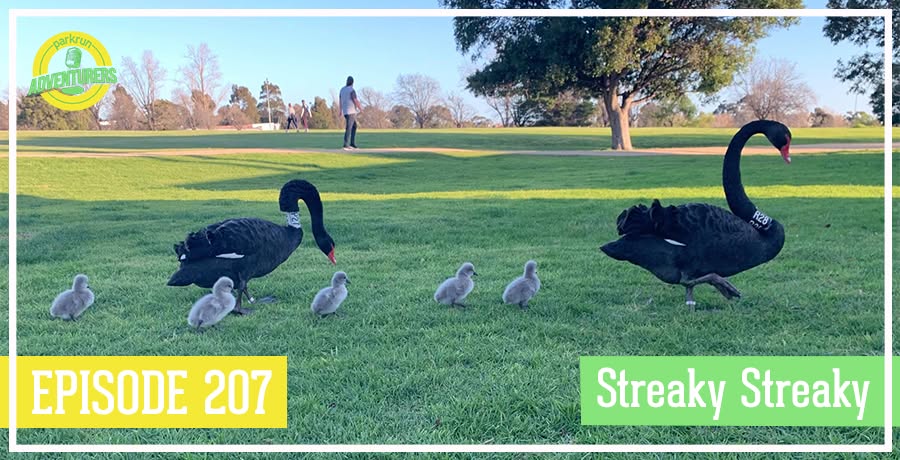
 — open the full-size cover
Episode 207 - Streaky Streaky
Episode details · · 192 speaker turns · sound cues from context
Enhanced transcript
Speaker names appear where they could be established with confidence. Others are shown as “Unidentified speaker”. Sounds that are not speech — music, laughter, people talking over each other — are written in [square brackets].
Episode 207 - Streaky Streaky · 2020-09-05
Enhanced transcript — Produced by an automated editing pass — speakers named, sound described, segments marked. NOT yet checked by a person.
Speaker names appear only where they could be established with confidence; others are shown as “Unidentified speaker”. Non-speech sound is in [square brackets].
Source: https://log.5kadventures.net/transcripts/ep207.html · The Adventurers Log · An independent project, not affiliated with or endorsed by parkrun.
Streaky September
Melissa Erbacher: Streaky September is here. Welcome to episode 207 of the parkrun adventurers podcast. My name is Mel Erbacher. I am the co-host of this little pod.
Interview Scott Watkins — Albert Melbourne parkrun Co-Event Director (Melbourne); returning guest co-host
Melissa Erbacher: And joining me this week is the wonderful Scott Watkins. Scott, welcome back.
Scott Watkins: Thank you, Mel. Happy spring. Happy streaky September. It's good to be back.
Melissa Erbacher: Oh, that's right. It's spring too. That happens in the world this month. Yeah.
Scott Watkins: Well, spring for us. Our Northern Hemisphere listeners are going into autumn.
Melissa Erbacher: They are indeed. And look, I wore shorts for the first time in a couple of weeks today because it was warm, warmer than usual, I should say. What's the weather like in Melbourne, Scott?
Scott Watkins: We have had a couple of warm days, actually. We had our normal cooler ones last week, but, yeah, we've had a couple of days that we've gone above 20, so the days are definitely getting longer. We have had, I think, like a lot of Australia, a pretty mild winter, so we haven't had too many bitterly cold days and certainly not much rain, although last weekend we did. But, yeah, no, it's been lovely.
Melissa Erbacher: Yeah, it has been unseasonably warm, hasn't it, actually? I mean, I'm still a cold fish and I've been feeling it anyway, but... We're very lucky, I think. Or maybe we're not lucky because we did have a bushfire yesterday on the Sunshine Coast.
Scott Watkins: You can't stop talking about bushfires again, Mel. We've had enough for this year.
Melissa Erbacher: I know. I know. Well, we've had enough of most things 2020. So what we're doing is we're finishing the year strong. We're bringing streaky September back for everyone. It's fourth year running. I am so excited about Streaky September. I'm so excited about the Facebook group, which has already started work. I got out for my first streak today. Scott, have you been streaking? Are you joining us?
Scott Watkins: I did, yes. No, I have enjoyed Streaky September very much over the years. And it's given me quite a lot of sort of accountability and camaraderie and fun over the years. I don't think I've made it every year. I think a few years ago... I did have some quite funny adventures in managing to keep my streak going. I got out early this morning. We have a curfew at the moment at 8 p.m., so I wanted to make sure that nothing got in the way of doing it so that I didn't have to do any late-night runs, which are not allowed. So I got a little lap of the lake in this morning, and it was lovely.
Melissa Erbacher: And not only do you have a curfew, you've also got some other restrictions imposed, one of which is you're not allowed to be anywhere further than five kilometres from where you live. Is that right?
Scott Watkins: Yeah, so we can't go more than five kilometres and only an hour exercise a day and all between 5 a.m. and 8 p.m. But we're four weeks into this six-week stage four lockdown and we're
Melissa Erbacher: The end is nigh.
Scott Watkins: Well, things will be reviewed. I think we'll find out a little bit more this weekend. I mean, things are more positive than they have been, so we'll see. It's not going to go back to normal, obviously. It's just which of those restrictions get eased is the question. Hmm. Before we go any further, though, just with the intro, you said at the start this is episode number 207. But it's actually a personal milestone for you because it's your 200th episode as the presenter. So congratulations. Thank you.
Melissa Erbacher: Thank you. Yes, it's an unofficial milestone.
Scott Watkins: Cue celebrations. You've got to insert celebratory music or claps here, but 200 episodes, that's probably like 200 hours almost of talking with people over the years. It's a really huge effort.
[music]
Melissa Erbacher: It's actually a lot more than 200 hours of talking. And I can't tell you, it's more than 200 hours of editing. Yeah. And I've only been doing it for the last year. So that's just me personally with my editing skills moving at a snail's pace. But yeah, it's nice to get to a round number every now and again, isn't it?
Scott Watkins: Yeah, and I think you should be very proud of it. There's a lot of people who've thoroughly enjoyed listening to your musings on parkrun adventurers, so well done.
Melissa Erbacher: Thank you. And look, it's been fun for me too, obviously, or I wouldn't still be here. And it's really nice that I get to celebrate it with a Scott, for starters, so thank you for joining me this week.
Scott Watkins: Quite a coincidence.
Melissa Erbacher: Started with a Scott, celebrating 200 with a Scott. And also that Streaky September is here because it is one of the major highlights of the parkrun adventurers year and something that I'm exceptionally proud of, which sounds really bizarre.
Scott Watkins: I think you should be.
Melissa Erbacher: But it's a motivational thing every year. It gets me moving again, but it also gets so many other people moving again. And I don't know if you're a member of the Streaky September group, Scott.
Scott Watkins: Yes.
Melissa Erbacher: I'm already seeing posts in there that are making me a bit emotional and just so proud and happy that it's something that people are embracing and getting on board with and improving themselves and improving their situations with.
Scott Watkins: Yeah look it's a very special thing for us I think some people out there will know my wife Joanne who's the Co-Event Director with me at Albert Park. Joanne had a back injury a few years ago and spent a couple of years recovering from that and walking with a cane and two years ago she managed to do the whole month and she was you know doing every one of those walks with a cane and two kilometres was really pushing her limits at the time but it was a really good motivator. Now she's long cane free and walking around the lake you know doing more than 5k's easily now so um yeah so it played a really important part in that so it will always be special oh that's lovely to hear where did you streak today
Melissa Erbacher: I streaked just around home. I did a blocky, what I call a blocky. It's about a 2.5 kilometre loop of several blocks in a bit of a cluster and managed to get all the boys and the one little girl in my family out, and it's nice actually to start Streaky September with the whole clan. We've never made it all the way through, all of us together, but great to start strong and got out there in my pineapple tights and 2019 Ugly Christmas Singlet and generally had a quality adventure. It was good company too, which made the time go fast and kept me amused. Did you happen to find anything amusing along the way while you were streaking, Scott?
Scott Watkins: me I was I was counting cygnets uh because we've had so quite a fairly early down at the lake here at Albert park the black swans have given birth and there's about four or five different families that have already had little babies there's one that's done very well they've got six so we'll see we'll see whether they can manage to keep six I think that's at the upper end of what they normally have and inevitably a few don't make it
Melissa Erbacher: Oh, no, I don't want to hear that part of the sentence. They all make it.
Scott Watkins: A lot of them make it. There's no shortage of swans here. Yeah, I think I spotted probably about – I should have counted, but I probably saw about 10 cygnets this morning on the loop around. So that was good, keeping check on where they are.
Melissa Erbacher: Oh, that's exciting. I would love to see some baby birds out on my streak. The way we went today is actually – the known path of um breeding pair of magpies but we didn't get swooped I'm not sure if that was just because it was too late in the day or they just weren't really interested we've been swooped during streaky September before or Adam has much to my amusement because he was ahead of me and he's taller too so I guess they thought he was more uh likely to cause harm the joys of spring hey
Scott Watkins: Yeah, it's probably worth just explaining that, though, because I remember when we moved to England, a lot of my friends didn't believe me that birds in Australia actually deliberately attacked people. But they really do, and magpies can be quite vicious and very aggressive, and particularly if you're startled by them because they generally come from behind you. It can be quite a nerve-wracking experience to get swooped by a magpie.
Melissa Erbacher: Yes. Oh, they're very brave. They don't usually swoop you from the front, so they don't want you to see them coming.
Scott Watkins: I mean, we used to walk to school and I have memories of plotting maps to map out an alternative route to get to school to avoid trees where there were magpies.
Melissa Erbacher: Yes, I think there's a lot of people who are getting in a bit more distance of their normal commutes or exercise this month because they're doing likewise. They're taking the long way around.
Scott Watkins: Yeah. Swans don't generally attack unless you go up really close. So maybe we should just talk about swans then. Yeah.
Melissa Erbacher: They're the friendlier, friendlier birds.
Scott Watkins: Yeah.
Melissa Erbacher: We have gone off on a big tangent here.
Scott Watkins: Well, we've covered what we did for the start of streaky September. So that's day one off to a good start.
Melissa Erbacher: Yes. No swoopings, only friendly bird sightings, to report at this stage which is good I'm looking forward to the rest of the month and we're going to discuss a little bit later in the episode some challenges that we will set for Streaky Bingo for new listeners to the pod or new participants I guess in Streaky September every year we release a Bingoe card and it has a whole bunch of challenges on it that if you complete them all you can yell bingo at the end and it's generally a race amongst a few extremely competitive streakers but it's also I think it's just a nice way for people to mix it up a bit if they're getting a bit bored with yeah just the everydayness of trying to do at least two kilometres
Scott Watkins: Yeah, because absolutely, if it was just about running two kilometres, that would be quite monotonous. But the fact that it's so open and inclusive and it's walk or run and do some of these things along the way that promote you to look around you and interact with your environment and some other people, that's, I think, what helps make it really special.
Melissa Erbacher: And we are keeping in mind all our friends that are living in stronger restrictions than some of us may be. And so all the challenges, while still challenges, should be achievable even for those living in lockdown situations.
Scott Watkins: Yeah. And one of them, which we'll get to, is not parkrun. And that's, I think, another very important topic to do. That's certainly growing in popularity. You've been doing your (not)parkruns, haven't you, Mel?
Melissa Erbacher: I have, yes. Yes, I have.
Scott Watkins: One a week or more than one a week?
Melissa Erbacher: Yeah, no, a couple. No, I think it's one week I did two. And I think now that Streaky September has started and, yes, it's a minimum 2K, but I think I'm going to try and do at least one other 5K that's not on a Saturday, maybe two if time permits. We'll see how motivated and organised I can be. But, yeah. Yeah, no, I've only been pretty much doing one. And even that though, Scott, it kind of occurred to me on the weekend, this is more regular exercise, more regular 5K distances. I won't say runs because they're not all runs and some of them are only partially runs. But this is the most... consecutive kind of 5Ks that I've done in a very long time because usually my parkrun experiences are predominantly volunteering with a couple of parkruns thrown in every now and again kind of thing. So this is more exercise than I've had in a while, consistent exercise.
Scott Watkins: Yeah, I would say the same. I mean, I think anyone that's involved with volunteering, you know, it does punctuate your parkrun history. So the fact that you can do them anytime means that, yeah, we are boosting our consistency. So I think it's been great and I've really, really enjoyed it.
Melissa Erbacher: has there been a big uptake at Albert Melbourne?
Scott Watkins: Yeah, it has. I mean, and that's something that I thought we could, you know, go through a little bit. It has. So yeah, as you said, Albert Melbourne parkrun is my home parkrun. And people seem to sort of get the concept pretty quickly, I think, when it started a couple of months back and pretty quickly took up logging it and, you know, logging a few a week. But it's interesting that it's really grown very strongly in Victoria, far greater than any of the other states. And For people outside Australia or not aware, so at the moment, Victoria and particularly the capital, Melbourne, is under much stricter restrictions because of COVID-19 than the rest of the country. The rest of Australia is, you know, moving back much closer to normal. But, yeah, here in Victoria, we've got quite strict lockdown. So it's interesting that the more lockdown place has somehow embraced lockdown this idea. And I'm curious as to why that happens. I think there'd be a study in that to sort of see, because last week, if we looked at parkrun Australia published a tally on their Facebook page and Victoria tallied 1,378 not parkruns for the week. And the next highest was New South Wales with 763. So it was almost half. In Queensland, only 653. And that's not, you know, normal. Like normal Queensland and New South Wales have far more parkrun participants and registered people at bigger states. It has been interesting about why it's been embraced there. We probably should give a specific mention to TOC, who was your co-host last week, who was the founder and still the largest advocate and promoter of Inverloch parkrun. And Inverloch's a pretty little town down on the south coast of Victoria, but they were once again the parkrun in Australia with the most number of participants.
Melissa Erbacher: Worth noting, too, that Inverloch this week are in the top 10 in the world. More than 2,000 events across the world and Inverloch parkrunners, they've only got a very tiny little community, comparatively speaking, to the bushy parks of the world. Yeah.
Scott Watkins: They had 94 people do it last week, which I think was actually more people than at their last parkrun before COVID, which is incredible. And that's great. As we're recording this, Pete Johns, regular listener and one of our event ambassadors and event founder, he pointed out that as things stand currently, the top 10 events in Australia are all from Victoria.
Melissa Erbacher: Maybe you guys all just run a lot more at the beginning of the week. Or maybe those of us in the north are not very good at actually logging things.
Scott Watkins: Well, I think, I mean, maybe it's a case of you've got more to do. I don't know.
Melissa Erbacher: It could just be that you guys down there are way more competitive than the rest of us and you're competing in something, you know, you're in this race or this competition that everyone else is like, oh, yeah, you know. Maybe we're just not as competitive about it.
Scott Watkins: I am interested in whether there are these other online networks where people are encouraging them. Obviously, each event has its own social media channels. And I think most of the events down here are publishing things saying, don't forget to log in, not parkrun. But I suspect that in some of the events, there are also other groups where people are probably encouraging themselves along and maybe doing that bit of competitive talking, let's beat Albert Park or something like that. I suspect there's a little bit of that going on.
Melissa Erbacher: Yeah, I wonder as well how much of it might be relating to virtual challenges and things like that that are going on. Garmin's always got badges for this and that and the other and Strava's got their own things going on and whether or not they feel the need, almost like it's doubling up or tripling up, to register these things across multiple platforms as different things to earn different kudos, I guess. Yeah.
Scott Watkins: Yeah. Have you signed up to any other virtual things? I know you talked last week about the Sunny Coast one that you did. Have you got any on the horizon?
Melissa Erbacher: No, that's it for me. The only virtual thing that I want to do right now is Streaky September because it's such a fun group. It's such a random thing to do. I think, and you touched on it earlier, Scott, when you said Joanne was coming back from an injury and the two kilometres was actually quite the challenge for her to accomplish. And what I love about it is that it might not seem like much to some people, but for those people, every day could be a lot, you know, just trying to do that every day. But then for other people, it is actually a big challenge, but it's still... And I'm hoping that even in places like Victoria where you guys are only allowed out for an hour, that that's enough time for people to be able to get two kilometres in. Of course, I mean, people can still do it on treadmills or indoors. And if anyone decides they would rather swim, two kilometres or cycle two kilometres it all counts you know we're not judgmental about how you actually do your streak yes we say or run or jog or whatever but if you choose to skip it if you want to do it on stilts more power to you and that's the beauty of it and that's the only thing that I'm excited about and it's not even really a virtual thing because you don't have to log it with anyone you don't have to prove it it's all an honour system yeah and it's just good fun
Scott Watkins: Yeah, it's the accountability. I remember it was two years ago and in normal times, I was travelling a lot and there was this week in the middle of it where there was something happening. I was probably getting a flight the next day, so I knew I wasn't going to be able to run the next day. And I'd had a really busy day and I hadn't run on this day. And I was like, no, I can't break my streak. And I remember it wasn't too cold. So it must've been, you know, spring or something like that. But I went out in Seoul at about quarters to midnight and I ran two kilometres up the river and waited, stopped, and then waited for the clock to tick over to midnight and then ran two kilometres back the other way. So I was outside, you know, my apartment for like 20 minutes, but I got my two days in either side of midnight. And then I could, you know, go and get my flight the next day and
Melissa Erbacher: See, now that's brilliant. That's right there.
Scott Watkins: It was very frightening.
Melissa Erbacher: Streaky September is inspiring creativity. I'm not sure I would be wanting to streak at close to midnight or just after midnight.
Scott Watkins: That's why I have to be careful at the moment because as we discussed with curfew, I can't do something like that. So I can't let myself slip back into bad habits. I've got to be a little bit more regimented at the moment about how I do things.
Melissa Erbacher: Yes, organisation I think is going to be key to getting through the month, that's for sure. Yep. Speaking of regimented and dealing with things like curfew, Scott, apart from you've only got one hour a day at the moment to fit your exercise in, how has lockdown impacted you? I'm sitting here on the Sunshine Coast with mild slash limited restrictions, nothing in comparison to what you're coping with in Victoria. What does your day look like? How has even exercising changed?
Scott Watkins: Yeah, look, it has been a big, big change and probably affected me more than I thought it would. I think obviously everyone around the world has had some form of restrictions on them over this year. And I think we had some that were in line with the rest of the country, but probably at the stricter end. And then we sort of came out of them and then things were starting to go okay. And then suddenly, you know, the cases started rising here in Melbourne and the number of people dying followed that very quickly. And so then the government put us back into a very, very strict lockdown, as we've discussed, far stricter than what we'd had before. And so I think that feeling of coming out and then going back had a bigger impact and I was doing a lot of running in the first part of lockdown and, you know, really enjoying that and trying to make that a regular part of my week. But I was getting a little bit bored with sort of, you know, doing the same thing. But then suddenly I was told, you can't. You're only limited to an hour. You have to stay within five kilometres. And so even though I was looking for an excuse to maybe change things, it's a little bit different when you choose to stop as opposed to someone telling you that you have to stop. So that definitely affected me more and sort of killed my motivation. And that's one of the reasons why I'm looking forward to Streaky September because it makes me a bit more accountable and gives me a little bit more purpose like what I was doing before. I've been fortunate in that we've both got jobs and we've been able to do our jobs pretty effectively, but I've got friends around us here. Who's it's, it's really, really tough. You know, the people that have got families and kids, obviously with schools shut, that gets a huge amount of focus in the media and a lot of people talking about that. And, but yeah, The other group that I'm probably a little bit more exposed to just because of our social circle is people who live by themselves and living in a city. We've got a few friends who live near us who are single and they live in very small apartments, just studio places. And they're normally great places to live because they're in a very vibrant city that there's always something going on. And in normal times, they don't spend much time in their apartment. But for them, you know, they've literally spent months in the same room. You know, they're waking up in the morning and they're walking into the lounge room where they spend their whole day at work and that's where they eat and that's where they watch television and wind down in the night and then they get into their bed and it's that same room and and for them not seeing anyone physically has been hard they're not able to see their friends a lot of them their friends aren't even within their five kilometre radius so they can't see them at all and yeah so there's a few of them that we've been trying to make a bit of an effort to connect with virtually on on video and and a couple running who live within the And I think that's been a really important part of it. Yeah, those are the people that I think, you know, all those groups, the families and stuff like that, that I think have been impacted more. But so my day, you know, get up in the morning and walk across the corridor and into my study and that's it, yeah, just try and pick an hour to go outside. But I haven't, you know, probably in the first few weeks of this lockdown, I wasn't using that hour every day. You know, there were days when I would get to the end of the day and think, oh, actually I didn't go outside. And that's where, you know, I said I lost a little bit of that motivation, but that's where I'm really looking forward to this month and the weather's getting better. So it becomes even more attractive to go and spend time outside.
Melissa Erbacher: You're a member of the Seoul Flyers running club.
Scott Watkins: Yep.
Melissa Erbacher: In South Korea. Obviously, you're not participating much in their group runs at the moment. I'm not even sure if their group runs are running at the moment. But are you a member of a running club here in Australia? Do you go apart from parkrun and run?
Scott Watkins: No, I haven't. Yeah, I guess, I mean, in normal times, I spend about 40% of my time in Korea and engage very strongly with the running club over there because it's a way of, you know, when I'm there, I'm on my own. So it's a way of meeting people and establishing friendships. And here, yeah, my running focuses, you know, almost entirely around parkrun and, you know, just occasionally running with friends that I know from there. But yeah, I haven't ever really engaged properly with a running group here.
Melissa Erbacher: And how are you coping with not getting to run in person with your Seoul Flyers friends?
Scott Watkins: Look, I miss them all immensely. And, you know, there might be one or two of them even listening to this. Hi, Toby. But with social media and stuff like that, we often joke the Seoul Flyers is a selfie club with a running problem. They're quite photogenic. Yeah. And so there's no shortage of photos of what the Seoul Flyers are doing on Facebook. Put it that way. I have very good idea of what they all look like still. And yeah, I've sort of reciprocated a little bit. So I think they can still remember what I look like.
Melissa Erbacher: What would we do without technology? Can you imagine having this pandemic 20 years ago?
Scott Watkins: Yeah, it's certainly different. It's given us different things. Absolutely. And I think we're very fortunate to have that. My family live interstate apart from my wife, Joanne. And I haven't seen any of them since the start of the year. And there's very little prospect of that changing soon. And Again, for people outside Australia, all our borders are closed to the outside world, but also within the country. So our state is well and truly locked down from going anywhere outside of here, even if we could get outside the five kilometres. So yeah, but being able to connect with people via technology has been hugely important and has helped bridge that gap.
Melissa Erbacher: Another thing I've noticed I've seen on social media, actually, you've posted some pictures of yourself. So obviously the Seoul Flyers selfie club with a running problem, it runs deep. I've noticed selfies, you're running in masks everywhere.
Scott Watkins: Yeah, it has been interesting because so here in Victoria, we are mandated to have masks on at all times outside of the home. There is an exemption if you're exercising strenuously. So they sort of say, well, if you're running, you can take one off. But if you're walking, you have to have one on. And And certainly, I think there's very high compliance with that. I saw a poll last week, actually, and the percentage of people that agreed with the rule was very, very high, a huge majority. So people are being good. But the area of running with a mask is probably a little bit controversial. So when it started, I thought, look, I'm going to try and run with this on. And my reason for that is actually more based on people's feelings and perceptions, because I don't think from the science point of view, me running past someone at speed is really posing that much of a risk to either me or them of, you know, if anyone was infected. I think that the chances are very, very low of that exchange when it's so brief. But absolutely there are people in the community who are worried about that. And I think all those tensions have been amplified by this being in the second lockdown and everything like that. So people are on edge. And there is, you don't have to dig too far online or talking with people to find people who are anxious about runners and cyclists being out. And there is more density on the paths. You know, some parts of Melbourne, you go out and there's a lot of people out there. And some of them are anxious about someone passing them without a mask on. So, yeah, so I thought, well, I'm going to try. And the first couple of times I did it, it was hard. And I tried a few different, you know, I tried some surgical masks. I tried some of the cotton masks. And I found that the surgical ones were okay, but I'm probably actually now more comfortable with the cotton ones, provided you can find one that's the right fit. And so I started doing it, and I did it on an easier run, and then I did do a 5K run where I really pushed myself, and that was really hard. I felt like I was almost choking on it, but I thought, I'm going to keep going. I think the first time I tried, I only made a kilometre, but then I did it again. And I did... Prior to this lockdown, I did get up and I did do a 21K run and I left it on the whole way. I did one one week where I sort of had it around my chin, but I would move it in front of my face when I passed someone. And I saw a few other people doing that similarly. But then the following week was sort of a bit more practice and did it. I think one of the keys with the handmade sort of cotton masks in terms of fit and stuff is when you're running, your mouth tends to be open a lot more. And if the mask really goes underneath your chin, your chin is pushing it down and then it starts sliding down off your nose and then you're sort of adjusting it. So if you can get one that doesn't fit really, really tightly around your chin, sort of fit it with your mouth open sort of thing then I think that makes it more comfortable and then you don't have to touch it it's an interesting cultural thing I mean have you have you tried it at all Mel have you tried doing any sort of vigorous exercise with a mask on
Melissa Erbacher: The only masks I own, Scott, are Chewbacca from Star Wars. I have a giant panda head that covers my whole face.
Scott Watkins: Okay.
Melissa Erbacher: Those are the sorts of masks I have. And I will wear them to parties, costume-type scenarios, but generally speaking, I don't run with a full mask on my face. So, no, I'm not experienced in that area.
Scott Watkins: Why it's an interesting cultural thing is like there are some parts of the world and Korea is one of them where there's certain times of the year where you do run with a mask in normal times for pollution reasons. So there's times of the year in Seoul where there's a lot of very fine dust and some people are very sensitive to that. And there have been times over the years where I have worn a mask there where I'm wearing it to filter out the dust. So I'm not worried about what I'm expelling. I'm worried about what I'm breathing in. So I had done it a few times before. And I remember one time with the Seoul Flyers too, we had a dress-up run and I wore one of those scream masks, you know. Yeah. And, yeah, I ran 5K with that on and that was challenging. So I've done it a few times. But I think, look, I'm not going to sit and judge and say everybody should wear masks when they're running. I think if you are out and you're in an area where there's homeschooling high tension around the issue like I'm experiencing at the moment. Certainly, I've had positive feedback from people when I've done it, and I feel like I've probably eased a couple of people's anxiety a little bit by doing it. Obviously, it's easier if you don't run at full capacity or full speed, but it's doable.
Melissa Erbacher: I know the industry mask making has boomed. Have you got any really cool ones that have pineapples on them?
Scott Watkins: I have indeed. I've actually got two.
Melissa Erbacher: Why have I not seen selfies of those ones?
Scott Watkins: To be honest, we have so many masks because when – When this all happened, we went and bought some, you know, like a 10-pack of surgical ones, but, you know, you don't want to reuse them and we sort of kept them for sort of emergencies. But then all these different neighbourhood things popped up where people were making them, you know, people down the road and people, you know, who knew people and there was a few groups supporting, for example, refugees that were selling masks and stuff like that. And I ordered a few and then Joanne found One of the running companies brought out a running one, so she ordered a couple of them, which had been a little bit hit and miss. And then friends interstate started making them for us very, very kindly. So my brother-in-law, his partner, she very kindly sewed a few for us and and that included a couple of pineapple ones but I'm being very good and treating them like your underwear so not touching them too much and washing them after you wear them so we've got a regular routine of washing the mask so that's maybe why you haven't seen any photos of me in in those particular ones
Melissa Erbacher: Okay, so when you say you treat them like your underwear, you're not one of those guys who wears them right way out, inside out, back to front and upside down or whatever it is. So you don't wear them four ways before you wash them?
Scott Watkins: If I go for a run and wear it, they're not in a state at the end of that run that I want to touch them ever again.
Melissa Erbacher: Well, see, I want to wash my hat, my visor after every run. So, yeah, same, same.
Scott Watkins: Yes. So, anyway, it has been interesting. But let's hope that the need to do this doesn't persist too long and we can get back to doing things unencumbered and unrestricted.
Melissa Erbacher: That's the dream, isn't it?
Scott Watkins: It'll be a reality soon. I'm very confident.
[music]
Melissa Erbacher: Scott.
Scott Watkins: Mel.
Melissa Erbacher: Did we mention yet this episode that it's September and that means streaky September?
Scott Watkins: We did indeed. And as we've gone across a number of issues, the constant has been the excitement that is building because it is the month of September.
Melissa Erbacher: It is, and it's Streaky September.
Streaky Bingo
Melissa Erbacher: And we said at the beginning that we were going to share some of the challenges from our streaky bingo. From streaky bingo. B-I-N-G-O-E. If you want to know why we spell it with an E, you need to go back to the first year and have a listen to when we first told everybody that Streaky September was coming and that we were going to play a game called Streaky Bingo. Now we've got 10 challenges on the card this year. Very excited. The majority of them are new. Normally we probably do a ratio of about 50-50. 50% of the challenges from last year and then 50% new ones. But this year... There's a definite domination of new challenges. And we should also mention thank you to Joanne Watkins for her contributions and also the Channel 5 News crew and yourself, Scott, for helping come up with the Bingoe card with you. Bit of brainstorming. Yeah, it's been a lot of fun. Shall we start divulging? We will share these on our Facebook page as well. However, we probably need a bit of an explanation because the Bingoe card itself only generally has a couple of words, which... Some of them, you know, might be fairly obvious, but others not so much. So shall we begin?
Scott Watkins: Let's go.
Melissa Erbacher: The first one is Streaky Strava Heart. Now, in previous years, we've had Streaky Strava Art where you can just go and do anything you like, any size or proportions you want. Some people have done some incredible things over, you know, 40 kilometre distances, for example, which... Beyond my comprehension, I'm usually restricting myself to a 400-metre circular oval somewhere so I can get some kind of perspective. But this year, because we want to share the love, we want to see your best self. love heart shapes. And it doesn't matter if you've got some kind of out-and-back course and you just want to tack a little love heart onto the end or if you've got a loop and you want to do a little love heart in the middle, however you want to get creative with your love, love heart.
Scott Watkins: If someone does a biologically correct heart with, you know, like valves and stuff like that, does that count?
Melissa Erbacher: Yes, and an anatomical – Oh, my goodness. I can't say anatomical. There we go. I got it second time.
Scott Watkins: Anatomically correct.
Melissa Erbacher: Yeah. If you could do an atomic.
Scott Watkins: Anatomically correct heart. Yeah.
Melissa Erbacher: Do one of those. We would love to see it. Valves, you know, valve replacements. If it's one of those ones that's got a pacemaker, go for it. Can't wait to see your streaky Strava heart.
Scott Watkins: Pacemaker, that'd be great. So that's a throw out to all the medical students out there pouring over textbooks and anatomically correct heart. Go for it.
Melissa Erbacher: Yes. Hey, look, bonus points for you.
Scott Watkins: But if it's just a regular stereotypical love heart, that's totally fine.
Melissa Erbacher: We would even accept the emoji kind where, you know, it's a funny opening bracket and the three.
Scott Watkins: Yeah.
Melissa Erbacher: That works for us too.
Scott Watkins: Sounds good. My attempts over the years at Strava Art have been spectacularly unsuccessful. So I think that, yeah, I think just the simplest heart possible might be mine.
Melissa Erbacher: That can't have been worse than my trying to get my tongue around anatomically correct.
Scott Watkins: We'll move on. Number two on the list is not anatomically correct at all. It's just do a (not)parkrun. So if anyone out there hasn't done it, you've got to dig out your password or reset it via the website and you can log in and log a (not)parkrun.
Melissa Erbacher: Yeah, and try and do that early in the piece because I think you'll find once you've done one, you might quite like to do another one. And if you do the first one slowly, if you've never done them before, the second week you can go for a PB. Yeah. It's awesome. Alrighty, the third one is going to be a streak in your jim jams. And we're coming into the warmer months or the warmer weather now.
Scott Watkins: So the jim jams are getting briefer. Yeah.
Melissa Erbacher: Yeah, they are. So you might want to do this one toward the start of the month as well while you're still wearing your full-length flannelette pyjamas.
Scott Watkins: Yes.
Melissa Erbacher: But we'll leave that to your discretion.
Scott Watkins: Okay, so number four is the DFYB, don't forget your barcode. So your barcode might be on your shoe, it might be on your key ring, it might be in the bottom of that little divider between the seats in your car. Go and find it and do a streaky September run with your barcode.
Melissa Erbacher: I thought you were going to say when it might be in your car. It's like, well, how can you do your streak in your car, Scott? But you just meant to find the barcode.
Scott Watkins: Yeah, yeah, yeah.
Melissa Erbacher: It has to be on your person when you do this streak. Don't just leave it in your car thinking you can get it after your streak. That's not going to work for us.
Scott Watkins: I just listed all the places that I have barcodes. After the Munich incident of a few years ago when I had to run and get a barcode printed at the end of my parkrun, I've filled my world with parkrun barcodes.
Melissa Erbacher: Yes, and I love your counting too with that DFYB being number four because it's much better than my counting with Jim Jams being number three.
Scott Watkins: So number five for you, Melissa.
Melissa Erbacher: We haven't thought of a witty name for this, but we will by the time we release the card. We want a bird picture. So this has been inspired, of course, by earlier conversations surrounding being swooped by magpies or spotting cygnets around Lakes at this beautiful springtime of the year. We want to see your close encounters of the bird kind.
Scott Watkins: So an incoming one, magpie about to strike, that would probably be quite memorable, wouldn't it?
Melissa Erbacher: If anyone can get one of those, they definitely get bonus points for bravery.
Scott Watkins: Okay, so number six is one that is coming back from previous years, and that's do one with a friend. Now, we know that there's a lot of physical distancing going on and some regulations, but I'm pretty sure that in most places where people are listening in, you're still allowed to do some exercise with another person. So hopefully you can find a way of doing one of your streaky September days with a friend.
Melissa Erbacher: And, look, your interpretation of what a friend is is absolutely up to you as well. If that is a teddy or an imaginary friend that you're particularly fond of, then I'm okay with that. No judgment. This is a nonjudgmental podcast.
Scott Watkins: Okay. And it can be a new friend too, I guess.
Melissa Erbacher: Yeah, absolutely. A new friend or somebody that you haven't met before, but you're going to be friends by the end of the streak because who wouldn't be? As you say, Scott, that one's coming back from previous years. I'm pretty sure this is actually the only challenge that has been on the card every single year because who doesn't want to streak with a friend?
Scott Watkins: Yeah.
Melissa Erbacher: Now, I've lost count of the numbers. Is it number seven? Well, the next one.
Scott Watkins: Yeah.
Melissa Erbacher: Okay, so seven. This one we had a lot of fun trying to figure out the parameters of and or give it a quirky name. It's called Sign Me Up. And basically, we want you to get creative with signs that you see out and about on your streak. So you can, well, give us some examples, Scott, of what you can do with signs.
Scott Watkins: Well, you can take a photo of perhaps one word on one sign and then another word from another sign, and put them together to make a name, a message, a whole sentence. Or you could even narrow it down and zoom in and just collect the letter of a sign and maybe do the alphabet. So you could collect an A from one sign and a B from another sign. And so not necessarily the first letter or the only letter, but you can collect words or letters from signs and spell things out.
Melissa Erbacher: So your message to someone might simply be keep left. If you can find a keep left sign and that's what you want to take a photo of, that's a message you want to get out to the world, we will accept that as a tick on your Bingoe card. If you want to spell out parkrun adventurers, we heart you, then please by all means do so. These are limited only by your imagination.
Scott Watkins: think the little um israeli restaurant around the corner from my house posted a picture of some road work across the road the other day and it says a rough road ahead and that may be a sign that was sort of you know quite apt for 2020 but hopefully so if you can find one that says you know good times ahead or something like that that'd be good
Melissa Erbacher: Yeah, look, even if you just find an interesting sign that somebody else has created, I'll pay that too. If you can find a sign that has got a good pun on it, double points.
Scott Watkins: Yep. Okay, so the next one is streak art. So we had a bit of a discussion about this too, and Mel introduced me to something that I'd never heard of before. I'll let you explain it because it's still quite... sort of head spinning that this sort of thing exists but many of you would be familiar with sort of the uh the trend during the earlier lockdowns we had people painting rainbows or putting sort of little signs on the pavement outside the house and stuff like that that's the sort of thing we're looking for or maybe even painting rocks or something like that something that you spot or if you hard up and live in the city you might find some graffiti on a wall somewhere and that's okay but the One of the other art forms that we're aware of is, Mel, a thing called Spoonvilles. So do you want to explain what a Spoonville is?
Melissa Erbacher: Yeah, and I was a little bit surprised. I thought everybody in Victoria must know what Spoonvilles were and I was just living under a little Queensland rock not having heard of them before. So Spoonvilles are little villages made of people that are made of wooden spoons. They're popping up all over Victoria. I don't know whether or not they've extended further out than that. So, yeah, literally people are just decorating wooden spoons. I'm not sure who has all these spare wooden spoons in their homes because I never seem to be able to find one when I want one. Yes. They're always dirty, but some people obviously have spare ones.
Scott Watkins: So they've decided to paint them and stick them in the ground in random places. And apparently this is not even in their own garden. Is that right?
Melissa Erbacher: No, it's just public spaces from what I can tell. So they're making little villages of people made out of wood.
Scott Watkins: So just to be really clear, it's people getting a wooden spoon, they're painting an image of a person on it and they're sticking it in the ground and a whole lot of them around them and that makes a village of spoons. And that's what a Spoonville is.
Melissa Erbacher: Yes. So if you come across a Spoonville on your street, we want to see a photo of it. But any streak art is totally fine. We don't expect people in other states or countries to create their own Spoonville. Of course, if that floats your boat, feel free to do so. But if it doesn't.
Scott Watkins: I feel like this is where I can sort of express a little bit of sort of inner city snobbery because I think all the places that are mentioned in here are like far away places from the city in Melbourne. Yeah. And maybe people in the burbs have got a bit more space and more spoons apparently. Because I'm like you, we never have enough wooden spoons. But, you know, in the kitchen we never used to have enough scissors. We were always running out of scissors. But I feel like in the last couple of months something's happened and I think we've bought a whole lot and we've just filled every drawer with It may be the Korean thing because in Korean cooking you often use scissors to cut meat up. Like the Koreans love a good pair of scissors in the kitchen.
Melissa Erbacher: Scissors are awesome for all sorts of kitchen things.
Scott Watkins: Well, so I feel now our kitchen is full of scissors because there's no shortage of scissors. There's always scissors everywhere you need and our dishwasher is constantly full of scissors. So maybe people got to that same point with their wooden spoons and they've decided to stick some in the ground.
Melissa Erbacher: Well, yeah. I mean, we're short of whisks in my kitchen also, but that's because I've got two little boys who have this just fondness for balloon whisks. I don't know what it is. It's the first thing they always take out of the utensil drawer and... And we've had to replace them because they've just gone missing full stop and we don't know where they're putting them.
Scott Watkins: I had to buy a whisk the other week too, actually. Joanne wore ours out. Like if you don't know, during the lockdowns on the Melbourne parkrun Facebook page, Joanne's been running a cooking Facebook Live every weekend and cooking videos. I mean, I've had to run an awful long way to keep up with all the cakes and things that she's been baking because they've been awesome. The carrot and pineapple cake from a couple of weeks ago with cream cheese icing was excellent. But apparently that took, they put quite a beating literally on our whisk. And so I was sent out to find a new whisk, but I succeeded.
Melissa Erbacher: Oh, well, that's good to hear because you definitely need one of those.
Scott Watkins: Can whisks live in Spoonvilles or is it only Spoonvilles?
Melissa Erbacher: I feel like a whisk could live there. It might have to be the opposite way around so it looks like it's wearing a skirt perhaps.
Scott Watkins: I don't know. Oh, I hadn't thought of that. Okay. Well, if anyone spots a whisk in a Spoonville, like that would be a multi-level up challenge.
Melissa Erbacher: Don't just take your own. Actually, you know what? I'm okay with people taking their own whisks just for a photo opportunity. That's all right with me.
Scott Watkins: So anyway, that was number eight. That was streak art. Spoonvilles, painted rocks, chalk rainbows, graffiti, whatever you can find, that's that challenge.
Melissa Erbacher: All right, so on to number nine, another returning from a previous year. It wasn't in last year, but it was the year before. Streaking with a podcast. We are not going to be prescriptive and tell you it has to be this podcast. However, that does come highly recommended. But you can listen to whatever podcast you like. There's heaps, heaps of great ones out there I'm listening to an awesome one lately called call me Watkins I can highly recommend that one also With Me Now is another parkrun themed podcast, or there's Free Weekly Timed what's your favourite podcast non-parkrun related well obviously this you know I haven't always been a huge parkrun listener apart from this you know and that's that's absolute truth so that's not just buttering you up whisking you up spooning yeah okay There's way too many utensils. It's going to get confusing.
Scott Watkins: The one that I have listened to most regularly is probably Wil Anderson's Wilosophy. Wilosophy is about getting interesting guests and trying to find what makes them tick. Yeah. Yeah. Okay. And the final one then is our fancy masquerade challenge. And so this is where you can wear something fancy. Now, if, as we discussed earlier, you want to run with a mask on, you can run with a mask on. But if you are in a place that is happily not using face masks, you can do some sort of fancy dress. So masquerading in the literal sense or more creatively in other sorts of dress up, you can choose. So this is probably an expansion on last year's Tie or Tutu one in that we're sort of opening up to a bit more creativity.
Melissa Erbacher: Ticking all the boxes.
Scott Watkins: So they sound like a lot of fun. I'm going to try for that magpie shot. Yeah.
Melissa Erbacher: Don't go stalking magpies intentionally.
Scott Watkins: Actually, a handy tip for Victorians, there is an app, a Find Your Magpie app, where you can report them and it's designed to help you, but you could use it in reverse to help find where the magpies are.
Melissa Erbacher: To find your magpie picture opportunities. Yeah, I don't know whether or not that app's ever been used in this way before. Pretty sure we've got a similar app in Queensland. I don't know if there's a federal government one or if it's just every state's recognise the value in having an app that identifies where magpies are so you can avoid them.
Scott Watkins: Again, for people not in Australia, they must just be wondering what is this place that these birds that actually attack you, you have to have an app to track where they are in order to avoid them. It is a strange thing.
Melissa Erbacher: They're not very big birds. They certainly aren't friendly like Fluffy, the emu at Nambour parkrun is, that's for sure.
Scott Watkins: No, no. Yeah, so you can use the app to find. Yeah, so I think I'll have fun with that bird one. I think the swans, swans is too easy. Let's just walk out the front door sort of thing. But I think the swooping magpie.
Melissa Erbacher: You've got to challenge yourself, Scott.
Scott Watkins: I'm thinking of all sorts of things now because I've got, you've probably seen it, Mel, I've got my three metre selfie stick with my 360 degree camera. That's probably the tool I need.
Melissa Erbacher: Probably, and you just need to put something that the bird would find a better target than you at the top toward the camera.
Scott Watkins: Well, I could probably get up sort of – I won't threaten the birds or distress them, but I could probably get up within range of nests with the three-metre selfie stick.
Melissa Erbacher: Oh, they're not going to be faked out by the stick. They will still be swooping the guy who's holding the stick. So I don't think you're safe if you do that.
Scott Watkins: Okay. And I've actually got one that does VR. That would be awesome, wouldn't it? Then you could put a headset on and watch it in like 3D.
Melissa Erbacher: I'm pretty sure if you do it in person, it is 3D.
Scott Watkins: Yeah. But I could share the attack.
Melissa Erbacher: It's got all the dig. It's got the smells. It's got the sounds.
Scott Watkins: No, these will be fun. I'm looking forward to seeing Jim Jams and friends and signs and spoons.
Melissa Erbacher: And look, with 10 challenges, don't try to do four or five all on a single streak, okay? You're just going to run through them too fast. And I understand people get competitive and you want to yell bingo before everybody else does. But just do it at your own pace. You've got one to do every two or three days if you feel so inclined. There's lots of opportunities in that list for people to be creative. So I'm looking forward to seeing what people come up with.
Scott Watkins: Yep.
Melissa Erbacher: And we hope you're as excited as we are about Streaky September and Streaky Bingo as well.
Scott Watkins: These are the things that just lift it up beyond just a logging of your runs. It's the things that gives you a mission, a challenge, and it's things that enable you to compare and connect with other people. And I think we need things like that more than ever at the moment. So, yeah, well done, Mel. This will be awesome.
Melissa Erbacher: It's going to be an adventure, Scott.
Sign-off
Scott Watkins: It will. Okay, well, that probably brings us to the end of the podcast. We've gone on a little bit longer than what we thought we did, but I hope people have found something interesting, maybe particularly at the end, a bit of joy in what we talked about. So, Mel, it's been a real thrill for me to be back. Thank you for the invite. Thanks for letting me share the 200th episode that you had done with you. So you've missed, what, seven? Were they all... When you were just out of hospital or having a break? Do you remember all seven?
Melissa Erbacher: I do remember all seven. The first one was the week Wesley was born, when he was three days old. Didn't show up for a recording for that one. The second, well, the next four after that were when Emmett was born. Scotty imposed maternity leave on me for four consecutive weeks at that stage. I think he just wanted an excuse to co-host with some other people and mix it up a bit, which was also great to listen to. So I didn't mind too much. That makes five. And then the two other ones that I've missed are the great episodes that have happened more recently this year where Mel and Ollie have co-hosted together.
Scott Watkins: Yes, when you let the kids have the keys.
Melissa Erbacher: Yes, the run of the house, as it were. And I'm sure Mel and Ollie will be back again soon for another episode, possibly before the end of the month. So we'll just have to keep an ear out for that. But yes, now that I've made my unofficial milestone of 200, we'll see what fun is to be had in the future anyway.
International Ugly Christmas Singlet Day
Melissa Erbacher: But hey, speaking of fun, before we head off, I just want to remind everybody that the International Ugly Christmas Singlet Day for 2020 is the third Saturday of December and the Ugly Christmas Singlets are coming. And not only singlets, but... This year is going to be fun and festive, and I cannot wait. There's some more joy. The design will be released before the end of this month. I can promise you that. So that's something else to look forward to this streaky September.
Scott Watkins: I'm excited to hear that. I heard you mention that last week. I've always bought the ugly singlets, well, bought both of them and worn them with pride, but I'm normally not a big singlet person, so I'm looking forward to having some variety this year. So nice decision.
Melissa Erbacher: Well, thank you, Scott, for joining me. It has been fun as always. And we hope everybody is back to listen to us again next episode.
Scott Watkins: Thanks again for having me. And yeah, take care, everyone. Keep doing the right thing and looking after yourselves and those around you. And thanks, Mel.
Unidentified speaker: Thank you.