 — open the full-size cover
Episode 252 - Jenny Blow
Episode details · · 232 speaker turns · sound cues from audio analysis
Enhanced transcript
Speaker names appear where they could be established with confidence. Others are shown as “Unidentified speaker”. Sounds that are not speech — music, laughter, people talking over each other — are written in [square brackets].
Episode 252 - Jenny Blow · 2021-09-15
Enhanced transcript — Produced by an automated editing pass — speakers named, sound described, segments marked. NOT yet checked by a person.
Speaker names appear only where they could be established with confidence; others are shown as “Unidentified speaker”. Non-speech sound is in [square brackets].
Source: https://log.5kadventures.net/transcripts/ep252.html · The Adventurers Log · An independent project, not affiliated with or endorsed by parkrun.
Māori Language Week
Unidentified speaker: Kia ora tātou katoa, nau mai hara mai ki te wiki o te reo Māori. E mihi atu nei ki ngā mema, ki ngā whānau o Oma Pāka. Nei rā te mihi ki a koutou, o koutou kaha ki te mau, ki te ako, ki te kōrero Māori. No reira, kia kaha tonu, kia maia, kia manawanui, kia pai te wiki, kia ora rā anō. [Te Reo Māori: "Greetings to us all — welcome, welcome to Māori Language Week."] [Te Reo Māori: "Greetings to the members and to the families of parkrun. ("Oma Pāka" is the Te Reo rendering of parkrun — oma, to run; pāka, park.)"] [Te Reo Māori: "Here is our acknowledgement to you all, for your commitment to holding fast to, to learning, and to speaking Māori."] [Te Reo Māori: "And so — stay strong, be bold, be steadfast, have a good week, and greetings once again."]
[intro theme playing]
Oliver Spake: Welcome to episode 252 of the parkrun adventurers podcast. I'm Ollie Spake and I'm joined by the brains behind the Ellis Palace parkrun themes, Melissa Ellis.
Melissa Ellis: Thank you.
Oliver Spake: How are you doing, Mel?
Melissa Ellis: Oh, my goodness. I'm good. Thank you. How are you?
Oliver Spake: Oh, I'm unreal. Thank you. Unreal. Firstly, let me say well done. Your costume and themes, again, and even the Dazza's joke, all to die for.
Melissa Ellis: Thank you very much. Always a concern of how I can improve on the next week. But yes.
Unidentified speaker: Yeah.
Melissa Ellis: It was all in good fun. But Ollie, we should actually first up comment on our introduction or our pre-introduction this week and explain why we had a little bit of the Maori language in our intro.
Oliver Spake: That's right. It's a special week. It's Maori Language Week.
Melissa Ellis: It is. New Zealand has its very own language, Maori, along with English and New Zealand Sign Language. And Te Reo Maori has been the official language of a... Help me out.
Oliver Spake: Aotearoa?
Melissa Ellis: Yes, since 1987. So every year, Maori Language Week is held to promote the Indigenous language and celebrate the culture. New Zealanders are encouraged to learn some of Te Reo Maori and are given the chance to experience the culture with events scheduled around the country. So we thought we would join in and support our friends across the ditch with a little bit of Maori flavour.
Oliver Spake: That's right. And thank you. Thank you for sharing that with us.
Melissa Ellis: So back to our parkrun morning, Ollie. How was your parkrun morning? Did you do a nottie?
Oliver Spake: Ah, I did a double nottie.
Melissa Ellis: What?
Oliver Spake: Yes.
Melissa Ellis: You're an overachiever.
Oliver Spake: A double knot. Oh, look, it was a special occasion, Mel. It's rare that we are able to have any kinds of visitors these days. So when the Wagi Bridge parkrun Troll shows up, you try and impress.
Melissa Ellis: It looks like you showed him the sights, Ollie. He got to see the light.
Oliver Spake: Yes, yes. Look, it was the morning light, but I was determined to try and get that shot under the Windang Bridge. So, yeah, it was an early start. Troll and I headed out and we caught up with Bec Bailey. Master of the Windang Bridge light shots these days. And I will say Bec did have it lined up to get an afternoon light shot, but unfortunately circumstances didn't pan out to suit that. So we had to settle for the morning light shot. And I think Troll was relatively impressed at the bridge.
Melissa Ellis: I'm impressed that you got a light shot with a Bailey shot. Yes.
Oliver Spake: A Bailey light shot, yeah, yeah.
Melissa Ellis: A double nottie with a double shot, wow. You're ticking all the, what's the phrase?
Oliver Spake: Boxes, I don't know. Yes, that. Yeah, ticking all the boxes, yes. Achieving just like a Bingoe card, ticking all the Bingoe cards. Yeah, we were able to take the troll out to take a look. I was able to enjoy, again, what I can of the Banksia Avenue Not parkrun course. So thank you once again, Bec, for sharing your (not)parkrun with me. And, yeah, some moderately bemused passers-by as well.
Melissa Ellis: Are you like me, a little self-conscious, running along with a little troll?
Oliver Spake: Look, somewhat. And look, I did carry troll in a satchel just to keep troll a bit safe at times. I did try and run with troll as well. It was probably when I was lingering under the bridge with my phone camera and a troll early in the morning and a few parents walking their kids by were... I suppose, slightly warily saying good morning to me. But look, Troll's reassuring smile I think put everyone at ease. And so from there, yes, the double nottie. So Troll and I made it home and then it was time for Troll to meet Sphinxie before Hannah and I took Troll out on Bass Point, not parkrun, and did our very best to find a bridge for Troll there. But dare say a plank of wood across a puddle doesn't quite raise an eyebrow. Yeah.
Melissa Ellis: Very good. And was Sphinxie impressed?
Oliver Spake: Yeah, look, he did so much as look at Troll. So, look, that's a major compliment in Sphinxie's book. Yes.
Melissa Ellis: Excellent, and good to know that Hannah got out for a nottie two. That's right.
Oliver Spake: Yeah, yeah. So, look, I was in great company for Knot parkrun Day, and we even managed to slip in a walk on Sunday past the Shellharbour parkrun course and bumped into some familiar Shellharbour parkrun faces so that Troll could say hello.
Melissa Ellis: Would they be scholarly faces?
Oliver Spake: They could be scholarly faces, yes.
Melissa Ellis: Excellent.
Oliver Spake: Yeah, so we did enjoy Trolls Visit. It's a very popular troll. And, yeah, waved goodbye with a tear in the eye.
Melissa Ellis: Well, that brought a little bit of excitement to lockdown, didn't it?
Oliver Spake: Well and truly, well and truly. It wasn't quite as exciting as your theme, though.
Melissa Ellis: Well, yes, with all the fun that we've had celebrating Zombies Run, the interactive running app, I thought, well, got to have a theme of zombies. So, yes, got up to do the zombie makeup. I actually went for my nottie.
Oliver Spake: Oh, this is behind the curtain.
Melissa Ellis: I don't know if I should divulge this. I was a little bit self-conscious of running yet again my local streets looking like a bit of a weirdo. So I actually put up and did an early nottie and got that done and came home and then got into costume.
Oliver Spake: Hey, at least you dressed up for brunch. I think that counts. Brunch is an essential part of parkrun.
Melissa Ellis: And so did Zoe. So we both had costumes and we both had painted zombie faces and Dazza got into the spirit of things as well. Not much else to say about it other than that. But it brings a little bit of fun to our morning.
Oliver Spake: I think it was an excellent choice in theme. And, look, I've just realised I really do need to show the zombie pictures to my little girls because one of their favourite shows is about zombies.
Melissa Ellis: Really? Yeah.
Oliver Spake: So I'll have to give you some feedback.
Melissa Ellis: It wasn't one of my most flattering themes, I have to say. And I don't know that I did an absolutely good job with the makeup. And I actually did a catch-up Zoom call with my running club not long after brunch. So I had full makeup still, which was a bit odd. People were a bit confused. Why does Mel look like that? Yeah. that's just me. I'm weird. But again, I have no idea what I'll do next week. Who knows?
Oliver Spake: Heaps of time, Mel. Heaps of time.
Melissa Ellis: It's only Monday.
Oliver Spake: Look, I'm sure we'll find some inspiration. Hey, look, perhaps, I don't know, maybe green has been done a little, but I was just thinking you could break out the four-leaf clover.
Melissa Ellis: Yes, because little old Ireland slipped in last week and returned to parkrunning. And we missed it, Ollie. Apologies. Sorry, Ireland. We missed it. Yes. But that's a good idea. A little bit of luck of the Irish.
Oliver Spake: Dress up as a leprechaun.
Melissa Ellis: I shall take that on board.
Oliver Spake: Excellent. Speaking of taking things on board too, Mel.
Emails
Oliver Spake: We got some more correspondence. You've got mail.
Melissa Ellis: Ooh, we did. Yes. We heard from Andrew, Andrew Turner from Maribyrnong parkrun. He sent us an email which said, Hi, team. Another interesting and fun edition this week. It was good to hear about Lyndell's trip to Tokyo. On the Paralympian theme, Jenny Blow, who was a member of the goalball team, also runs with the Achilles Club and has completed 10 parkruns. She's in hotel quarantine at the moment, so may have time to chat if you are interested. Cheers, Andrew. So, Ollie, I thought we'd get on to that and we did reach out to Jenny and, yes, we've secured an interview. So... How about we have a listen?
[background music]
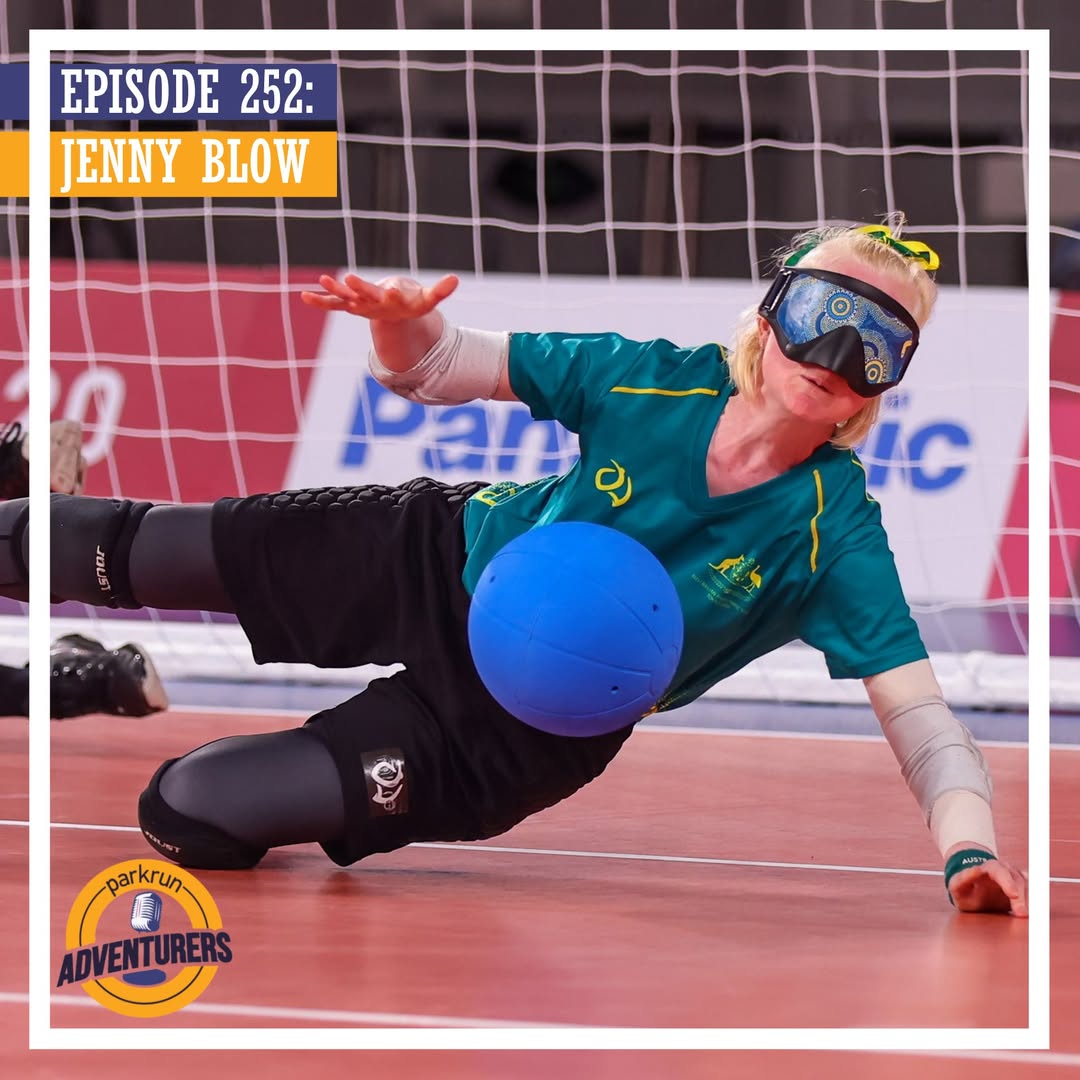
Interview Jenny Blow — Three-time Paralympian, Australian women's goalball team (Aussie Belles); Education…
Melissa Ellis: Our guest today is three-time Paralympian Jenny Blow. Jenny competes for Australia in goalball and is currently quarantining after her return from Tokyo. Welcome to the podcast, Jenny, and thank you for taking the time to talk to us today. Thanks, Mel. Thanks for having me. Oh, you're welcome. Firstly, I guess for those listening who don't know what goalball is, can you give us a rundown of how it began and how it's played?
Jenny Blow: Yeah, goalball started after World War II to accommodate blind veterans returning from the war. I like to explain it. It is like reverse dodgeball, but everyone's wearing a blindfold and you peg the ball at other blind people. Obviously, it's a little more nuanced than that. But yeah, the concept is it's for athletes with a vision impairment. Everybody wears a blindfold. The ball is 1.25 kilos, and you roll it at the opposition, so who are obviously also wearing blindfold. The ball has a bell in it, so we play by listening to the bell as opposed to seeing it, like most ball sports. And the aim of the game at the end of the court is nine-metre goals, and there's three players defending those goals. So we want to roll the ball into our opposition's goal and score, and the same thing, they want to defend their goal and then pick up the ball, and then they try and take a shot at our goal. Kind of like... I guess kind of imagine blindfolded soccer goalies, but there's three of them and the goal's nine metres.
Melissa Ellis: And even though you've got a vision impairment yourself, you still have to, everybody wears a mask.
Jenny Blow: Yeah, so like all Paralympic sports, there's a minimum disability. So I meet the minimum disability, which basically means I'm vision impaired enough to compete at the Paralympic Games. But I have quite a lot of functional vision. So if you saw me in the street, you probably wouldn't recognise that I had a vision impairment. If you saw me reading my phone up really close, then you'd be like, okay, she can't see very well. Yeah, and because of that, just to make it fair, because there's obviously athletes who are totally blind, everyone wears a blindfold. So it's all completely equal.
Melissa Ellis: Okay. And there's actually, there's three people on a court at one time, but you substitute people in and out during the game?
Jenny Blow: Yeah, three on court. And we usually take a team of six. You can take, obviously, you can take over a team of four or five. Generally, most countries will take a team of five or six. So you've got three subs on the bench and then obviously a coach and And we have an assistant coach and a physio on the bench as well. And you can do up to four subs in a game and then some subs at halftime as well. So you can sub quite a lot. But often we'll play a whole game with just the three players as well.
Melissa Ellis: Okay.
Jenny Blow: And how did you come to be involved in playing goalball? Completely by chance, to be honest. I mean, growing up with a vision impairment, I'd heard of it. I knew it was the sport for people who were vision impaired or blind. But I grew up just playing mainstream sports. I was never any good at them. Obviously, I used to play netball and you need to be able to say to play netball pretty good. But I just played mainstream sports. I never really thought about playing sports for people with disabilities. And then it wasn't until I was first year uni and my friends had met a lady who was running this schools program. So taking goalball into schools. I was studying to be a teacher at the time and they needed some helpers to run this program. And I thought, oh, great, this is great work experience. So I learned how to play the sport so I could teach it to kids. And then at the same time, she's like, well, actually, I was living in New South Wales. She's like, we don't have a New South Wales women's team for nationals. And I thought, oh, okay, well, I don't really care if I'm no good. I'll go to nationals. This sounds fun. And went to nationals and It wasn't too bad and came second. And then the Australian coach was there and said, hey, do you want to come to an Australian squad camp? I was like, same thing. I was like, oh, this is fun. Yeah, okay. Yeah, and then just kept going from there and never gave up.
Melissa Ellis: Wow.
Jenny Blow: So I did see that you're the youngest of three girls. Is that right? Yeah, I have two sisters. Even though my vision impairment is genetic, neither of them have a vision impairment. I'm the lucky one. But you grew up just, I guess, following along and doing all the same things that they did. Yeah, definitely. And I think I'm forever grateful for my parents just bringing me up just like a normal child. I always knew I had a vision impairment that wasn't, you know, it wasn't hidden or anything like that, but it was just something to be proud of. That was something that I was different, but I could still do anything that anybody else could do.
Melissa Ellis: Okay. And so do you think that like you played netball, I think I saw, that helped your ball skills with goalball?
Jenny Blow: Maybe. I've never really thought about it. Goalball is so different because obviously it's not even the eye-hand coordination. It's ear-hand coordination. I don't even know if that's a thing. It's completely different ball skills. But I think... Generally being active and athletic perhaps helped. So having, I guess, that awareness of your body or the gross motor skills probably helped me pick up goalball quickly, I think.
Melissa Ellis: And this was your third Paralympics. The Australian women's team is called the Aussie Belles and you competed in London in 2012 and in Rio in 2016 as well. So growing up, I guess you never imagined you'd be a Paralympian.
Jenny Blow: Not at all. Yeah, not even for a second. Like, I knew the Paralympics existed. I was, I think, nine or 10 when Sydney happened. And of course, every school kid in Sydney went to the Sydney Paralympic Games. So I knew they existed. But I just, I was never into sports as a kid. I was active. And like I said, I played netball. I did it for fun. But I was never good at anything, I guess, sport related. So... Yeah, not even a dream. And then you find a sport that you actually can play because it's fair. You know, playing netball against sighted people is not particularly fair. But once I did find a sport, I was like, oh, actually, I'm okay at this. So that was pretty cool to know that actually I'm all right at sport. I just hadn't found the sport that I guess suited my vision impairment. So tell us about Japan. What are some of your highlights there? Oh, I don't think it's sunk in yet. Yeah. So I'm still sitting here in hotel quarantine. So I feel like I'm still in this Paralympic bubble almost because I guess our whole Paralympic team's in various forms of quarantine in Australia. We didn't see much of Japan because obviously there was a lot of rules with COVID and whatnot. But it's still, I was kind of expecting it to be compared to like London and Rio Paralympic Games, I was expecting it to be quite, I guess, disappointing from the experience kind of side because of all the rules and you know, you weren't allowed to go out of the village. You weren't really allowed to socialise with any other countries. Australia, we had some extra rules, so we weren't allowed to go to the dining hall or anything like that because we were quite protective of staying COVID free. Obviously, some of the other countries have a lot more COVID going around. But honestly, it definitely was a different Games, but it wasn't disappointing at all. What I guess we didn't have In some of those experiences, we had new experiences. Like I don't think our Australian, in terms of a whole Australian Paralympic team, I've never been on an Australian Paralympic team that has been that close and that supportive of each other because we literally, that was the only people we saw. And we didn't go out of our allotment. We stayed in our allotment and things like that. So that was a highlight for me is just being part of this incredible team. And it wasn't about the people who won medals or the people who finished last. Everyone deserved to be there And everyone was super supportive of everyone being there. So that was a huge, I loved that. Obviously, competing or walking out onto a Paralympic court is always a highlight. And I think my second major highlight was the coverage. Some people listening, probably, hopefully some people listening know what goalball is because they saw it on Channel 7. We never, ever get any Paralympic coverage because we're such a small sport. No one's heard of us. But we got lots of coverage on Channel 7 and games shown live and things like that. So I think that was a huge highlight for me that it was on commercial TV with commentary. That's pretty cool.
Melissa Ellis: Wow.
Jenny Blow: And how did the team go at Tokyo? Yeah, so we ended up finishing – we got knocked out at the quarterfinals. So after you get knocked out at quarterfinals, we don't play playoffs. Okay. And that was the best ever result in the history of Australian women's goalball. So I think that's pretty good. We are a very small sport. Because we don't have an able-bodied counterpart, we don't get very much funding, very, very, very little. We do pay out of our own pocket to compete overseas. Even just our daily training environment, like strength and conditioning coaches and hall hire, equipment, all that stuff, we don't We pay ourselves. We work full time to support ourselves. So, you know, while people might be like, oh, you didn't come home with a gold medal, for us to, we beat the world champions, yeah, Russia, the world champions during, to get to the quarterfinals. We only got knocked out of the quarterfinals by Turkey, who ended up winning gold and have the best thrower in the world on their team. Our score in the quarterfinals was 10-6, which was the best ever score a team had against Turkey in the whole competition. So we did pretty well for a pretty small, underfunded team, I think.
Melissa Ellis: Oh, absolutely. And I note that as well as your training, as you said, you also work full-time and support Blind Sports Australia as a brand ambassador. So you're a busy lady.
Jenny Blow: And I try and fit in some parkruns when I can too.
Unidentified speaker: LAUGHTER
Melissa Ellis: Yes. So what's your role with Blind Sports Australia?
Jenny Blow: Yeah. So Blind Sports Australia asked us, all us girls on the Aussie Belles team, if we would be ambassadors for them. Like I've already said, Blind Sports in terms of all the different blind sports out there, that's been a huge part of the last decade of my life. I only discovered really blind sports when I was in university. Imagine if I was a 10-year-old or a teenager and I discovered goalball 10 years earlier before I started playing. So I think we're very passionate that it's not to say that if you have a disability, you have to be playing a sport specific for your disability type. But if sighted sports or able-bodied sports don't suit you or you can't get where you want to go in those sports, then more people need to know that there are opportunities for people with disabilities out there. So yeah, blind sports, we've come on board as ambassadors to promote blind sports. And in turn, in the last year, they've helped us out just providing resources and funding where they can, which is really good. So mutually beneficial. So is there schools out there that are introducing goalball? Yeah. Well, actually, part of my role, I'm a teacher. I was working as a teacher and I work at the moment for Paralympics Australia, actually, as the education manager. And a big part of the education program is we take goalball into school. We take a range of para sports, but goalball is a really accessible sport to take into schools. So we actually take goalball. into schools and teach some kids about goalball and things like that. So more schools are including it because, I mean, kids at school have probably played wheelchair basketball and things like that, but that requires a huge truck and trailer to transport all the wheelchairs. All you need is some soft eye shades and a ball that has a bell in it. And obviously for the kids at school, we play with a softer ball, not the 1.25 hard ball. Yeah, so it's really accessible for schools. So it's a great sport to play in schools.
Melissa Ellis: Oh, that's really good. So I believe you're living in Melbourne now and at the moment involved with the Achilles Melbourne Running Group. So how much of a difference do groups such as Achilles make in the vision impaired community?
Jenny Blow: Achilles is great. So I moved to Melbourne three years ago. And the one thing I love about Melbourne is there's so many great running tracks and trails. But whereas, like I said, I can walk around. I've got enough vision that I can walk around by myself. I can probably jog quite slowly by myself as well. But when you're in a new environment or a busy environment, we all know the Yarra trails, there's bikes and things like that. Or for me, a really sunny environment. You don't have the same amount of confidence just to be able to run. It's not as simple as just being like, oh, I'm going to chuck on some shoes and go for a run. It's a little bit more, a lot more thought process. You kind of have, when you are running, you have that fear like, am I going to hit someone? Am I going to hit a bike? Am I going to hit a tree? So having a group like Achilles is incredibly important, just to be able to access some physical recreation, in this case running, that otherwise I wouldn't be able to access, just like everybody else who's sighted. So I think that's huge. I don't know the statistics, but there's so many statistics about the importance of sport for everybody, but particularly the importance of sport and activity for people with a disability and a vision impairment. So it's groups like Achilles that make that possible. And then I think the second side of it, of course, is the social aspect. I've made so many friends and met so many different people through Achilles and I got introduced to parkrun through Achilles. I didn't otherwise know what parkrun was. That was going to be my next question.
Melissa Ellis: So, yeah, you are a parkrunner, Jenny, and you've done 10 parkruns at six different locations.
Jenny Blow: Which one do you call home? I think I signed up with Albert Park, so that's my home. I think I kind of, Albert Park and Parkville, I'm quite new to parkrun. I'm still, yeah, very much a newbie and obviously COVID meant I couldn't do as many. But I was thinking next Saturday maybe I should try a park, a 5K, not parkrun in my hotel room maybe. Oh, I definitely think you should.
Melissa Ellis: Yeah, so I saw that you, I think you only joined parkrun at the end of 2019. So yeah, that was not long before we went into the pause.
Jenny Blow: Yeah, and I think I joined through Achilles and I actually, that's another thing about Achilles because I wanted to go to parkrun a lot sooner than that. But again, being vision impaired in an environment with lots of people, different processes, like even the barcode scanning and things like that, You don't have the same amount of confidence just to turn up and give it a go because you're scared that there's going to be all these things you might miss or you might do something wrong because you can't see something. And, you know, you don't always want to walk into an environment and be like, can someone help me? I can't see. So I actually, you know, hit up someone from Achilles and be like, hey, can you, I want to go. Actually, it was Monica Wong. And I said, can you help me out? I want to go to my first parkrun. And that's why it was Albert Park. Yeah. Yeah, I assume people from Albert Park will know Monica. I believe I've met Monica. I think everybody's met Monica.
Melissa Ellis: Oh, that's really fabulous. So and you've been up to Fingal Bay as well. Was that on holidays?
Jenny Blow: Yeah, my parents live up Shoal Bay. So I think I've done Fingal Bay twice. And I've forgotten his name, but there was this with a British accent and he was the pacer. And I just followed him the whole time.
Melissa Ellis: And is there anything that you think parkrun could do to improve the experience for vision impaired runners?
Jenny Blow: Oh, no, I think they do a fantastic job. Maybe I guess they could say, promote more that if you because I guess I knew to contact Achilles to get help at parkrun, but maybe they could put on their website, like, feel free to contact us if you need a guide or need some help or want to meet up with someone or even, I guess, if you're even thinking about people with other disabilities who might need a support person. Like, I think every parkrun around Australia, if you messaged them and said, I need a hand, they would go above and beyond to help you out. I think people maybe just keep promoting that they're happy to do that because I think they would be.
Melissa Ellis: Okay. So have you been a runner for long? Like did you run when you were younger?
Jenny Blow: No. So I'm your typical COVID runner. So when the games got postponed, the Paralympic Games got postponed last year, I've been playing goalball since 2009. So pretty much since 2009. I've been playing sport and I've been training, whether it's cardio or strength or whatever I'm doing, it's all been because of goalball to get better, to be the best in the world. And then the games got postponed last year and it's really hard, it was really hard to train for games that are a year later than what you expected and games at the time, because we're talking, you know, June last year, are games that in my head I'm like, these games might not even go ahead. So it was really hard to maintain the motivation to keep training for a goal that was so, I guess at the time, so obscure. So for me, I quickly realised I need to train for fun and I need to go back because, you know, I love playing goalball. It's so much fun. But training for fun has not been the priority. Training has been to get better or to get stronger or to get fitter. So it's kind of like I needed to re-teach myself how do you train and work out and stay fit and run for fun, not just to be the best in the world. So I took up running because I loved I just loved that, one, it was easy and, one, you were allowed to do it during lockdowns. But also I loved that it's so black and white. Like you set a goal. You go, right, today I'm going to go and I'm going to run 5K. And it doesn't matter whether you run that fast or slow. You meet that goal. You run 5K. And then once I got a little bit faster, I was like, okay, well, I want to run 5K in 30 minutes. And it's so – that sense of achievement when you achieve that was great. So, yeah, I became a COVID runner and then I – set myself the goal last year of running a half marathon. And so I trained for that. And I, not in an official race, obviously, because there was no races, but ran a half marathon last year with some great people from Achilles who kept me up to a good pace. And yeah, now I'm hooked on running. And then I've joined with the 605 runners to do some trail runs. So now that Tokyo is over, definitely going to take up more running.
Melissa Ellis: I actually saw that you ran Studley as well. And I thought, gee, that would be a challenging parkrun course for somebody with vision impairment.
Jenny Blow: Yeah, that one is. I definitely did that one with a guide. And I think it was probably one of my slower times, but that's a beautiful course. Oh, it absolutely is. And your training partners, are they in Melbourne, like for goalball, or are they scattered all around Australia? No, I'm the only Australian women's goalball player in Melbourne. So training was very interesting. I don't know if anyone, particularly the people down in Melbourne, have seen on TV there was that ad with Sharon Strzelecki from Kath & Kim, and she's playing netball by herself and passing to imaginary teammates, even though they're not there. That was literally how I trained for the Tokyo Paralympic Games. I would have, like, my coach up one end throwing balls at me, and I would have just a helper down my end throwing pretending to be my teammates and I literally would call them by my teammates' names. So I had like as close as possible could emulate training with my teammates when it was literally just me.
Melissa Ellis: Wow. It must have been very challenging for, I can't imagine. Well, I hope that one day I could cross paths with you at parkrun. I hope you get out to do a lot more in the future when we open up again. But Jenny, it's been wonderful to chat to you and learn all about your sport. We wish you continued success and look forward to following the Aussie Belles as they continue to grow the awareness of the sport and inspire the next generation of vision impaired athletes.
[background music]
Jenny Blow: Thank you so much. Thanks for talking to me today.
Oliver Spake: And thank you, Jenny, and thanks, Mel, for that great interview. Firstly, well done, Jenny, and thank you for sharing, I think, some interesting insights into our goalball team and what seemed like a pretty decent tournament for them over at the Paralympics. I mean, Mel, they lost to the gold medalists, so you've got to be somewhat happy with that.
Melissa Ellis: Definitely. And I know a lot more now than I did previously.
Oliver Spake: Yeah.
Melissa Ellis: Just learning so much on this podcast, Ollie.
Oliver Spake: Yes. And again, love how our podcast family just set things in motion. It's awesome. We never know where we're going to go.
Melissa Ellis: I know. Thanks for that, Andrew. Thanks for helping tee us up with Jenny so we could hear all about her Paralympic journey.
Oliver Spake: Yes.
Streaky September
Oliver Spake: Now, Mel, another journey we're on at the moment. It's September. It's streaky September. I don't know if it's been swoopy September for you, but we're pretty much around the halfway mark. Are you still streaking?
Melissa Ellis: I am. I'm doing really well, Ollie.
Oliver Spake: Well done.
Melissa Ellis: I'm still going. And no, I'm not getting swooped.
Oliver Spake: Okay. I have to say, I have seen some slightly swoopier magpies up here. So I don't know if they've come north. Maybe, I don't know, it's seasonal. Maybe they're a bit disoriented. I'm curious if the masks are throwing them because I'm sensing a bit less trust than usually I sense from them in other years.
Melissa Ellis: Well, they do move around. So I've done my research on magpies because I feed my magpies. So that's probably contributing to my lack of being swooped because I'm friends with them all now, you see.
[crosstalk]
Oliver Spake: Yeah, yes.
Melissa Ellis: And from my research, I know that they don't nest in the same tree every year. They move around. So there's no nesting magpies in my street this year either. And there is one section and it's on my journey to my local supermarket if I walk or run, where I know there's a little swooping Maggie and I just go around that. I don't go down that stretch because I know he's there and I know he's just protecting his family and his little nest. So I just go a different way and I leave him in peace so he doesn't get stressed out.
Oliver Spake: Yeah, a bit of calmness.
Melissa Ellis: And, you know, I've got Brett, our Ellis Palace parkrun mascot. Yes. He's on my side too. Yeah. So it's all good, sweeping. Yeah, but anyway, yes, I'm going well with my challenges, Ollie, too. I've only got one that I haven't done so far. Oh, wow. I haven't found a stranger thing yet.
Oliver Spake: No stranger things. Okay.
Melissa Ellis: Not yet. I'm working on it. But what about you? Is your streak continuing? No.
Oliver Spake: My streak is continuing, loving the streaking, loving all of the inspiration, some of the fantastic photos, continuing to roll through the art, the spelling challenge. And, yeah, I've got a long way to go on the Bingoe card. I'm making progress. I've ticked a few things off at the weekend, so I was happy with that. But, yeah, it's going to take a bit of work.
Melissa Ellis: Ollie, you and I should have put Streak with a Troll on the Bingoe card and then we would have won.
Oliver Spake: Do we ever want to share what the prize is for the winners, Mel?
Melissa Ellis: We haven't got a prize. Oops, spoiler alert.
Oliver Spake: That's right. It's all about the journey. It's all about the streak.
Melissa Ellis: I've got so excited about streaking that I've entered a virtual ultra marathon. Ollie, I'm going to be streaking till Christmas.
Oliver Spake: Well, if you're doing 2Ks a day, potentially, yes, next Christmas.
Melissa Ellis: I think I need to up that for the ultra though. I need to do 5.6Ks a day.
Oliver Spake: Yeah.
Melissa Ellis: But that's okay.
Oliver Spake: Yeah, yeah.
Melissa Ellis: Not much else to do.
Oliver Spake: Ah, it's good to have that motivation, that's for sure. Yes. And, Mel, I suppose it's another week now, isn't it? Yes. And so by that I mean we need to level up again.
Melissa Ellis: Another challenge.
Oliver Spake: Yes.
Melissa Ellis: We've got to add to the card.
Oliver Spake: We do.
Melissa Ellis: Do you want to announce it?
Oliver Spake: I'd love to.
Melissa Ellis: Okay.
Oliver Spake: Thank you. It's very kind of you to give me that opportunity.
Melissa Ellis: I'm giving and caring. What can I say?
Oliver Spake: So in the spirit of giving and caring, we have received a few suggestions and thank you to those that have shared those suggestions because it's all about the streaking community that makes this so wonderful. And there's a lot of good vibes out there. So we want to see more good vibes. We want to celebrate the good vibes. So the level up challenge that is coming out on the Bingoe card, and of course, if you've seen it on Facebook already, before the time this podcast is released, you'll know all about it. It is kinder things. So not kind of things, things that are kind, kind of things, examples of kindness.
Melissa Ellis: Exactly.
Oliver Spake: What could that be, Mel?
Melissa Ellis: Well, Ollie, you might go past somebody who's put out a basket at their funeral, front yard of lemons, giving away for free. You might see somebody who's done some art. Like I know our friends, the Bomacantes, they have a local blackboard and every day there's somebody in their neighbourhood who does a beautiful, positive affirmation drawing and message on a blackboard every day for the public to enjoy. Okay.
Oliver Spake: And it's been, you know, I think one of the, dare I say, highlights of lockdown experiences is to see some of the chalk art on footpaths.
Melissa Ellis: Yes.
Oliver Spake: You know, there can be some lovely art which brings a smile to our faces. That's kindness.
Melissa Ellis: Yeah, it is, Ollie. And if you can't find an act of kindness in your local area, perhaps you could perform an act of kindness. Maybe you could write a positive affirmation on the pavement out in the front of your house for other people to enjoy.
Oliver Spake: That's exactly right. And, I mean, we've seen so much encouragement and kindness in the Facebook group, but, I mean, maybe just screenshotting the group is... Slightly underdoing it.
Melissa Ellis: That's a stretch. Yeah. Anyway, go out there, go forth and find kindness.
Oliver Spake: Yes.
Melissa Ellis: I'm reaching my arm out as in the grandest jolly. Can you see? No, you can't.
Oliver Spake: I can hear it through the airwaves. That's right.
Dazza's
Oliver Spake: And look, one of the Bingoe card items that I have yet to tick off is coffee. It's coffee at Dazza's. What? I haven't been to Dazza's. Shame on you. Sorry, Dazza. That's why I was in such a foul mood, obviously, after I'd wrapped up with Troll, all the highs, but I didn't have that coffee afterwards to keep me going.
Melissa Ellis: You had a post-Troll slump.
Oliver Spake: That's right. Nothing worse. But we did have some people that maybe not post-troll but had the highs of joining Dazza's.
Melissa Ellis: We did. We did, Ollie. And let's start with a couple of our streakers. We had Ingrid Botha. Just walking the dog today. We'll get out for a (not)parkrun tomorrow before it gets too hot. I'm really enjoying streaky September, but I'm going to have to stretch my brain as well as my legs to spell anything in my suburb. I love the challenge. And Peter Pohlman, we completed our suburb name in street signs this morning. And smiley, winky face there because Peter posted a photo, one photo of one street sign, which was Waratah Street. So... Well played, Peter. We also heard from Janet Reid, and she says, Puff, puff, pant, pant, shuffle, shuffle. Phew, just made it to Dazza's before closing time. A lovely morning aboard the mothership Lochiel. The highlight of today was Jeff doing his first parkrun since his surgery four weeks ago. He finished it in under 45 minutes, with 50 minutes being his goal. My heart was so happy. Then when I got home, I had a lovely long Zoom chat with a very special friend who is in lockdown. We talked all things parkrun, zombies, pods and palm22. And we may have had a glass of wine or two. Sending parkrun love and hugs to all of you in lockdown. You are all awesome. Thank you, Janet. And it was a very good post-nottie Zoom too. And we heard from Tracey Wood. Morning, team. I had one hand guiding a VI athlete and the other hand was signing to my deaf friend, so I didn't have a spare hand to take a photo. Never mind. It was an absolutely amazing morning at Kedron. I live for Saturdays. And so do we, Tracey.
Oliver Spake: Well and truly. We also heard from Bernadette Bennett, and she tells us in March 2020, October 2020, March 2021, and September 2021, we were supposed to be at a much-awaited family wedding in Melbourne. We planned to incorporate it into an eight-week tour with different parkruns each Saturday. In honour of our nephew not getting married again, we salute them with our not... wedding series of not parkrun week one the not buck show not parkrun a route planned around the map search for celebrations and scuttled by a last minute visit to corona street it's a nice a nice way to do it And Nadine Crawford. We went for our regular Not parkrun at Rosebud parkrun. Ran my best time in four years. Backed it up with coffee and a chat with a few locals at the local. May have also done a little Not parkrun tourism this week. Where will I pop up?
Melissa Ellis: Oh, I know, I know, I know. I spent the best part of the day trying to figure out where Nadine had been, a few messages backwards and forwards to figure it out, and she was visiting Wallaby Track.
Oliver Spake: Nice work.
Melissa Ellis: And she also did a super speedy parkrun, so well done on that, Nadine.
Oliver Spake: Yeah. Well done. And Richard, good morning, everyone at Dazza's. Cycling and running combination this morning. In answer to Mel's inquiry, and this is from last week's podcast, just for those that might not have heard, no, my sister in Canada is not a parkrunner. But luckily for me, when I get to visit, she is only 16 kilometres away from Downsview parkrun in Toronto. There's still time. You can register, Richard. Sam Schroder. Hi, Dazza. I got my (not)parkrun done on my home course at Picton today, plus a bit, and picked up a kebab kit for dinner while I was there. Luke is still deciding whether or not to go out for a nottie today. I tried to do a bit of nottie tourism to give Inverloch a birthday present, but computer said no. And sorry, sad face there, just so we're all familiar. If anyone has any tips on how to make a change of home parkrun stick for tourism, I'd love to hear.
Melissa Ellis: And we're happy to announce that Sam did manage to get to Inverloch parkrun. And we heard from our first Bailey shot, Tanya Bailey, lovely morning for our (not)parkrun on the trail. Stopped for a photo and a cuddle with Brunner. Chef Brett cooked a great breakfast, remembering 9-11.
Oliver Spake: Brett Bailey, Woodend Beach Not parkrun with Tanya and Brunner on the Tūhaitara Trail. Got you there, guys. Some ducks in the background, Mel. Snowy Alps in the distance and a brisk two-degree start. Home for a Bailey Cafe full-cooked breakfast. To which Rebecca Bailey replies, you could stump Mel and Ollie with the full name of the trail, Tūtaepatu Trail in the Te Kōhaka o Tūhaitara Trust Coastal Park.
Melissa Ellis: And thank you for that, Alison. And ha-ha, Brett, we outsmarted you.
Oliver Spake: Good help goes a long way.
Melissa Ellis: And Rebecca Bailey, beautiful morning for a Banksia Avenue not parkrun, time to the morning light under the bridge and even met a special visitor or two along the way. And, of course, we already know who they were.
Oliver Spake: That's right. Now, we also heard from Val Warwick. Oh, Dazza, that dad joke. I was a big fan too, Val, by the way, on tokens at Devonport, but got my SS number two short walk in beforehand while listening to Mel, Ollie and Lyndell, partly. Does part of a pod count in bingo, I wonder? It's cold and overcast, but that's the way of spring, isn't it? And as I write this, the sun comes out. Thought you might like this shot of one of our scanners continuing to send love to all in lockdown.
Melissa Ellis: And we should probably mention that the scanner was wearing, was it a blanket, Ollie, that signified the Melbourne Football Club who has just made it into the grand final.
Oliver Spake: How do you feel about that, Mel?
[crosstalk]
Melissa Ellis: Oh, I'm on board.
Oliver Spake: Good.
Melissa Ellis: I'll back them because my good friend Sally Heppleston, she's a big Melbourne supporter, so I'm going to be hoping with all my heart that they come through with the goods for Sally.
Oliver Spake: Excellent. Way to go, Val. Ten points. And we also heard again from Val, second order, popping back to Dazza's. Thanks for the coffee. It invigorated me and I could take another walk listening to the pod and enjoying again the company of all of last week's get-together at Dazza's. Definitely a welcome to Lynette and to Dazza's. Love your work, Ollie and Mel. Thank you for the pod, a highlight of each week.
Melissa Ellis: Aww.
Oliver Spake: Now on the parkrun Trails, we heard from Claire Statchbury, ticking off event number 97 at Central Lakes this morning. My 196th run, 34th in Queensland and 41st in streak. And another 0001 token for Jack Corkill. Well done, Jack.
Unidentified speaker: Mm-hmm.
Oliver Spake: Linda Coombes, a chilly three degree start that warmed up quickly in Warwick. Bella Dog did her customary 500 metre flat out 1.5K dawdle, 500 metre puppy anchor routine before volunteering in the chief pat receiver volunteer role. Good work, Bella Dog. Chris Hood, an F, a stopwatch bingo number and a lovely run at Forest Lake. Achievements. And Pippa White. So, slightly late to Dazza's because totally arbitrarily, I've just completed my 200th day of volunteering and my 250th volunteer role at Riverside Juniors. So, hot chocolate, please, Dazza. And fantastic work there, Pippa. Well done.
Melissa Ellis: Yes, congratulations, Pip. Wow. Wow. Busy morning. Lots of achievements going on.
Oliver Spake: Very busy. Just as well I didn't pop in, Mel. There would have been no coffee left.
Melissa Ellis: Well, well, probably time, I would think, for us to hear what our informant has for us this week, Ollie.
[background music]
the Informant
The Informant: This is the informant. These are unofficial stats. They are only counted the time they are collected and may differ from the stats you read elsewhere. Alas, parkrunners, it has been a tough week in Stat Central. It appears the spreadsheet has burst its seams and will require a fair amount of welding before it is back into any kind of useful shape. It seems a migration project is going to be necessary over the coming week to keep this show on the road. Or else you may not get your number fixed next week. The number of global events hit a post-COVID record of 1,292, which included the return of Ireland and seven launches, one in Denmark, one in Germany, two in Ireland, one in Poland, and two in the UK. There were 254 runs in Australia, up 45, and New Zealand is still on a break. Aussie New Zealand attendance was up 3,000 to 21,282, that of 164,627 worldwide, which is 2,000 more than last week. Down under we had 2,566 PBs, while 721 people participated for the first time. 51 juniors reached their Junior 10 milestone, 101 people reached their 50 milestone, 68 reached their 100 milestone, and 12 people reached their 250 milestone. All up by a few on last week. Nine people called bingo. Greg Edwards was the quickest with 158 events. Eric Velvick was slowest on 356 events. Just two new statespeople this week. Will Rolfe and Mick Cruz in the Northern Territory. No movement at all in the top 20 most events list. Overall biggest mover was Elaine Rogers, moving up 18 places to 222. 46 people increased their Wilson Index. Biggest Windex mover was Alan Raven, who moves up a healthy 27 to 62. Last week, I had an email. It was a glorious sight to see that little envelope pop up on the screen. A regular listener from South Australia asked if I could do a report on the Alphabeteers. You bet your corduroy trousers I can. Prior to last weekend, there were 264 Alphabeteers in Australia and 9 in New Zealand. Queensland leads the race by far with 140, followed by Victoria with 54, New South Wales one less, 53, there are 7 South Australians, while ACT, WA and Northern Territory have 5, 3 and 2. Where does Tasmania sit? Off the south coast of Victoria with no Alphabeteers. To see these stats in full, look for The Informant on Facebook or visit the blog at www.theinformant.me. That's The Informant, all one word, dot M-E. This has been The Informant, and my spreadsheet is bigger than yours.
Oliver Spake: And thank you very much to our informant. We appreciate all of your help and all of your support.
Consolidated Club Report
Oliver Spake: Mel, would you like to give us an update on our Adventurers Club?
Melissa Ellis: Ooh, definitely. So we actually want to thank Johan Duvenhage from South Africa who alerted us to the fact that our Adventurers Club wasn't available to international parkrunners to join. So we had a few emails backwards and forwards with parkrun support and we got it changed. So we can now have our international friends join us and Yay, in our new club. And we're up to 42 members. Hooray. Hooray. So we had 16 members on the consolidated club report. And I can't tell you how many notties we had because when I went to look today, it had ticked over to the new week and I couldn't figure out how to check what last week's was.
Oliver Spake: Ah, yes.
Melissa Ellis: I'm sure there's a way. I'm just still yet to figure it out.
Oliver Spake: All right. Well, we'll have to ask our informant.
Melissa Ellis: Oh, yeah, true.
Oliver Spake: Yeah.
Melissa Ellis: Yeah, he'll be able to work it out. He's so clever.
Not parkrun results
Melissa Ellis: But we probably should give an update on this week's not parkrun results or last week's not parkrun results, should we, Ollie?
Oliver Spake: I suppose we can. I suppose.
Melissa Ellis: Competition was pretty fierce.
Oliver Spake: It was.
Melissa Ellis: Mm-hmm.
Oliver Spake: Yeah.
Melissa Ellis: And so Inverloch came in number one.
Oliver Spake: They had a big weekend. Yeah, they kind of did. They did it both ways.
Melissa Ellis: They were fortunate enough to come back from the pause, or pause number three or whatever we're up to here, with their birthday this week, seventh anniversary for Inverloch parkrun. Yes. So a big return for them. And, yeah, and they took out line honours in the (not)parkrun results with 90.
Oliver Spake: 90. Wow. That's a lot of Not parkrunners.
Melissa Ellis: It is. Not quite the 100 I think they were aiming for, but not a bad effort nonetheless. Topping Wyndham Vale, who came in second with 75. So stellar effort from Wyndham Vale.
Oliver Spake: Yes, yes. Well done, Wyndham Vale.
Melissa Ellis: Shellharbour was eighth, Ollie.
Oliver Spake: You're skipping down the list a bit there, Mel.
Melissa Ellis: No, we can't read out everybody.
Oliver Spake: Well, I want to give a shout out to Port Macquarie in third there. Good to see some representation up the coast.
Melissa Ellis: Okay, well done.
Oliver Spake: But yes, yes, very proud of Shellharbour's effort.
Melissa Ellis: And Toolern Creek. We were 20th.
Oliver Spake: Fantastic.
Melissa Ellis: With 10 and a special guest visitor this week.
Oliver Spake: Yeah.
Melissa Ellis: Thank you for visiting, Ollie.
Oliver Spake: There have been a few visitors here and there, haven't there? But look, I'd love to get there in person, obviously, but hey, you know, desperate times.
Melissa Ellis: And I thought we should give a special mention to the Westerfoldians. Westerfolds parkrun, they came in number ninth, so just one behind Shellharbour with 28 runners. Well done. And I visited the beaches.
Oliver Spake: Oh, what was that like, Mel?
Melissa Ellis: A lot warmer than currently in Melbourne, I must say. And I probably podiumed because there was only three.
Oliver Spake: Oh, well done.
Melissa Ellis: Yes. So, yeah, that's your little roundup for last week's notties.
Oliver Spake: Yeah. Well, we're back in another week, so enjoy your not parkrunning, everyone. Oh, and of course, everyone, enjoy your parkrunning. But Mel, it's also coming up is another important week.
Melissa Ellis: I know. Would you want to tell us about that, Ollie?
Oliver Spake: I would love to. So coming up.
National Week of Deaf People
Oliver Spake: Beginning the 20th of September is the National Week of Deaf People. So the National Week of Deaf People is a week-long national celebration in Australia of deaf individuals and the Australian deaf community, which includes celebrating the International Week of Deaf People and International Day of Sign Languages, which are initiatives of the World Federation of the Deaf. These two events are traditionally held during September and are based on the founding date of the World Federation of the Deaf, which is the 23rd of September, 1951. It's an opportunity for deaf people to celebrate their community's language, culture and history, make the public aware of their local, state and national deaf communities and to recognise their achievements. It's also an opportunity for organisations involved with or wishing to be involved with the deaf community to build and maintain relationships with deaf people and be recognised as an ally to the deaf community. And so, Mel, the theme this year for Deaf Australia is chosen the same theme as the World Federation of the Deaf, and that is celebrating thriving deaf communities. And everyone is encouraged to use the theme when considering their events and to see as many events as possible partaking in this celebration and personal achievements recognised this year.
Melissa Ellis: Oh, that's good. Thank you for that, Ollie. And I think we might find that one of our very own Channel 5 News crew in training might have more to say about this very soon.
Oliver Spake: Yes. Stay tuned, everyone.
Sign-off
Melissa Ellis: What are your plans for next week, Ollie? Have you got, I mean, coming off the highs of the troll visit? I mean, can you top that?
Oliver Spake: Very hard to top a troll, unless you're on a bridge, I suppose.
Melissa Ellis: Or a billy goat.
Oliver Spake: Yeah, so no, no grand plans. I know that I do need to get to Dazza's. I do need to get to Dazza's and I do need to find me a flightless bird amongst other things. So if I haven't achieved those by the weekend, Mel, I believe my (not)parkrun will.
Melissa Ellis: Excellent.
Oliver Spake: Yes. What about you?
Melissa Ellis: Oh, no. I'm tipping that I will be running around my block... And waving across fondly to Toolern Creek parkrun, wistfully hoping for its return. But, yeah, no theme yet decided. But, you know, there's a couple of ideas in there. I mean, maybe I need to revisit something to do with New Zealand. Maybe I need to learn some sign language. I don't know. Okay.
Oliver Spake: I think our podcast family have given us plenty to work with.
Melissa Ellis: They have.
Oliver Spake: Yes.
Melissa Ellis: Absolutely. So anyway, I think that's probably it for this week, Ollie. As always, you can contact us via Facebook or on our email, which is parkrunadventurers at gmail.com. But that's it for another week. We'll see you all next week for more adventures.
[outro theme playing]
Unidentified speaker: Bye.