
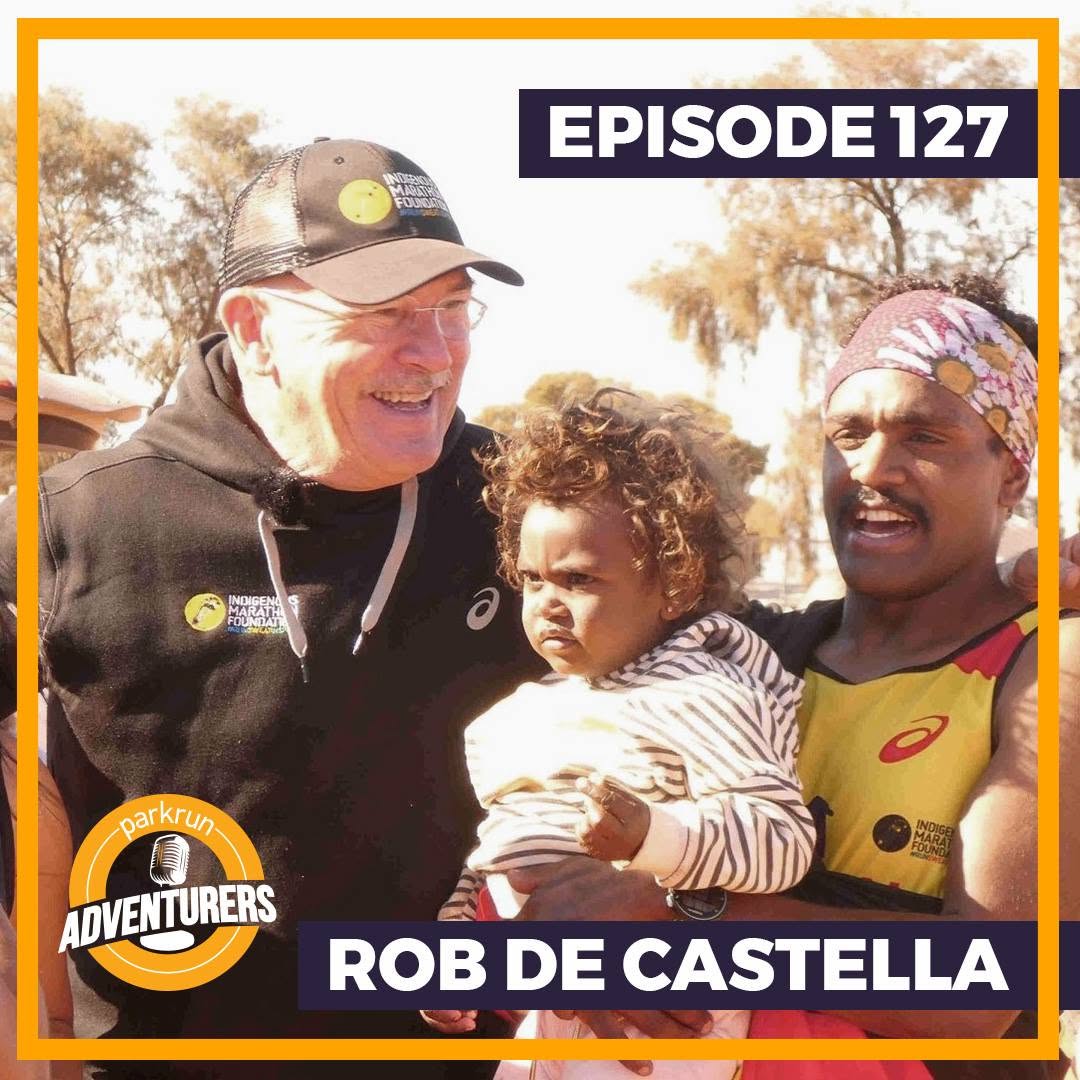
 — open the full-size cover
Episode 127 - Rob de Castella
Episode details · · 234 speaker turns · sound cues from context
Enhanced transcript
Speaker names appear where they could be established with confidence. Others are shown as “Unidentified speaker”. Sounds that are not speech — music, laughter, people talking over each other — are written in [square brackets].
Episode 127 - Rob de Castella · 2018-08-29
Enhanced transcript — Produced by an automated editing pass — speakers named, sound described, segments marked. NOT yet checked by a person.
Speaker names appear only where they could be established with confidence; others are shown as “Unidentified speaker”. Non-speech sound is in [square brackets].
Source: https://log.5kadventures.net/transcripts/ep127.html · The Adventurers Log · An independent project, not affiliated with or endorsed by parkrun.
Welcome
Scott Trickett: Another week has passed, which is perfect timing for another episode of the parkrun adventurers. My name is Scott Trickett. Welcome Mel Erbacher.
Melissa Erbacher: Thank you, Scott Trickett.
Scott Trickett: This is a podcast all about parkrun and parkrun adventures. And on the weekend, as the two hosts of said podcast, we like to get up to the odd adventure here and there that are parkrun related. This week, Mel, I went in search for my E, for my alphabet. A little bit elusive, the old E. It's a vowel, but not many places are named. With the letter E. Names starting with the letter E. But we launched... We've got a couple in Victoria. We do. We've had a couple of new ones recently. And we launched Eastern Gardens on the weekend. Now... You might have seen this on TV, or you may not have because you were all at parkrun. I hope you were all at parkrun, but we were on the TV. Channel 7 Sunrise were down there to help celebrate.
Melissa Erbacher: You're silver screen famous.
Scott Trickett: Yeah, well, I don't think I got my fat head on the TV. We did record it and we watched it. I made sure the attractive people in my family, i.e. my wife and daughter, I pushed them in front of the camera as much as possible. But I, working in this space for a number of years, I've learnt how to avoid the camera. And the best trick is... Know where to stand. Yeah, it's behind the cameraman because he's never going to pivot to get a shot just of the guy standing behind him because that's not a great shot.
Melissa Erbacher: Fair enough. Did you have a good morning? Was it fun?
Scott Trickett: I had a great morning, but I was working.
Melissa Erbacher: Television at parkrun, that's not an every week thing.
Scott Trickett: No, it's not. It's not. So I'm sure everyone listening to the podcast is aware that Medibank have launched their free and active initiative. And under that is they want to get more people moving, which is a great, great idea. And they've helped us launch 40 events. And Eastern Gardens was the 40th event under that. And so we had a celebration. And it was a very different launch. Like if you came along to Eastern Gardens, Don't expect that to be a regular because we had free coffee. We had coffee machines set up. We had massages for God's sake. You could have finished your parkrun and then grabbed a massage if you wanted to. We had picnic blankets down. We had this massive awesome PB bell. And as I said in the TV show producing live crosses every half hour, They got to run through a banner, like an AFL-style footy banner, that I'll peel back the curtain here a bit, Mel, in the discussions, because as you know, you know that I work for parkrun, and in the discussions we were planning this event, and the banner idea was thrown around by our colleagues at Medibank, and I wasn't sure how it was going to work. But they assured me that it was going to be good. People were going to have fun, get into it. And I was wrong. They were right. People loved running through it. Visually, it looked good. But it's not the normal. It's not the normal for a parkrun launch. But the biggest disappointment of the day is that because I was working, I didn't get my E. at the end of the day.
Melissa Erbacher: You didn't run. I didn't run. Oh, so you can't tell us about the course then.
Scott Trickett: Well, I can because I've walked it and ran it a few times in preparation and it's a lovely course. It's a sort of an out and back and then it's a bit short so you've got to do a little bit extra out and back so it can get a bit confusing at the end, particularly with over 300 people but... Well, maybe simpletons like me could get confused, but not many people in the day got too confused. But it's a nice little path in a beautiful location of Geelong, down by the bay. You've got tree-lined avenues all the way. About a kilometre in, you run under bats. So what I did do is I walked.
Melissa Erbacher: You run under bats, as in like the flying kind of bats?
Scott Trickett: Yeah, the flying bats. They're all in the tree.
Melissa Erbacher: Presumably asleep.
Scott Trickett: Yeah, asleep and hanging upside down. So they're all there. And what I did do is I walked with Kasia, who wasn't feeling great. So we walked just a little bit because she wanted to run through the banner or I wanted her to run through the banner. So I made her do that. Then I caught up to them and picked Kasia up. But we got to the bats. And I think the kids are going to love it because Kasia was perked up and she was excited to see the bats. So there's lots to see at Eastern Gardens. And it's good because I'm going to head back there. I'm reinvigorated on my alphabet challenge because I'm pretty close. I'm surprisingly closer than I thought.
Melissa Erbacher: How many letters have you got to go?
Scott Trickett: Don't get into specifics, but it's only a couple. I plugged my numbers into the Chrome extension last week and I'm really close to the bingo challenge. I'm really close to the Bee Gees challenge, which I had no idea about.
Melissa Erbacher: You know, I actually plugged it in last week too and had a look. Yeah.
Scott Trickett: What inspired you?
Melissa Erbacher: I wanted to know whether one of the indexes that Danny had mentioned to me was on there and it's not. So I don't know how one goes about trying to figure out how far up that index is or whether or not they just have to – like manually figure it out and which way too much work for me so I won't be pursuing that.
Scott Trickett: I think we were motivated by the same reason because I was listening to With Me Now and they were cracking on about it and they mentioned something about some index I've forgotten now but it wasn't there either. So either down is long or it's selective to UK. I want to say the Wilson Index.
Melissa Erbacher: I'm pretty sure the Wilson Index is there.
Scott Trickett: Yeah, that's it. That's it.
Melissa Erbacher: Well, maybe it is there and it says three for me, but it doesn't elaborate on what all my other missing ones are. So it's like, well, if you want to join the dots to get further along, then how do you know? Like, I might not have done event number four, but... I could have done five, six, seven, eight, nine, you know, for all these other ones. And it's kind of like a game of Tetris. If you just get number four, then boom, you sort of clear all those extra ones as well. So I want to know how that works. I think we'll have to get in touch with Mr. Norman and get the inside word.
Scott Trickett: So if you don't know what we're talking about, where have you been? But if you've got Chrome and you install an extension called Running Challenges, what it does is it links up your background profile with all these extra challenges that are unofficial. But certainly for adventurers that listen to this podcast, they will love it. It's a bit of fun. We should make it official. Let's knock on some doors. Let's make some calls. Well, maybe let's not. Let's just leave it unofficial. Shut up, Scott. Say something, Mel.
Melissa Erbacher: I'm trying. I'm trying. I want to give a shout out to the guys at Running Challenges for creating the Chrome extension for starters, but also for being nice enough to admit that their Compass Club is the wrong Compass Club. Really? Even if it's the popular one in the UK or wherever, they have acknowledged that it's not the right one.
Scott Trickett: So kudos to them. That's good.
Melissa Erbacher: And they tweeted us. Yep. How are you going on Twitter lately, Scotty?
Scott Trickett: I'm loving it. Loving it. Check in every day. Check all my tweets and my retweets.
Melissa Erbacher: You know where we haven't been lately? Strava.
Unidentified speaker: Yeah.
Melissa Erbacher: It's been a little while.
Scott Trickett: Look, I'm going to bring it up before you do. My August challenge – I know, it failed miserably – Nobody came along for the ride, so I don't feel too bad about it. But if you recall, I had the Freedom Challenge once a week.
Melissa Erbacher: I was there for the ride the first week and you didn't join me.
Scott Trickett: I was there for the week before August started.
Melissa Erbacher: That's not how these challenges work, Scotty.
Scott Trickett: There's flaws in my challenges, but that's okay. That's okay. We'll save that for another August. But Streaky September's in the books. Big time in the books. Close the books on that one. It's happening. Countdown's on, literally. You might even be listening to this and you've missed the start.
Melissa Erbacher: No, surely not. Hopefully not. Shall we elaborate, though, a little bit more on Streaky September later and get to our interviews?
Scott Trickett: We should. It's a cracker this week. Our most requested guests when we did our perlustration, which is also coming up, Next month or the month after. I love Perlustration time.
Candy: Perlustration's great.
Scott Trickett: But yeah, enough of us. Let's go to our guest.
Interview Rob de Castella — Founder, Indigenous Marathon Foundation; Australian marathon great
Scott Trickett: Our guest this week is very familiar to everybody involved in running in Australia. He's arguably our most famous marathoner, runner. Welcome to the parkrun adventurers, Rob de Castella.
Rob de Castella: Hi, Scott. Great to be able to join you.
Scott Trickett: Thanks for joining us. You're a legend of running in this country, Rob, but what we want to talk to you about is your involvement with IMF. We also want to get back to your running days, but... This weekend at parkrun, we're celebrating the Warrior parkrun, and you've got your Warrior Run. I'm curious, if we go right back to the beginnings, why did you start IMF?
Rob de Castella: Well, I mean, yeah, this is our, we're heading into our ninth year now, so we started back in 2010. And initially, the whole thing started because I sort of had a random phone call from a guy in Sydney who wanted to do a documentary and he said, look, you know, he said, you know, my brother's just run his first marathon and I just ran the city to surf and he said, oh, you know, do you think Indigenous Australians can run like the Africans? Do you think there's that, you know, fundamental physiological long distance endurance ability? And, you know, as you know, you know, the Africans dominate everything on the world stage. So it was a pretty interesting sort of a question to ask, you know, to see whether maybe it would be possible to one day find, you know, one of our Australian Indigenous men or women who had that fundamental capacity to take on that African dominance. So, you know, we started, you know, sort of on this little project. And as I said, he wanted to do a documentary, wanted to select a group of young Aboriginal men and follow them and train them for about, you know, six to nine months and then take them to New York. So, you know, we started and we ended up with four Aboriginal fellas, you know, two from Alice Springs, one from up in the um, uh, remote community of Maningrida and, and another one from the Kimberleys in Kununurra. And, uh, and, you know, we sort of, uh, those fellas didn't know what a marathon was. They never, never heard of the New York city marathon, never even heard of the city of the surf or fun run. They were all very much footy and basketball based, but, um, you know, sport was a big part of their lives. And, um, It was the first time, I guess personally, that I had an opportunity to get out into some of the more remote parts of the country and see face to face our indigenous culture and also be confronted with what was a very disturbing situation. I mean, I've travelled all around the world and been to a lot of third world countries and to see the dysfunction and the poverty and the problems face-to-face in our own backyard was something I was a bit ashamed of as a proud Australian to see our First Nations people in such a state of dysfunction and so many problems. So, you know, sort of it was very confronting. But then on the other hand, it was incredibly... thrilling and rewarding to see the beauty of our Indigenous culture and to be welcomed into the families and into the communities and work with those four fellas and their families. And it wasn't so much as we progressed along, it wasn't so much the grog and the obesity and the diabetes and all of the chronic disease that disturbed me the most. The thing that disturbed me the most was was the lack of self-respect and pride. It was like a culture of hopelessness and an attitude of why bother? Why should I bother going to school? Or why should I bother getting a job? Or why should I bother getting off the smokes? Because there's nothing for me. And it was that hollowness that really disturbed me the most. And what I saw when those four fellows eventually made it across the finish line in New York was the opposite. You know, I saw this incredible pride of accomplishment and this sense of achievement of doing something that was really, really hard, you know, sort of running their marathon off less than six months of training and only one of them had ever got over 30K. The others had struggled to get through 20K. But on the day they all finished, And it was that pride, I think, which made me realise that maybe there was an opportunity to use running and to use the marathon, not to find an elite runner, but to find and to promote a sense of pride and self-worth and obviously help the active lifestyle through. So that was the start of it. And that was back in 2010. And as of last year, You know, we've now got 75 Indigenous graduates with men and women. We take six men and six women, 18 to 30-year-olds, from right across the country every year. So we have a squad of 12 that we work with and coach and put through a compulsory education component and then, you know, take them over to New York and get them to do something which is so far outside their comfort zone that when they do achieve it, the sense of personal pride, but also the shared pride that their families and their communities have is just amazing and it's empowering and it's life changing. And then we work with them when they come back. Getting them to run a marathon is great, But if that's all we did, then we'd fail. We have to actually then work with our graduates and those 75 and provide opportunities for them to continue to grow and develop and make a difference. And that's what we do as a foundation, as a charity, is we raise funds so that we can provide them with grants and scholarships and help them to set up their own running groups and help them to get kids involved through the communities and through the schools. get the elderly out walking and exercising. So it's a whole range. And it flows on beyond just running as well, helping them to maybe go to university for the first time ever or to start a small business or to do things which address some of the really personal issues that they've struggled with and they don't want their children and their nephews and their nieces to have to go through that same thing. So it's an incredibly... empowering and a powerful journey that we take them on and then, you know, work with them beyond that marathon to support them to drive change.
Melissa Erbacher: Rob, there's no doubt that IMF is making a massive change to a lot of people's lives. You mentioned that, you know, you're in the ninth year now and obviously your goals and your motivations for doing the project have changed from, you giving people that sense of pride. It's been an evolution. How do you, let's say, how has it changed in terms of how you picked those first sort of intake to how you recruit now? What's the process involved behind that? How do people apply?
Rob de Castella: Yeah, thanks, Mel. Yeah, look, it has changed and it's grown enormously. You know, when we first started back in 2010, you know, we struggled to find four fellas, you know, they were getting a free trip to New York and we still struggled to find them and they didn't know what a marathon was. So that wasn't so much of a disincentive. But now, you know, we have nearly 150 applicants every year and, you know, they are amazing young Aboriginal and Torres Strait Islanders who pretty much just had a gut full of the way things are and want things to change and be better and they want to be part of that that future um so you know we um I've got you know three of our graduates who work with me full-time here in Canberra in our head office uh and one of them Adrian Dodson-Shaw from Broome um he he ran with us back in 2014 uh 2015 he he uh I took him up to the north pole one of our our supporters donated a couple of entries to the north pole marathon So Adrian and I went up there and he ran his second marathon up right on the floating ice of the North Pole, having never seen snow before coming from Broome. So he's an amazing, strong individual. And then I really was keen to have as many of our graduates involved in helping strategically and operationally delivering our foundation. He came with his family from Broome and now he's based here in Canberra and he manages the program and his job is to interview and screen every applicant. So he travels around the country for nearly six weeks on the road interviewing the applicants and a little bit of physical testing. The girls have to do a 3K run and the guys do a 5K run but the most important thing is the interview and they need to they need to tell Adrian what their purpose is, you know, what their drive. And when they hit the wall at 30K in their marathon, where are they going to go? What are they going to go to to dig deep, to keep them going when their body's saying, I want to stop, I want to quit, it's all too hard. But they have to have something deep inside them which is going to keep them driving forward. And then we also have to see in them the capacity to be these change agents, these, you know, inspiring leaders and advocates for a better future. And we work with them to cultivate and refine and develop those attributes. But we have to see within them the potential to be those leaders. So, you know, they're the two things. One is, you know, what's going to keep them going when they hit the wall? And the other is, you know, will they be able to channel that into driving change across Australia. So that's the basic criteria that we use to select the 12. A lot of them obviously miss out. We have nearly 150 applicants, so a lot miss out. But because we work with 18 to 30 year olds, if they're, as long as they're not 30, then they have an opportunity to come back and try out again next year. And we want to see the sort of people who don't give up. Just because you missed out this year, If you give up and walk away, then you're probably not the right person for IMP anyway. So we want people who are not only going to try out again next year, but also add to their story, you know, demonstrate through what they're doing that they do have that leadership capacity that we're looking for. And, you know, we had one of the fellas in the squad, 20, Fifteen, Zibeon Fielding, who's the face on our Warrior Run medal. It's just amazing to be able to acknowledge and recognise Zibeon. Now, Zibeon tried out four times before he finally got in, and he's from a tiny little remote community called Mimili with about 300 people in the APY lands in remote South Australia. And what he's done since his IMP period journey as a graduate has just been amazing. You know, he's raised over $50,000. He's a nurse practitioner, a health worker in the Mimili Clinic. So he's working every day with local Aboriginal people struggling with chronic disease and health problems. And he's, you know, not only passionate about driving change, but he's actually out there leading. And he's a the sort of person that we want to acknowledge and recognise as our warrior, as a noble warrior who is out there fighting for a better future and driving change. And so it's great to be able to recognise him. But he's really, for years and years, tried out and missed out and came back the following year. He was always close, but just never made it until we finally selected him.
Scott Trickett: Rob, I love this idea of change agents from your grads, and Zibeon is a great example. So what's the success rate of all your other graduates going through the program? Do a lot of them go on and make a difference in their community? Have you got some stories around what that difference means, what it looks like?
Rob de Castella: Yeah, yeah, look, absolutely. Out of the 75, there's probably about 60 that are still actively involved. We use a lot of social media and even those that we don't, you know, sort of work with and hear from, you know, every few weeks or so, they're still engaged and following us and then, you know, sort of something will happen. Like, you know, one of the guys from 2011 from Sunbury in Victoria, you know, I saw on his Facebook that he just, started his own little electrical business with a mate. He's an electrician. So I sent him a little note and, you know, came back with this huge big spiel about how proud he is and what he's done. So they're still doing things which are amazing. A lot of them don't necessarily continue running or running marathons, but then we've had others like, you know, Charlie Maher, who was our first IMP graduate, Back in 2010, he's run five marathons and has just continued to drive change. He started off in Alice Springs and now he's a director of the Clontarf Academies in Port Macquarie and he's started a deadly running, an indigenous and non-indigenous running and walking group called Raw Running and Walking. And he's got over 150 participants, he and his wife, in this stuff, deadly, Port Macquarie deadly. So, you know, there's so many stories about the graduates. I mean, every single one of them are amazing. And, you know, Social Ventures Australia, which is a big research and evaluation company, did a social return on investment evaluation of the program and followed three years of our graduates and looked at what they were doing before and what they were doing after and the impact that they've had on their lives and on the lives of their communities and families. And they tried to quantify and measure that and give it a dollar value. And they, after, you know, a huge amount of work and interviews and analysis, calculated a 6.6-fold return for every dollar that's been put into the IMP program. It's generated a 6.6-fold return. So, you know, I think, not only in terms of the life-changing experience, but the benefits to the community and the benefits to the country are just so clear and so strong. And it's just been amazing to see the way the graduates have just continued to step up. And it's like, you know, sort of, you know, when you run a marathon, anyone who's run a marathon, you're never the same afterwards, are you? I mean, you know, you push yourself so hard and you've been struggling, but your mind is so strong to keep you going and to stay positive. And then to be able to transfer that to other areas in your life is such a life-changing and powerful thing to go. Like a rite of passage, you know, it's something which we're using to really, you know, have our graduates realise how strong they are and also the impact that they can have on others, which is just amazing.
Melissa Erbacher: I love that you're finding leaders and you're giving them the skills and empowering them to, you know, continue the impact. So it's all just going to filter on and on like a big domino effect and it's getting out to the most remote areas as well. You mentioned Zibeon is the face on the Warrior Medal. I've got one of those in the post on its way to me at the moment. Rob, can you tell us a little bit more about the Warrior Run for those who haven't heard of it?
Rob de Castella: Yeah, absolutely, Mel. I mean, the Warrior Run, this is our fourth year, and we have a major event in Centennial Park. And, you know, I want to build it up to be a fundraising initiative for the foundation, you know, a little bit like the Mother's Day classic for breast cancer. I want us to be able to use the warrior run to celebrate and acknowledge men as these noble warriors. You know, sort of women, and rightly so, get a lot of, you know, Mother's Day is a really important event and day on the calendar. But it's so important also for us to recognise and celebrate and acknowledge men and the really important role that men play as fathers and brothers and uncles and grandfathers and sons, and the contribution that men make to families and to communities. So our warrior run is about acknowledging and celebrating and recognising those men in our lives who have helped us to be the great person that we are today. It's a little bit of a tribute run, So we have a 5K and a 10K, a 10K run and a 5K run walk in Centennial Park. And then we also have a kids and dads or kids and parents dash, a little 2K. And we also, it's an opportunity for us to showcase and celebrate our amazing, rich Indigenous culture as well. So a big part of what the foundation does is about demonstrating the to the whole country how strong our Indigenous people are and how their strength and resilience is just amazing. For them to be able to run a marathon from no running to finishing New York in six months is, I think, a testament to their capacity to do incredible things. And our Warrior Run is also an opportunity for us to showcase our Indigenous culture. So there's a really strong Indigenous-themed you know, art and dance and food and celebration throughout the whole day as well. We have the, there's an alcohol and drug rehab centre up on the north coast called The Glen and they've been doing amazing work helping men to rebuild their lives after, you know, a lot of them have hit rock bottom and they use a lot of culture and they've, in the last, you know, four years since we've started, they've come and And early on, you know, sort of they didn't really know much about it and they'd come down, but they brought, you know, they'd bring ochre and they'd bring, the men get all danced up and painted up in traditional dress and performed for everyone there. But they've also bringing ochre and actually, you know, putting markings on the men and the women and the kids, traditional markings on their faces. And it's a way for us to immerse ourselves indigenous and our non-indigenous cultures together and showcase and do that through the simple activity of running. So our Warrior Run in Centennial Park is great. And we also have about another six or eight Warrior Runs in communities, just free events in our communities that our IMP graduates put on and host. And then obviously the great partnership that we started last year and have developed with parkrun to give everyone all around the country the opportunity on Saturday to come out and be part of embracing our indigenous culture and using running as a way to demonstrate the richness and the vitality of our people and also for us to be able to acknowledge, again, those great men in our lives and just, you know, sort of on the Saturday, at all of the parkruns to be able to just have a stop for a moment and think about those men, those really strong, positive men in our lives who we really want to recognise and say thank you to.
Melissa Erbacher: We are all very lucky, I'm sure, to have a lot of strong, positive men and role models in our lives. You, Rob, would be this role model, not just for your own family, but for a lot of people. But I would like to bring it back to your family. You've come from a very active family. Your siblings and your parents were all very involved in sport and running and things. How did that translate into into when you became a parent, like how have you approached sport and do your kids, you know, are they the sporty kind? Were they nerds growing up? You know, did they embrace it or did they just go, oh, no, not another thing dad wants us to do again?
Rob de Castella: Yeah, I think that's it. I mean, I've got four kids. I've got three kids from my first marriage and my eldest is 35, and is an amazing, amazing woman over in, lives in the US. And I've got two other boys. And it was very hard for them in some ways because when they were growing up, you know, I was still running and I was, you know, sort of a bit of a high profile and there was a bit of an expectation that, on them that every event that they go in, that they'd win it. So even when they did run well, it was always, oh, yeah, but you're Rob's son, so we sort of expected you to go well. So they never really, I think, got the recognition that they deserved for the effort that they were putting in. So none of them have really embraced running. Although my youngest one said to me the other day, that's Lachlan, he's about 26, I think, He said to me, oh, Dad, when you die, I'm going to run a marathon in your honour. I said, Lachlan, don't wait till I die. Do it before so I can celebrate and say thank you. But those three are all very active. But I think the things that they have learnt and picked up are the attitudes that you have to have to really... achieve your full potential and that's to me more important than whether they run in fun runs and all those sorts of things. So that's what I'm incredibly proud of. My youngest one, Sophia, she's just turned 13 and she's incredibly active and loves the sport and she just competed last weekend up on the Sunshine Coast in the Australian Cross Country Championships up there and had a great run and And so, you know, she's got, hopefully if I can cultivate and not have too much pressure put on her, she might stick with it a little bit. But she also loves rugby and she also loves soccer. So we'll wait and see what happens. But she's active and, again, it's those attitudes which I think are the most important things of consistency and, you know, teamwork and just listening and being patient and not being too disappointed when things don't work out and hanging in there and, and really putting everything into everything that you do to get the best out of yourself that I think are the most important attitudes that I'd like to pass on to my kids.
Scott Trickett: And you've been heading along to parkrun with Sophia, and you'll be heading to Tuggeranong this Saturday, I imagine. Yeah.
Rob de Castella: Yeah, yeah, absolutely, Scott. I'll be down there. We did parkrun the other day as part of Sophia's prep run, for the National Cross Country and it was a great hit out down there and I'll be down there. We've got a lot of our graduates attending parkruns around the country and, you know, sort of for them to be able to do an acknowledgement of country and talk a little bit about the importance of being a noble warrior and the men in their lives. It's a way for us to continue to push forward encourage and provide opportunities for them as leaders to stand up and to um you know not just do incredible things but we've got to share that with them you know I say to them the fact that you've done something like running a marathon in six months is great but if no one knows about it then then you're only really impacting on yourself we we need to find more ways to share that achievement and to demonstrate the incredible strength and resilience that you've shown and reset the stereotype for Indigenous people. Unfortunately, in the country, a lot of what we hear about are only the negative things, all the closing the gap type things, focusing on addressing the negative. And what we also need to do is to showcase and highlight the positive things, otherwise the negative will become the stereotype and that becomes the norm. And it's not the norm, it's still a minority. And so we need to ensure that the non-Indigenous and Indigenous people coming through see the positive strengths and the attributes and these amazing role models and examples of leaders that are out there as the norm. And that's how hopefully we can really make all Australia proud of our Indigenous people and our Indigenous culture because, you know, why would you be proud of something if all you hear about is that we need to, it's really important, I think, for us in terms of advancing our Indigenous culture and advancing our Indigenous people to showcase and celebrate these positive attributes and achievements.
Scott Trickett: I'm glad you said that too, Rob, because I agree. There's a lot of negativity around this. I'm passionate about it. I'd like to see a lot more of this creep into our parkrun Saturday mornings. I think it's really important that the grads are going to do the acknowledgement of country at some of the events they're visiting this weekend. I think it's great. I really do. We want to start promoting the positive aspects, of indigenous culture and people and I think this is a great way to do it um so thanks very much I thought we were going to talk a little bit about your running history but I think you're going to have to come back Rob because um we've gone long enough on the imf and imp stuff that I think you're gonna have to agree to come back absolutely always always happy to Scott anytime
Roving reports & the Channel 5 News crew
Scott Trickett: We have some roving reports this week, but I wanted to intro the first one with an apology. A couple of weeks ago, the president of parkrun Australia visited Weipa, an event that we definitely do not hear enough about, and he got some roving reports, but I missed them. They were sent through, and for whatever reason, I missed them.
Melissa Erbacher: In your defence, Scotty... He did blindside you with a very interesting article, which you also managed to not read.
Scott Trickett: People, don't message me on Facebook. I don't like it. I'm not reading them.
Melissa Erbacher: He's not going to retain that information. Send us an email to parkrunadventurers.com.
Scott Trickett: Remember, it's 2018. I'm all about the emails. But let's get to the President and Weipa.
Roving report Scott Watkins — Weipa
Scott Watkins: Hello parkrun adventurers, this is Scott Watkins. I'm reporting in from Seoul in South Korea where there is no parkrun yet, but I am off on a bit of an adventure. So while Joanne and I are Event Directors at Melbourne parkrun in Melbourne, I work in Korea and my job does take me around the world and I get to do a few different adventures. And a few weeks back, I did the KK Challenge, which was Cologne in Germany and Kedron in Brisbane. So I left Germany on Thursday night and arrived in Brisbane at about 6.30 on Saturday morning, got a hire car and rapidly got to parkrun, made it there by about 7.21 and headed off just as the first finishers were finishing. So I managed to catch the Tail Walker at about the halfway point and finished about 290th there, but in the last few months I've also had a few adventures in some other parts of the world so I've been able to do parkruns in Berlin, Vancouver and San Francisco and this parkrun day I'm adding another exotic location to that list and this is Weipa so it's quite a journey from Seoul to Weipa in fact I've got four planes to catch from here So I'll check in when I'm a bit closer. So I have made it to Weipa. So when I left Seoul, I got a flight from Seoul to Hong Kong, Hong Kong to Brisbane, Brisbane to Cairns. And my layover in Cairns ended up being very quick, 10 minutes, bit of a run from the plane from Cairns. Fortunately the plane to Weipa was pretty small so it was just sitting there on the tarmac with everyone on board waiting for me and I saw the baggage cart go past with my bag on it so that made me happy. So I got on the plane, flew into Weipa and arrived Friday afternoon. So here we are. It's really lovely here. It's sunny. There's lots of blue sky and water and incredibly red earth coming into Weipa it was just amazing Weipa is a bauxite mining place and the ground is just red and it's just piles of red dirt everywhere they just dig up and put on these giant conveyor belts and fill up ships and then send it to where I came from one of the places is korea send the bauxite there and it gets refined into aluminium So the water here looks amazing, but no swimming because there's plenty of crocs out there, apparently. So I won't be doing that. But we'll head on down to parkrun in the morning and hopefully catch up with a few of the locals there. So now, parkrun adventurers, I'm here with Alicia, who's the Event Director here at Weipa parkrun. So first of all, thank you, Alicia, for putting this on this morning. I really enjoyed it. So how did you first find out about parkrun?
Alicia: I found out through my aunt Tonya Cook at Point Cook parkrun. She had been doing it for a few years and I went along with her one Saturday and fell in love with it. Found out that Albert Melbourne was near me so I started going along there and have tried to go as often as I can ever since.
Scott Watkins: And how did you come to be the Event Director up here?
Alicia: So my dad was working up here for Rio and when he moved up to Weipa he'd already caught the parkrun bug from his time in Perth and he decided to set one up and it took him just three months to get it up here. Then when I came along dad actually left town about six months later and I took it on myself so that it would keep going for the community.
Scott Watkins: That's awesome. Did you have to have your arm twisted to take it on or were you just passionate enough about it?
Alicia: No, no, I do. I love parkrun and I think what it brings to the community is fantastic. It's been great for me as a networking someone new to town, getting to meet all our volunteers and all our participants and particularly as a school teacher to connect with the kids as well on the weekends. It's been wonderful.
Scott Watkins: And I have heard that from people, that a lot of people up here have moved here for work, so they didn't grow up here necessarily and don't know people. Is that your experience?
Alicia: Yeah, look, it's a very transient community, particularly with the mining industry. And because of that, we do have a lot of people coming and going, and parkrun is just a constant. And particularly for people coming from out of town who do know parkrun, it's been good for them to have something that they're already familiar with when they come to town. Something for them to meet locals as well and make new friends. It's, yeah, they've really, really enjoyed it. And we're quite a sporty community too. So it's really been taken up quite well by everyone in the community.
Scott Watkins: Yeah, I mean, on that, the reason why I'm here, obviously, is to do the marathon tomorrow. And that's sort of come out of this community from parkrun. Is that true? Yeah.
Alicia: Yeah, so we got together a committee and most of them are actually parkrunners as well. So that's kind of how we all met each other and started off talking about this running event tomorrow. And as you can see today, we've got kind of a collection happening for tomorrow. So a lot of our participants for our running festival also do parkrun and that's been great to see. We also have the kids triathlon today and a lot of our under 11 parkrunners are actually participating in that as well. So they've been using us for training, which has been fantastic to see them really pushing their personal best and getting out there with their parents on a weekend and participating in something that they love.
Scott Watkins: Yeah, that's really great. I mean, I think seeing parkrun seed other events and support other events in the community is a really, really great thing to see. And has it helped you personally meet people up here?
Alicia: Yes, coming to Weipa as a first-year teacher and not really knowing anyone in town except my dad, it's been great to just make those connections with other people and meet people who are interested in similar things.
Scott Watkins: Okay. And tell me about the school. How big is the school here?
Alicia: So I work at the local Catholic school. It's only been open for, this is our third year. So we have about 170 students at the moment. I teach a class of 17 year fives. So quite a small school, but I found that really welcoming as well to be in a community with, I guess, smaller class sizes and you get to know the kids really well and the staff as well.
Scott Watkins: And that's 170 over what age?
Alicia: Over prep to year six.
Scott Watkins: Okay, okay, great.
Alicia: So it's not tiny, but it's... No, we are the second school in town, so there's also Western Cape College, which is our local public school, and they have all the other students from town and from local communities just outside of town, but we are, I guess, a different option for those kids who want to come over to a smaller community. Yeah.
Scott Watkins: Great. Well, thank you for speaking with everyone on the parkrun adventurers podcast today, and thanks for everything you do for your community, Alicia. It's amazing. I obviously know some of what goes in behind the scenes, but it is amazing. You do great things. You're a hero in your community, so thank you for what you do.
Alicia: Thank you so much for making the trip up. It's wonderful to finally meet you, and I look forward to future events and possibly coming back to Albert, Melbourne.
Scott Watkins: Great. Okay, thanks a lot. So I'm here now with Lorraine, who's a regular participant here at Weipa parkrun. So how long have you lived in Weipa?
Lorraine: We came up nearly 12 months ago. We come up here usually every year and mine people's houses and look after their pets. But because so many people wanted us, we've been here about 12 months and we're booked out until next year.
Scott Watkins: Wow.
Lorraine: So it's nice. We can come on this walk regularly now.
Scott Watkins: And had you done parkrun before you came to Weipa?
Lorraine: No, we would just do little walks here and there wherever we were but very rare and because of my illness I thought I wasn't able to walk because I didn't have the energy but fortunately the hospital here discovered what it was, gave me the tablets and so I've been walking for nearly 12 months now.
Scott Watkins: That's amazing. And has it helped you meet people here in Weipa?
Lorraine: Yeah, well, I recognise their looks. I can't remember their names, unfortunately. But, yeah, we just put our hands up and say hi, and, yeah, they're very good. Everybody knows everybody.
Scott Watkins: Yeah, that's really great.
Noel: Well, thanks for speaking with us today, and thanks for everything you do for parkrun.
Lorraine: Thank you.
Scott Watkins: So next with me here is Noel, who is the principal of Western Cape College. So tell us a little bit about the college, Noel.
Noel: We're a large schooling environment in a remote location. We've got about 1,000 students. 60% of those are Indigenous, local Indigenous students. And we run a high school, two primary schools, and also a residential campus, like a boarding school as well.
Scott Watkins: And you've been doing parkrun here for a little while?
Noel: Yeah, well, probably a couple of weeks after its inception. So yeah, it's been great. And have you travelled to other parts of the country and done parkrun on your travels? Yeah, done one in Brisbane and one in Lismore.
Scott Watkins: Okay. And tell me about here. So what sort of involvement have you seen from the students in parkrun here?
Noel: So we get a whole range of students, both Indigenous and non-Indigenous, getting involved. A lot of them are involved in their own athletics programs, so they might be cross-country runners or athletes. training for long-distance events at our regional and state events. So we get a really eclectic group and they all enjoy it. It's a great community event.
Scott Watkins: And what about the community in general? Have you seen awareness growing about parkrun here and more participation?
Noel: Absolutely. Sometimes here it's weather dependent. So this time of year in our dry season, I guess you could call that our winter, but it's not cold. It's a little bit more popular when it gets hotter and wetter. The numbers do tend to drop off a little. But generally speaking, it's a really positive community function for so many people. It's a great way to start the weekend. Great, well thanks for speaking with us today and thanks for participating in parkrun and all you do for your community. Thanks Scott, really appreciate the effort of parkrun to be a real community contributor.
Scott Watkins: So I'm now here with Kat who ran parkrun this morning and you're a regular visitor here to Weipa, is that correct?
Kat: That's right, yes. I come up here and I do some contract work as a dietician.
Scott Watkins: Right, so helping the community get healthy and as well as doing parkrun.
Kat: That's right. That's the aim. And I promote parkrun in my consults.
Scott Watkins: Excellent. Excellent. I mean, that's something that we're really interested in, in parkrun, you know, across the country about getting more medical professionals involved in promoting it. So that's really great. So tell us your story. You live on the Gold Coast, but you spend time up here.
Kat: I do, yes. So I've been really lucky to have been coming up to Weipa for nearly 12 months now. And I cover the dietician position when I'm up here, which is based at Weipa Hospital, but services remote Aboriginal communities as well.
Scott Watkins: Great. And how many parkruns have you done here?
Kat: Oh, that's a good question. I'd probably be coming up to about 10 and pretty much every weekend I've been here, I've been involved in parkrun and I was lucky to be here for the 100th parkrun. So yeah, it's a great community event here in Weipa. It really brings everyone together.
Scott Watkins: Have you met people through doing parkrun here?
Kat: I certainly have, yeah. Yeah, it's been a really good way to interact with the community and through parkrun I met a fellow group of runners and we've been training for the Weipa Running Festival this weekend.
Scott Watkins: Yes, and Kat's standing here. She did a very gentle run by her standards apparently this morning, but doing the half marathon tomorrow here?
Kat: Yes, I am going to give the half marathon a go tomorrow and, yeah, the track looks really fun. It's sandy, it's got some trails, we're hardly on bitumen, so it's going to be a fun day out there tomorrow, I think.
Scott Watkins: And going back to your work as a dietician, so working with the Indigenous communities and more remote communities, do you see a greater awareness amongst them about parkrun and maybe trying to build some stronger connections with them?
Kat: I think there's a great opportunity that lies there and something that can certainly be explored. Yeah, it's such an inclusive and welcoming event and like I said, I'd be really keen to try and bridge that gap between community and getting them involved in parkrun. Our closest community here to Weipa is about a 10-15 minute drive so maybe it's something we can explore, getting a bus that can bring some community members in every Saturday morning and get involved. Yeah.
Scott Watkins: Great. Well, thanks for all you do for parkrun and good luck tomorrow and I hope you keep enjoying it up here.
Kat: Thanks. I wish you the same.
Scott Watkins: So just a quick recap on an amazing weekend at the very pointy bit, right up at the very top of Australia. Firstly, I neglected to comment on the Weipa parkrun course. So it's a flat, fast course. It's pram and dog friendly. It's out and back on pretty much the only paved path in town, but it starts right in the centre of town. So it's really close to the hotels and the lovely cafe where we went for breakfast. And when we were there, the town authority had just built them a brand new covered table and chairs where they can have their scanning and stuff. After parkrun, Mike, who's actually the husband of Lorraine, who I interviewed, took my friend Carol and I on a tour of the town, which was very generous of him. It's certainly an amazing place. The bauxite mine is the largest in the world and it's getting bigger. There are about 3,000 residents in Weipa and about half of them work for Rio Tinto, who own the mine. But there's definitely a real strong sense of community here, which is essential when your next big town, Cairns, is an incredible 12-hour drive away. So I can confirm that the crocodiles are definitely real. Mike spotted one floating in the river and we watched it through his binoculars. And just to further reinforce Australian stereotypes, the river also has sharks in it. So the running festival on Sunday was great. Over 200 people participated across the five events. So a big thanks to Alicia for parkrun and being part of the committee. Lauren, who's the president of the Weipa Running Festival Committee, did a great job. And Lorraine Lawson, who's actually one of the Event Directors at Cairns parkrun, was the race director for the run. And Lorraine did a great job as chairing all her experience. The marathon was tough. So we set off in the dark at 5am and the course was exactly as Kat described it in her interview. In terms of results, Carol managed second female in the marathon and As for me, despite running about an hour slower than what my marathon PB is, I managed to finish eighth overall. So yep, a top 10 marathon finish. There were only 11 participants, but I'm keeping that top 10 finish. But seriously though, what was really great in the half marathon, Kat, who I interviewed, was the overall winner. So she ran down the lead guy in the last few kilometres. And personally, I guess like many things here in Weipa, I attribute this good thing to parkrun. It's certainly been an amazing parkrun adventure for me this weekend. And best of all, I'm now only two flights away from my home in Melbourne. So it's Scott Watkins signing off from Weipa in the very, very far north of Queensland.
Roving reports & the Channel 5 News crew
Roving report Melissa Ellis — Wimmera River
Melissa Ellis: Good morning, parkrun adventurers. It's Melissa here for the Channel 5 News crew coming to you from Wimmera River parkrun launch. I've got with me one of the co-EDs here, Candy. Hi, Candy. Hi, Mel. How are you? I'm good. Now, listen, you are showing off. Oh, my God.
Candy: We're doing well.
Melissa Ellis: Australia. Australia.
Candy: Need to come to Wimmera River parkrun.
Melissa Ellis: This is setting the stakes pretty high. It's absolutely gorgeous. It's an out and back along the Wimmera River. Surprise, surprise. Yes.
Candy: Over the Centenary Footbridge. And it's just picturesque. It is magnificent. The sun is out last week. The sun is amazing. All week we've had sun. We were just crossing our fingers making sure it was staying for today. Now, as an adventurer, this has been whispered about for a very long time. For a very long time, since March. No, it's probably been whispered about since maybe January. Earlier is probably January. The real whispers started in March. So how did you get it together? Andrea Draper. She was actually the one who planted the seed and said, as I said in the talk this morning, was, do we have a parkrun here? And if not, why not? And she used to be a Horsham person. So she was obviously coming back. And yeah, if not, why not? And then next minute, Sos and I got to talking and we both said, let's run with it. Pardon the pun.
Melissa Ellis: That's good. Now, do you have a history with parkrun? What's your story?
Candy: None. Oh. I'm a mother of two. I've got a nine-month-old and a four-year-old. So I have no idea of the world that we've just entered into.
Melissa Ellis: You don't really.
Candy: But the vibe here is fantastic. You'll be wearing... And it's addictive. Like, I can tell why it's addictive.
Melissa Ellis: Pretty soon you'll be in purple tutus and cheetah ears. I'm totally okay with purple tutus and cheetah ears.
Candy: I nearly dressed up this morning, but I knew that there was the tutu gang coming, so I thought I'd better leave it to the pros.
Melissa Ellis: Our reputation precedes us.
Candy: Your reputation does precede you. We knew about the tutus months ago.
Melissa Ellis: So how many do you think you got here today? Any idea?
Candy: What are you up to? I think we've definitely hit the 200 mark because we've had to get the next stash of tokens. Nice. So we're 200 plus so far and obviously not everyone's coming through yet. So I think we're about 45 minutes. What are we? What are we? We're... about we're an hour in yep yeah that's great and you've got the is it rotary we've got the east rotary club um cooking the brekkie and hill Ross donated the food for us and cafe de curb on the hill giving the coffee fixes for everybody who's been up so the community's got right behind it they have it's been absolutely awesome yeah it really has Really hoping that it keeps going. As a volunteer roster looking for the next few weeks? Yeah, we're slowly filling. I think everyone's scared with the concept of those roles, but I think they'll see how easy it actually is. Hopefully in another couple of days we'll have next week's roster full and then it'll bump ahead into the next few weeks.
Melissa Ellis: And have you got the whole family down here today?
Candy: Not today, no. Hubby works away, so he's away for the next two weeks and my mum's got the kids because I didn't know how long I was going to be here today. I've left Coop and Paige at home with Nana and I'll catch up with them later when we're finished. Because it does consume a bit of your morning once you're back doing going to brunch. Yes, yes. And do all the uploading or whatever you call it. Do the results. Yeah, do the results.
Melissa Ellis: And the socialising is very important.
Candy: Yes, it is very important. Next week I'm the Tail Walker. Because I actually haven't done the track yet. So it's my way of getting involved on the track to do that.
Melissa Ellis: That sounds good. Tail walking's a nice role, though. You get a different perspective.
Candy: Yeah. You're actually out on the track. It would be nice to see. Yeah.
Melissa Ellis: All right. Well, it was lovely to meet you, Candy. Lovely meeting you. Thanks for talking to me. Yes. And good luck with the future of Wimmera River parkrun. Thank you so much.
Roving report Tony O'Connell — Wimmera River
Tony O'Connell: Howdy parkrunners, it's TOC reporting in from Wimmera River. This is an absolutely sensational day. We're looking up a river and there's a bridge here that Scott Trickett needs to run. It is the bridge of all bridges. I'm with Soss. Soss is one of the Co-Event Directors. Howdy Soss, how do you think the day went?
Soss: Yeah, g'day guys. Yeah, fantastic morning. Great support. 243 is our total runners for the day. So, rapt with that.
Tony O'Connell: That is an amazing number, giving you, what, three, four hours from Melbourne?
Soss: Yeah, four hours from Melbourne.
Tony O'Connell: So it's a fair drive and you've got that sort of numbers and a great number of locals out and about. There are quite a few Horsham footy tops and lanyards out on the course.
Soss: Yeah, for sure. And we've tagged into the Wonderland run at the Grampians this weekend too. So lots of great trail runners turned up as well. So making the double weekend.
Tony O'Connell: Yeah, I see you've been out marking the course out there. It's looking like been a terrific event as well out in the Grampians.
Soss: Yeah, wearing a few hats, so yeah, doing a bit of trail marking on those 20 and 36k courses and then ED and RD for Wimmera River parkrun.
Tony O'Connell: So, Soss, I'm sitting here and you can see probably 80% of your course from the start line. Give us a quick description of the course.
Soss: Yeah, so it's just an out and back 2.5km, so we run up to the new Wimmera River footbridge, Anzac Bridge, across that, out then along the river, along the banks along the other side for 1.5km and then we turn around and head back to the start line. We do run past the Horsham Caravan Park too, it's part of the course as well, so there's some great accommodation just probably... 500 metres from the start line too, so all visitors are welcome.
Tony O'Connell: And when you're doing your out and back on the other side of the river, you're only about 50 metres from the start line, so there's a few waves going on across the river.
Soss: Yeah, plenty of support. Yeah, fantastic.
Tony O'Connell: Well, you've picked a crack of a day for it, Soss. There's not a cloud in the sky and it's gorgeous up here.
Soss: Yeah, beautiful winter weather. Always perfect up here, guys.
Tony O'Connell: Well, thanks for your time, Soss, and enjoy Wonderland. No worries. Thanks, guys. Cheers.
Scott Trickett: At the top of the program, we talked about my visit to Eastern Gardens, which was one launch in Victoria. There were two reports from our Channel 5 News crew from the event in Horsham, Wimmera River, parkrun. Victorians rule. It's a Victorian domination over the roving reports this week.
Melissa Erbacher: Yeah, we need to get our Channel 5 News crew out in the other states happening again.
Scott Trickett: Let's cut Greta some slack. Because she's been delivering.
Melissa Erbacher: She has. This is true. Everybody else, if you still want to be involved in the Christmas episode, you're going to have to give us some content before the end of the year.
Scott Trickett: We never did get a news crew member from New South Wales. It is the black hole. It is the black hole of the parkrun adventurers.
Melissa Erbacher: I don't know. I don't think you give New South Wales enough credit, Scotty. I don't think they give us enough credit. Perhaps they're just quiet because they're just happy with what happens.
Scott Trickett: Maybe, maybe.
Melissa Erbacher: Who can tell?
Launches and anniversaries"Where is the cake?"
Melissa Erbacher: They've got a couple of anniversaries happening this weekend, though, in New South Wales, which could be good to go to if you happen to be in those necks of the woods. First one up is at Blue Gum Hills.
Scott Trickett: Broadbeach Waters and Capalaba are in Queensland, also celebrating their anniversary.
Melissa Erbacher: Inverell in New South Wales.
Scott Trickett: I'm combining them now because there's so many. Lochiel in South Australia.
Melissa Erbacher: Then we've got Newport Lakes in Victoria.
Scott Trickett: Wagga in New South Wales.
Melissa Erbacher: And we're finishing up at some other lakes and W's at Warner Lakes and Warwick in Queensland.
Scott Trickett: There we go.
Streaky September
Scott Trickett: Let's get on to Streaky September because Mel, you're going to take us through the rules as just a refresher.
Melissa Erbacher: I am. We're pretty excited about this. Personally, it was a big challenge for me last year, and I know there were a couple of days that just got that little streak in by the skin of my teeth. But you know what? This year, Scotty, I'm considering combining it with a couple of other personal challenges. I've been having a lot of Skittles lately and a lot of chocolate lately. And a lot of wine lately.
Scott Trickett: This is focusing on the more the happier, not the healthier part.
Melissa Erbacher: Mmm. Yeah? I'm thinking about streaking without chocolate or lollies or wine for September as well.
Scott Trickett: Sugar-free September.
Melissa Erbacher: Well, I won't go so far as sugar-free because I'm pretty sure I will still indulge in baked goods.
Unidentified speaker: Okay.
Melissa Erbacher: I don't want to be that kind of strict about no sugar. I don't want to put that kind of thing on myself. But certainly, yeah, the kinds of lollies and chocolates that you buy, that you purchase, and yeah.
Scott Trickett: I'm going to join you, Mel. I'm going to join you. You've taken the brave, bold step. I've been thinking about, I think I'd probably drink too much coffee. Oh, Scotty. I know, I know, but I'm not 100% sure it's good for me.
Melissa Erbacher: You're just thinking that now?
Scott Trickett: Yeah, well, I do enjoy it. It's delicious. But for many years I didn't drink coffee. And I've met a couple of really weird people recently who don't, you being one of them. Yeah. And they, you know, they seem pretty normal.
Melissa Erbacher: I do manage to survive and function.
Scott Trickett: Yeah, yeah.
Melissa Erbacher: Mind you, I do eat a lot of chocolate lollies and drink a lot of wine. So perhaps those vices are making up for the fact that I don't have coffee. I don't know.
Scott Trickett: You give up that, I'll give up coffee for September. We both do streaky September. Let's see how far we go. Let's focus on the 2K part of it because we still haven't got to the rules.
Melissa Erbacher: Yes, so this is the part that we want everyone else to participate in. You can opt in or out of getting rid of a vice for the month as well just to, like, supercharge your Streaky September Challenge. But the rules of the challenge are... every single day in September you need to run or walk a minimum of two kilometres and we I mean it's an honour system so everybody has to just you know keep a track of their own records we're not going to be keeping notes on people however we will be creating an event where everyone can share their runs or walks and maps on Strava or experiences with streaky September You do not have to limit yourself to 2K. So if, like Scotty, you're feeling super energetic, you could do a lot more. And parkrun, of course, counts. So we're starting everybody off on the right foot. Streaky September, we have lined up this year to start on a Saturday, otherwise known as parkrun day. So bang. There's your first streak in the bag, unless you're volunteering, in which case we recommend you show up early or run or walk afterwards. But that's pretty much the rules. If you want to, please, we encourage everybody to join the parkrun Adventurers Club on Strava because that way you can also post your runs, like, directly there and you don't have to share them anywhere else. And we do encourage everyone as well to hashtag Streaky September. So that we can look up your hashtags and give you a shout out on the podcast throughout the month to encourage you all and keep you all on target. Because we know that some days will be easy and some days really, really won't. It's hard to fit in two kilometres around life and other things going on.
Scott Trickett: Well, not hard for some, and I want to give a shout out to one of our listeners, one of the legends of Westerfolds, I might add, Amanda, who joined in Streaky September last year and is still streaking to this day. So she's gone a whole year. Wow.
Melissa Erbacher: That's amazing. Yeah, it is. And we kind of started that, Scotty. We can take a little bit of credit. I know, obviously, we didn't make her streak for every day of the last year, so that is incredible.
Scott Trickett: We planted the seed, Mel. The seed.
Melissa Erbacher: We did the seed part. That's what.
Scott Trickett: So I think we both said at the end of Streaky September last year, we're going to see how long we can go. I think I lasted two days. You lasted one.
Melissa Erbacher: I'm pretty sure I never said that.
Scott Trickett: Oh, did you? Oh, let's go. I'll go back.
Melissa Erbacher: I said I was going to break my streak like on day one. But then in the end, I did do a run on the 1st of October last year. Do you think you're going to see how you go again this year?
Scott Trickett: No, no, no, no. October 1, I'll be out. But that just proves how much of a phenomenal effort that is to streak for a whole year.
Melissa Erbacher: That is phenomenal. And last year we had heaps of people get involved and it was really great to have the whole parkrun adventurers community sharing that all. And we've already got people out there, or one person in particular, who is actively promoting the event, recruiting without being asked. I think we might need to give our friend Carolyn a bit of a title, Scotty.
Scott Trickett: The Ambassador of Streaking.
Melissa Erbacher: It's quite wordy. Maybe – definitely ambassador. Maybe not the and of. Maybe just streaky September ambassador.
Scott Trickett: Okay.
Melissa Erbacher: What do you think?
Scott Trickett: Yeah. Yeah, I like the ambassador streaking.
Melissa Erbacher: All right. Well, if you'd like – We can workshop it.
Scott Trickett: We can show – hey, it's up to Caroline, but we just want to give her a high five and say thanks, for the support because she's our Poem Zone Hall of Fame member as well.
Melissa Erbacher: She is and she's actively, although you know she wasn't part of Streaky September last year because at that stage I believe she was either not quite listening to the podcast yet or had only just started and was listening to us from episode one. So she might not have quite made it to Streaky September in time to participate. We're very glad to have her on board this year and everybody else. It doesn't matter what country you're in. It has been asked, can you streak overseas? Of course you can. If you can do two kilometres wherever you are, you are part of Streaky September and we would love to have you.
Sign-off
Scott Trickett: We have more listeners than this time last year, so hopefully more people will join in. But that's it. That's it for another episode. Good one, Mel. I think it was a good one. Are you going to warrior it up on Saturday? No.
Melissa Erbacher: I am, indeed. In fact, I'm actually going to go out this afternoon and check my PO box to see whether or not my medal has arrived.
Scott Trickett: Will you wear the medal at parkrun? Are you going to run this week? Are you run directing again? What's the plan?
Melissa Erbacher: I am actually volunteering this week, so I will probably...
Scott Trickett: When was the last time you ran or walked at parkrun? Question on notice?
Melissa Erbacher: Um, Main Beach, a few weeks ago.
Scott Trickett: Oh, there you go. Because you just said that we're giving you a head start with Streaky September and then you're proceeding to volunteer.
Melissa Erbacher: Yeah, but I also said unless you're volunteering, in which case you have to show up early or go across late. I'm not saying I'm not going to streak on day one. I'm just saying that parkrun this week will not be the first streak for me. Next week. Next week will be my first streak. And you know what? I have been not pulling my weight in the adventure stakes for the last couple of months. I am aware of this. My adventures have all been at home of late. But things are changing, Scotty. I have booked flights. I'm arranging road trips. I am keenly aware that I still need to do – I think it's nine – more events, different events by the end of the year to meet my New Year's goal. And that's a lot of events when you consider you've only got like four months to go. That's more than when I started the year. It was like, oh, yeah, you just have to do two, like one every month and a couple of months just had to do two. And then I have had this terrible streak of a few months where I haven't done any additional new events yet. So, yes, plans are afoot and I'm going to be traipsing all over the place and reporting in from lots of new places, which will be exciting.
Scott Trickett: Exciting, challenging, daunting. I reckon you're in trouble.
Melissa Erbacher: That's a lot.
Scott Trickett: That's nine new events before the end of the year.
Melissa Erbacher: It is when you look at my run directing schedule as well and trying to, yeah, I'm going to be cutting it fine. Wish me luck.
Scott Trickett: I wish you a little bit of luck, not too much luck, because I don't think I've still caught you. I haven't been trying new events lately.
Melissa Erbacher: I think you must have caught me. I think we're at least equal.
Scott Trickett: I haven't done a new event for quite a while.
Melissa Erbacher: You did two overseas more recently than I have. They don't count, Mel.
Scott Trickett: They don't count on the Australian list. We're Australians, so we only look at the Australian list. I know. It's another thing where I've done more than you, but I'm still behind. It seems to be a theme between the two of us. Oh, Scotty. I'm not sure how much I have to actually do to surpass you in anything in life. But something's always conspiring against me. Yeah, so I still haven't caught you. But I do wish you luck. I do. I genuinely do. Just not too much.
Melissa Erbacher: Well, you didn't say if it was good luck or bad luck.
Scott Trickett: Jeez, I'm in the mood for a sing-along. I really am. I wish we could. I really do. What a shame. What a shame.
Melissa Erbacher: We need to find another way to end it upbeat, Scotty. We can't just be sad every week now that we don't have a sing-along. We need something else.
Scott Trickett: Should we find something to be happy about, Mel?
Melissa Erbacher: We should find something to be happy about. Each week. Did you just catch the fact that my husband just walked into the room and said he wants to sing along in unison after I said it?
Scott Trickett: I'll tell you what we can do. You know what we can do?
Melissa Erbacher: I don't. You're going to tell me, I hope.
Scott Trickett: Okay. So I got the hot tip during the week that to avoid copyright issues, you can play a recorded version of a live performance. So the algorithms won't pick it up because there's not people listening to it. You know, Toto wasn't sitting there in their kitchen listening to the parkrun adventurers podcast. Are you sure? Take those guys down. No, I'm pretty sure. It's computers. It's, you know, massive nerd power has come together. But if you play a live recording, they can't pick it up.
Melissa Erbacher: You think that's going to work though?
Scott Trickett: We're going to give it a try. I'm going to give it a try. Hey, I've got a call going.
Melissa Erbacher: Okay. Well, I will speak to you next week then, Scotty.
Scott Trickett: On that note, yes, you will. See you, Mel.
[music]
[the recording continues here — the words are not reproduced]