
 — open the full-size cover
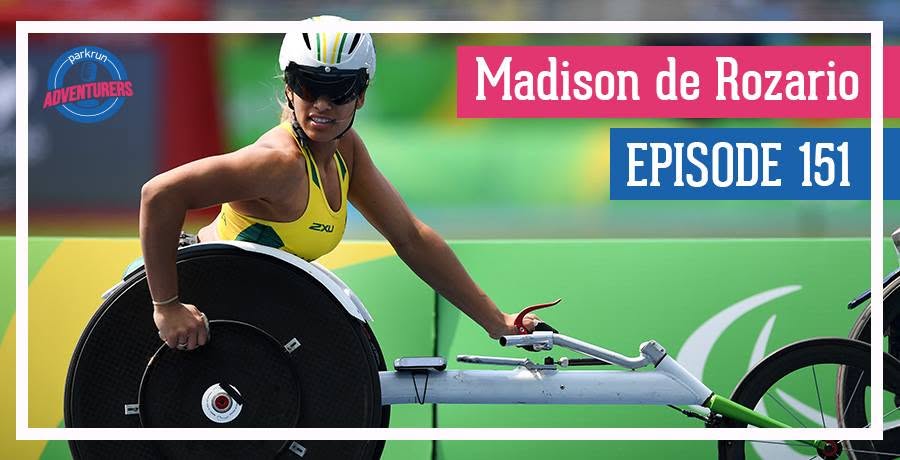
Episode 151 - Madison de Rozario
Episode details · · 285 speaker turns · sound cues from context
Enhanced transcript
Speaker names appear where they could be established with confidence. Others are shown as “Unidentified speaker”. Sounds that are not speech — music, laughter, people talking over each other — are written in [square brackets].
Episode 151 - Madison de Rozario · 2019-03-28
Enhanced transcript — Produced by an automated editing pass — speakers named, sound described, segments marked. NOT yet checked by a person.
Speaker names appear only where they could be established with confidence; others are shown as “Unidentified speaker”. Non-speech sound is in [square brackets].
Source: https://log.5kadventures.net/transcripts/ep151.html · The Adventurers Log · An independent project, not affiliated with or endorsed by parkrun.
Welcome
Scott Trickett: Episode 151 of the parkrun adventurers is here for about, I reckon, the fifth or sixth time now. I've got the fever again.
Melissa Erbacher: It's been a while since you've had the fever, Scotty.
Scott Trickett: It's always a good fever. It's always a good fever. But can you guess what my fever is this week?
Melissa Erbacher: This week? We're sort of in March. Is it the end of daylight savings fever? Because I'm keen for that fever to take on.
Scott Trickett: Really? I'm keen for us to get in sync. I'm keen for the mornings to be light again. But no, it's not that fever.
Melissa Erbacher: Okay. Oh, there's so many possibilities. So many possibilities.
Scott Trickett: For the sake of a short and sharp and snappy pod, I will fill in the gaps.
Melissa Erbacher: Okay.
Scott Trickett: I've got run west fever.
Melissa Erbacher: That was going to be my next guess. You should have just let me go for it.
Scott Trickett: Yeah, yeah. This weekend, Run West, it's my first running event for a long time. And I'm trying an untraditional approach to it. What's the untraditional approach? Well, generally, when you enter a running event, there's training involved. You get excited. You stick to a plan. You try and improve so you perform better on the day. I've gone the opposite.
Melissa Erbacher: So you've done, you know, months and months of taper and you're just trying to cram in your training to the last week?
Scott Trickett: No, not even doing that. I'm on a three-month taper.
Melissa Erbacher: Okay.
Scott Trickett: I'm feeling fresh, feeling great. Brought new shoes for the event. Okay. I have no excuses.
Melissa Erbacher: What kind of distance are you going to do?
Scott Trickett: Well, there's 4K options and there's a 12K option. When I entered this, so I got caught up in the hype. Remember when we launched Run West or when they launched Run West? They said that if parkrunners enter and tell them that they're parkrunners, we'll fund more events. So I got swept up in all that and I entered. I genuinely entered, paid cash and got excited. And I also entered the 12K.
Melissa Erbacher: So you got ambitious. Yes.
Scott Trickett: Yeah, I did. I did. Maybe a few regrets now. Like the 4K. The 4K sounds like a great Sunday morning of fun. 12K is just that bridge too far at the moment. But we'll see. We'll see.
Melissa Erbacher: You'll be right. Haven't you been doing all that training and stuff like that with your... Like, aren't you a coach now? Yeah.
Scott Trickett: I'm a coach and that's what coaches do. Coaches stand around in track suits and tell people what to do. And I've been doing a bit of that. And I'll tell you what, so last week we tried a mile race on the track with the group and I was like a minute behind what I've... what I think I can usually do. And I was a bit shocked and disappointed on the night. And a few people, more than one, reminded me, well, then you probably should have not been standing around telling us what to do. You probably should have been training with us.
Melissa Erbacher: Did you say, I'm the coach, do as I say, not as I do?
Scott Trickett: Yeah, no, I just walked away from them. Had a conversation with somebody else. Yeah.
Melissa Erbacher: Well, you bought new shoes. Are you going to wear a new T-shirt so that you have all the new apparel to chafe you in the wrong places?
Scott Trickett: Have a malfunction with? This is another dilemma for me because we're going to be there in the parkrun way. We're going to be with fellow parkrunners. So should I be in my apricot that had a misfortune with the washing machine in the UK a number of months ago? Should I wear the milestone shirt that is really tight and doesn't really fit me much anymore? Or should I wear the parkrun adventurers Christmas singlet?
Melissa Erbacher: I don't even know why this is a question, Scotty.
Scott Trickett: No, you're right.
Melissa Erbacher: You're right. Singlet all the way, right? Yep.
Scott Trickett: Yep. You're right.
Melissa Erbacher: Good, good. I'm glad that's resolved. Run West fever. Hey, well, good luck with all that.
Scott Trickett: On theme, because we've got a great interview coming up with a Run West ambassador, but we're doing things a bit differently for 151.
Melissa Erbacher: We are.
Scott Trickett: Everything's arse about.
Melissa Erbacher: Well, I was going to say non-traditional. But, you know, if you want to bleep yourself out in the intro already, then go for it.
Scott Trickett: I think arse about's okay.
Melissa Erbacher: Well, by doing things backwards or non-conventionally, we've actually got a couple of roving reports or at least we've got reports submitted by roving reporters who weren't actually roving. We do have one of the Steadfast Channel 5 news crew who is doing it the traditional way. Thank you very much, Melissa Ellis. But we have got, yeah, like I said, reports from Mark and from PK who has risen to the challenge. Actually, both their reports are about a bit of a challenge this week, Scotty. So, yeah. And also, our guest interview, she's not actually a parkrunner. So while normally we speak to the converted, those people who are massive fans of parkrun and what we do, we chose to speak to somebody this week who's never done a parkrun and tried to convert her instead.
Scott Trickett: Future parkrunner. Future.
Melissa Erbacher: Yes. There's a lot of promise there. Or at least a lot of promises. Yes.
Scott Trickett: So we're going to throw it over to PK. He does the intro for us. So take it away, PK.
Roving reports & the Channel 5 News crew
Roving report Paul Kitching — Mount Barker
Paul Kitching: The story you're about to hear is true. The names have not been changed because everyone's innocent. Well, I am anyway. G'day, excellent parkrun adventurers. It's PK, Paul Kitching. Checking in, not for a roving report, but you're about to find out why. I'm just doing a little... addition here uh to my actual uh real report which you're about to hear for two reasons one because there's quite a bit of car noise so uh hang in there I'm not sure if Scott or Mel have been able to edit the car noise out but um you'll find out why in a minute because I was in the car driving uh hands free of course uh up to a parkrun and I was chatting with a fellow parkrunner uh Apologies for that, for the car noise. Also, I'm not sure if it's even actually in the pod. Scott may edit it out, but there is an errant bee at one point manages to buzz around in the car whilst we're doing 110 on the freeway out of Adelaide. But we managed to deal with it. The reason for the bee, I'm not going to tell the long story, but the reason for the bee is that we got up like mega early yesterday to pick up the parkrunner that we took up to Mount Barker. And I don't know why, there were crazy bees around my house, like hovering around a light, you know, the only light that I turned on, trying to be quiet, to leave the house quietly at 6am. And of course, one of them managed to get into the car. We didn't think that it was around, but of course it is. So it's a pretty funny light moment within there. So I thought I'd better just cover that. Excuse me, cover that off. Anyway, that's it. Sit back and enjoy the ride and the chat. Cheers. Good morning. This is Paul Kitching, PK to all the parkrun adventurers out there. I know it's been a while. Apologies. I've been a bit missing in action because, yeah, I don't know, hashtag kidsport, hashtag life. But today I'm coming to you not about an adventure. Well, it is an adventure of sorts. But I'm not heading to any new parkrunner or anything like that. I'm heading to Mount Barker. I'm not going to go on about Mount Barker because I know you guys hear about it a lot. But today I am in the car with a fellow parkrunner who I picked up to come and join us up at Mount Barker.
[laughter]
Talking to Tim Jenkin — Anti-apartheid activist and 1979 Pretoria Prison escapee, portrayed by Daniel Radcliffe…
Paul Kitching: It's our fifth birthday today. That's not the reason he's here. But I'd like to welcome to the parkrun Podcast, Tim Jenkin. G'day, Tim.
Tim Jenkin: G'day, Paul.
Paul Kitching: How are you?
Tim Jenkin: Very well, thank you.
Paul Kitching: Good man. Now, Tim is in town in Adelaide. I'll probably get him to tell the story, but the reason Tim is in town is that Daniel Radcliffe, okay, so we all know Daniel Radcliffe, Harry Potter, etc. He is in Adelaide at the moment to film a movie called Escape from Pretoria. Uh, it's about, um, a man and his fellow prisoners who were, uh, put in jail, uh, 1978, 79, um, uh, uh, during the anti-apartheid, uh, movement. Actually, I'm going to get Tim to tell it because the reason I'm telling all this is because that man, Tim Jenkin is here with me. Daniel Radcliffe is playing, uh, Tim in the movie and, uh, I'll tell you why, um, Tim with us in a minute, but Tim, tell me more about your life. I mean, I suppose, well, not everything.
Tim Jenkin: Not everything is a very, very long story.
Paul Kitching: No, but so you, this movie is about you having been put in jail and then escaping from jail.
Tim Jenkin: Yes, that's correct. As you mentioned, I was involved in the anti-apartheid struggle in the 1970s. That was the heyday of apartheid. And I was an activist doing underground work, so to speak, spreading literature for the African National Congress, which is the ruling party today. And together with a mate of mine, the two of us were doing this work, and after a couple, two and a half years, we got arrested. There was a trial, and I was sentenced to 12 years in prison. Well, we were... Oh, is it a bee? Oh, hang on a minute.
[crosstalk]
Paul Kitching: No, it's okay.
Catherine Hocking: Is it a bee?
Paul Kitching: Oh, good. Is it out?
Catherine Hocking: Yeah, the cow.
Paul Kitching: It's okay. It's a bee. It's a bee. It's a wasp. I did warn Tim that there could be a bee in the car.
Tim Jenkin: Yeah, as soon as I start talking. I know. As soon as it comes out. You did not hear the story.
Paul Kitching: That's another long story for another time.
Tim Jenkin: But anyway.
Paul Kitching: So, yeah.
Tim Jenkin: So, I ended up in Pretoria Prison, which in those days was the special... prison for white male political prisoners. As you know, under Apartheid, everything was divided up. Nelson Mandela and his colleagues were on Robben Island, which is a tiny little desolate island off the coast of Cape Town. Pretoria is a thousand miles away in the north of the country. So even before I got into prison, while I was still an awaiting trial prisoner, the two of us planned this escape. We decided we were not going to accept whatever sentences they gave us, and we were going to escape and managed to smuggle in some money. And a book called Papillon that taught us... Oh, yes, of course. ...inspired us and taught us how to... think about escaping and the two things that this book what I told many gave us many tips but the main thing was that every escape has two stages the one is to get out of your prison and the second stage is to get away from it yes so that's why you either have a helicopter to take you away or you have money to get away very quickly Well, it's a very long story, so I can't tell the details.
Paul Kitching: Well, people have to watch the movie, but it's currently being filmed in Adelaide. But I believe you, and I'm certainly not making light of the whole story, but fast-forwarding, you managed to make... your own key out of wood keys I should say and which then helped you escape from the prison we had a workshop that we worked in and uh
Tim Jenkin: We were able to cut out the shapes of the keys in the workshop. Amazing. And figured out how to make them. And on the day of the escape, we had to open ten different doors to get out of the prison.
Paul Kitching: Phenomenal. I was watching last night, I believe there was a documentary done, Breakout. There is a documentary, yeah. Yeah, and just watching that is phenomenal. I can see now the interest, obviously, with the movie happening. So the reason you're in Adelaide is because there is a movie being made about your life. Daniel Radcliffe is playing you. That must be a surreal experience. When did you find out that Daniel Radcliffe was going to be playing you?
Tim Jenkin: Actually a couple of years ago they mentioned that they were looking for good actors and they said that they'd got Daniel. But they hadn't got all their ducks in a row and it failed after a year. And then they managed to get another slot with Daniel. So that's the thing with these actors, if you miss the slot, then you actually have to pay them for that slot. But they have insurance and all kinds of things.
Paul Kitching: And so you've come to Adelaide to immerse yourself, I suppose, in the... Well, get him, I suppose, Daniel, to immerse himself more in the character so he can meet you. Is that the reason?
Tim Jenkin: Yes. Well, that's one of the reasons, was just to be able to talk to the actors, to get them to understand the psychology of being a prisoner and what it means. And I've tried to help him along the way. We did have a few Skype chats before that. Okay. When I was still in Cape Town.
Paul Kitching: Yes. And so it must be... surreal, as I said, or crazy experience to be on the set. I believe, and you said that you were an extra the other day. That must have been crazy.
Tim Jenkin: It was a very, very strange experience. We were sitting in the simulated visiting room, and he was sitting right next to me. So he's me, and I'm just some other prisoner. And he was waiting for his visitors who didn't turn up. Ah, right, and I was talking to my visitor.
Paul Kitching: Yeah, it must be. It's been great having the film being made here in Adelaide. It's been really good. There's been a lot of interest. The town's been shut down. There's been a few times where, you know, Major streets in the city have been transformed into the 70s. And so, yeah, you're the man that stopped our town.
Tim Jenkin: I'm sorry about that.
Paul Kitching: No, no, no. It's been really good. But tell me more about... So the reason Tim's in the car with me now, heading up to Mount Barker, is that when you arrived, I think you said to one of the producers, what do you want to do on the weekend? And you said parkrun. And then as it turns out, one of our regulars up here at Mount Barker, Josh, is working on the film and he went, oh, I know, I know the guy to speak to. And yeah, that's how we got together. And you could have done, there's a number of different parkruns around Adelaide, but being an avid parkrunner that you are, it's always nice to go with other parkrunners that you may have met or know of. So your home parkrun, how do you pronounce it? Rondebosch. Rondebosch. The Dutch word for round bush. Rondebosch. So that's Rondebosch. So that's in Cape Town.
Tim Jenkin: And how did you get into parkrun? I'm not sure actually how I got into parkrunner. I used to see them because I lived very close to the circuit there and I used to see these mad runners running around every morning or every Saturday morning. I didn't know what it was and then a friend of mine told me what it was and said come along. I was a bit sceptical and I signed up and got my barcode and and joined it, and after that first one, I was hooked. Yeah, well, it gets like that.
Paul Kitching: And you've done 46. I've done 46.
Tim Jenkin: Well done.
Paul Kitching: I'm out for the 50. Well done, yeah. Any plans to where you're going to do your 50? Well, I guess I'll be back home again at that stage. You also, you got a PB last week, well done. Yes, I did. 2304? Yes. That's mighty fast for a man of your, well, you're not young. You're not old, but you've done very well. Good work, mate. Yeah, yeah, yeah. Tell me about the course then in Cape Town. I believe I saw last week there were like 850 people there, so it's obviously a popular course.
Tim Jenkin: Yes, it's a very popular one. Sometimes we have well over 1,000 people. Gosh, yeah. It's quite a boring course actually because it's just circular and you do two laps around it and it's absolutely dead flat. So it's a very fast one. There are other ones, there's many in Cape Town, there's something like 15 of them or even more depending on how far you go.
Paul Kitching: Sure. And so what does parkrun mean to you then? Why do you do parkrun?
Tim Jenkin: Well, it's just addictive. I mean, it's not supposed to be a race, but you're racing against yourself. You always want to improve. And fortunately for me, my time just keeps coming down every time I do it. To run faster in the cooler weather. Okay. My time always comes down in June.
Paul Kitching: Well, we've just arrived in Mount Barker and it's 18 degrees up here at the moment, so Celsius, that should be nice. So, were you, have you always been a runner? Were you running like in prison or were you keeping fit there?
Tim Jenkin: I was always good at running, but I was not interested in sport when I was in school. Right. And... Some of the sports masters recognised that I was a runner and tried to get me to come, but I didn't really participate. In the prison, we used to run every morning.
Paul Kitching: Yeah, I'm not sure if you know, but there are now parkruns in prisons.
Tim Jenkin: Oh, really? Yeah.
Paul Kitching: So in the UK, I know there are... Don't quote me on this, I'm sure Scott and Mel will... Confirm. But I know there are a number now of parkruns in prisons, and it's been a fantastic exercise for those people to exercise. What's that, dummy? Stay fit. Absolutely. Sorry, that's Es, my little producer assistant in the back, holding the phone. So, yeah, I am interviewing Tim whilst we're in the car, but it's okay, everybody. I've got my hands on the wheel. And thank you, Es. Was there anything else excellent that I was going to ask Tim that I've got listed there? See, I've even got the questions here. You've got to be prepared for these things. when you're chatting with fellow parkrunners. But it's, yeah, we're up here for the Mount Barker fifth birthday, so it should be a lovely day up here.
Unidentified speaker: What about do people recognise you?
Paul Kitching: Oh, yeah, so do people recognise you at parkrun, or are you just another parkrunner?
Tim Jenkin: Just another parkrunner. Just another parkrunner.
Paul Kitching: But still, it must be, as I said, it must be surreal to be here in Adelaide. I don't know whether... I think it's wonderful that you've come here and that you're getting to know more about our town and just to visit another parkrun. It's great, isn't it?
Tim Jenkin: Yeah, it's absolutely fantastic.
Paul Kitching: Good on you. Well, I think we're going to go for a run. I reckon I've asked you just about everything I wanted to ask you.
Scott Trickett: Where would you parkrun if you could parkrun?
Paul Kitching: Oh, where would you parkrun if you could parkrun? That's a good question, Es. Is there anywhere that you... You were talking before about America, but you weren't able to find many there.
Tim Jenkin: No, there were none in America, or at least not the places that I went to. I don't know. I suppose if there was one on a mountain somewhere, that would be great. I guess that becomes a trail run rather than a parkrun.
Paul Kitching: Yeah, we've got one here, Cleland. So if you're around next Saturday, you should do Cleland.
Tim Jenkin: That's very much a mountain one. We've got one that goes through a forest. It's quite dangerous because it's got ditches and tree roots and things. Oh, gosh. You have to dodge trees and so on. Yeah. Wow. But it slows your time down a lot.
Paul Kitching: Oh, that's the problem, isn't it? But you get to see other things. Well, Tim Jenkin, it's been an absolute pleasure. We're going to get out there and enjoy the parkrun now and see what it's like. We may even have a quick chat on the way home just to see what you think of our course. But thanks so much for chatting with us today. My pleasure, Paul. Good man. Okay, we have just done the Mount Barker parkrun, me and Tim. Tim, what did you think of Mount Barker?
Tim Jenkin: Well, as far as the track goes, it was amazing because it was there and back track, which when it's your first time, it's quite easy because you get to the end and then you repeat exactly what you've done. Indeed. So some tracks, when you run them the first time and they're circular... you don't know what's up ahead so you don't know how to pace yourself you don't know where you are and how far to go but here it was quite clear because you're running down a road that you've done before indeed it is a it's a beautiful course all right beautiful nice and flat And you got a pretty good time, 24-something, I think you said? Not totally monotonous, because there were some bends and curves in it. Indeed, indeed. And you were running past the wetlands, so it looked very good. It is gorgeous, isn't it? And you could see the other people struggling along the other way. Sometimes you can't believe that they're so far behind.
Paul Kitching: I know. Well, you came in at 24-something, I think it was? 24-something. Well done. That's great. Well, that's a PB for Australian, for the Australian course anyway, right?
Tim Jenkin: It must be, yeah.
Paul Kitching: No, well done. Good on you. Yeah, we had fun. We had a great turnout for the Mount Barker fifth birthday. 375, I think it was, in the end, which is well over our record. I think our previous record was 295. Lots of people in orange and lemon. We had paces, lots of cupcakes, celebrating our fifth birthday. So another awesome parkrun day. Great to have you in the country and in South Australia. Hope the rest of yours stay here in Adelaide goes well. And I suppose we'll have to try and look out for you in the movie whenever it comes out. Escape from Pretoria, and see if we can recognise you as a random extra, hey?
Unidentified speaker: Yeah.
Paul Kitching: Good on you, Tim. Thanks so much, mate. All right, cool. Thanks very much. Cheers, mate.
Melissa Erbacher: Hey, Scotty. I mean, obviously, there was heaps in that PK interview to talk about. But you know what caught my attention right at the very beginning was where he was talking about driving hands-free. And I didn't know we had those cars in Australia yet.
Scott Trickett: They're coming. Well, he's pretty sophisticated. He's a fancy man.
Melissa Erbacher: Yes. He's got all the technology happening. But just the idea of, you know, having a chat in a car and your hands aren't on the wheels while you're driving, that freaks me out a little bit. So lives life on the edge, does our PK.
Scott Trickett: So we set PK the challenge. We threw it down for him to remain in the crew. He stepped up. His next challenge is to get Daniel Radcliffe.
Melissa Erbacher: We don't aim low around here. You know what we're like with our challengers.
Scott Trickett: We know he likes to run. We know we've got an in with Tim. Tim's going to get in his ear. PK just has to make the final connection and get him to Mount Barker, Pakapakanthi, Cleland. Take him out to Cleland. That's a great view over Adelaide at the turnaround point there. Lots to choose from. Meanwhile, Mel, how was your parkrun weekend?
Melissa Erbacher: My parkrun weekend was a little bit non-conventional. Once again, Scotty, I was at home volunteering, so that's all convention right there. However, not long after the event started, my phone started ringing off the hook. Which is never a good thing on a Saturday morning, especially not when one of the phone calls is from your husband and you've literally just started the event maybe two minutes before. And I was walking back from the start line to the finish line and Adam was on the phone and he was reporting that somebody had fallen over shortly after the start and he Could I get back there and take care of the incident? And I missed a couple of phone calls from some other volunteers as well who had my emergency contact numbers. And yeah, so I had to attend an incident. And not only did I have to attend an incident, it was a serious one where we had to call an ambulance and have our parkrunner taken off to hospital to get some stitches to a head wound. which doesn't happen very often. But it brought up a few things for me, specifically how awesome are parkrunners? Because seriously, I mean, I had to run to get to her, so I might have had to run maybe 500 metres or And with my pregnant belly and wearing Birkenstocks because I thought, no, that'll be more comfortable than runners this week. The one week I choose not to wear runners, I actually have to run. So that was interesting and I'm sure I made a very merry sight for a lot of people. But in the time it took me to get to her, you know, there were already like half a dozen parkrunners who had stopped immediately to assist her, which was just amazing to see and brilliant. And I don't want to say it's unexpected, but it's always still just really heartwarming, I think, just that people completely – willing to to stop and take care of somebody else and throw their parkrun out the window irrespective of timing or anything like that like obviously they've got their priorities in the right spot um She's okay. I should mention that right now, that the lady in question, the parkrunner in question, is all good. She, I think, was a little bit miffed, to be honest, about the whole scenario because she didn't have time to go to hospital in the morning. She informed me that she had two cakes to bake and had to be back early, at the surf club by midday to do surf patrol, which I thought was... That ruined her morning.
Scott Trickett: Well... Yeah, I get that.
Melissa Erbacher: No, no, this is... She was just... She was saying that, you know, she didn't have time to be going to the hospital. And when the paramedics arrived, one of them came over and introduced himself and he's like, oh, you're a parkrunner. Well, do you need to scan in before we take you to the hospital? And... And she said, oh, no, no, it happened right at the start. I haven't done the course. I said, no, no, she can't scan in. She didn't get a token because she hasn't finished. And he's like, that's okay. That's okay. You'll get a PB. So I was very pleased to see that the local paramedics also are across how everything works at parkrun. And they had a good sense of humour about it. But fortunately, they managed, like she got such great care from the parkrunners who assisted her to begin with as well that they managed to fast track her at the hospital. And she, when I called to check in on her later in the day just to make sure everything was all right, She's like, oh, yeah, you know, it's all fine. The hospital didn't take too long. And I said, how did the cake situation go on the surf patrol? She goes, oh, yeah, yep, got the two cakes done back at surf patrol by midday. And I was just blown away by this woman, seriously.
Scott Trickett: That's an impressive feat.
Melissa Erbacher: Yes. And incident notwithstanding, she still has her sense of humour, which is the best part about it all. Yeah.
Scott Trickett: So a good outcome to a potentially miserable, crappy kind of morning.
Melissa Erbacher: Yes, yeah. What started as a bloody mess, literally, still ended happily ever after, even though she didn't get her run in on the morning.
Scott Trickett: And I take up your point there, how good are parkrunners? And I'd like to believe, Mel, that most people and definitely almost all parkrunners would stop and assist someone. Like, you'd have to be a pretty miserable person to see somebody fall down or injure themselves and sort of keep running or jump over them on your journey to a PB.
Melissa Erbacher: Jump over them. That would be a bit extreme. Like, yeah. You would hope, Scotty. You would hope. Yeah.
Scott Trickett: And you did, so thumbs up. Thumbs up to the Kawana parkrunners.
Melissa Erbacher: Yes, but where were you on the weekend?
Scott Trickett: Were you at home? No, well, home. No, I wasn't at home. Westerfolds is home. But I went to Darebin. Back to Darebin. Playing the long game on my P-index. Really, like, really working on that 9, 10 P-index. As well, not many people, like, that's a tough one to get.
Melissa Erbacher: That's a huge one to get. That's a lot of... That's like two years worth of parkrunning at only 10 events. No, that's not. It's even more than that. No. I'm terrible with maths. That's 10 years at 10 events.
Scott Trickett: No.
Melissa Erbacher: Okay, well, give me the facts.
Scott Trickett: If you timed it perfectly, to get to a P-index of 10, you could do it in two years. So, if you went to 10 different events 10 times. That's 100.
Melissa Erbacher: Yeah. Yeah, so I was right the first time. Did you say no to me when I said that's two years of parkrunning?
Scott Trickett: I thought you were going somewhere else. I thought you were going somewhere else, but… Yes, you're right.
Melissa Erbacher: I'm easily confused at the moment, Scotty. So if I give you the right answer the first time, don't make me try and review my maths. It's not going to end well.
Scott Trickett: Anyway, so the P-index is all about and heading to Darebin. Tick that box. And I do, you know, I love Darebin.
Melissa Erbacher: And how is your P-index like? You're going for the long game. You're going for the 10. Are you still at just like three or four?
Scott Trickett: No, no, I've got a P index of seven. So it's a long game. Yes, I've got to do some bit of work around these events that are on five, six. But I'm really close.
Melissa Erbacher: When you're at seven already, that's not that long of a game.
Scott Trickett: No. Hopefully by the end of the year. Hopefully by the end of the year.
Interview Madison de Rozario — Three-time Paralympian wheelchair racer; London Marathon champion; Run West ambassador
Melissa Erbacher: Our next guest is somebody who competed in her first Paralympics in 2008 at the age of 14 years old. She's a bit handy on the wheels. Her name is Madison de Rozario. Maddie, welcome to the parkrun adventurers podcast. Thank you for having me on, Ed. I would like to go back to 2008. I was a little bit younger then, certainly not athletic by any means. However, you were attending your first Paralympics. What kind of experience was that for a 14-year-old?
Madison de Rozario: I was. That was unreal. Beijing was so intense. It wasn't something I was expecting at all. None of us were. We were training for London at the time with the big goal being 2012 and I got a call up for the relay because they were one person down and I was kind of essentially just like filling a spot in an emergency and that was about six months out that we started to really explore that option and I just got thrown into this entirely different world and going on my first overseas trip with the team and just being so frustrated I guess, amazed and blown away by what life was like. And then Beijing itself was unreal. I think I was definitely very spoiled. Beijing was an amazing game and everyone who's been to it, you know, previous ones, definitely says the same thing. They put on an incredible show. It was, you know, a full stadium and I was very lucky to get to race in that. But I just remember being overwhelmed every step of the way in the village, you know, on the track, on the warm-up track, in all the venues, just being, you know, so intensely overwhelmed by everything that was going on and lining up for the relay. That was, you know, the big event that I was there for. And we just, We're definitely not expected to find our way onto the podium. I think we had, of the four athletes in the team, two of us had never been to the Games before. I was 14, but Jemima was only 16. So it was a very young, very inexperienced half of the team. And so coming home with a silver medal in that was far more than I expected going into those Games.
Scott Trickett: Now Maddy, Beijing was a number of years ago, but I have this perception that you've sort of burst onto the scene and you're still relatively young. I imagine like 10 years plus is not really bursting onto the scene in your eyes. You've been doing this for a number of years now, putting in a lot of work.
Madison de Rozario: Yeah, it's kind of, it's a bit strange actually. I feel like I'm still quite young in terms of, you know, other people in the team that I'm on, but I've been on the team for quite a long time now. So it's, It's kind of a weird balance. But I feel like it's been my entire life. You know, I went to my first Games when I was still in high school and it's been, I guess, my everything for the last 10 years.
Melissa Erbacher: And you don't just participate in relays either. You're a multi-distance athlete, which I've got a whole bunch of questions about how that even works, not just focusing on one thing. But have you got a favourite distance?
Madison de Rozario: I do. I do. I think the 5,000 on the track is a real big one for me. It's this combination of, you know, it's so tactical and you need to be so fit to be dominant over the distance. And, you know, you have to be consciously aware of what everyone else is doing. But at the same time, you have that fitness kind of factor that comes into play. I feel like the 5K is just this combination of absolutely everything that I love about wheelchair racing thrown into one and and I do love the marathons I love how you know how much you have to push yourself and and how I guess how extreme it is and and I love that but I think in the marathon you kind of have to find the rhythm and and that's a part of the a part of the business a part of the game is you know in that rhythm and you know, just picking the kilometres over, whereas the 5K, you're kind of on the entire time and everything that you do matters. And I love that part about it. It's very intense.
Scott Trickett: Hey, Maddy, you know what else is 5K? parkrun.
Unidentified speaker: Is it the parkrun?
Scott Trickett: We call it the parkrun adventurers. But you haven't been to a parkrun yet, but we're going to try and get you there. You're living out near Rhodes. So is parkrun something that's come on your radar? Is it appealing to you?
Madison de Rozario: I'm not going to be a difficult person to convince, to be honest. I live so close. I feel like I live in my little training bubble though and I focus on, I guess, doing what I do. But you guys are so close. There is no reason for me not to get down to one.
Melissa Erbacher: So what do you normally do on a Saturday morning?
Madison de Rozario: Saturday mornings are usually a long push. I think this Saturday morning I have a 25K roll.
Melissa Erbacher: Okay, so that works out perfectly for parkrun because you can use it as a little warm-up, like you can just head on down and then 5K warm-up and then do the rest of your 20 or the 20 on top of that super fast or whatever speed you need to do. Heaps of people train that way with parkrun. They just chuck it in the middle or at the finish or at the start. It works out well. All you need to do is remember your barcode.
Madison de Rozario: I actually really could. It's actually quite a practical thing to do. Actually, I really, really could.
Scott Trickett: Okay. Well, we're going to be scanning the results at Rhodes over the next couple of weeks, so we hope to see one Maddie de Rozario. I'm guessing you're going to be up the front. You will be first finisher, so we'll be looking out for that. Now, one thing I want to know, Maddy, is that the parkrun adventurers, Mel and I, aren't quite the athletics aficionados that we may come off as. I want to know some of the more basic, simple questions of being an elite wheelchair athlete. What's, like, the skill is in the pushing the wheels. I'm taking it right back. So you have to have a lot of upper body strength and a lot of endurance.
Madison de Rozario: Yeah, look, I think it's... So many ways to approach wheelchair racing. There's, I guess, sort of two different kinds of athletes. There's athletes that are able to apply a lot of power and they're, you know, obviously more your sprinters. And that's kind of a different style of pushing. And that's kind of that constant acceleration, that constant building, momentum whereas then you kind of have your athletes more like myself who are better at maintaining that momentum like I take a long time to get to a high speed but I'm quite efficient when I push and so that kind of allows me to just kind of slowly kind of just slowly build on what I put down and maintain it but if you ask me to get to a high speed quickly it's just not I'm completely incapable of doing it so I feel like there's two very distinctive styles of wheelchair racing um And 1 through 400 is very much that power. You have to have that strength and just that real power. And then 1,500 and up is more, you know, the building on that momentum. And the 800 sort of sits in the middle and that's – I struggle with the event because you're racing athletes that have that power and that explosive sort of ability. And then, you know, I'm kind of approaching it from the other side of it. And it's kind of interesting, but I definitely think there's two different ways to approach wheelchair racing.
Melissa Erbacher: Well, for somebody who struggles with 800 metres, you don't do too badly having a world record in it. Meanwhile, I'm going to ask some of the basic questions too because I'm just fascinated with the whole methods and styles and things like that. Like there's obviously a reason that you use both arms on both wheels at the same time rather than one arm on each wheel, like in turn. Where do wheelchair athletes chafe? Chafe.
Madison de Rozario: Okay, so my ribs kept very bruised from sitting in the frame. So where the side of my body or my rib cage touches the frame, I get really bruised and that rub, especially over the course of the marathon, quite badly. Okay. And that's because the frame has to be so tight. Every time my body moves to steer the race chair, I need it to move with me. So it needs to be very, very fitted. The other place is kind of, I guess, on the inside of your elbow. So if you have to flip and hit the push rim instead. So the push rim is the rubber coated ring that we actually contact with our gloves. And that's moving quite quick. So oftentimes when you're pushing, you'll actually end up, when you're at the bottom of your push, you'll kind of chase the top part against your arm and that one can get pretty bad, I think. You know, I've seen a lot of athletes finish marathons and they're just bleeding from that part of their arm. So, yeah, those two are definitely the two points.
Melissa Erbacher: It's like high-speed carpet burn, I imagine.
Madison de Rozario: Actually, such a good analogy. Yes, it is.
Melissa Erbacher: Like super high speed, especially the speeds that you go.
Scott Trickett: We've got Run West Vivo this week. You're going to be there. You're one of the ambassadors. Do you get that high speed carpet burn doing 12 kilometres, which is the event you're going to have a crack at on Sunday?
Madison de Rozario: Yeah, no, definitely. Yeah. Yeah, I'm really looking forward to Run West. I'm so excited to be on board as an ambassador. I was really excited when they asked me. I know it's late in the piece, but I've just got back from overseas and now I'm trying to get as many people as I can to enter last minute. So anyone that hasn't entered yet, it is still open. It's open. Entry's open until I think the day before. So come and join us. I've talked my training partner into doing it. He is a Commonwealth Games silver medalist. He won a silver in the triathlon. So I've talked him into joining me Sunday morning. And we have a development group that we work with on Saturday mornings. But I'm trying to get as many of those guys along as well. I think it's going to be a really fun morning. It's such a valuable event to have in Western Sydney, though, I think is really the biggest benefit of it. I mean... I am very biased, but I think racing on the road is one of the best things in the world. And I'm so glad that so many people are now having the opportunity to do that as well. And in a new place and a new event, I think we've had 6,500 people registered so far and and again entries are still open so I'm super interested to see how many people you know actually sign up for it but that's it's an amazing number of people for for the very first event and it's such an easy way to get active I think it's hard to just want to go for runs with no final motivation and I completely get that whenever I'm training I'm thinking about the next event so I think it's such a good way to to get people out running not just the morning of of run west but in in the lead up and you know in the lead up to next year I think it's such a great event and such a great opportunity and I'm looking forward to seeing how it goes and it's going to be a fun weekend it's going to be it's the first time they're having it so we're all going to witness history if you're going along now you've got a bit of a crazy schedule post Sunday do you want to tell us what you're up to yeah um yeah my whole year is we've kind of packed as many races into it as possible this year we're seeing how it goes I've But the week following Run West, we have our nationals here in Sydney. So I'll be racing on the track there. I'm just doing the 1600 on the track. And then the following week, I'm heading overseas. We've got Boston Marathon, um in early April mid-april um and then two weeks later we've got London marathon so I'll be doing both and staying overseas between the two but I've never done Boston before so I'm really interested to see how it goes my coach is Louise Sauvage and she has been so excited since I accepted my invitation for it it was I think Boston Marathon was kind of her baby. It was her, you know, her favourite marathon. She's won it multiple times. She's raced it an unreal number of times and she hasn't been back since she was an athlete. And so she's been like just constantly so excited. Every time we're doing specific Boston training sessions, she's just like so unbelievably excited about it. So I'm really looking forward to that. Again, I've never raced it. I've just heard so many things about it. It's such an elite marathon, so I'm looking forward to that. And then I'm very excited to get back to London for the London Marathon. It's also the World Championships Marathon this year, which throws in a little added pressure and a little added something. But it's the only marathon major that I've ever won. I was so surprised to win it last year, but I've never had to return to a marathon as a defending champion. So I'm also nervous, but the course suits me and I love the race. I love the organisers and so I'm definitely looking forward to that one.
Melissa Erbacher: No pressure at all, returning champion. I'd like to ask, London, I mean, there's a lot of cobblestones in London. Does the marathon course take in cobblestones? And if so, how do you cope with that in the wheelchair? Yeah.
Madison de Rozario: They actually cover them for the night. The actual course stays on the road, thankfully, but over the bridges where all the joins and stuff exist, they're actually covered in carpet, which is tricky to push over anyway. It's definitely tough, but it's better than, you know, getting a tie caught, you know, in a crash or a republican or something. So, yeah, they actually cover all those parts of the road.
Scott Trickett: And are you going into these events as favourite?
Madison de Rozario: No, definitely not Boston. It's an overall Boston's a downhill course and I'm one of the lighter athletes, so I don't actually coach particularly well. So I don't actually think Boston is a course that's going to play to all of my strengths. So that one's more just working out, you know, where I sit in that field and getting to know the course and seeing how that's going to work into my program coming up. And In terms of London, I think despite winning it, I won it in a sprint finish with four other women. And so any one of us could have crossed that line first. I don't think it was anything about necessarily being stronger or faster. I think I just made a break at a time that worked and I was able to hang on to it. So I'm definitely not... Yeah, definitely not going in as a favourite. I think our field of wheelchair races at the moment is so competitive and so strong. The world record was broken in Berlin last year by Manuela Schar, and she'll be there, and Tatiana McFadden, who's been so dominant over marathons for the majority of my career, will also be there, and there's so many others. No, I don't think so. I really do think it's anyone's race. It's just a matter of running a smart race and putting ourselves in the best possible position.
Melissa Erbacher: And how do you do that when you're training, I guess? I mean, you've got so many different races and events on, but they're all different. distances how how do you focus on one particular distance like when when you know this week you're racing this distance and then next week you're racing that how do you how do you train to be good at all those things at the same time complicated actually um we're lucky in road racing we can span a larger number of distances um far more comfortably than than a runner can and
Madison de Rozario: For that reason, it's not as much of a challenge to track all of the events as it would be for a runner. It's definitely something that wheelchair racing lends itself to, which is exciting. But for the most part, we do focus on the marathons. The 5K and the marathon are my two favourite events. And so a lot of our work goes into those longer reps and being able to hold that high speed for a long period of time. But thankfully, that carries over quite nicely. So I don't get off the start line particularly fast. But once I am at a speed, I can hold quite a high speed for a long time, which is a massive asset in the marathon. That's why we're working, working so hard on building up that particular skill, but something that carries me really well through 15s and 5Ks as well. So it was very tricky around Comm Games when I was racing 15 in the marathon and both events were so important, both obviously being the only two events on offer. And so picking one to prioritise was impossible. So trying to make the training work and work on the specific skills to race them both, you know, within a week of each other was very, very challenging. And it's not something that I would necessarily, like, be doing all the time. But for the most part, we focus on the longer stuff. We focus on the marathon, and those skills carry me over through the longer stuff on the track.
Scott Trickett: I'm exhausted hearing about all the distance you've got to cover, Maddy. I tell you what, I'm going to look out for you on Sunday at Run West. I'll be able to find you. That might be easier. But I'm also going to be looking out for you in the Rhodes parkrun results. Maybe when you come back. We'll give you time when you come back from London. I want you to dedicate your training solely towards parkrun. So thanks for joining us on the parkrun adventurers this week. It's been a pleasure catching up with you.
Madison de Rozario: Thank you for having me on.
[12 seconds of audio that could not be transcribed]
Roving reports & the Channel 5 News crew
Roving report Melissa Ellis — Frog Hollow
Melissa Ellis: Good morning parkrun adventurers, it's Melissa here coming to you from Frog Hollow parkrun in Endeavour Hills in Victoria. Now I promise I'm not stalking Scott Trickett or the Westerfoldians, it's a pure coincidence that they were also here last week, running the beautiful Frog Hollow. Now, the reason I'm here is because I'm chasing P-indexes, so that's brought me out in the rain. We've got a light drizzle here this morning and a crowd of maybe about 100, maybe more. Anyway, I've got with me the lovely Catherine Hocking. Hello, Catherine. Hello. Now, I know you from Slow Burners running group, but you're a parkrunner as well. And is Frog Hollow the closest parkrun to you?
Catherine Hocking: Yes, at the moment, although I believe that the Birdsland parkrun is going to be up and running shortly. I don't know, it's all very secretive at the moment, but that will be my local once that starts. So whereabouts do you live? I live in Selby, which is right next to Belgrave, so in the beautiful Dandenong Ranges.
Melissa Ellis: Yeah, there's a bit of a gap up there. So Birdsland is much anticipated.
Catherine Hocking: Yes, yes. I haven't been involved in any of the organisation of it, but a friend of mine is. And, yeah, she assures me that it's coming soon.
Melissa Ellis: We're looking forward to that. So you've done Frog Hollow a few times. Where else have you ventured to?
Catherine Hocking: My first parkrun was actually at Jells Park. So I was actually involved at the first event at Jells Park. I think I was Barcode Scanner. So that's where I started my parkrun adventure, volunteering. And yeah, so I've done a couple of runs at Jells, a couple at Wilson Botanic, and I've also done a couple over in Adelaide at Christies Beach. So I think that... Albert Park and one at Studley Park. Christies Beach is beautiful. We were there late last year. So what takes you over that way? Family. So my husband's from Adelaide and his family live on that side of the city and yeah, it's good to
Melissa Ellis: get out and do something while we're there it's usually rather warm but it's good yeah it's a beautiful one on the beach yes so anyway why I wanted to speak to you today we've got I've gone back to my fashion reports fashion's on the field at parkrun so today you're sporting the lovely snaily yellow top yes would you like to tell us a little bit about the slow burners
Catherine Hocking: Yes, so I was just looking back into the history of the Slow Burners Facebook group and it was actually started back in 2014 by Rochelle Olsen who was basically feeling a bit dejected and upset about getting left behind running with various running groups when you're a slower runner. So she had the brilliant idea of starting her own group specifically for slower runners. And I joined up pretty much soon after that. But then she went on to bigger and better things cycling across America and said you're in charge now basically so you were entrusted with the with the flock yes what do you call a collection of snails I don't know if we've thought about that yet I'll have to think about it we will a trail of snails maybe oh I like that because So the slow burners primarily are in the trails. Yes, we are. And I guess that's part of the thing. As well as, I guess we prefer not to say that we're defined by a pace, but we're more, I guess, a community or a social group. So anyone can join us as long as they're happy to go at a relaxed pace, conversational, and And because we run in such beautiful places, one of our regulars is the Sherbrooke area, Birdsland, Lysterfield. We just love taking the time to appreciate our surroundings and not be so focused on going as fast as we possibly can so yeah that's that's part of the ethos I guess of the slow burners group just getting the slow burners getting out there enjoying it and anyone being able to enjoy it no one needs to feel like they're going to slow the group down or be a burden because that's really not what we're about
Melissa Ellis: You definitely are a friendly group and you always loop back. Yes. And wait at the intersections.
Catherine Hocking: Yeah, so regular regrouping. Some of the runners loop back. Others prefer to just hang around and chat and take photos. But yes, no one ever gets left behind and we do our best to make sure that No one feels pressure to hurry and keep up with the group. People have different abilities. Some people might be great at chugging up the hills. Others may be better at going downhill or on the flat. So everyone's got their own strengths and we like to appreciate that. And your husband coaches as well, doesn't he? And yourself, you both do a little bit of coaching? Yes.
Melissa Ellis: Yes. And you take regular training runs, I know. Before rollercoaster, the slow burners were regularly out doing the loops, getting familiar with the course.
Catherine Hocking: Yeah, so I think it started about 2016 when we, in the nicest possible way, bullied one of our members into entering the 21K at Marysville. And that's when we actually really started thinking about training plans and preparing people for... for particular events and yeah it's sort of been part of the group ever since. We've dropped back a bit over the last year because I've had foot problems and not been able to do the weekly events but people have just really stepped up and kept the group going and When we've come up to Roller Coaster, another group member has come along and said, oh, OK, I can lead a run. And it's just been wonderful that such a friendly and inclusive and supportive group that people feel that they can do that. They can just...
Melissa Ellis: And I like that because it's not just the elites that need to be prepared and have a training plan and work their way up to these kinds of things. So your average person, they need to be just as prepared. They need to know about hydration. They need to know how to carry their gear out on course, how to pace themselves. They need to be prepared.
Catherine Hocking: Yeah, and especially, I guess, with the increasing popularity of trail events, a lot of people who may never have run on the trails before... increasingly entering events such as Roller Coaster, Two Bays, Wonderland, the Trails Plus events and it's quite a challenge, some of them, especially the ones based in the mountains. You've got to worry about hills and a half marathon that you may be able to run on the road in two hours, you're not going to do that on Mount Dandenong. I might have learnt that the hard way.
Unidentified speaker: But the
Melissa Ellis: another thing I've got to say about the slow burners now my first experience was I saw on social media that the slow burners ran a snake awareness training out at Lysterfield and that was the first time I ventured along I thought oh I need I'm doing some trails now I need to know about snakes so I came along and you know paid a little bit of money and we came home with a snake bandage and I really learned a lot and so that's another important safety aspect yeah so yeah we're trying to do little bits and pieces here and there we've
Catherine Hocking: I've recently partnered with a couple of companies, Glimmer Gear being one of them, and I'm looking at whether we can run an event specifically tailored to night running. A lot of people may never have run in the dark, out on the road where you've got street lamps. So the difference between running on the road and having light provided for you as opposed to having to bring your own light and deal with the differences. I guess the main one I find is that your depth of perception changes a lot when you're running in the dark with a headlamp as opposed to in the light. And when you're doing that on trails... that's something that you really have to be aware of. So yeah, we're looking at really what we can do to prepare people for the events that they might want to do and whether that be learning about what to do if you come across a snake or get bitten by it or how to tackle those hills or how to run in the dark with a headlamp. We're sort of trying to get people prepared.
Melissa Ellis: Yeah, and so your husband Paul, he's actually no slouch when it comes to running. He does quite good, doesn't he?
Catherine Hocking: Yes, yeah, he's a very speedy snail and... Yes, I think we've had a few shocked people with the Slow Burners t-shirt appearing on podiums every now and then. But yeah, I guess it shows that it really isn't about a particular pace. It's about... It's a mindset. It's a mindset and it's so much different to a lot of the other groups where you may really be focused on a pace. I mean, absolutely, it's great to have
Melissa Ellis: time goals in mind but other people might want to have different goals and that's what we're about so that fits in well with parkrun too because that's sort of the parkrun ethos that you know no one's left behind uh you can do it at any pace you want and the uh emphasis is on community and having fun definitely yeah so and so where's your husband he's Paul I've got a Paul you've got a Paul there's lots of pauls around um he's Mullum Mullum today
Catherine Hocking: Yes, I believe his coach specifically told him he needed to do Mullum Mullum parkrun today. That's one I haven't done yet. You have to get out there.
Melissa Ellis: It's beautiful. Yes. We can have another running day out of Mullum Mullum.
Catherine Hocking: Yeah. We've got to get back there too. I have run... in the area but not a parkrun so yeah that's something I need to do something about.
Melissa Ellis: So you didn't scan today because you're training and so you did a shorter loop and you didn't go through the finish.
Catherine Hocking: Have you done that very often? I've done it a couple of times basically with recovering from the injury I've got at the moment. I've been walking rather than running and sometimes a 5k is longer than I can cope with but I still like the social side of things I mean I'm more of a social runner than a head down get it done sort of runner and being injured I really miss the social side of things so I guess recovering from injury has really been where I've come back to to doing parkrun because I really hadn't done that many of them before the last year and yeah coming along to a friendly non-judgmental no pressure event that's on weekly like parkrun has been really good and If I have the ability on the day to do the full distance, then it doesn't matter. I just don't cross the line and everyone's happy.
Melissa Ellis: I love that. Well, I'm so glad you came out today. Thank you, Catherine. Thank you for talking to us and telling us all about the slow burners. And we'll look out for those yellow snail tops out on the trails.
Catherine Hocking: Yes, always give us a wave. And if anyone is looking for an inclusive group that runs in Melbourne, look us up. Thank you. Thanks.
Melissa Ellis: Bye. I've got with me now Rosemary. Rosemary was the Tail Walker today at Frog Hollow. Hi, Rosemary. Hi.
Rosemary - Frog Hollow Tail Walker: How are you? Sorry, I don't know your name.
Melissa Ellis: Melissa. Hi, Melissa.
Rosemary - Frog Hollow Tail Walker: That's a bit rude of me. You would have told me, but I didn't.
Melissa Ellis: Actually, when somebody said talk to Rosemary, I thought, I know that name. And I think we've actually walked and had a chat before here at parkrun. Yeah, I think so. It would have been a while ago, and it might have even been a Christmas day. I did a tail walk on Christmas Day. I've done four, but it wasn't last year. Anyway, that's besides the point. I wanted to speak to you about Frog Hollow.
Rosemary - Frog Hollow Tail Walker: Oh, Frog Hollow's my spiritual home, I think.
Melissa Ellis: Well, that's why they told me to speak to you. Because you must be the person that knows everything there is to know.
Rosemary - Frog Hollow Tail Walker: No, I don't know everything. I mean, I'm a relative newcomer because I've only been here two years. But in that two years I've done, today's 103.
Melissa Ellis: Oh, well done.
Rosemary - Frog Hollow Tail Walker: And only seven haven't been done here. Oh, so you're a bit of a tourist? Not really, only because New Year's Day ones, we don't have New Year's Day.
Unidentified speaker: No.
Rosemary - Frog Hollow Tail Walker: And twice, once I've stayed at a girlfriend's and once I was looking after my dad, and then once one of our 14-year-olds did her 250th, so I had to go to that at Berwick Springs.
Melissa Ellis: Okay, which is a local one.
Rosemary - Frog Hollow Tail Walker: Yes.
Melissa Ellis: Yes, so Berwick Springs and Frog Hollow tend to share traditionally the Christmas Day, New Year's Day duties in the area.
Rosemary - Frog Hollow Tail Walker: Well, yeah, we have Christmas and they have New Year's Day. Yeah. Packing them during New Year's so we can do the New Year's Day double.
Melissa Ellis: So that's how come I've been at Frog Hollow for four Christmas days.
Rosemary - Frog Hollow Tail Walker: I've only done two because I started on Christmas Eve and I didn't really know about Christmas. My daughter brought me. She brought me on Christmas Eve. So I really didn't know what was going on for Christmas Day the next day.
Melissa Ellis: So she sort of swept you up before you knew what was happening. She brought me here. And then you were addicted.
Rosemary - Frog Hollow Tail Walker: Yes.
Melissa Ellis: Yes.
Rosemary - Frog Hollow Tail Walker: Addicted is the word. With my tail walking, I did 50 last year for the year.
Melissa Ellis: Excellent. So tell us about the Frog Hollow course.
Rosemary - Frog Hollow Tail Walker: The Frog Hollow course is a flat course, although people will tell you there's a bit of hill over the other side of the freeway when you're coming back, but you don't really notice that. No, it's a flat course, different surfaces, but more of it's concrete than when I started. We've been going five years in June. I got to run direct by Fluke the 250th a couple of weeks ago. And we had our 20,000th finisher, which meant 100,000 Ks done collectively. We didn't expect it was a long weekend, so we didn't think we'd have enough to get to that record. And our 108th person came across the line, so we did. And she's a girl who does it here regularly, so it was nice that it was a local.
Melissa Ellis: So typically what sort of numbers do you get?
Rosemary - Frog Hollow Tail Walker: Our typical average is I think around 80, 90, but most weeks we get around 100. Last week we had 176. I'm not sure why. Oh, yes, I do know why. Because a group had been doing a 12-week or 6-week program at Westerfolds and they came here because Westerfolds is a hilly course.
Melissa Ellis: Yes, and your reputation is to be quite a fast course.
Rosemary - Frog Hollow Tail Walker: Yes, the girl who brought the group, it's her fastest place, so she brought and her mum did a PB here last week, so...
Melissa Ellis: Fabulous. That would be Tash Davies, I'm guessing. I don't know, but I know her mum did a PB last week, so she was quite excited. Excellent. So the course here at Frog Hollow, you go out... And around the lake and then under the freeway.
Rosemary - Frog Hollow Tail Walker: At the minute it's not as pretty because a lot of the Lakes have been drained, but they're doing works here to change the water levels. And we just have to put up with it in the meantime.
Melissa Ellis: That's okay. These things happen. It'll be come back. Yeah.
Rosemary - Frog Hollow Tail Walker: It'll be better, no doubt. It will be. And recently got some new cygnets. Last year, one of our adult swans was killed and we lost a couple of cygnets. So it was very exciting to see another, batch of and there's only two it's out of season hopefully it's a little bit earlier than last year's out of season babies they came later and I don't think they made it through the winter because I don't think because they're too young I think the cold was probably too much for them or a fox got them
Melissa Ellis: But your mascot for your parkrun is a frog. He's Frog, Ribbit. Of course. Ribbit, that's his name? Yes, his name's Ribbit. And are you already planning a theme for the upcoming birthday?
Rosemary - Frog Hollow Tail Walker: They're thinking about it, but we've been told to think about it. That's as far. So I don't know the theme yet in June.
Melissa Ellis: All right. Well, thank you for talking to me, Rosemary. Thank you. It was lovely to hear a little bit more about Frog Hollow. I love Frog Hollow. I'll see you again soon. Bye. Thank you.
Scott Trickett: And thank you, Melissa. Very prolific roving reporter ever since she entered the crew. We should be keeping a tally. Let's start another competition.
Melissa Erbacher: To see who's done the most roving reports.
Scott Trickett: Yeah, let's pit them. And let's go a quality versus quantity debate.
Melissa Erbacher: Oh, yeah, let's start. We'll start reviewing the roving reports, giving them scores out of 10.
Scott Trickett: Hey, seeing as we're going to catch up with them in October, A matter of days' time. Well, a lot of them. Let's not have that debate. No. Anytime soon.
Melissa Erbacher: Not until after palm19, perhaps.
Launches and anniversaries"Where is the cake?"
Scott Trickett: Let's look ahead, though, to launches and anniversaries in Australia this week. No launches.
Melissa Erbacher: No launches. Got a few anniversaries across a few different states. We've got Chipping Norton in New South Wales.
Scott Trickett: Kelvin Grove in Queensland.
Melissa Erbacher: Manjimup for the Manjimuppets in WA.
Scott Trickett: And Mount Isa and Riverway in Queensland.
Melissa Erbacher: Oh, the northern Queensland ones are quite happy to have cake this weekend. Oh, I need to get to an anniversary. It's been too long since I've had cake.
Scott Trickett: Well, are you going somewhere this weekend, Mel? Let's get that out of the way now.
Melissa Erbacher: I am going somewhere this weekend, which is not my home parkrun. I'm headed to Lota.
Scott Trickett: Lota.
Melissa Erbacher: Yes, which we've spoken about before, but it's a bit special.
Scott Trickett: But it's a special occasion. Yeah, tell us, tell us.
Melissa Erbacher: My little brother and his wife are becoming Run Directors on the core team at Lota, and this weekend is their first stint run directing. So I'm headed down that way to mess up the timekeeping and, you know, really give them a baptism of fire. Yeah. and see if they can see how they cope. No, I'm not really going to mess up the timekeeping. I'm going to do a good job of the timekeeping. And yeah, I can't wait to see how they do.
Scott Trickett: Yeah. You know what, Mel? I reckon that's awesome. I think everybody who steps up and has a go at run directing, they're a friend in my book because it's tough. I think the public speaking thing is really tough for a lot of people. The taking responsibility for this event when sometimes you don't think you're capable and you don't have the experience. but they do it. They do it because they love parkrun, and it's such a rewarding experience. I'm so happy for your little brother.
Unidentified speaker: Yeah.
Scott Trickett: He's doing that, and everyone else who's run directing on the weekend. I know we've got – I'll share a little story that Melissa Ellis, part of our Channel 5 news group, we just heard from her. She's going to have a crack at it. She's joining our junior team.
Melissa Erbacher: Oh, how exciting.
Scott Trickett: Yeah. And so I'm a bit – I'm excited to see that happen. I'm a bit bummed I'm not going to be there at Juniors on the weekend because I'm going to be in Sydney, as we know, for Run West. So I'm going to miss Juniors, which is the first time in a long time. I'm a little bit sad about that.
Melissa Erbacher: But I'm sure the event is in very capable hands.
Scott Trickett: It is. It is.
Melissa Erbacher: Well, good luck, Melissa. I'm sure it'll be a wonderful, wonderful weekend at Juniors. I can't wait to hear all about it. Meanwhile, where are you going to be on Saturday, Scotty?
Scott Trickett: On Saturday, I'm heading along to Centennial parkrun.
Melissa Erbacher: Oh, you are chasing me down.
Scott Trickett: I am. New event to see for my Pirate Club that I've neglected terribly.
Melissa Erbacher: That's a disgrace. Nobody should be neglecting the Pirate Club.
Scott Trickett: Not many season. If we weren't heading to Centennial, I was eyeing off that anniversary at Chipping Norton.
Melissa Erbacher: Interesting. Wow, I can't wait to hear all about it.
Scott Trickett: Yeah, really looking forward to it. Really looking forward to that.
Melissa Erbacher: Mind you, I think that is going to bring you up literally equal with me on the most events list.
Scott Trickett: And that's pretty disappointing because I had such an opportunity this past month because you've been at home so much.
Melissa Erbacher: You have. And you know what? You made a throwaway comment. I'm not sure if you did it on the pod or if it was just in a chat with me. I think you'd said it on the pod, that you are happy when Adam doesn't get a run in because you're trying to chase him down. And he was, because of that, he decided to volunteer as doing the first times brief at Kawana on Saturday and get a run in. So he wanted me to tell you that he volunteered to see that you would go, oh, that's great. That means I got an extra run. And then he find out that he'd actually run as well. But as it turns out, because he stopped running, to help at the incident and then Wes was really sick he didn't end up running anyway fantastic so he returned to the finish area but so his best laid plans got foiled okay so I'm catching you're catching him slowly I've put a ban on all volunteering for the rest of the year
Scott Trickett: In a bid to catch Adam.
Melissa Erbacher: On Saturdays. All Saturday volunteering. Okay. Got to have goals. Yep.
Scott Trickett: Now, goals. This leads us to – we're going to end the pod with this. It's not my issue, Mel. It's yours. So do you want to explain?
Melissa Erbacher: It's not an issue. Look, I just – I don't think I need to explain. I think the report says it all.
Roving reports & the Channel 5 News crew
Mark - roving reporter: Hello, parkrun adventurers. This is Mark, and today this isn't a roving report. I was back home at Gungahlin this week again. I enjoyed a nice walk around Yerrabi Pond with my two kids, but today it's more of a response to the challenge that has been set by Scotty and Mel, for those who have been listening. So you may remember this from episode 149.
Scott Trickett: Now, one of our roving reports has been involved It's a funny and impressive role in the submissions. You know who we're talking about. Mark has been dazzling us with some stats and some great roving reporting. It's about time we had the discussion about whether he's worthy to enter into the Channel 5 News crew. Well, the thing is... As with all new entries. Yeah. As with all new entries, we're setting challenges. And the challenge for Mark, if he wants to become an official member, is what, Mel? What?
Melissa Erbacher: Well, being that Mark likes to pop in some stats at the beginning of his roving reports and give us some of that background information, I think he needs to do something a little bit stats related, Scotty.
Scott Trickett: Yes, I agree.
Melissa Erbacher: And, you know, we're all about the adventuring and we're currently, both of us, even if you don't admit it, are sort of chasing Wilson index numbers at the moment. So the challenge, we made things pretty difficult for Melissa Ellis when she wanted to come on board and join the crew, and she had to up the ante with her game, so I think we definitely need to do that again. And so what do you reckon, Scotty, about he could go to an event, getting cuddles again, that neither of us have on our Wilson index yet? And just to add a little bit more interest and flavour, he's got to come up with some out there random stats about that particular event that we would never think of.
Mark - roving reporter: So there you have it. There was the challenge that was set out a couple of weeks ago by Scotty and Mel for me. And the following week happened to be event number 287 at Gungahlin. So I went along to Gungahlin and provided the stats. And some could say that it was good luck, good fortune, but also remind you of this event from the 2002 Winter Olympic Games. Here's the bell. One lap for gold.
[other]
Unidentified speaker: He's reaching back for one more gear. Trying to hold off Lee. They bump. They bump. A total wipeout. Steven Bradbury of Australia across the line.
Mark - roving reporter: So that's right, Steven Bradbury winning the 1,000 metre event at the 2002 Olympic Games after all his opponents were involved in a last corner pile-up. So he went on to win gold that year for Australia. So you could kind of say that maybe I pulled out of Steven Bradbury. It was just good luck, good fortune that I happened to cross a Wilson Index number at my next home event that Scotty and Mel didn't have. And in response to that, this is what Mel came back with.
Melissa Erbacher: Scotty, I feel like I've been foiled. Well, I thought we were setting a hard task for Mark because it can't be easy. It can't be easy to join the Channel 5 News crew. Like Melissa had to go hunting. She had to take doughnuts and pineapple chocolate, you know, to lure Mel and Scotty to the events that she was attending. And what has Mark done? He's just happily happened across a Wilson index. And see, this is the thing. I don't think we – I think – I don't want to use the word cheat because it wasn't a cheat. He played by the rules. I actually really enjoyed listening to all the information about Gungahlin. So nailed that, totally nailed that. But I think to make things fair – the Wilson index number needs to be under 100.
Mark - roving reporter: So there you go. There's the new challenge set by Mel. And Mel, I will accept this challenge. I will point out, though, that there are only five numbers that both of you do not have. So I will go out and I will try and find an event that you haven't done yet on your Wilson index and put in a report accordingly. It might take me a while, so watch this space. Mark out for now.
Melissa Erbacher: Scotty, I am the first to admit that I am not often wrong.
Scott Trickett: Ooh. However. I didn't know this was coming.
[laughter]
Melissa Erbacher: Mark made some excellent points, and I have never laughed so much in a roving report, I think, as when he played the little clip from the Bradbury gold medal. And you know what? It is a perfectly legitimate argument, and he is spot on. So I am going to retract what I said last week about setting the bar a little bit higher for him to enter the Channel 5 News crew. I think he's done it with that little stellar – Yeah, with that stellar report right there. Mark, you're in. You've made it. I don't think Scott is going to disagree with me.
Scott Trickett: No, and the studio audience agrees as well.
Melissa Erbacher: Don't we love our studio audience? Now, the only thing is if he wants to achieve gold level status, then he can choose to accept as he already has. He's accepted the challenge with the Wilson Index where we've got like less than four that are both the same. So if he wants to do that in the future, that's completely up to him. However, he is a member of the Channel 5 News crew. I'm sure the crew will be very happy to welcome him. And congratulations, Mark. Thank you for entertaining us with that report. I really enjoyed it, even though you weren't roving anywhere or anything like that. Love your style. You've got exactly the sense of humour we need on this crew.
Sign-off
Scott Trickett: Okay, so we'll tackle the gold level status question at the Beaches in two weeks' time. Just checking for your benefit. Not next week. It's the week after.
Melissa Erbacher: Yes, there'll still be more.
Scott Trickett: So you're clear, I'm clear, our listeners are clear. Not this weekend. You're going to be at Lota, I'm going to be at Centennial, so it'll be a bit of a fizzer. Yes. If it was this weekend, but definitely the weekend after, April the 6th. Yes. The same weekend we're launching parkrun in Japan.
Melissa Erbacher: Yeah.
Scott Trickett: Massive weekend. Which will be bigger in the park?
Melissa Erbacher: Oh, look. It's just – it's insane, really, isn't it? I mean, it just goes to show our level of commitment and passion for this podcast that we – have chosen the exact same weekend as a launch in another country, an inaugural launch for a new country coming on board on the same weekend as the anniversary of parkrun in Australia, the eighth anniversary of parkrun in Australia as well. And we're choosing to spend it at the, what I'm sure is going to be amazing beaches. It's hard to say who's going to be bigger. To be honest, Scotty, I think it's going to be bigger at the Beaches.
Scott Trickett: Big call. I think you're right.
Melissa Erbacher: Bigger fun anyway. Let's go for that.