
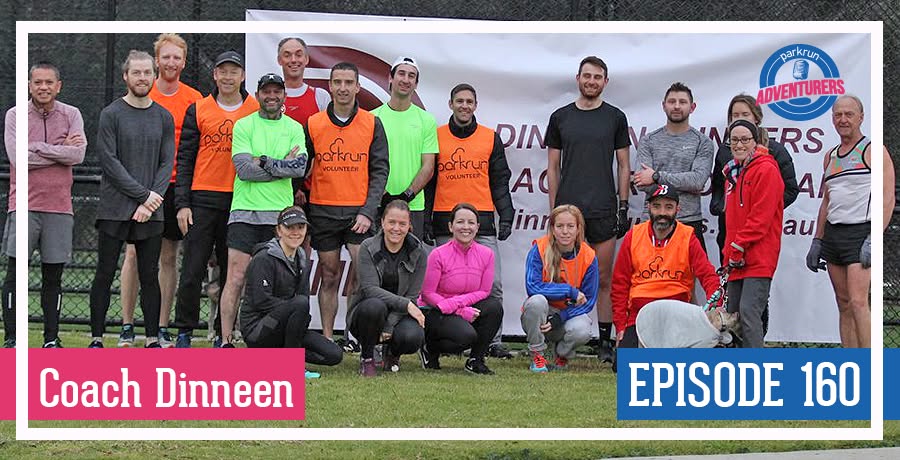
 — open the full-size cover
Episode 160 - Coach Dinneen
Episode details · · 275 speaker turns · sound cues from context
Enhanced transcript
Speaker names appear where they could be established with confidence. Others are shown as “Unidentified speaker”. Sounds that are not speech — music, laughter, people talking over each other — are written in [square brackets].
Episode 160 - Coach Dinneen · 2019-06-14
Enhanced transcript — Produced by an automated editing pass — speakers named, sound described, segments marked. NOT yet checked by a person.
Speaker names appear only where they could be established with confidence; others are shown as “Unidentified speaker”. Non-speech sound is in [square brackets].
Source: https://log.5kadventures.net/transcripts/ep160.html · The Adventurers Log · An independent project, not affiliated with or endorsed by parkrun.
Welcome
Lyndell Murray: Alrighty, parkrun adventurers. It's Lyndell, it's not Mel. I'm standing in for Mel for long-time listeners of the podcast would know that I'm standing in for Mel just for a short time. And welcome to the podcast for number 160. G'day, Scotty.
Scott Trickett: Hey, Lyndell. I've got to tell you, I'm a little bit excited. I'm excited to be chatting to someone else other than Mel. Yeah. Is it okay to say that? I think it's okay. Maybe Mel will understand.
Lyndell Murray: I'm sure she'll understand.
Scott Trickett: Yeah, yeah. Absolute pleasure to have you. Thanks for agreeing to do this. And you say a short time, you know. Let's wait and see. Could be a long time.
Lyndell Murray: I don't know whether I'm as funny as Mel. She's the funny one out of this duo, isn't she? And I don't know that I'm that funny.
Scott Trickett: Don't hurt me like that. So early on, Lyndell, in our partnership, I tend to think that I'm the funny one, but Mel is the public face of being funny.
Lyndell Murray: I'm sure that's true. I'm sure that's true.
Scott Trickett: In my mind, that's how it works. Hey, now, I'm not sure how close you've been following the parkrun adventurers podcast, but what we usually do is we like to talk a bit of parkrun, and that usually involves us retelling our adventures of the previous parkrun day. So I'm keen to know, Lyndell, where did you get up to on Saturday?
Lyndell Murray: This last parkrun day, I ventured along to Mitchelton parkrun for their sixth anniversary. So Mitchelton is a fairly, well, not an inner city suburb, but it's not too far out from the Brisbane city area, sort of northwest of the CBD. It was their sixth anniversary, so that was fun. There was cake. There was delicious cake. And they had a theme. So for those of you who may be, you know, reasonably newly married, you might know that the traditional and modern gifts for six years of being married are iron and lollies, or confectionery and so that was the theme so um I decided to channel Mel I know Mel likes a good dress up and since I'm a stand-in Mel I I did dress up I went along as a licorice all sort so that was fun um
Scott Trickett: Hang on a second. Take it back. So the theme was iron and lollies or was it just lollies? Did they drop the iron?
Lyndell Murray: No, no, no. Iron or lollies.
Scott Trickett: Oh, okay. So it could be either. Rightio.
Lyndell Murray: Yeah, there were a few people there as dragons from Game of Thrones and I think there was like an Iron Man and a few people celebrated the irons.
Scott Trickett: Yeah, look, I like it. You've got to get creative after six years, don't you, with the themes. I know at Westerfolds, I think we must be coming up to six years as well, and I think the event team might start scratching their heads. So I like it. Iron and lollies. And so how is it parkrunning as a licorice allsort?
Lyndell Murray: Oh, not too bad. Look, I was a very abstract licorice allsort. I wasn't square. I didn't wear a box. As I said, I was a bit abstract, so I wore mainly black with some pink shoes and socks and a purple tutu and an orange buff. So that was my version of a licorice allsort.
Scott Trickett: Did you have to explain to people that you were a liquid? I did have to explain. Okay.
Lyndell Murray: But that's okay. I was very happy to do so. I don't mind. I knew it was a bit abstract.
Scott Trickett: That's good. I think you're actually channeling me when you go with that costume. I think Mel's very specific.
Lyndell Murray: Yes, yes. Mel's costumes are very on point, very on point.
Scott Trickett: Yes, staying up until 3 or 4 o'clock in the morning to get them right. Exactly. And so Mitchelton, I don't think we've ever heard much about Mitchelton. I've certainly never been there. Six years, they must have some stories to tell.
Lyndell Murray: Yeah. Look, it's a pretty reasonably sized parkrun. It's obviously very established. So they usually probably get 300 or 400 parkrunners along on any given day. It was a big day for them this week as well. Their long-time Event Director, Vince, stood down from that role, and they've got two brand newies in that role now moving forward with Carl and Luke. I had a bit of a chat to Luke on the day. He's a lovely young bloke. And Carl looked smashing in his candy cane outfit, so I think Mitchelton's in pretty good hands. Good, good.
Scott Trickett: When you say young, what do you mean by young?
Lyndell Murray: Oh, well, not as old as me.
Scott Trickett: Okay.
Lyndell Murray: I don't know, 25, 30, something. Oh, that's great. No, this is great.
Scott Trickett: I love seeing younger people involved in parkrun. I think, you know, one area we really struggle with attracting is those girls and guys in their 20s. So to see an Event Director step up. In that age group. It's awesome. You know, we need to have leaders. People need to follow someone. And if our leaders are of a similar age, that's how it happens. So that's great.
Lyndell Murray: He's a lovely bloke. He came and had a chat. You know, he's in good hands. He'll be great. I think I've got high hopes for the Event Director team at Mitchelton.
Scott Trickett: Good. Good.
Lyndell Murray: How about you, Scotty? Where did you?
Scott Trickett: I was in Queensland. I was in your neck of the woods. Last Saturday, we ventured out to Victory Heights, which I know about and I got excited about after you visited there and gave us a roving report and got me all excited.
Lyndell Murray: I'm glad you went.
Scott Trickett: Why did you go up to Victory Heights?
Lyndell Murray: Oh, really boring reason - I went there to get my V.
Scott Trickett: I thought that was it. I thought that was it because that was the reason we went there. Because for those that don't know, and that's everybody outside of Queensland, I reckon. So Victory Heights is in a town called Gympie. Now, we were staying on the Sunshine Coast. We were staying at Noosa for the week. And Yvonne and Kasia don't have a V. I already have a V. So I was open to going anywhere. But they really wanted the V. And so we weren't going to miss the opportunity. And after your report, and Mel's a big fan of Victory Heights, and I looked up their Facebook page, and it looked like an event that would suit me, so we headed there. But it's a funny one, isn't it? Gympie. Like, what's Gympie famous for? I think I saw a billboard as we were driving in, and it's the town that saved Queensland.
Lyndell Murray: Yes, it did. I can tell you all about it, actually. Oh, do tell. Being a Queensland girl. So Gympie is famous for gold. I thought so. Yeah. So you may have driven past a big, I don't know, some kind of structure that they used to use to pull gold from. out of the ground. There's a lot of underground mines there. So it's not an open cut mine. It is literally tunnels under the place. And I think a lot of, you know, back in the day, there was a lot of gold just in the creeks. But they discovered gold in Gympie at a time when the Queensland government was pretty much on their last legs financially and didn't have any money in the coffers. So they found gold at Gympie and obviously the government got their cut and Gympie saved Queensland.
Scott Trickett: Well, that's a good story. It's good to know because, yeah, so it's an hour north of the Sunshine Coast and we cut it fine. We cut it really fine because... I might have taken a wrong turn. We reached the juncture in the road at one point and we either had to go left or right and neither Yvonne and I were really paying attention and I took the call to go left, which actually sent us back to Brisbane. Oh. And added 15 minutes to the journey and we were already cutting it really fine. There was a bit of panic. Yeah. Yeah. Yeah. Yeah.
[19 seconds of audio that could not be transcribed]
Scott Trickett: that were rushing from the car park, missed the whole event briefing. All we heard was, you know, basically ready, set, go. And people were running off and we had no idea where we were going, but we survived. Because as you know, Victory Heights is like a, it's a trail parkrun and it's a really, it's a narrow single trail course with a lot of switchbacks. So you get to see a lot of the other parkrunners while you're out doing the parkrun. But they could be 100 metres in front of you, but you could literally reach out and touch them, just is the nature of the zigging and the zagging of the course. And it's also, what I liked about Victory Heights is that it's a sort of a one-lap course. And I think this is, so I think your parkrun experience is dictated by what you grew up in, essentially. So I grew up at Westerfolds. Westerfolds is a single lap course. So that's my experience of parkrun, essentially. I like the idea of starting at one point, going out and coming back and finishing at that point. Whereas I know there's a tendency in Australia, we have a lot of out and backs. And we even have a lot of out and backs, out and backs. We don't have too many like laps, multiple lap courses in Australia. But we have very few single loops.
Lyndell Murray: Yeah.
Scott Trickett: Which is what Victory Heights is. And so, I don't know. I just really liked it. I felt at home like you're just out every footstep you take. The scenery changes. Yeah. I didn't fall over. I didn't join the stack club. That's excellent. But the lady in front of me did. Oops. And it was okay. I was the only one who saw it. So she was all right. And, yeah, it was a lovely, lovely morning in Victory Heights.
Lyndell Murray: Sounds like a victory all round.
Scott Trickett: It was. It was. So put it on your list not for – The V, just put it on your list, is that it's a great place to go for a run on a Saturday morning.
Lyndell Murray: I concur, Scotty. It is a great place for a run.
Scott Trickett: Yeah, and you experience these new towns. So it's fair to say the Tricketts would not have gone to Gympie if it had not been for parkrun. But we got to spend the afternoon exploring the town, exploring the railway yards, and we found a nice cafe to have breakfast in. So it was a great morning all around.
Lyndell Murray: Terrific.
Scott Trickett: Now, Lyndell, some of our listeners may be wondering, like, it's great that you're here, but they want to know what's happened to Mel. She's not here, so that's a good indication that she has had the baby. So... So fill us in, Scotty.
Lyndell Murray: What's happened with Mel?
Scott Trickett: There is another Erbacher in this world. Mel has surrounded herself with boys. And so Emmett Avery Erbacher joined us last week. Very healthy. I don't understand this. Never have, Lyndell, but he was 10 pounds. I think that's a big baby.
Lyndell Murray: I think that's big, but I don't really know either, Scotty.
Scott Trickett: You don't know either? Why do we say pounds? I don't do pounds, but for some reason for babies we do pounds.
Lyndell Murray: It's a mystery, isn't it?
Scott Trickett: Yeah, yeah. But I had the pleasure. We stopped in and I got to meet Emmett and the rest of them. Mel was there too. was handy. Caught up with Mel. The showman and Wesley were also in town in fine form. And everyone's doing really well. Well, they were last week.
Lyndell Murray: Well, that's fantastic.
Scott Trickett: Emmett is healthy. Mel is firing. We caught up with her literally days after, and she was Mel. She was up and about, happy as you would expect, I guess, from Mel. Wesley's now two, and he was in a very happy mood. He's a pretty cute kid, I've got to admit. I'm not going to choose favourites just at this stage. Because I've got to be fair to Emmett, he's only been in this world a week. Wesley is a pretty cute kid. So he's nudging your head just at this minute.
Lyndell Murray: I'm sure Emmett is just as cute in his own way.
Scott Trickett: Now, what do you think of when you think of Emmett? Now, we'll let Mel answer this when she comes back and joins us. But when you hear the name Emmett, what's the first thing you think of?
Lyndell Murray: I think of books like Jane Austen books and things like that. That's what I think of.
Scott Trickett: Oh, really?
Lyndell Murray: It's a very distinguished name.
Scott Trickett: It is. Well, here's the social experiment. I go straight to Back to the Future. Oh, yes. Doc Emmett Brown.
Lyndell Murray: Yes.
Scott Trickett: So, well, there's the tease for a couple of episodes' time to find out what's the inspiration behind the name Emmett Brown.
On the Couch with Coach Steve
Scott Trickett: Last week, we had a return to the regulars with Kelly and Charles joining us. This week, the coach is back after far too long, and I think he's got some company with him as well.
Interview Steve Dinneen — running coach ("Coach Steve", returning guest)
Scott Trickett: So, welcome back to the podcast, Steve Dinneen.
Steve Dinneen: Thanks a lot, guys, for having me here. I've got my little four-month-old son, Billy, asleep at my lap at the moment. I've got my daughter sitting beside me watching Kung Fu Panda Bear on Mums in Better Six, so... Yeah, I've got a little bit of company, but they should be quiet for us today.
Scott Trickett: It's the norm now, it seems, for all our guests. And everyone's having babies at the moment.
Steve Dinneen: It's a good time of year to get them out there and all ready for our summer.
Scott Trickett: Exactly. Now, nice lead-in, Steve, getting ready for summer. Let's lead off with, I've had a long break, and we need to start getting fit, getting ready for summer. Is it too far out to start planning for, like, sort of that marathon race season that is coming at the end of the year? Should we be starting thinking about that now?
Steve Dinneen: Yeah. See, my big belief in all this is the earlier you plan, the better your result's going to be, generally. So... I have a lot of guys that say to me, oh, you know, should I plan 10 weeks out for the marathon? You can plan 10 to 12 weeks out for the marathon. If you plan 20 weeks out, you should be getting better results. If you plan 30 weeks out, you should be getting better results. So I think preparation is the key. The closer you plan to the race, the less time you have for the hiccups to go wrong. So I think preparation is ideal. And it definitely, I'd say to most people, I'd be starting now, if not in the next month, And not late to last second where you increase chance of getting sick, chance of getting injured. So, yeah, plenty of time and the further you can do it out, the better it will be.
Lyndell Murray: So, Steve, I am a little bit less fit than I have been in the past, let's say. I've... I won't get into what's happened to get me into that state, but I've noticed I've lost a bit of strength and a bit of conditioning and I feel like I need to get that back. So have you got any tips on some strength? What are the best strength exercises for runners to just build that core strength and leg strength back up?
Steve Dinneen: Okay. So when you're trying to build back up and get strong, you've been out of the game for a while, a few components and the main one that I tell most people is just build up real slowly and the idea of that is you've been out for a while, one thing you've done is lost condition. That might be in the muscles, that might be in a fitness example, say your heart and lungs. So the key for you being out for a while is just start up really slowly and for some people that have been really out of the game and lost fitness, it might mean start up walking. Others that aren't so far off might mean start jogging real slowly and then how far and how long you go again starts at your level. So So long as you get through it comfortably, you'll be fine. The number one tip I give to most people, start off walk jogging. Walk for a minute, jog for a minute, and do that 10 times. And once that starts to feel a bit more comfortable, two minutes jog, one minute walk. And everyone's quite familiar with the Couch to 5K program a lot of people do. That's an example. If you haven't been out for a long time and you're just trying to learn how to run again, start off running like a Couch to 5K where you literally walk, jogging, walk, jogging, more jogging, jogging, running. And once you build a base fitness, then you can look at doing sessions after that and longer runs.
Scott Trickett: But Steve, what do you say to the people like myself, for example, who get really frustrated because I know what I used to be like, and now I'm here. And it's a much slower pace, and I just don't want to walk, run.
Steve Dinneen: Yeah, and I get that really well. I understand that, Scott. People often think, oh, you started this, you did that. The thing is, just to get a realistic check on where you're at, just because you want to do that doesn't mean you can do it just now. And if you try to force yourself, the chances are you'll get injured and you'll get more setbacks and they'll even make you feel worse. So a guy like me at the moment, I'm not far off my 40th birthday. What I used to do when I was 30 isn't what I can do now at 40. It doesn't matter how hard I train now, I won't be able to run, you know, try and get down and watch 29 low sub 29 minutes of 10K anymore. I'm trying to get below 30s. So you've got to be kind of realistic with where you're at. As frustrating as it is, end of the day, if you push your body too hard, too early, too soon, things can go pear-shaped really quick. And rather than saying, oh, I've been out of the game for now three months, I've been back running for three months and I keep getting injured and now that's six months, that's nine months. So really, it's just, you know, whatever spot you're in, listen to your body. The bigger your base is, the easier your jogging is, the quicker you'll get to the goal you want to achieve. If that means you start off, you know, for the first two weeks walk jogging, it's much better than doing that and spending two weeks running, two weeks injured, one week running, one week injured, and going along that way for the next six months until you're frustrated and then want to give away the sport and have another break from it. So I just think listen to your body, be kind to your body, and work into it easy. Enjoy where you're at because while you walk jogging, it won't be too long until you're running, then you're doing longer runs, and before you know it, you'll be going for long Sunday runs going, gee, I'd like to have a bit of an easy day soon.
Scott Trickett: One thing we've been doing in the Dinneen Runners and one thing I've benefited from enormously and helped me avoid injuries is drills and strides. And I've introduced it into the Westerfoldians as well. And so what we do is we do a few active drills as opposed to doing the traditional stretching method. So can you go through, break it right down. So what's the difference and why do we do that and what are the benefits? There's a few questions there.
Steve Dinneen: Yeah, that's for sure. So back in, would you believe, in 1999, I did my sports science degree. And back then we were told, look, we're sort of in a different way in the sports science world. We're doing less stretching and more dynamic stretching, which is the drills. And the idea of the drills is to actually get your joints, your hips, your ankles, your knees through the range of motion. So part of the dynamic stretching is that while you start doing the drills, you're putting your body through the ranges as they warm up and stretch, rather than go and do a 20-minute jog, you stop and do static stretching. And then that 15-minute static stretching, you go cold. So the idea of the warm-up is to get the muscles ready before you do your session. And what they used to do in the past is go do a jog, stop for 20 minutes, stretch, and suddenly you've got cold muscles again. So you're kind of really avoiding those muscles cooling down. The second part of the drill is actually teaching the body the biomechanics pattern. So you So when you're running, you're teaching yourself how to stride in the way your legs need to move, the way your arms need to move. So I tell a lot of my athletes, if you can't do these basic drills where you've got knee lift, you've got your stride, you've got your heel flip and all that, if you can't do it over 20 metres doing some drills, how are you going to do it over a 5K parkrun where you take roughly 5,000 steps? If you can't do it over 10 steps, you've got no chance. So we're kind of teaching everybody the motor patterns in those drills as well. So the drills and strides, the idea of that is firstly to loosen the body, warm it up, stretch it so you don't get injured. The second part of the drills and strides is to actually get you doing the motor patterns so the legs go through the ranges they need to go for running efficiently, effective and fast. And then the third thing is the actual strides itself. We do four strides, 70%, 80%, 90%, 95%. And the reason you're progressing up is one, that each stride you get a little bit faster and further, things stretch out. The second part of it is also actually on a biochemical level, that as you go through the warm-up, you know, your blood pHs all start to change as you start to introduce oxygen deficit in your body. So there's actually so many reasons why we do it. To make it simple for everyone, one is to allow the body to warm up. Two is to get the biomechanics and the motor patterns working. And three is to allow the chemical change in your body to start to adapt. Rather than going from a cold car motor to a hot car motor, you're warming the motor up before it starts to race. If that makes sense.
Scott Trickett: It does to me. Do you do them before every run? Or is it just when you're doing a hard session or racing?
Steve Dinneen: So, because I do three sessions a week, Tuesday, Thursday, Saturday, I do it three times a week. With a lot of my newies, I say to them to do it every second day. Go out for an easy run. And at the end, do it because you've got to then teach your body how to go through those techniques and patterns. So for me, I know how to do all the drills. So yeah, three times a week or if I'm racing, I might do it on a Friday just to sort of lift the body up. But a lot of people that I'm sort of coaching initially get them to do it more frequently just to get used to it. And that almost becomes their session. Do the warm-up, which might be 20, 25-minute jog. Then do your drills, do your strides, and your runs done for the day. If I was to do a big run, so let's say we're doing Melbourne Marathon, you'd probably find the third hour of Friday before Melbourne Marathon, I'd do a half an hour jog, drills and strides and leave it at that. And, you know, people with all the fun runs around Australia probably notice about 10 minutes before the start of a race or 20 minutes, all the elites are at the front doing these run-throughs, strides and all that. That's what they are doing before they're over their race. So, you know, their optimal performance is ready to come out.
Scott Trickett: Good to know. Now, the other thing is you don't do it on your slow run. And this is something that I struggle with. Making sure that my long, slow run is that, that it is slow. I have a tendency to run too fast. And I know you're going to tell me, Steve, that I've got to slow down. But tell me why I have to do my long run slow.
Steve Dinneen: Okay. So at the moment, the way we do it is one of the biggest problems in Australia is lots of people do their slow runs too fast and their fast runs too slow. That's the biggest problem. People run too much in the medium area. The idea of you doing your slow, long runs is about recovery. So when you go for a nice, easy run, you're allowing the blood to go through your body and pretty much filter through the muscles. And that way you clear all the waste products and all that in the body. And you're also allowed to recover and heal. So an example is if you went out and did a fast 5K right now, parkrun Saturday, a fast 5K, and didn't do a cool down after, which might be a walk or a small jog afterwards, you'd find Sunday you wake up a little bit sore and stiffer. That's because all the waste products that you've done in your run are still in your legs. So with your Sunday long runs, we work on clearing the body out, letting the blood go through and recovery. The second part of a long, slow, easy run is getting base fitness. All you're trying to do is just get nice and easy, work your heart and lungs, develop some strength, When you jog at an easy level, you actually develop more blood vessels in your legs. When you do a lactic run, lactic acid damages them. So the idea of a slow run is to clear your legs out and build that vascular, the blood supply to your legs. So again, a long, slow, easy run is pretty much about recovery. And the idea of that is so your heart and lungs recover along with your muscles and you also get the extra bonus of getting some extra cage in your legs and some extra fitness.
Lyndell Murray: So coach, I'm a pretty slow runner and I've done a lot of longer events in my time and I think that's part of why I run so slow apart from probably lack of natural talent as well. Is that a bad thing? Should I be trying to run faster or is running slow okay?
Steve Dinneen: So that's a great question there in terms of it's good to do long, easy runs, slow and get fit. But then what you've got to also do is sometimes during the week, do a run which is a bit quicker and break up your stride. So if your body starts to run too slow all the time, then that becomes a template and it just runs slow all the time. So that's where the strides come in handy. So even if you're just building up fitness, you might just want to at the end of one run do some strides, which is a bit faster work. 100 metres, stride it out, do that. And then you might want to introduce one other run a week where you just go for, let's say, a half an hour run And for five, ten minutes of it, you're running a little bit faster. And once a little bit faster, if you're running and jogging at six-minute K pace, if you get down to 550, 545, that's enough to start with. And over time, that will actually help. So, you know, for her, once a week, picking up your run to run a little bit faster, it will, in the long run, make your slurrer run faster. It feels just as easy. Does that make sense?
Scott Trickett: Great tips, Steve. It's great to have you back. Away far too long. And the kids behaved.
Steve Dinneen: Kids are always good here, mate. I'm very lucky with my kids. They're very chilled out.
Scott Trickett: Billy's sleeping?
Steve Dinneen: Yeah. Yeah, Billy's sleeping and Brookie's pretty relaxed. He's happily watching us on TV for once. I'm quite lucky there. And, you know, even when I go racing, they're all pretty relaxed and chilled out. So I'm fortunate to have kids that let me do what I need to do.
Scott Trickett: Good. Well, maybe next time we have you on, you can give us some advice on juggling life running balances because you seem to do it pretty well. Thanks for coming back on the podcast.
Steve Dinneen: No, thanks a lot for having us and I hope I gave you some good tips there for people and good luck to everyone out there running.
Roving reports & the Channel 5 News crew
Roving report Scott Watkins — Westpark parkrun in Munich, Germany
Scott Watkins: Hello parkrun adventurers, it's Scott Watkins here and I've actually got two adventures to talk to you about. The first one is just me talking, but the second one has a few more interviews, but the first one has an important lesson. So the first one took me a couple of weeks ago to Westpark parkrun in Munich, Germany. Now this is another event for me in Germany and parkrun is really growing there. I'd previously done the Hasenheide parkrun in Berlin. So Westpark parkrun, just to give you an idea of the course, it's a double lap around a lake. The path is mainly gravel and a few paved sections. It's really pretty. A large part of it is just a shaded path where you're not actually really close or even within sight of the lake. It's a little bit undulating but the hills are not challenging at all. So really, really nice and being a double lap you get to see some people on the second lap. Now the locals there were a mix of British expats who lived in Germany and a lot of Germans. The Run Director on that day, Charlie, was a British guy who did an admirable job of doing the run briefing in German. The adventure part for me came while I was standing there listening to Charlie and I thought, oh no, I've forgotten my barcode. Now, I'd already told the team that I was involved in parkrun in Australia and that I was visiting, so I couldn't tell them that I'd forgotten my barcode because it would have just created an awkward situation because we all know the rule, no barcode, no time. So I'm standing there during the briefing and I thought, this is either going to be a freedom run or I can try and solve this problem. So I quickly pulled up my phone and did a search for internet cafes and I found that there were two pretty close by. So I thought, okay, I can do this. I had a look at last week's results, saw that the Tail Walker had come in at about 45 minutes. I thought, okay, that gives me about 23 minutes after I finished running. So I set off and ran and I finished in about 23 minutes, and then I uh without sort of saying anything to anyone I put my finished token in my pocket and I ran to an internet cafe now the first one was closed Google had said that it would be closed but I thought I'd check because it was closer so I kept running past that ran to the second one managed to talk to the guy in german work out how to log on printed out my barcode pay him the 90 cents and then run back to parkrun now the the journey to and from the internet cafe added about nearly two and a half kilometres to my run so my 5k parkrun turned into a seven and a half k parkrun but I got back to the finish line at about 40 minutes so the Tail Walker who I'd actually seen on the first lap they weren't back yet so I managed to present my printed barcode and my finish token and get scanned and record my parkrun adventure so yes I know you can buy tags I have tags I just a whole combination of new shoes being in a foreign country and deciding not to take my wallet and I didn't take any of the barcodes that I do have with me along so important lesson people um don't forget your barcode but you it is possible to problem solve and I should say I was uh I was prompted to think of this idea because we've actually had a few people do similarly at Albert park over the years run to office works and print out their their barcode So, yeah, great time in Westpark parkrun, and parkrun's really going places in Germany. There's lots of new events on the horizon, and I look forward to doing some more when I'm back there for work.
Roving report Scott Watkins — RecPlex North parkrun in Pensacola, Florida
Scott Watkins: Now adventure number two is the event that I have just finished which is RecPlex North parkrun in Pensacola, Florida. So I again was in the US for work and I flew into New Orleans arriving at about 7pm on Friday night. I then thought, I'm just going to grab a car and drive across to Pensacola. Now, I knew it was a long drive, but I probably hadn't thought it totally through that spending 24 hours on a plane and then getting in a hire car to drive 300 kilometres across four states probably wasn't the optimum idea, but I honestly felt fine and did it okay. So Yeah, leaving Louisiana, I drove across the border into Mississippi, then across Alabama, and then into Florida, and got to Pensacola about 10.30 on Friday night. So I booked a hotel there, got up the next morning, parkruns in Florida at 7.30, so earlier start for me. Turned up, it was a really beautiful morning, probably 28 degrees, quite humid, very sunny, and was greeted by the team who I'd got in contact with beforehand and they were all happy to see a visitor from Australia and I set out and and did the run and it's a trail course it's really beautiful and I managed to speak to uh quite a few of the team who've put it together afterwards at at the parkrun so here's what they had to say so now I'm here with allison at uh recplex north parkrun so allison how did you find out about parkrun
Allison: I found out about it on Facebook. And I saw it was on the University of West Florida campus, and it was going to be the first college campus in the United States to host a parkrun. And I know there's nice wooded trails that are shaded, which is great in Florida, especially in the summer when it's hot. Would love to run in the woods, but normally doesn't feel safe. But when you can come out with, you know, 100 people, 80 people, however many show up on a Saturday, it's nice, it's safe. Good opportunity to make new friends.
Scott Watkins: That's great. And how many have you done?
Allison: I have done 12 maybe. Yeah, it just started in January or February actually.
Scott Watkins: And have you met new people?
Allison: Lots of new people, yeah. We socialise after, meet for coffee at Starbucks. So yeah, it's been a great, great experience. I love it. I normally don't like to get out of bed on a Saturday, but I get up every Saturday for this.
Scott Watkins: Excellent. Great. Well, I'm glad you're enjoying parkrun. Thanks for talking to us. So I'm here with Robin. Now Robin's the Co-Event Director here at RecPlex North parkrun. So Robin, how did parkrun get started?
Robin Foley: parkrun got started here. I came across parkrun in Ireland, Marlay Park, 2014, and thought it would be a no-brainer for the US. I came back and people were looking at me as if I had two heads, you know, free, you know, how are you going to do it? And I did another parkrun at Bere Island in West Cork and came back again and read an article in the Wall Street Journal whose headline was, would Americans take for free what they usually pay for? So anyway we got down to work and finding a suitable course was an issue but we have a lot of nice parks in Pensacola but they're all small and nobody wants to do 10 laps in the heat or more. So we found the University of West Florida and they want to be a destination campus. They want the local people in Pensacola to come visit the campus. So this was like pushing an open door and they had the trail that was disused and we got to work on it, a group of volunteers, and here we are. And you literally hewed the trail out of the woods? We retrieved the trail, yeah. It was pretty tight, closed in, you were pushing briars apart when you were going through it before. We also had obviously help from the University of West Florida maintenance staff, but our volunteers are really the guys that have been whacking it out there. And so for the listeners, just describe the course. Well, we like to, it's a wooded course, natural course, lots of roots on the trail. We like to call it as undulating, um some people call it very challenging but uh it's certainly not a course for baby strollers we had one last week guy and we told him hey you know we don't think you should do this and he said well he was an english guy so that that's makes an allowance for something so he was giving that a try and when he came back he said it wasn't bad but he was a strong fellow I I hate to see young lady um picking that up
Scott Watkins: Yeah, it would be challenging, I think, with a stroller.
Robin Foley: He worked up a good sweat, I can tell you. He was wringing.
Scott Watkins: And how long have you been in Pensacola?
Robin Foley: 30 years in Pensacola. What brought you here? Well, to the States. Initially, it was the Irish economy downturn in 1983, early 80s we came. And we spent five years up in the New Jersey area. And then we came down to Pensacola.
Scott Watkins: And what's this city like?
Robin Foley: What are the major industries here? Pensacola is mainly tourist, mainly tourist economy. We have a local paper mill. They're getting into aerospace now at the airport. They have aircraft repair. just started maybe a thousand thousand jobs and we also have navy federal a big credit union which has brought ten thousand jobs to the pensacola area all good jobs so pensacola is on an upswing and we got parkrun to cap it all great well thank you for bringing parkrun here and thank you for having me today you're welcome more than welcome
Scott Watkins: So now I'm here with Gabby, who's with the Pensacola Runners Association. So you're the president, Gabby, and you've brought along a group today to parkrun. Is that correct?
Gabby: Well, I don't know exactly how many people came here from the Pensacola Runners Association. I guess at least 50. But we have helped promote it and funded most of the stuff that they have here in parkrun. And we encourage people to come here every Saturday to... you know, do the 5K and then hang out after the run.
Scott Watkins: Did you already have a run on Saturdays before parkrun started?
Gabby: No, we have social run on Thursdays. We have also 5K in the Gulf Coast Brewery and we have also the Monday group that trains here in the university with Coach Caleb. And we put a couple 5Ks, but organised 5Ks during the year.
Scott Watkins: Okay, so parkrun fitted in pretty well with your schedule already.
Gabby: Yeah, because it's another social run that we encourage and offer our members to come and do.
Scott Watkins: Great, well thank you for all you do for parkrun here and I hope it keeps going well.
Gabby: Thank you very much.
Scott Watkins: So now I'm here with Austin who's the Volunteer Coordinator here at RecPlex North parkrun. I'll get it right eventually at the end of the morning. So Austin, how did you find out about parkrun?
Austin: So I'm friends with Caleb Carmichael who started this with Robin Foley and I knew they were getting it going and I've been running trails out here for years and so Caleb talked to me about potentially helping get stuff going and then The guy who was previously doing the Volunteer Coordinator, William Cutler, he moved away, and so I took over. But before that, I'd been helping out. I like seeing the trails get used. You know, these trails here, they weren't used for a decade, so there's no cleaning of them or anything like that. And you really couldn't go on them. And so Robin and Caleb, they got all this started, and they got the trails cleaned up. And it's nice to introduce people to other ways of running besides just running on the road, yeah and have you met new people through this um yeah I mean especially through doing Volunteer Coordinator just you know interacting with everybody and encouraging people to come out volunteer and come and run um so yeah I've definitely increased my base of people I know in town and you know different runners and stuff like that so have you done any other parkruns around the world yet this is my only one I was actually in dc in early April and I was going to try and hit one of theirs up but my um My plane was leaving too early, so I didn't get to. So this is still my only one, but I want to do the other ones.
Scott Watkins: Okay, great. Well, thanks for talking with us today.
Austin: Yeah, thank you.
Scott Watkins: So now I'm here with Caleb, who is the other Co-Event Director here at RecPlex North parkrun. So, Caleb, how did you find out about parkrun?
Caleb Carmichael: Robin Foley, actually. He was the first guy who brought it up. I had never done a parkrun before, believe it or not. He gave me this crazy idea about people running, and it's free, and it just was a strange concept. I'm used to racing, and I have a coaching background, so it's a unique concept that I really kind of... I'm not sure this will work here or not, and after talking, after getting... kind of the ball rolling we started figuring out hey this people may like this so you're a pretty uh active runner yeah I run anywhere from 80 to 100 miles a week most weeks and I actually coach the university of west florida here I'm a cross country coach okay so I have a lot of background in coaching and running so yeah I'm quite busy with it and it's nice that I actually had the course right here on campus to utilise and do you see many students coming along That's the hard part. The students are lazy. So trying to get students to encourage the guy out there. We're trying to find some ways in the fall, maybe use some incentives through the university to make sure people can come out and use it. But it's actually more of the general community, which is great. We'll have multiple races in Pensacola that weekend and people still come out and do our parkrun and keep our numbers high, which is great. And what about the volunteering? Where do you see them coming from? Volunteers were parkrunners who came out, and then some of them decided to help, and really that's what it was. We had a small number of volunteers to start off with, and people came out and liked the idea and concept and wanted to contribute in some way, and that's how we got our volunteers. Have you met new people in the community through park oh yeah yeah I mean because generally I mean I'm I'm obviously my background racing I I tend to do well in races most of the faster people kind of gravitate to the master fish so I get the back of the pack kind of walkers and runners and really neat getting their perspective and cheering them on and and understanding and listen everybody's out here having a fun you know having a good time yeah great well thank you for all you do for your community it's great I really enjoyed the event today I appreciate it thanks so here I am uh with uh a few more runners and this is their third parkrun so who have I got here
Unidentified speaker: Courtney Martin. Sydney Martin. Shannon Martin.
Scott Watkins: Okay, and mum and two daughters. So how did you find out about parkrun?
Courtney Martin: We just moved up to the area, up to North Pensacola and UWF's right across the street from our neighbourhood. Found out about it and just thought it'd be a good way to get some exercise. Not have too much fun on Friday night to be able to get up on Saturday to run and then meet people.
Scott Watkins: And have you two met some people here? Not yet?
Courtney Martin: No.
Scott Watkins: No?
Courtney Martin: Yes, we have. Marine. We met Luigi. And then the coach for UWF. Track team.
Scott Watkins: Do you do some running outside of parkrun?
Unidentified speaker: Yeah.
Scott Watkins: What sort of running?
Unidentified speaker: The duathlon and the sea turtle triathlon.
Scott Watkins: Okay. What part of triathlon do you like best?
Unidentified speaker: The biking.
Scott Watkins: Biking, okay. And what about you? Do you do running outside?
Unidentified speaker: I did cross country last year at my school.
Scott Watkins: Okay, okay. And have you been enjoying parkrun or does mum have to drag you along?
Unidentified speaker: She has to drag me.
Scott Watkins: okay you dragging or enjoying enjoying okay good yes we like it well well done I'm glad that you found parkrun and there's there's um over a thousand parkruns around the world so your barcode now is your passport to doing parkruns all around the world so enjoy it cool yes thank you great thanks a lot So now I'm here with Elizabeth, who is a very enthusiastic parkrun participant. So Elizabeth, how did you find out about parkrun?
Elizabeth: I found out about parkrun through my mom. She likes to read the newspaper a lot, and she kept encouraging me to come.
Scott Watkins: Did she come?
Elizabeth: She has come once. She did not complete the whole thing because she's 86.
Scott Watkins: Wow.
Elizabeth: And so she walked two miles of it. And I told her no, I wasn't going to come do it because I work at UWF and it's like a 30-minute commute and I didn't want to come back on a Saturday morning at 7.30. But I came the first week and I've been coming every single time since. I love it.
Scott Watkins: Wow. And so what's your mix of participating and volunteering?
Elizabeth: I volunteer as much as I can and... A lot of the times I try to do the processing results so I can run as well, but it's just wherever they need me.
Scott Watkins: And you've met new people through parkrun?
Elizabeth: I've met a ton of new people, a ton. And it's been so much fun getting out and knowing everybody and just making connections at UWF that I haven't made before because we do have faculty and some staff that come out. And I'm really working to try to get student participation up, so I work with the ROTC group and I'm working with health and fitness and some of our other departments to have students come out. We've had faculty say they'll give extra credit. And so we're trying. 7.30 is a hard sell for a college student.
Scott Watkins: It is. It is. But I think, you know, once they understand it, as you have, they'll enjoy it.
Elizabeth: Absolutely. It's fun.
Scott Watkins: Have you done any other parkruns yet?
Elizabeth: Not yet. I'm waiting. I really want to go to Weedon Island. I've kayaked there. But my next one is going to be Goat Trail up in outside of Chattanooga in Tennessee.
Scott Watkins: Okay.
Elizabeth: That's the one I want to go to.
Scott Watkins: Excellent. Well, I'm sure that once you discover parkrun tourism, that'll add a whole new level to your passion.
Elizabeth: It is on my bucket list. That is my goal now, is to hit every parkrun in the world.
Scott Watkins: Okay, well, that's a big challenge.
Elizabeth: It's a big challenge.
Scott Watkins: But you can come out to Australia and parkrun adventure in Australia anytime you want.
Elizabeth: I would love to come.
Scott Watkins: Great. Well, thanks, Elizabeth. Thanks for everything you do for your community.
Elizabeth: Well, thank you for coming out and visiting us in Pensacola, Florida.
Scott Watkins: Thank you, so that's it a really great morning at RecPlex North parkrun in pensacola florida so I didn't add that if you look at a map of florida pensacola is up in the top left corner the the northwest of florida and there was another recent launch so there are now four parkruns in florida so if you're travelling to the us make sure you check a map because there's pretty much a parkrun a week launching in the us and it's it's really growing strongly now So, yeah, a huge thanks to both of the teams in Westpark parkrun in Munich and RecPlex North parkrun in Pensacola for being so welcoming to me. As you heard in those interviews, the passion for parkrun is the same all around the world. And I am very lucky to get to visit some of these places when I turn up there for work. So I appreciate the people being so welcoming and friendly of me.
Roving report Melissa Ellis — Curl Curl parkrun
Melissa Ellis: towards me so it's Scott signing off from another set of parkrun adventures good morning parkrun adventurers it's Melissa here and I'm coming to you from Curl Curl parkrun I've got a big parkrun adventure weekend this weekend um but firstly, can I congratulate Mel, Adam and Wes on the arrival of baby Emmett. Well done, he looks beautiful. But back to parkrun. We've just finished the course here and I've got with me Sandra. And Sandra ran her very first parkrun today. Good morning, Sandra. Good morning.
Sandra: How did you find it? A lot of fun. It was a good course, interesting and pretty and nice. And how did you find out about parkrun? Through somebody I ran into a few days ago. And you're a local here? Yes, I am, yeah. So you thought you'd come down? I did, yes, because she and her husband come regularly, and even in England, that's where he started doing this. So, yeah, instead of running by myself today, I thought I'll join the gang. Yeah? And how did you do? I don't know. I think I ran like I normally do. I think it's a fairly average pace. And so you're a gym instructor, you said? I am. Yeah, group fitness, group fitness instructor.
Melissa Ellis: So parkrun's been a very good way for people to get into fitness. Yeah, great way, great way, because gyms aren't for everybody, that's for sure. I have to admit, I've never been to a gym myself.
Sandra: Yeah, well, you know what, I don't blame you. But certainly the great outdoors is always going to be better for you mentally. Yeah. And physically it's great. There's no pressure. No one's looking at you. You just do your own thing.
Melissa Ellis: Yeah, that's right. All right. Well, thanks for talking to me today, Sandra. I hope you come back. Oh, absolutely.
Sandra: Now I'm going to find where they have coffee.
Melissa Ellis: That's the second best part of parkrunning. That's exactly. That was the other thing that got me lured in too. Thanks so much. All right. Okay, I've got with me now Kim and Dana. Now Kim, I believe, are you one of the longest standing EDs, if I've done my parkrun homework correct?
Kim: That's correct. I think I'm the third. I think, who's the ED at Albert Park? I think he's sort of the longest standing, and then Paul Wilcox, so, and then me, I believe. So have you been here since Curl Curl started? Yes, yep, May 2013. Wow. Can you tell us about the course? Sure. It's a lovely course. It's probably one of the fastest in Sydney. So you sort of do a... Oh, it's more of a figure of eight around a parkland. You know, it's got the hockey fields, the soccer, the netball. So it's really quite a sociable sort of Saturday morning. And, you know, where we start, we've got sort of the toilets, the facilities, and then we go for coffee afterwards. So we've really got everything within five minutes. It's great.
Melissa Ellis: You get big numbers, don't you?
Kim: Today, I don't know, Dana, what are we up to?
Dana: About 300... 350 or more by now. So probably going to get close to 400 today and that's winter. And Dana, I commend you on your run brief. Thank you.
Melissa Ellis: You're very confident. What's your story in parkrun?
Dana: I started parkrun about six months after parkrun had started at Curl Curl. And I just heard of it through my substitute science teacher, Ken, who is one of our regular runners here. And he was like, yeah, everyone, you should run. It's really good for your... think I think cardiovascular health or something like that so then I decided to do it and then in 2014 I was volunteering regularly and then in 2015 I started becoming an Event Director no Run Director sorry and even though it's technically not allowed but as I was under 18 but it
Melissa Ellis: I'm sure you're one of the Run Directors. I was endorsed by the Australian CEO, Tim, so it's all good. Very good. What's the history of Curl Curl parkrun?
Kim: Who got it started? I actually started it. The course itself was actually discovered by Debbie Soms. She runs BEXI, which is a Northern Beaches running club specialising in women running triathlons and things like that so her and her husband Martin actually founded the area but because of their day jobs they couldn't commit and so when I was coming back from the UK I was like I want to do parkrun there wasn't one on the northern beaches I was in contact with Tim and he goes do you want to set it up I'm like sure what does that mean and here we are well thank you very much very friendly welcoming community here I've really enjoyed it
Melissa Ellis: And I look forward to the longest run tomorrow. I'm going to join you guys. Great. So, yeah, early start. We've got on the fun bus. We do. 5 a.m. pickup. All right, we'll see you there. Thanks. Thank you. Okay, that's it from me from Curl Curl parkrun. And in typical tourist fashion, I've got to walk my way to find the coffee. Sydney, what's going on? I thought it would be warmer up here. It's marginally warmer than Melbourne. Warm enough by my standards at least to be in a t-shirt. The Sydney people seem to think it was cold. Anyway, I'll find a way to fill in the day exploring the beaches at Manly and I might check in with you tomorrow after the longest run.
Roving report Melissa Ellis — the longest run in Sydney
Melissa Ellis: Bye. Good afternoon parkrun adventurers. It's Melissa here coming to you from the longest run in Sydney. We've just completed event number five, at the secret location, which turned out to be Mona Vale Beach. I've got with me Ollie from Shellharbour. Hi, Ollie.
Unidentified speaker: Hello.
Melissa Ellis: And brand new parkrunner, Emily. Hi, Emily. Hi. So this has been an amazing adventure today. Sydney, what's with the hills? Mona Vale has some hills and it has some beach running, and it's not the easiest course to run uh for your fifth parkrun but it is beautiful absolutely beautiful we've had stunning weather here today haha Melbourne the sun's in Sydney um eventually and they've been fabulous hosts today um we've got another couple to do the legs are very tired and so Ollie how are you finding it it's starting to hurt but it's a lot of fun
Unidentified speaker: which has been the standout today for you um so far oh look I think it was um was it Rouse Hill Rouse Hill was pretty pretty beautiful over the hill and with the some of the mist still there yeah and um still a few nice ones out there Wildflower again brutal but lovely oh Galston hills
Melissa Ellis: but this this is something special so uh it is yeah it's just the view's just amazing and um and Emily so you joined us um at Wildflower and you're new to parkrunning so this is a new experience yeah how have you found it don't know if I want to run again or never run again we'll see it's probably a good thing to run but it hurts Well, not every parkruns like this. Generally, you just do one. Generally, there's less hills, hopefully. And yeah, pick a nice flat one. Now, did you say Centennial Park's going to be your home parkrun? So I would think that's relatively flat. I haven't done that one. I heard someone called it easy. Well, that's good. So are you going to front up next week to Centennial?
Allison: No promises, but maybe. I'll get there eventually.
Melissa Ellis: Ah, okay. Well, it was lovely to meet you today. You too. And we might check back in after the last parkrun.
Unidentified speaker: Yes.
Melissa Ellis: Okay, so the longest run's finished. It's been a fabulous day here in Sydney. Now I've got with me, friend to the podcast, Paul Rainbow. Hi, Paul.
Paul Rainbow: Good evening, Mel.
Melissa Ellis: And... was great today thank you yeah thanks for coming up I've had a ball so we had East Richmond parkrun first in the fog in the fog which is pretty much we couldn't see anything but it wasn't raining and it wasn't cold so I'm happy with that yeah it was perfect other than couldn't see anything well there's that yeah um and then we had breakfast
Paul Rainbow: Well, the breakfast was great. I just want to say, you know, we had actually a great location for breakfast because normally it's so slow, but we had a great turnaround. That's right. And then we went off to Rouse Hill after that, which I was surprised because the guys from Rouse Hill, the EDs there, turned up and set up the whole course, which is absolutely amazing because it's actually really confusing. Well, not confusing, but there's a few turns that you could go the wrong way. So they put all the cones out. And it was great because they ran as well and then they would have had to go back and pulled them all down.
Dana: Yeah.
Paul Rainbow: And then where did we go after that? We went to Galston and again all the EDs came down and helped us out. We had Karen down at the junction point showing us the first lap, second lap. So it was great to have those volunteers out on the course because it makes life so much better for the longest run.
Melissa Ellis: I think the event teams get a kick out of hosting.
Paul Rainbow: they do when you say you're part of this part of this longest run they really they appreciate it and we we try to get them involved and just want to let them know that we're going to be there yeah and then what Wildflower was next Wildflower for the uh the our hilliest run yeah um so thanks for that there that's all right you know we wanted to test your legs um but yeah wildflower was nice again you know we had such great weather we had we probably had our best turnout at, um, Rouse Hill, but then at Wildflower or Galston, and then Wildflower but at wildflower we had a we had quite a few numbers there yeah a few people turning up for just that run Yeah, it was a nice call. Some of the people just did the 3K rather than the 5K option, which was something you can do at Wildflower.
Melissa Ellis: And I loved the touch of the special secret parkrun.
Paul Rainbow: The secret parkrun, right. So this is something I've been building up for a while because... I've been wanting to create a new parkrun on the northern beaches for probably about four years so it's still not there yet but it's something that I'm proposing to council and you know it's probably it might be a few months it might be a few years away but it's something that I'm wanting to do so when we've done the longest run before we've we have included
Melissa Ellis: proposed parkruns before so I thought well you know this is something that could happen and it hopefully will happen what did you think about the course Mel I loved it you loved it well I didn't love it so much after already doing four parkruns did your legs love it my legs were a bit cranky about the about the um elevation yes but it's beautiful yeah you know it's just a beautiful place so why would you not want a parkrun there
Paul Rainbow: Did you stop at the top of the hill and look around at the scenery? Yeah. Starting on the beach, you've got the swimming pool right there, you've got people doing laps, you're starting in a great location, you've got an absolutely awesome view at the start, run down the beach and then up and over the hill and do a couple of laps up around the hill.
Melissa Ellis: Because we can't have enough beach running in our car.
Paul Rainbow: No, of course not. Yeah, well, you know, I was going to mention on the page, you know, definitely bring a second pair of shoes because one pair could get wet. Yeah, thanks for that. That would have been handy. Yeah, it would have been handy. Didn't want to like, you know, didn't want to make sure anyone guessed where we were running though, you know.
Melissa Ellis: After Mona Vale. Mona Vale, yeah. We can say the name now, is that okay? Yeah, you can say the name, yeah. Okay, it was in Mona Vale. Yeah. We had a nice flat Curl Curl parkrun, which was also well attended. And finishing up at Mosman in the dark.
Paul Rainbow: Finishing up at Mosman. So the planning side of things, we need to add more time in for, I guess we could say it as social slash communication slash chatting slash, you know, whatever you might want to say. But I need to add in some sort of factor for that because I've really just got driving and running is the only two factors. So next year I'll add in a bit more calculation for chatting, which I think was the main reason we're socialising socialising them sorry so that was the main reason we were about an hour ish late I think at the end of the day um so not too bad but we did definitely start in the dark and um there's quite a few people with head torches quite a few people with um you know just the um the white stits I don't know what they did but we were just shouting at them at distances saying yeah we're over here this is this is the corner Turn here.
Melissa Ellis: Oh, it's all part of the adventure. Yeah, true. But you've done a brilliant job. Oh, thank you. The attention to detail with all your maps and I know your social media page.
Sandra: Yeah.
Melissa Ellis: The information there and the posts that you put up and the updates made it so easy for us. So thank you. That's right. Yeah, and I look forward to maybe joining... Next year? Next year. Wow.
Paul Rainbow: Yeah. Well, maybe we'll do a different seven parkruns. I can find a tougher course for you. Can you stretch them from Melbourne to Sydney? No, unless we do. This is what I was thinking, what we could do. Could we do seven states in a weekend? Seven states and territories, all right?
Melissa Ellis: You reckon?
Paul Rainbow: Maybe. I was looking at it the other day. I was like, can we do maybe Simpson Desert or something and do a loop? Get a plane down to like... Tassie might be difficult. Tassie, I don't know. Yeah. Go down to Victoria from there. Can you get a plane? I don't know. I was considering it, whether you could actually do seven... We could get a helicopter.
Melissa Ellis: Oh, and I noticed, I've got to say... on the Mona Vale course, you've got a helipad.
Paul Rainbow: We have got a helipad. I took a photo with that. I was very impressed. So we've got obviously the defib, but obviously we need a helipad as well for, you know, in case of emergency. That's right, safety reasons. So it's all provided by parkrun Australia. So they fork up the cost of the helicopter in. But, yeah, that's at the junction point after you've done the two laps of the hill. So, you know, it's the perfect place to put the heli pad. It is. Yeah, it's convenient.
Melissa Ellis: Very convenient, yeah. All right. Well, we'd better wrap it up. Thank you for a brilliant weekend in Sydney. I will. And, yeah, all the best. I'll come down to Melbourne soon. You're a bit of a celebrity. It took me a while to get time with you. Yeah, that's right, you know. All right, thanks, Paul.
Scott Trickett: Our gender balance was spot on this week with the roving reports, as we heard from Scott Watkins, the president. He's quite the international traveller. First, he was in Germany with his tales of lost barcodes or forgotten barcodes, and then he was in America. Yeah, gets around and then thanks to Mel Ellis who ventured up to Sydney went to Curl Curl she had a 7 a.m start at Curl Curl and then she did the longest run so it's good to hear report we haven't chatted about the longest run much well at all this year so thanks for giving us an update on that Mel Ellis Lyndell, have you got any plans for the longest run this year?
Lyndell Murray: Well, I have just missed the North Brisbane one, which was on last weekend. And South Brisbane is on in a couple of weeks. South Brisbane is on the weekend actually closest to the Equinox. So who knows? I might get along to some of the runs or all of the runs when that happens in a couple of weeks' time.
Scott Trickett: Have you done a longest run before?
Lyndell Murray: So yes and no. Last year I missed the North Brisbane one because I was away somewhere. So I did the North Brisbane events but on the day of the Sunshine Coast longest run. So I did it all by myself which was a bit lonely and it got a bit hard by the 6th or 7th one but I got through it.
Scott Trickett: So that's not how it's supposed to be done, Lyndell. You're doing it all wrong. Like, it's good that you're doing it, but I think it works really a lot better with other people.
Lyndell Murray: I think you might be right, Scotty.
Scott Trickett: Yeah, yeah. How about you? Well, it's a similar tale for me this year. So because we were away and the longest runs down here fell on Sunday, the weekend just gone, there was a Western version, there was an Eastern version, and there was a Gippsland version down in Victoria. So lots of choice. But I wasn't here for any of them. So I selfishly decided to do my own. I made up my own rules. I invited some Westerfoldian mates and a couple of the other local running clubs around close to us. And we did our own shortened version on Monday.
Lyndell Murray: Oh, yeah, long weekend Monday, yeah.
Scott Trickett: Yeah, so we had a long weekend down here in Victoria. So I did a five-event version, and I was also a little bit pissed that Westerfolds wasn't included in any of the other longest runs. So I thought that was a criminal injustice. So in my little version – You just did Westerfolds five times. Yeah, we just ran five laps at Westerfolds. Yeah. No, no, no, no. We basically went to the five events around me. So as I said, very selfish. But also there are five events that I've actually all got a connection to. And so I did this silly thing. It was probably, it could have been viewed as quite an ego trip, but I did this story time with Scott before each of the runs. So I sort of just told the people who joined me a bit of the history of the event because essentially I was involved in all the events that we ran. Because I kind of get the, well... It was an ego trip, but I also think that the people that are joining in these longest runs are parkrun tragics, and they kind of want to hear stories about the history of the events. And if I'm in a position to tell them because I lived them, I thought I'd give it a try.
Lyndell Murray: And was it a winner?
Scott Trickett: I think so. They got longer and longer as the day went on. I don't know if I got more confident or if I had – I started thinking about them a bit more on each run. But it was interesting. So we finished at Westerfolds, and I didn't really have anything prepared for Westerfolds because everybody kind of – I thought everybody knew it. But I came up with something. And I got emotional again, Lyndell. I think the power of this bloody parkrun community, it brought up some emotions because I talked about how much I love that silly park and how much this sense of calm comes over me when I drive through the gates like I'm coming home. I've watched my daughter essentially grow up. So she started in parkrun as a four-year-old. You know, now she's 11. When she grows up and she's having these conversations at dinner parties, hopefully she's going to mention, yeah, my parents drag me along to the park every bloody weekend. But she'll also have stories about surrounded by this parkrun community and this running group community called the Westerfoldians that she all knows.
Lyndell Murray: And so that's the story I told. It sounds like a terrific experience, Scotty. And one day you'll have to tell me the story of Westerfolds parkrun because I'd love to hear it.
Scott Trickett: Yep. One day. One day. You've got to come to Westerfolds.
Lyndell Murray: I'll have to come to Westerfolds.
Scott Trickett: If you come to Westerfolds, we'll have a four-hour breakfast after parkrun and I'll tell you whatever you want to know. All the stories. Yeah, I'll tell you the stories that we can't put on the podcast as well because I've got plenty of them.
Lyndell Murray: I bet you do, Scotty. Look, it sounds like you said it was an emotional experience. I think that people love hearing people's stories and people love – I could listen to anybody talk about pretty much anything that they're passionate about, Scotty. It's a wonderful thing to do and it's a wonderful thing to share.
Scott Trickett: Yeah. And it's funny because I was inspired by Dottie at the Palm Listener meetup. So he gave that great speech before our Freedom Run at Newy, where again, he got emotional. And again, he got emotional talking about people. And so I thought, like, that was an engrossing 10 to 15 minutes with Dottie when he was telling the stories of this event that I'd never been to, telling stories of people that I never knew, but I loved every minute of hearing it. So I tried to evoke that feeling when I was telling my stories a little bit towards the end. So you're right.
Lyndell Murray: What a fantastic goal.
Scott Trickett: Yeah.
Lyndell Murray: I think that's terrific, Scotty. I wish I had have been there.
Scott Trickett: Next year. Next year. Yep. Yep. Because we've started a new tradition. So it's a breakaway longest run tradition. Only five events, which is a lot more sensible too. And I was really struggling on the fifth. Yeah. I couldn't have done another two. I can tell you that now.
Lyndell Murray: We'll see. Well, if I get along to South Brisbane 1 and I get through, I don't think I'll get through 7, to be honest. But anyway, we'll see.
Scott Trickett: Now, back on track.
Launches and anniversaries"Where is the cake?"
Scott Trickett: Anniversaries. We have no launches again this week around parkrun, but we do have anniversaries at Burley Griffin in the ACT. Corrine Glades in Western Australia. Dolls Point, New South Wales.
Lyndell Murray: Mernda in Victoria.
Scott Trickett: North Shore, Queensland.
Lyndell Murray: Port Sorell in Tasmania.
Scott Trickett: Wangaratta in the Garden State.
Lyndell Murray: And Yeppoon in the Garden State.
Scott Trickett: No, Yeppoon's in Queensland.
Lyndell Murray: Ah, Yeppoon in Queensland. um where are you heading this parkrun day lindell can you share yeah I look I am heading along I'm doing a bit of work on my p index and I'm gonna head along to New Farm is the plan okay how many times have you been to New Farm This will be my fifth time at New Farm and I need to get it to six to get my P index to six.
Scott Trickett: Oh, good.
Lyndell Murray: Good.
Scott Trickett: I like New Farm. I've run there once before.
Lyndell Murray: New Farm was my very first parkrun. Oh, really?
Elizabeth: Yeah.
Lyndell Murray: So it's kind of like going home, but Bunyaville, as everybody knows, is my new home and my spiritual parkrun home. But New Farm's a pretty good second.
Scott Trickett: I'm going to put you on notice. I want to hear about your patient zero, your parkrun patient zero next week.
Lyndell Murray: My parkrun patient zero?
Scott Trickett: Yeah.
Lyndell Murray: You might have to fill me in as to what that is between now and next week.
Scott Trickett: But there you go. There's another tease for next week. You can hear about Lyndell's parkrun patient zero. But you mentioned your P index. Yes. We had some exciting news during the week, that the V index that Mel came up with a couple of weeks ago has been added to the running challenges, the Chrome extension that we all love and some people obsess over. So big thumbs up.
Lyndell Murray: Thumbs up, all right.
Scott Trickett: Yeah, to Laura and Andy and also Pete Johns. Pete Johns, he did the nerdy stuff, did some nerding on the computer and came up with something to help that happen. So Pete Johns is one of our ambassadors here in Australia. So do you know your V-index?
Lyndell Murray: My V-index?
Scott Trickett: No, Pete, your V-index.
Lyndell Murray: My V-index is three.
Scott Trickett: Okay. Okay.
Lyndell Murray: So I've done, but interestingly, I've done four different volunteer roles three times each. I think I've figured it out and I know what I'm doing. And if I just marshal one more time, I can get my V index up to four.
Scott Trickett: There you go. Yeah, it's the same as the P index, but in roles. I'm getting my head around it. But if I think it's the same as the P index, but instead of events, it's roles, it makes sense.
Lyndell Murray: Yes, me too.
Scott Trickett: Yeah.
Lyndell Murray: Cause I couldn't get my head around it for a little while. I didn't know.
Scott Trickett: It's very confusing. It's very confusing, but I'm all over the P index.
Lyndell Murray: Um, how's your P index going, Scotty?
Scott Trickett: Uh, as I scroll up, my P index is sitting at seven, but I'm really close to getting that to like nine or 10. Cool. But I've just got to commit to, um, getting back to those events multiple times. Um, And it won't happen this week. Well, again, I'm playing a really long game because I'm going back to Rosebud parkrun this week and I've been there before. So that'll take me up to two.
Lyndell Murray: It's a very long game if you're already seven or eight.
Scott Trickett: It is. And Rosebud's like an hour and a half away from home. So I can't imagine I'm going to be visiting there too often, but.
Lyndell Murray: But if it's a nice parkrun, it's worth going back to, you know?
Scott Trickett: It is. And it's the antitheses of what I'm used to, what I was talking about earlier. It's an out and back, out and back.
Lyndell Murray: Right.
Scott Trickett: Which is like the complete opposite to a single loop.
Lyndell Murray: But, you know, the out and back and out and back, it's a good opportunity for high fives. It is. An out and back and out and back. It is. So all of the different kinds of parkruns have their place.
Sign-off
Scott Trickett: They do. I think we survived, Lyndell. I think we did okay. Yeah. Were you nervous?
Lyndell Murray: A little bit.
Scott Trickett: Yeah? Well, it's over now. You can relax. That's a wrap on 160. Look, I'm going to make the big call. You're going to be back next week, despite I did tell Mel that it's not up to her, it's up to me, when she's ready to come back. And I think we're going to give her at least one more week. So will you do this again with me next week?
Lyndell Murray: If that is okay with both you and Mel, I will be back next week.
Scott Trickett: No, no, it's okay with me. That's good.
Lyndell Murray: It's okay with me.