 — open the full-size cover
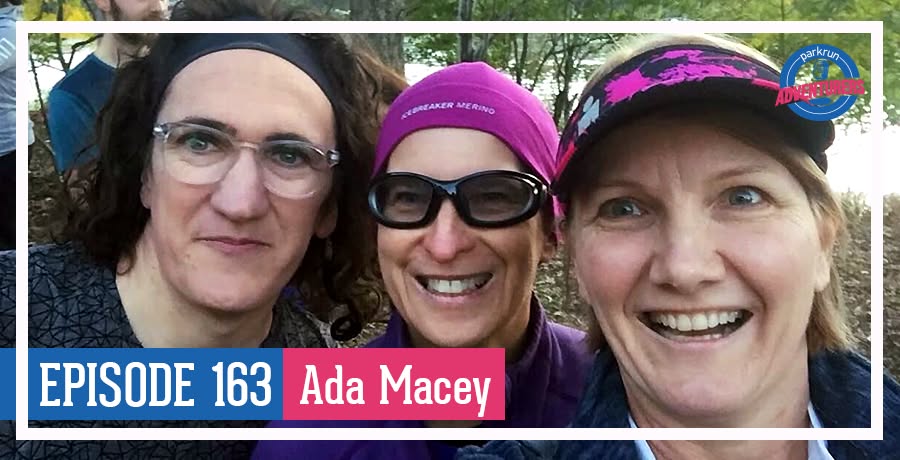
Episode 163 - Ada Macey
Episode details · · 166 speaker turns · sound cues from context
Enhanced transcript
Speaker names appear where they could be established with confidence. Others are shown as “Unidentified speaker”. Sounds that are not speech — music, laughter, people talking over each other — are written in [square brackets].
Episode 163 - Ada Macey · 2019-07-04
Enhanced transcript — Produced by an automated editing pass — speakers named, sound described, segments marked. NOT yet checked by a person.
Speaker names appear only where they could be established with confidence; others are shown as “Unidentified speaker”. Non-speech sound is in [square brackets].
Source: https://log.5kadventures.net/transcripts/ep163.html · The Adventurers Log · An independent project, not affiliated with or endorsed by parkrun.
Welcome
Scott Trickett: We're back for another edition of the parkrun adventurers, ready to break new ground in the number one parkrun podcast in Australia. Welcome back to the podcast, Lyndell Murray.
Lyndell Murray: G'day, Scotty.
Scott Trickett: Now, we're breaking new ground. We're going to have a third co-host this week. Can you guess who?
Lyndell Murray: Is it Fluffy, the emu from Nambour?
Scott Trickett: No, no. But I'm glad you mentioned Fluffy. We have an update for everyone who's concerned about Fluffy and Miffy. But you've got to wait to the end of the podcast. We'll get to that. I'll give you another guess.
Lyndell Murray: If it's not Fluffy, I'm guessing it's not Miffy either. So welcome to the podcast, Ada Macey.
Ada Macey: Hi. Yeah, Lyndell and I go way back.
Scott Trickett: Welcome. So we're trying the three-way host thing. Don't know how it'll go, but Ada, I'm reliably informed you're quite hilarious, so I hope you'll add a lot to this episode.
Interview Ada Macey — Guest third co-host; transgender parkrunner and subject of parkrun Australia's…
Scott Trickett: We might start with your story. So Ada Macey, who is Ada Macey? We don't really know who Ada Macey is. If I said to you, what is the most popular blog article and newsletter that parkrun Australia has ever put out, would you know the answer to that, either of you?
Lyndell Murray: Well, I'm guessing that if you're asking that today on this podcast when Ada is here, that it's probably the article that was written about Ada.
Scott Trickett: It was. It was. So, Ada, you shared your story with the parkrun audience. We're going back 12 months now. It's over 12 months. The story of a transgender parkrunner. And it captivated the parkrun audience. People loved reading your story, loved hearing about your parkrun experience. Did you know that, first, Ada, that it's the most popular newsletter we've ever had?
Ada Macey: Yeah, no, I have an inside source who may have told me that it was really popular, which was quite a surprise for me, but, like, I mean, it made a big difference in my life. I had people coming up and recognising me when I went to parkruns, or I'd mention my name, and I'd say, you know, I'm Ada, and they're like, oh, are you that Ada that had the article in the newsletter? Yeah. So that was a sign that it had really reached quite a wide audience. A lot of people in my transgender communities as well read the article. So it came back from a lot of different ways in a lot of different areas.
Scott Trickett: And so you said that that surprised you a little bit.
Ada Macey: Yeah, absolutely. I mean, I guess we always see a lot of transgender news in the media. We're always talking about transgender people, especially in athletics and sports, right? But to see a positive article done about transgender participation in sports and then to see such a positive response to it, just when I walked through the community, when I was talking to people, I had people... messaged me on Facebook that had read the article. I guess I wasn't expecting the real world effect, just the way it would change going to parkrun on a weekly basis. So it was quite... quite positively surprising and in a way I didn't expect. And then I was speaking to Rikki and she told me that Rikki is the author who wrote that wonderful, wonderful story. And I was speaking to her and she told me that it had been a really, really popular article and just it made me so happy to actually get such a positive article out there like that. So, Hopefully we can get to see more stories like that in the future because they're not as common as they should be.
Scott Trickett: So we'll talk about it. I'll address it from my perspective. So as the one who effectively published your story and wanted to share it, your story with the wider community, I got a lot of feedback and I got it from yourself as well, Ada, but I got it from others that this was kind of the first positive experience of transgender reporting in the sporting field and maybe even a broader field than that. Can you explain that? Yeah, look,
Ada Macey: when you look at transgender people in sports, there is always discussion about the controversy and there's discussion about whether it's fair or whether it's unfair. And the sensationalist element about it, you know, draws people in. They want to sort of, the media tries to generally create headlines that are contentious, right? But, you know, I mean, we're all parkrunners. We know what the parkrun community is like. And to have an article done from the community perspective that talked about the support that I got from the community and my transition through the community and And my experience as a runner was touched on, but it wasn't the core element of the story. The story was about my community, and it's just really hard to find stories that are done like that. I can't think of any others. I would like to think that there are others out there, but it's too easy, I think, for people to go to the contentious stuff. I know Rikki, who contacted me and did the interview that that article was based on, I think for a lot of people, people aren't aware of how to touch on a lot of issues around transgender people and the right wording to use and the right communication, what you can say and what you can't say. But Rikki was quite upfront about wanting to listen to my preferences and approach it in a way that was respectful to me and to the broader community. And I think that really, really showed in that final result. So I can't say enough good things about the whole process. It was just wonderful to see from me as a member of the community. And a lot of the community came back to me with that as well.
Lyndell Murray: It's fantastic to hear, Ada. And of course, you know, we've sort of become friends by hanging out at parkrun together. And I've just really enjoyed that experience of getting to know you as a person. As a person, first and foremost, and not so much as a transgender runner or any of those kinds of things. But you were saying that people are sometimes a bit unsure what to say and what not to say.
Ada Macey: um is that something that you experience in your day-to-day life a lot um and what would you say to people that are a bit unsure about what to say um look it's not something that I I guess I don't deal with it too much in my day-to-day life anymore um I've been transitioned now for a couple of years so most of the people who I interact with on a day-to-day basis it's just You know, we've been through the learning phase, right? And when I go to talk to new people that haven't met me before, generally things are pretty smooth. But I think that's because the way you're perceived as a transgender person is In that early stage, when you're early in transition, people don't know how to read you and they don't know how to gender you and they don't… Appearance-wise, you can be quite, I guess, out of the typical binary male-female expectations that people have, right? And that creates a challenge for people. So… When I was earlier in my transition, when I was transitioning through the parkrun community, especially when I had to put on active wear, which it's a bit hard sometimes to be overly feminine when you're in a running top. It's a bit of a challenge, but... I think the biggest thing there, people in the parkrun community, they got it right, even if they made mistakes. didn't make a big deal out of it. They didn't go, oh, I'm so sorry, please forgive me. It was just, they acknowledged that they made the mistake. And then that was that. And they just tried. And that's the biggest thing you can do if you have a trans person in your life, is just be willing to keep trying. If you get it wrong, they'll let you know. And they don't mind if If you're genuinely trying to get there, if you're genuinely trying to show respect for someone who's going through a transition, then that's the best you can do, right? And that's what the community gave me. So in that way, it was really quite a positive thing. I think in a workplace environment, people are a little bit more formal I think it can sometimes be hard to navigate that but in the parkrun community it's very relaxed people are there people there's a familiarity right that's it's a community so even if you don't know the other people there you kind of feel like you know them because you've got something in common with them and that makes it easier to easier to navigate so if people are a little bit yeah I think you're right yeah I mean look parkrun is that kind of place where everybody belongs and
Lyndell Murray: And everybody can have a conversation with anybody. You know, it becomes a place where it's really natural to just talk and just be with other runners and other people that are like-minded. So it's really nice that you've had that experience as well.
Ada Macey: And that's actually one thing. You said like-minded there. That's actually been one of the really good things about parkrun is that there's a lot of people in the parkrun community who aren't the people in my usual circles. They're not the people that I would talk to in my day-to-day life. We wouldn't simply cross paths. So there is an opportunity there, to meet people that you don't normally get to meet, right, and have those discussions, even leaving, you know, transition and that side of it aside, you can talk to people that are part of your community because you share running, you share Saturday morning, you share that community in common. And that was really, I think, helped people feel more comfortable around me as well as me feel more comfortable around them. It's one of the real positives of the parkrun community.
Scott Trickett: Well, see, this makes me happy to hear, Ada. So what I want to know is that do you become identified as the transgender or has it got to a point where you're just Ada, the parkrunner now? Yeah.
Ada Macey: So, if I'm at my local parkrun, then I'm just Ada. People just know me as Ada now. Well, I mean, I guess even through my transition… My name changed, but I was still just the same person I always was, right? But where it gets a little bit different is when I go to another parkrun that I haven't been to before. I like talking and I talk to anyone. And quite often, I'll be talking to someone and they are, hi, my name's Ada. And when they realise I'm transgender and my name's Ada, they'll go, oh, wait, wait, you're Ada. Are you the person that they did the article on? And I'm like, yes, that's me. And I guess in those moments, I become Ada the transgender runner. But I try and make that not last very long because I like talking about anything and everything. So that's a good opening to get chatting to people. But after that, I pretty much just become Ada.
Lyndell Murray: Ada, I also remember at some point we were talking about how people had reached out to you on the back of that article as well, other runners and other parents of runners or people who had identified as transgender and that you'd been able to just talk them through that a little bit and maybe offer some advice or support. What's that been like for you?
Ada Macey: Look, one of the moments that stands out to me, I had a lady, she's a parkrunner herself and she was just going through the early stages of her transition and she had read the article and then she tracked me down on Facebook and sent me a message and told me her story and And then she actually came out to my parkrun so that we could meet and we went and had coffee afterwards. And we had a big chat and I met her partner. And it was just a really positive experience to get that connection with someone who shared my passion for running, but also understood me. some of the unique experiences of transitioning in that space as well. So that was, from a personal level, that was quite empowering. But right after the article came out, I had a lot of people reach out as well who, parents, as you said, who have transgender children transgender children um a couple of people reached out and said that seeing a positive um mention of transgender people in the media I had one one mother who reached out and said her daughter looked at the story and said she's like me I'm like her and that was you know I mean that That's one of those things that makes it worth it, right? Like, for me, visibility is something that – visibility is very important. That's why I did the article. That's why I'm here, because the more visible trans people are in day-to-day life – as just regular people, then the easier it is for us to become just part of everyday life, not something different or unusual, but just regular people. And so for this kid who I've never met, I've just been told about this child who was able to see a representation of themself in the media and feel a bit of positivity from that and say, oh, look, I'm like her. That's amazing to me. So, yeah. Yeah.
Scott Trickett: Yeah, come on, that sort of lump in the throat sort of stuff, hearing it, Ada, that's really got to touch you.
Ada Macey: Yeah, oh, it does, right? Like, I mean, when I was a kid, I grew up in a small country town, and I'm old enough that there was no internet available, so I had no knowledge of anything to do with transgender people. I... had no knowledge no ability to reach out to talk about the stuff that was going on in my head I had no answers I had no clue what my future held because I didn't understand the things going on in my head but to realise that a transgender kid growing up today has a million opportunities and the ability to see themselves and see a future for themselves and see other transgender people out there just
Scott Trickett: living life I mean that's such a such a powerful thing it is now we said we were going to just include you as part of the podcast so I also know another thing about you Ada and that you didn't go to parkrun this weekend oh I know you told me you weren't going to bring that up sorry sorry Well, I brought it up now so we can't take it back. But it's okay. It's okay. We'll work with you through the rest of the episode. This is your replacement to parkrun, talking parkrun.
Ada Macey: Oh, good. This is how I make up for it.
Scott Trickett: Yeah, well, let's live vicariously through Lyndell who went to North Harbour parkrun.
Lyndell Murray: Yes, I did, Scotty.
Scott Trickett: How was that? It was great. Give us an update on North Harbour because they've gone through some changes, I think.
Lyndell Murray: So North Harbour has, well, they have got a little bit more infrastructure there. We both went to the launch, Scotty, as did Mel. That's where I first met the two of you. And look where we are today. So there's a lot of things that are the same. It's still cross-country. There's still lots of cows. It's still in a beautiful spot along the Caboolture River. They've got a little bit more infrastructure there and the housing development that's there is ever burgeoning. I got some fun facts from the Run Director on the weekend because, as you'll recall, Scotty, you turn up there to a parkrun called North Harbour and you expect to see boats. And there are no boats. There's not really a harbour there.
Scott Trickett: It's a cow paddock.
Lyndell Murray: It's a cow paddock. There's still no harbour there but I did find out why it's called North Harbour. Back in the day there used to be quite a lot of traffic on that part of the Caboolture River because that area before it was a cow paddock was a forestry area. And before it was a pine forest, it was a dairy farm. And before it was a dairy farm, it was a sugar cane plantation. And the harbour was there to transport all of the sugar cane and the rum, dare I say it, from that part of the world. So what used to be, you know, quite a little area of... Commerce and manufacturing is now a bunch of cows and cow poo in a paddock with parkrunners on a Saturday morning.
Scott Trickett: There you go.
Lyndell Murray: So there you go. That's why it's called North Harbour.
Scott Trickett: By any chance, did it increase your P-index as we talked about last week?
Lyndell Murray: No, it did not increase my P-index, Scotty. Can you detect a little bit of a please explain in my voice, Scotty? No.
Scott Trickett: I'm not very good, am I? We made a pact last week and I went out and broke it like days later.
Adrian Royce: Two days later.
Scott Trickett: I know. I know. Shocking. Yeah. So I went to Diamond Creek and increased my P index to eight, which I'm really chuffed about. Nobody else cares about, but I'm really happy. But yeah, we were going to do it together and I went ahead and jumped it.
Lyndell Murray: And I could have done it on the weekend too.
Scott Trickett: Oh, really?
Lyndell Murray: Yeah, I'm only one away.
Scott Trickett: We really should talk more. The history of Diamond Creek, you've done it for North Harbour. There are not diamonds in the creek, and I'm not even sure how correct this is, but I think there's a story that Diamond Creek is named after a cow named Diamond who got stuck in a creek.
Lyndell Murray: Yikes.
Scott Trickett: That's a good story.
Lyndell Murray: I think. Did Diamond make it out alive, or is that her resting place? Could be her resting place. There you go. Well, we had cows in common at least, Scotty. Yep.
Scott Trickett: Yeah. The reason why I went to Diamond Creek is because it was pouring down with rain on Saturday morning. Diamond Creek is actually the closest parkrun to my front door as the crow flies. So, yeah, sorry. And I think Yvonne convinced me to go there to work on her P-index as well.
Ada Macey: My P-index is only three. I have a lot of work to do.
Scott Trickett: Wait till you get to eight and you'll know how impressive it is.
Ada Macey: Well, eight, that might be a long way off.
Lyndell Murray: You've got to play the long game if you're chasing your P index. You've got to just keep chipping away at it, I think.
Ada Macey: I'm focused at the moment on 94 volunteers and 132 parkruns. So I want to get to 100 volunteers and 150 parkruns at the same time. And then I'll focus on my P index.
Scott Trickett: Sync it up.
Ada Macey: Yeah, exactly.
Scott Trickett: This is the thing. Some people like to sync up their their milestones, even though, what is it, 150? It's not really a milestone.
Ada Macey: No. I know. It's not a real one, but it counts.
Scott Trickett: But you know what it is? It's 250 times at parkruns, 250 times you've participated at parkruns. So really, you should be getting your green shirt. Yeah.
Lyndell Murray: Well, that's a really good point, Scotty. Very good point.
Ada Macey: If you can make that happen. I can't. Okay. So another 120 parkruns to go then. All right. I can do that.
Lyndell Murray: We're pretty close in numbers, Ada, around parkruns. We're both on around that 130 mark.
Ada Macey: We'll have to do our 150th together.
Lyndell Murray: We will have to do that.
Roving reports & the Channel 5 News crew
Scott Trickett: We had a launch last week and our man Dave Moss, Mossy was there. He went out to Charleys, was it Charleys Creek? Out at Chinchilla and he got us a roving report. So take it away, Mossy.
Roving report David Moss — Charleys Creek
David Moss: And hello, we've just finished the Charleys Creek parkrun and I'm with... Adrian Royce from Wishart. Wishart, what are you doing all the way out in Charleville? No it isn't, we're at Chinchilla.
Adrian Royce: Yeah, Charleys Creek reminds you of Charleville doesn't it? Well we're out here for the inaugural run of Charleys Creek parkrun on a lovely blue sky day in Chinchilla.
David Moss: It is, it's perfect actually out here. And what did you think of the course?
Adrian Royce: Oh, look, it's a bit of a challenge, but it's a lovely course right next to Charleys Creek, amazingly, hence the name, with a nice hill over the railway. And yeah, it's a bit windy, but in the middle of town, I think it'll really take off.
David Moss: The location's fantastic. It's a very short walk from the middle of town. There is that hill, two hills really, right in the middle of the course. How do you feel by the end?
Adrian Royce: Well, I quite enjoyed the course and as you know, I got first. Congratulations Adrian I think it's one feature of this course it's really well marked out it's you know you cannot get lost at all they've got red green arrows going out and red arrows coming back and that's just very clever I've got to give a bit of kudos actually to the the people who organised this course it is well marked there were loads of marshals out there it really was quite good when you look at it on a map
David Moss: It does look a little bit complex. When you're out there, it's fine.
Adrian Royce: Yeah, it's brilliant. It's brilliant, yeah. And well done to you, David, as well, running around there.
David Moss: Thank you, Adrian. Okay, thank you very much, young lad. And we hope to see you down at Wishart. And congratulations on your 100th different parkrun. In Australia, yeah. In Australia, a true parkrun adventure. I made three figures at last. And I should also say for any listener out there, We had the longest parkrun in South Brisbane last week. Adrian was at the Wishart parkrun and welcomed everyone there with a good song. A superb, very well done.
Adrian Royce: Nice rendition. If you come to our fifth anniversary, I'm going to rehash it. That was just a practice last week.
David Moss: It did superb. Thank you very much. Thanks, David. Okay. Okay, I'm now with the Run Director, Event Director as well. Correct. And your name? Ronald Thompson. And what made you start up parkrun out at Chinchilla?
Ronald Thompson: Well, about three years ago, a group of us thought it'd be a great idea to get it going because we're in the middle of the gas boom and lots of people around. And so I thought, let's have a go at it. And at that point, we had about 15 or so keen people. wasn't quite so much support from council in those days so fast forward three years and we've gone same sort of keen 15 are still going and go let's have another go and um four months down the track here we are so that's a very long gestation period isn't it three years And is this pretty much the course you had from the word go? Yeah, pretty much the same course. We've made a few tweaks to it and that's the thing at Chinchilla is finding a place that you could actually do it safely. So it needed a bit of work in places and to be fair most probably needs a bit more but we've got good council support now so Yeah, it's great.
David Moss: Well, they seem to have put in quite a bit of gravel out there.
Ronald Thompson: Yeah, you would have felt that today, I guess.
David Moss: However, it does look good, and once that's packed out, I think that'll work out very well. The other one is, I mean, we're in the middle of winter at the moment, so it's a nice, cool day. This is actually perfect. Yeah, it is. In summer, you've got lots of trees around the place, too.
Ronald Thompson: It's a great course in summer because 90% of it is shaded, and you're running along next to the creek for quite a bit of it, so it is actually a good course to do in summer and springtime, but yeah, today is a good day, you know start at 5 degrees will be 10 or so now and it's a beautiful day I'll also say for our listeners Charleys Creek when we think of the standard Australian Creek it's a little bit bigger than that yes yes so Charleys Creek is one of the tributaries into Condamine River systems so yeah it always has water and we're lucky because it's a little town where so it has water all the time so it's great it's beautiful this is really good because it is close to the middle of town as mentioned beforehand
David Moss: So it's easy access, parking is great, you've got toilets right next to the start.
Ronald Thompson: of a kid's playground up here yeah so there's yeah there's there's playground there's that there's area you know it's safe for dogs as well to you know when you arrive and um yeah look it's great it's a great spot I thoroughly recommend it I'm very glad that you actually did put this thing together as well and it's great to see so many volunteers out there yeah look it uh it was actually good today we've had about a dozen people saying uh they'll do it I guess we won't need to have as many marshals on course down the track but it uh people just put their hand up so make the most of it.
David Moss: And like most parkruns, I will give it this, there seems to be a really good vibe there. I mean, this is the first course.
Ronald Thompson: I don't know what you've got, 150 odd people? Yeah, I think I just did 100, gone through 100 about 10 minutes ago and there's still sort of walkers coming in. So yeah, we've got Yeah, there's most probably about 150, so it's good. It looks as though you've got a school yard of kids in here as well. Yeah, yeah.
David Moss: Look, beautifully done, and I think everyone, thank you very much, and we wish you the best for the future. Very good, thank you.
Ronald Thompson: Thank you very much. Brilliant.
David Moss: Okay, and I'm with... Alan Middlebury. Alan, welcome. Is this your very first parkrun?
Alan Middlebury: No, second one.
David Moss: Where else have you been to? um here but it was um and oh the practice one yeah the practice one beforehand yes and what got you into uh having a go at it um my wife's in it and I need to get fit that's a common motivation is when the partner's doing something it's good to get out there that's right and uh you're local you enjoyed it yes and be back do you think every week or
Alan Middlebury: Oh, every week that I can make it, yes. It'd be awesome.
David Moss: Excellent. It looks like a nice crowd of people. The whole town's been good. Yes.
Alan Middlebury: I'm impressed how many people that we've got.
David Moss: It's a cold start to the day. It's harder in winter than anything else. But no, it's excellent. I'm very glad you're out there. You're walking it or running it? I'm just walking it at the moment. I think there'll be a lot of walkers. Yes. Which is absolutely brilliant. It really is just good getting out there and getting the blood moving. It is.
Scott Trickett: I'll leave you on that. Thank you. Thank you. Great stuff. We listened to it this week, so thanks very much. Ladies, are we making plans to get to Charleys Creek? It sounded like it was a hive of activity. Lots going on there on Saturday. It's
Lyndell Murray: It is a fair way away. I don't have plans currently.
Ada Macey: Yeah, I think it might be a while before I make it out there.
Scott Trickett: So what are we saying? We're saying four hours, which is a bit of a stretch on a Saturday morning from Brisbane.
Lyndell Murray: It's pretty much an overnighter, so that takes a bit more commitment than jumping in the car at 4am, doesn't it?
Launches and anniversaries"Where is the cake?"
Lyndell Murray: It does.
Scott Trickett: Now, we don't have any launches this week, but if you were listening to the podcast last week and you got all excited about Atherton's anniversary because we announced it, sorry to disappoint. It didn't happen because that was an administrative error on our behalf.
Lyndell Murray: So if you head to Atherton this week, you can get cake.
Scott Trickett: Yes, they are having their anniversary this week, along with Aveley in WA, Cobram in the Greater State Victoria, Strathalbyn in South Australia and Woy Woy in New South Wales. Also last week, we talked about Fluffy and Miffy. We've got good news to report.
Lyndell Murray: Yes, we do.
Scott Trickett: So according to the Department of Environment and Science, who manage the reserve out there at Nambour, they said they do not intend to remove emus.
Lyndell Murray: Which is great news. They've realised that most people who know the emus absolutely love them. Yep. And they've been very popular at Nambour parkrun and they've known to pop up there all over the place and they don't bother the parkrunners and the parkrunners don't bother them. No.
Scott Trickett: I mean, the reporting didn't mention it, but I think there was a bit of media pressure put on this situation by our podcast last week and I just think they succumbed. They grumbled. Yeah.
Lyndell Murray: Yeah, well, maybe they realise that I need to get there to be the emu whisperer to do my other role.
Ada Macey: We need to get there.
Lyndell Murray: Yes, we should arrange that, Ada.
Ada Macey: Yes, let's make it happen. Let's go and meet Fluffy.
The Other updatevolunteer 'Other' role challenge
Scott Trickett: No segue, Lyndell, to the other update. And I did warn everybody last week that we wouldn't get any interaction on this topic. We did get one, thanks to Hayley Louise to save the day. She got her volunteering other while she was doing... wearing her L plates as a Run Director. So as a Run Director, training, shadowing experience, which is a pretty, that's a pretty thumbs up way to get your other, I reckon.
Ada Macey: I have another story too. So that counts, right? That's two of us.
Lyndell Murray: Yes, please share, Ada.
Ada Macey: So my other story, I went to Albert in Melbourne and I was recovering from surgery. So I wasn't allowed to run, but I was not going to miss parkrun, you know, like I did this week. So I reached out to them and I said, hey, I'd love to volunteer, but their roster was full. So they said, we'll find something for you to do. So I went down as another and I ended up doing, Well, a little bit of everything. I was a photographer. I helped with setup. I was on the funnel at the end. I was a Marshal at the beginning. And it all just got wrapped up into other. So, it's a lot of bits and pieces.
Lyndell Murray: I think that's a really good use of the other role because you don't want to turn away a volunteer, right? And even if your roster's full and you don't have a specific role, there's always something to do, isn't there? There's always something that comes in useful in any of these kinds of event situations. So I approve of that use of other as well.
Ada Macey: I made it quite clear that, you know, I'm from Queensland. And I'm only down in Melbourne for a little while, so I can't run. And I really, really want to come to Albert and do something. So I'll do whatever you need me to do. So they were quite willing to find something for me.
Scott Trickett: I think this is great. And I think we've said this on the podcast before, but if there are any Event Directors listening, never knock back an offer to volunteer, even if your roster's full. find something because you never know that might be that person's first attempt at reaching out to volunteering and they get knocked back and then they may never try again, but many hands, like it's always, we're discovering it a bit at juniors at the moment because we have to put out a big call out from time to time because we need so many marshals and we get a great response. So quite often we get more volunteers than we need, but I've never said no because we can always have an extra Marshal. We can always have someone helping out at the finish line as you did, Ada. So that's a plea to our Event Directors.
Ada Macey: If you're someone who likes to be involved in parkrun, I think that's something that we really need to, you know, like give people the chance to keep that up, you know, and if nothing else, they can stand around and chat to the other volunteers as moral support, right? Because there's a bit of a community there. The volunteers get the chance to talk and chat and build those connections that you don't always get to do when you're out on the course. So I think, yeah, squeeze them in as much as you can.
Lyndell Murray: That's it. I mean, even if you just stand there and cheer for people. Exactly. Why not? Maybe that's what I could do for my other. I could just cheer for people randomly.
Scott Trickett: Yeah, you can really elevate it, Lyndell. Go to the $2 shop and buy a big foam hand and give out high fives with the foam hand.
Lyndell Murray: Yes.
Scott Trickett: I've seen that.
Lyndell Murray: That's a big success. Chief high fiver. Yeah, that's a good other role.
Scott Trickett: If you have a prop, it's hard to argue with. If you bring a prop, they're not going to say, no, we're not going to do that. I've still got some more questions for Ada. Can I ask you some more questions? Yeah, of course.
Lyndell Murray: Let's do that. Well, I'm saying yes on behalf of Ada, but I probably shouldn't be doing that, should I?
Ada Macey: I like questions. I like talking. Ask away.
Scott Trickett: So, Ada, you're going to head to parkrun this week.
Ada Macey: I am. I'll be at Kedron this week, my home parkrun, so walking distance from home. So I'll take the easy way out.
Scott Trickett: Can you give us an update on how you're going physically as a runner and participating in parkrun as a runner or a walker? How's that going as you transition?
Ada Macey: Well, it's been a bit of a journey. Running for me – was a way of clearing my headspace. It helped me through some rough times before I transitioned while I was struggling with everything going on in my head, and I used running to really push through a lot of that. When you start taking hormone replacement as a transgender person and when you block the testosterone in your system, it has very, very real impacts. So my athletic performance dropped. I started to slow down. Runs felt harder. And my recovery took longer. And that was a bit of a... bit of a mental challenge, actually, because I had started to take quite a bit of pride in my running and my performance and my speed and chasing PBs and all those sorts of things. And as my time slowed down and I sort of fell further and further away from those PBs, I had to redirect what I was getting out of my involvement with parkrun. And I ended up, I've been doing a bit more volunteering. So for the vision impaired parkrunners, there's quite a few of them involved in Kedron that I've been helping out with. And generally just trying to find a new vision that isn't just chasing PBs. And then I had a gender confirmation surgery in August last year, and that involved me being sidelined from all physical activity for three I think it was about 10 weeks, so almost three months. And during that time, I lost a lot of my fitness. And I haven't truly got my fitness back from where it was before surgery because I've been going to parkrun every week, but a lot of my running outside of that has slipped away. I'm not doing as much as I was. But the bug has bitten me again recently. So I've just – I went out and did a 5K and a 10K last weekend, the weekend before last weekend. And so I'm trying to get some of that lost fitness back. Now I'm starting to try and bring those times down again. And I know we're not meant to focus on times, but, you know, they are – I find from a personal level, it just gives me another target to aim for. So my current goal is to get myself down to 27 minutes and we'll just see how long that takes me. And that will encourage me to get a bit of my fitness back as I go.
Lyndell Murray: So have you found, Ada, that if running has become, you know, a bit harder physically, is that when you really started getting involved as a volunteer at parkrun?
Ada Macey: I was – I've been involved – as a volunteer, not from the beginning, but pretty much from very early on, because community itself is important. I know that sounds like an easy thing to say, but I really value community and being involved in volunteering has always been an important part of my involvement with parkrun. Whenever I find myself doing a sport or an activity, I tend to get involved in volunteering and helping it be organised and coordinated. I like to be a part of all aspects of it. But what I did spend quite a bit more time doing when my fitness dropped off was finding those roles that let me run and without, you know, whether I got a volunteer role or not, but something that would let me get out there on the track. But without having to worry about the time and my lost fitness, it could be about someone else's performance. It could be about someone else's experience. So I've done a lot more VI guiding since I've lost my sort of old performance. And it's just a way of And getting back to enjoying what the parkrun experience is about and which is about that community, connecting with other people and helping them, which in turn helps me.
Lyndell Murray: That's fantastic. And, you know, you say that community is an easy thing to say. I think there's a lot of runners that have joined parkrun and not expected to have that kind of connection to that group of people who, you know... We're strangers and then become just a big part of your life because of that connection. So I don't think anyone thinks that's a trite thing to say or, you know, a throwaway thing when it comes to parkrun, to be honest. I think everybody is pleasantly surprised at how community-oriented parkrunners are. Yeah.
Ada Macey: Yeah, no. If I think back to before I joined parkrun for the first time, I was very, very intimidated by it. I put it off for quite a while. And it was only when parkrun opened up. I was living in Chermside at the time and Chermside parkrun opened up. And that was right where I was running on a Saturday morning anyway. So... That was really the... the thing that got me past that intimidation factor. And so I guess, yeah, maybe it isn't as tried as, as I just have a tendency to get involved in volunteering though, wherever I go, I can't help myself. And once I got past that initial wall, I think it was inevitable that I was going to end up volunteering because I like fostering community and being involved and building community up for
Scott Trickett: So where to from here, Ada? I know that you're also involved in a community radio station now presenting to the LGBTI community, a program there. Yes. Are you going to expand your role? Are you going to be a spokesperson? Or what's happening there?
Ada Macey: Outside of the parkrun space, I'm doing a bit of roller derby as well at the moment. But within the LGBTI space, I'm focusing a lot on transgender visibility. So I have been doing some talks. I've been involved in roundtables. I've spoken to other organisations about transitioning in the workplace and some of the considerations and realities for employees. That has been quite a new experience for me. But it's been really, I've seen a lot of positive, strong results from that. So I definitely would like to keep myself involved in those opportunities when they arise. And as you said, I'm involved with community radio as well. So every week we're out there. It's specifically for an LGBTI audience, as you said. And, again, the whole point is to raise visibility and awareness. And the more I can do that, the better.
Lyndell Murray: Is that something that you think comes naturally to you, Ada, to get out there and be a spokesperson?
Ada Macey: Look, I think it does now. Before I transitioned, before, you know, I don't think – In my previous life, if you will, I don't think that it would have come naturally since transitioning and getting more comfortable in myself now. I guess I've become even more extroverted, you could say. When I've started to see the impact that it can have, I remember the very first time I spoke to another person, another transgender person. And I was talking about my experiences and they were talking about their experiences. And we understood each other without having to explain in detail. We just clicked and connected. And that was an amazing moment when you realise, wow, I'm not alone. There is someone out there who understands this, who has been through it before. And I think those moments... When I've realised I can create those moments for other people, I can allow other people to have those connections where they can realise that they're not alone. That's sort of what drives me now. And I've got the opportunity to do that. And I'm going to take every opportunity I can because it's really, really important.
Unidentified speaker: Yeah.
Lyndell Murray: What really struck me there, Ada, is that you used the words being comfortable in your skin. And it's something that maybe people who aren't transgender maybe don't quite understand. But if you don't mind, I'd just like to share with the listeners and with Scotty the images that you posted recently on your Facebook profile. Oh, yes. Yeah, of your transition and there were pictures of you before you were Ada and pictures of you as Ada and it was something that I noticed and that others also commented on that there were so many more smiles in the photos of Ada yes It was really obvious and that really, for me, if you don't mind me saying, that was a real, you know, it was just such a blessing for me to see that, to actually see that transition in you, Ada. It was a really special experience for me. So, yeah, if you don't mind me sharing that, I just thought that might be a nice story. That would be great.
Ada Macey: I mean… As you say, you see the photos, right, and you see the change in me. I remember one of the things really early on in my transition, I hadn't really changed much to look at physically or anything like that, but I was having a conversation with my mum and she said to me, I keep waiting for your transition to start. I keep wondering, when are you actually going to change? When is this going to start happening? But she said, I don't wonder that anymore because I see how different you are. I see how you smile more now, how you're happier now, how you are more comfortable now. And she said, so this transition has been happening the whole time without me seeing it. So it's already happened. And that was a huge thing to hear my mum say that because that was one of those moments where I could see she got it. She finally understood what that was all about. And that comfort is visible in those photos. You can see me growing into myself.
Lyndell Murray: That must have been a very special moment for you with your mum. Yeah.
Ada Macey: Yeah, absolutely. My mum – when I came out to my mum, I knew without a doubt that I would be supported by her. But I kind of thought it would be the kind of support that you said, oh, mum, I – I may have broken the law and your mum will be like, oh, that's not great, but I love you anyway, right? That's the sort of reaction that I was expecting, right? Because we fear coming out to our family so much because we fear rejection, right? We fear that loss of family. And to get to the point where my mum was able to say that to me, to say that she could just see the change in my happiness and my comfort, it told me that she understood what this was all about. She understood why this was important and why it was so important to me. And it was, yeah, just a magical moment for me.
Scott Trickett: Ada, what has been the reaction from family and friends? Has there been any negativity? Have there been people who have left your life?
Ada Macey: Look, I have... There have been a few people who were, not so much have left my life, but I've grown away from over, you know, in the sort of time of my transition.
Scott Trickett: That's a great way of putting it.
Ada Macey: Yeah, you know, like I haven't faced anyone that has been really overtly reacting in a strong negative way. But yeah, just distance has formed in some relationships with some people. Yeah. But for the most part, all of my close family and friends have been hugely, hugely supportive. My son was really supportive of my transition and has been a huge support for me because he has been unflinching in his support of me. and my workplace was very supportive. My friends were very supportive. My family was very supportive. My grandmother was 99 when I came out to her, and she was supportive. I was talking to her on the phone, and she said to me, you know, in my head, I can't even see the boy anymore. All I can see is the girl, and I'm like, From a 99-year-old... My 99-year-old grandmother to hear a comment like that, you know, is like not something that I ever dared dream that would ever happen. But... I guess one thing is I'm lucky enough to sit on a pretty big pile of privilege compared to a lot of people because my experience is not the universal experience and it can sometimes turn out quite negative and people can lose friends and family and lose their support networks. But thankfully for me, it's been a really positive experience.
Scott Trickett: And hopefully by you sharing your story, then that will have a flow-on effect that other people's experience will be more positive and less negative. I want to bring it back to parkrun a little bit.
Top three parkruns
Scott Trickett: You're a parkrun adventurer. I've looked up your profile. You've been to a few different parkruns. Have you got a top three? We haven't asked our guests for a top three for a long time. Ooh. So I'm going to ask for yours. Have you got a couple that have stood out, ones that you've visited?
Ada Macey: Well, I'm going to say – actually, now that I think about it, there's a common theme here. Narrabri? Narrabri? which is my old hometown in New South Wales. It is a run around a lake. Well, sometimes it's a dry lake, sometimes it's a full lake, but it's just good to go back to my hometown and it's good to have a parkrun there. And I love running around the lake. Albert as well. Same thing, running around the lake. Albert, I just love Melbourne and the chance to get down there and run around the lake. It's pretty good.
Scott Trickett: So you'd agree with my statement of Victoria being the greatest state?
Ada Macey: Look, if it wasn't for the weather, I'd love, if we could pick Melbourne up and move it to Queensland, it'd be perfect. Yeah.
Lyndell Murray: Scotty, I think Ada's saying that Victoria is not the greatest state. I'm sorry.
Scott Trickett: I heard her say it was, just there's one thing that's missing.
Lyndell Murray: Yeah, like it not being in the greatest state of Queensland.
Ada Macey: Oh, and I have to come up with a third one, don't I? And what would number three be? Minnippi. Again, just for the – I've only done Minnippi the one time, but it's also running around the lake. But I went there in the middle of winter and it was freezing cold, and there was mist and fog coming off the lagoon in the middle, and it was just beautiful. I had to run to keep warm, but it was a beautiful, beautiful sight, and I'd love to get back there and do it again, but maybe in summer this time.
Scott Trickett: I'm glad I asked because Narrabri, I don't think we've ever talked about Narrabri on this podcast. I couldn't even tell you where Narrabri was, so it's great to hear.
Ada Macey: Yeah. Northwest New South Wales. Not a very big town. And the first couple of times I went back there after the parkrun bug had bitten me, there was no parkrun. And I found myself in my hometown and I'm like, what am I going to do with my Saturday morning without a parkrun? So I did a 5K run, but it wasn't the same. But then they've had the parkrun going for a couple of years now. So every time I'm there, I go back and visit and say hi.
Sign-off
Scott Trickett: Ada, I can't thank you enough for coming on and being our experimental third host for this episode. I'm saying it's a success. I've loved having a chat to you for the past, I think we've gone for almost an hour. Wow. I'm hearing your story. So thanks very much. Lyndell, thank you again. This could be the end. This could be it. I had a quick brief chat with Mel and I think she's keen to come back.
Lyndell Murray: Rightio.
Scott Trickett: My sincerest thanks to you. I've loved having you fill in for Mel. You're welcome back any time. And I don't want to go too overboard because you might be back next week. Yeah. I can't 100% confirm Mel's coming back. You know, she's still got two kids and things change.
Lyndell Murray: That's it. Well, if that's the case, I'm in. And if it's not the case and Mel's back, well, thank you for having me.
Scott Trickett: But if you're busy, Lyndell, and this is how I want to wrap up this episode. Ada, tell us about Rikki. Rikki, you touched on her a bit earlier in the story. I think she'd make a great guest for this podcast as well. So tell us about Rikki and the role that she played and how important that was as we say goodbye to Episode 163.
Ada Macey: I'd love to see Rikki on here. Rikki contacted me, uh and write the uh to write the article and we've been friends pretty much chatted on and off ever since um I can't say enough good things about her I'd love to have her on here great um but thank you thank you again both of you uh that wraps up this episode 163 we'll see you all next week bye
Unidentified speaker: Thank you.