
 — open the full-size cover
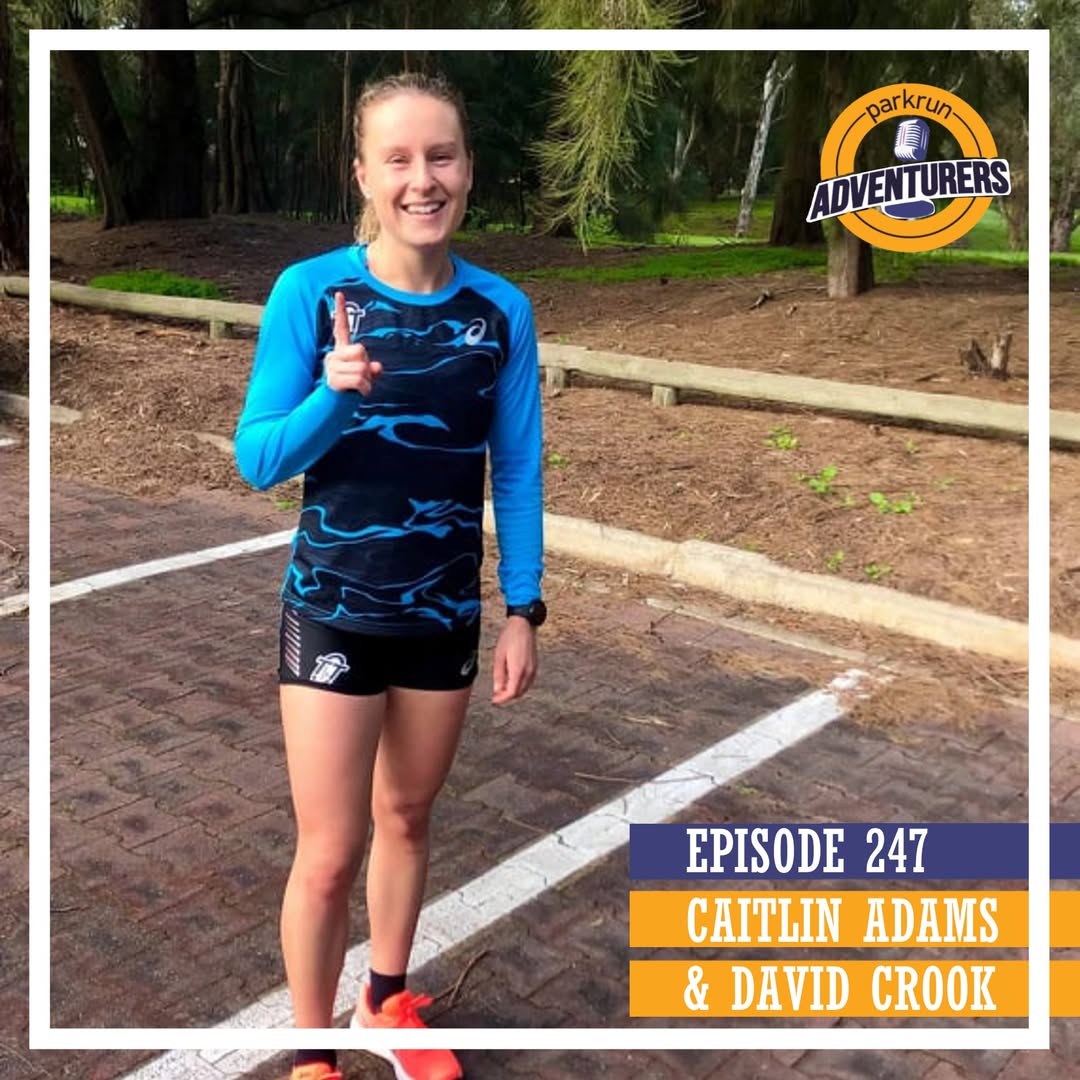
Episode 247 - Caitlin Adams & David Crook
Episode details · · 207 speaker turns · sound cues from context
Enhanced transcript
Speaker names appear where they could be established with confidence. Others are shown as “Unidentified speaker”. Sounds that are not speech — music, laughter, people talking over each other — are written in [square brackets].
Episode 247 - Caitlin Adams & David Crook · 2021-08-11
Enhanced transcript — Produced by an automated editing pass — speakers named, sound described, segments marked. NOT yet checked by a person.
Speaker names appear only where they could be established with confidence; others are shown as “Unidentified speaker”. Non-speech sound is in [square brackets].
Source: https://log.5kadventures.net/transcripts/ep247.html · The Adventurers Log · An independent project, not affiliated with or endorsed by parkrun.
Welcome
Melissa Ellis: Welcome to episode 247 of the parkrun adventurers podcast. It's been a huge week in parkrun and in the Olympics. So blah, blah, blah. Welcome, Ollie.
Oliver Spake: Yeah, it kind of feels a bit overshadowed this week. Don't you reckon, Mel? Sitting here all locked away.
Melissa Ellis: There's so much going on, though, Ollie, outside of parkrun land, but also with parkrun, you know, records.
Oliver Spake: Yeah, big records. Yeah, where did that come from?
Melissa Ellis: I don't know. It took me by surprise. I was just minding my own business, doing my own little Ellis Palace parkrun, and then bam.
Oliver Spake: Yes, yeah. Oh, look, fantastic achievement. But before that, more important things. How was Ellis Palace parkrun?
Melissa Ellis: It was a fun day. I mean, they always are thrown together at the last minute. And we celebrated the 1920s.
Oliver Spake: Hmm, sort of the gangster vibe.
Melissa Ellis: Yeah, gangster. Yeah, yeah, that's it. I went all gangster with Dazza and poker games and I learned about speakeasies, didn't even know what they were. Ollie had to do some Googling.
Oliver Spake: I might need that context. I hope I'm not the only one that doesn't know that. Would you like to enlighten us?
Melissa Ellis: Oh, well, it was a term used for sort of the underground places that sold illegal alcohol during the prohibition in America and named as such because the bartender's would ask patrons to speak easy, as in quietly, to avoid detection from police officers. And something I didn't know about was bathtub gin. All the cocktails from the 1920s involved bathtub gin, and which I can only assume was because everybody was making their own gin at home because it was the easiest alcohol to brew. So everybody made it at home in their bathroom. perhaps literally in their bathtub. And so all the cocktails from that era are very sweet because they've all got all this sugar added to cover up the harshness of the bathtub gin.
Oliver Spake: Wow. Well, you've done your research. That's impressive.
Melissa Ellis: That's the layman's explanation. This is no quoting from Wikipedia. This is just straight from Mel's memory. But also I've never had gin. I will put my hand up and say in my whole life never drank gin ever. So Paul got sent out to buy a bottle of gin and that was what we had for breakfast because that's what you've got to have in lockdown, alcohol for breakfast.
Oliver Spake: Wow, that's fantastic. Look, I was impressed when you learnt gözleme in a week for brunch there, but this is a whole other level, Mel. So you obviously didn't brew it in the bathtub, didn't distill it, I should say.
Melissa Ellis: No, but we had fun and it was learning about a new era of history, so it was exciting. Well done.
Oliver Spake: Ellis Palace does it again. Yes.
Melissa Ellis: That's it for another week. But what about you? What did you do, Ollie?
Oliver Spake: Well, I went and injured myself once again. Yes, injured in the artistic jumpy-jumpy event on the final day of the Olympics.
Melissa Ellis: Okay. For the listeners, please explain.
Oliver Spake: Yes. So this was the final weekend of the home Olympics. We've had five days of events spread across two weeks. And fortunately, fortunately, Mel, I did get out for a run. Now, I was inspired last year by Mr. Brendan's So I went out for one of those again this weekend. That's what we call it, isn't it? They all seem the same these days. It's one of the non-work days. And got out there in the rain, came back, and was nice and warm and ready for the events of the day. We had six events left remaining in the Olympics. And proud to say that despite my injury, I managed to nab a bronze for India in the artistic jumpy-jumpy. So...
Melissa Ellis: But you injured yourself during the jumpy jumpy?
Oliver Spake: Totally worth it.
Melissa Ellis: Why were you representing India?
Oliver Spake: Well, we've all had three nations, you know, a bit of learning, a bit of artistic elements in terms of colouring in our flags. So because, you know, of course, everyone gets a medal. We didn't want to just have five nations cleaning up the medals. I mean, that's kind of boring, isn't it? So I chose to represent India, Kenya and Colombia, um I'm liking kenya yeah I'm with you there Ollie I mean the lack of a marathon was a particular disadvantage um and the fact that yeah there were a few favourites but uh suffice to say for our listeners um the top three at the final medal standings uh Ireland in third uh Hannah New Zealand in second. That was Ava. And Australia cleaned up. And, you know, no prizes for guessing that that was Yongzali.
Melissa Ellis: oh and so you did indicate to me that jumpy jumpy's on the trampoline so perhaps a case of um dad trying to do a little bit more than what he was capable of yes well as my five-year-old daughter did point out beforehand grown-ups are not meant to go on the trampoline we reassured her that it would be fine the five-year-old was right Oh, Ollie, have you been to the doctor? Is it actually serious or is it just a bit of a twinge?
Oliver Spake: No, no, just a flesh wound.
Melissa Ellis: Oh, okay.
Oliver Spake: I jest, I jest. It's fine. Yeah, just slight discomfort. We'll be fine.
Melissa Ellis: No broken ribs?
Oliver Spake: No broken ribs.
Melissa Ellis: Right.
Oliver Spake: I bounce back. Not quite as athletic as some of our parkrunners that we've seen, but I bounce back.
Melissa Ellis: Yeah. Wow. Okay. So huge weekend in Ellis Palace and Spake Olympics.
Oliver Spake: Yeah, that's right. And despite that, Mel, despite that, we have very much been overshadowed, as we said, by all the excitement this week. So look, you were also quite quick and managed to have a bit of a chat to Caitlin, the new global female fastest parkrunner. So why don't we have a listen?
Unidentified speaker: you
Interview Caitlin Adams — Distance runner, Team Tempo (South Australia); set the parkrun global women's record
Melissa Ellis: Our guest today is a young athlete who yesterday at parkrun broke the world female parkrun record with a time of 15.38 at Lochiel parkrun in South Australia. Welcome to the parkrun adventurers podcast, Caitlin Adams. Hi, thanks so much for having me on. No worries. Congratulations on yesterday's run, Caitlin. The parkrun community was abuzz yesterday when the news broke. Was it a deliberate attempt at the record?
Caitlin Adams: Oh yeah, it's been a crazy 24 hours. Like I was saying to you off air, it's amazing how much traction it's really gone through over the last day. Like I've had a couple of phone calls and it's cool to see how relatable it is in the parkrun community and just to the you know, everyday jogger, walker, runner, you know, wanting to get out and do a parkrun every weekend. So it's certainly sort of taken off on social media, which has been really surprising. But, you know, going into the parkrun yesterday, I wasn't really expecting too much. Like I think we're all sort of in the same boat with random lockdowns that have been happening and quarantining that's been happening all around the country. So a lot of our big races that we've been wanting to do interstate or locally have been either postponed or cancelled in the last couple of months. So I've really just had a long period of time of getting some consistent big weeks of training in and training's been going really well and I'm just having a lot of fun with it and there's sort of no pressure. I think the summer season with athletics brings a little bit more pressure in that I guess it's a little bit more important. Track times are more relatable and sort of looked upon for standards and making teams and things like that. But this time of year, it's really fun just to get down to business and put the work in. So my group, I run for Team Tempo under the coach, Adam Didyk, and we just really wanted a fast hit out this weekend as sort of everything was back open again after a lockdown. So we found Lochiel parkrun. We'd heard about it before because it's one of the boys from our group had run it before and said it was a pretty fast course. So jumped on board for that yesterday morning and yeah, had a really good time. And when I sort of rocked up to the run, like I said, we haven't really had many races lately. So I actually wasn't too sure what sort of shape I was in. I'd ran a random, you know, cross country race with Athletics SA in the last month and, you know, did a track race in June and That was about it. So I didn't know where my fitness was. I'd just known that I'd strung together a lot of consistent weeks and was feeling fit. So I guess there was no race goal or time that I really wanted to get. I just wanted to have a fun hit out at a parkrun. And even when I got going, like I didn't look down at the watch too much at all. It was only in the last K that I looked down at the watch and thought, oh, gee, where's this finish line?
Melissa Ellis: Yeah. That's really impressive. So, yes, I noted that you were there with Team Tempo and your coach, Adam, he's over at Tokyo at the moment, I believe. So did he know that you all snuck off to parkrun?
Caitlin Adams: Yeah, well, I guess at the start of the week we were waiting to see if a local race was here in SA was going to go ahead and it was sort of cancelled earlier in the week and we're all a little bit disappointed and we're all at the point in our training program where we wanted a bit of a race effort and race hit out. So, Adam had been talking to my boyfriend, Lockie, actually, because Lockie's sort of taken on a coaching role in the group and they were both trying to organise something that we could do this weekend and I think some of them wanted to, like some of the people in our group wanted to do like a bit of a track-based time trial and majority, we had a majority vote out at training Tuesday night and everyone, including myself, you know, most people wanted to do a parkrun just because it's really fun to get out in the community and have something that feels a little bit more like a race rather than just like a team-based time trial, if that makes sense. So Adam was really keen for parkrun. He was leaning towards that option. So I guess in hindsight, it was really good that we did do a parkrun after everything that's happened in the last 24 hours and, you know, how I was feeling yesterday and feeling pretty strong. So, I'm glad that we chose that. And like I said, Lochiel, we've never done that one before. I've done Torrens a couple of times in Adelaide and Queenstown in New Zealand when I was on a holiday and that was super fun. And Lochiel, the course is sort of a little bit I guess downhill the first half and then you're pretty much gradually going uphill on the second half. So it's certainly not a flat speedy course, but it was super fun to just try a new one and get involved in that community out at Lochiel.
Melissa Ellis: It's well known for its koalas too, but you guys were going a little bit too fast to spot any of the local wildlife?
Caitlin Adams: Yeah, it's a great part of the River Torrens. Actually, it's really beautiful, surrounded by heaps of trees and a golf course there. But I was sort of tucked in behind a couple of my teammates. So I was getting them to sort of weather the wind and navigate the course, and then I did try and help out a couple of times like in the article I said that with a K to go I sort of got up on you know Max Sperling's side one of the guys who I trained with out at Team Tempo and sort of just said like let's go like you could see on the course marker that it was a K to go and I thought I'm feeling good I'm feeling strong like I'm not sure what time this is going to be but I feel like it's going to be fast like I felt strong the whole run so yeah didn't want to let them take the whole brunt of the work that's for sure.
Melissa Ellis: So you said one of your teammates is a parkrunner. It's quite normal for there to always be that one person in a group that's always nagging you to go to parkrun?
Caitlin Adams: Yeah. So I guess depending on what our schedule looks like through the year, we do all year round, we're doing either cross country, road racing or athletics. And athletics is really our key season throughout the year where we've all got our different disciplines that we focus on. And when we are I guess parkrun is a really good option for us when we're coming back from our little breaks between seasons or like this weekend where, you know, we haven't had many races and we really want a fun hit out in the community. We often will look for a parkrun and some of our teammates as well have like done some of the different parkruns around Adelaide. So that's why we always look to people to suggest like which one we should go and try out. I know Jess Stenson loves a good parkrun as well. Like if... You just want to have a bit of a hit out that weekend and the coach is all happy with it. She'll jump out to a parkrun or someone, a lot of the group will often do that just as a bit of a see how their fitness is going at the time.
Melissa Ellis: Yeah, parkrun is known to be a very community-based event. So it's great that it attracts participants from a wide range of abilities, from the weekend walkers to elites such as yourself. And it sounds like you did get the community vibe yesterday and that it does add a different aspect to the training that probably would be always very regimented, I'm guessing. Yeah, absolutely. So it's good to hear that it brings some fun, but for many of us, it's just all about the brunch. So did Team Tempo go for brunch yesterday?
Caitlin Adams: Yeah, well, it's funny because we had planned to book into the line on Melbourne Street in North Adelaide afterwards. We didn't hang around for coffee with everyone at parkrun afterwards, just because there was a couple of restrictions and we didn't want to bombard that sort of area. But we booked in at a brunch place. And I guess the initial plan was to finish parkrun, do a little bit of a session afterwards, warm down, and then head to this place and watch the last half of the women's marathon in Sapporo. But they ended up starting, I think, about an hour earlier due to the heat. So we missed the last part of that race. But Jess had her phone out on the warm-up. So, we were sort of listening to the commentary and watching bits of the race there. But a little disappointing that we couldn't go to brunch and watch the second half of that. But it was still good to go anyway and just recap the morning because it's funny. I came 10th in that parkrun, which is crazy. That sort of time often doesn't occur at a parkrun usually like it's definitely an anomaly then to come 10th with you know a lot of my teammates running personal best road times for the 5k and just having a really good day it was um it was cool to go back to brunch afterwards have a coffee and debrief and uh really enjoy everyone's results
Melissa Ellis: So it would be very different because usually you'd be running, you know, I guess your track work is just continual loops. So you wouldn't be used to having to do that like turnaround. Yeah, yeah. That would slow you down, right? Yeah.
Caitlin Adams: Yeah, it is a bit of a tight turnaround on the, on the Lochiel sort of Torrens loop there. So yeah, that was a bit of a momentum killer, but that's parkrun for you. Like I like, I love all the different courses and navigating that. And, you know, there was at about the 2k mark in, there was a massive puddle that was covering the whole path. So you sort of just had to splash it out in the middle or try and go across the sides and get through. So it was a little bit of everything that day. Yeah.
Melissa Ellis: Yeah, you definitely get all those different nuances, don't you, with parkrun courses? Yep, yep. Your profile on the Australian Sports Foundation website says you're a distance runner. Is 5,000 metres your preferred distance?
Caitlin Adams: Yeah, so I guess... I probably had a bit of a breakout. Like I've been running and, you know, been involved with the sport since I was a young kid and, you know, played other sports and grew up in the country. So I moved to Adelaide, the big city to pursue university and, you know, just train a little bit more with the team and see how far I could get with running and athletics. And had a bit of a breakout a couple of years ago and sort of been riding that high ever since. I think I just put that down to years of consistency and just showing up, just turning up, doing the training. And so 5,000 metres is probably the distance that I'm going to focus on going forward and hopefully can make a couple of teams with that. distance. I made World Uni Games in 2019. That was a really exciting year for me because I finished top two in the trials for the World Cross Country Championships. So I went to Denmark for the World Cross Country Champs at the start of that year and then made World Uni Games, which was in Napoli in Italy in the middle of 2019 for the 5,000 metres. And that was my first or international track competition, which was a super exciting experience and just really confirmed to me my love for the sport and travelling with it and, you know, being on a team of Aussies and meeting new people. Ideally, I'd love to run like a 3,000 metres race on the track. That's, I think 3000 metres right now is, is my sweet spot. Like it's got a little bit of speed, but also endurance too. Um, still sort of navigating the final two Ks of a, of a 5k, but definitely going to be heading down that 5k path and really trying to knock off some time off my personal best. And next year is going to be a big year. We've got Commonwealth Games coming up, World Championships, World Uni Games again. There's also World Cross Country Championships if that's able to go ahead in Australia. So my focus is really just getting fit while I can in this winter season, doing a couple of races, but then really focusing on that athletic season next year and getting that 5K time down to be really competitive and hopefully try and book a spot on one of those teams.
Melissa Ellis: The current COVID situation must have had a big impact all across the world on athletics and the ability to compete against different people. So this, especially, I suppose, at the Olympics, that's been a unique situation for people to go out and test themselves against others.
Caitlin Adams: Yeah, it was disappointing. Last year, you know, coming off of that 2019-2020 athletic season, I had a really great season in the 5k and, you know, I was able to go over to New Zealand and race and Australia was awesome. Just having a lot of girls coming in from who usually base themselves overseas and coming in and racing our national champs and just was really loving that season and then had plans to go overseas with Team Tempo and a few other groups from around Australia and do a bit of a distance altitude camp up in Flagstaff in America and then some high quality races and competition over there because, you know, there's a lot more depth and opportunity to run those sort of times that get you on teams. You can certainly do it in Australia, but, you know, going overseas, a lot more depth, a lot more people to really tuck in behind and race. So that was something that I was really looking forward to because I've only been overseas through making teams. I really wanted to have that opportunity to do a proper training camp and really push the boundaries of what I can do with running. But then COVID really brought that to a halt. So I guess the only positive that I can take out of that is I was starting a Masters of Teaching at the start of last year, which is a two-year course. And it's really allowed me to sort of focus on that. And, you know, it is a bit draining. There's a lot of placements around the same time and a lot of demands with that. So... I have sort of found that I've been a lot more anxious and tired whilst I've been studying and trying to train and work at the same time. So I think the only blessing out of COVID was that it really forced me to stay home and just get it done, just get this uni degree done and get it done to the best of my ability, get placements out the way. And then hopefully, you know, end of this year, next year, things start to open up again and I can have that opportunity to actually go overseas and travel and train like I did want to do in 2019.
Melissa Ellis: And you're probably lucky being in South Australia. You've had a lot less restrictions in that state than you would have had if you had been in, say, Victoria or New South Wales or Queensland, which are all currently this last weekend had degrees of parkruns cancelled due to COVID. So you were lucky. You were lucky. They only just came back this week.
Caitlin Adams: Yeah, I know. We've been super lucky. Like we've only really had two small lockdowns. It's really devastating to see what's going on in the other states. I can only imagine how, you know, insane you'd all be going and just... Really dreading another lockdown. But yeah, SA has been really fortunate and it's been so good that we can still, you know, train with our group and have a crack at some parkruns. And, you know, not too many, I guess, competitions have been cancelled around SA. But yeah. It's always so good to have parkrun come back on as soon as, you know, weekend after the lockdown is done, they're back on. And so that was probably why we really looked to do that yesterday. But I'm also pretty fortunate too that I live with three other boys. So one of them is my partner and then two other boys, Isaac and Lockie, and they both are runners as well and really handy runners in their own right. So when we were locked down, I could... you know, train with them and do all of our runs together. And Lockie Hennig and I are pretty similar ability levels when we do train. So, it was really good to have them and, you know, still have that motivation to get out the door and have people to run with. Sometimes it was a little bit too much. We just wanted to put the headphones in after living with each other and then running with each other as well. But yeah, it's great. So, we We really love the sport and it's so good to live with them and see how they go about things and the little one percenters they do. And that was really what got us through a couple of those tough times when we, you know, races were cancelled, we had lockdown. It's always fun in our home. So it keeps it lighthearted.
Melissa Ellis: Do you just go and run your local streets? I know here when we get told we go to five kilometre radius and you can only go out for an hour at a time. So, you know, you're doing multiple laps of the block and trying to squeeze in as much as you can in your little timeframe. Is that the sort of thing that you had to do?
Caitlin Adams: Yeah, yeah. So, we actually did a session sort of around our local, the roads around one of our local footy ovals here. And we're just trying to pick out some sneaky areas that we could actually do a session or... We were a little bit worse. We had a 2.5 kilometre radius. Wow. So before our run, we would have to really map out what roads were going to go down and we're sort of surrounded by some main roads here in Adelaide. So we sort of knew what was within our radius and it did get a little bit boring towards the end of the week, that's for sure. Yeah.
Melissa Ellis: And so just one of the other notes that I had written down, I saw that you ran 15.29 at the Oceania Invitational on the Gold Coast in June. Do you think you might come back for another world record attempt? Because we've got a nice fast course here at Toolern Creek.
Caitlin Adams: Like I said, going into yesterday, I didn't have any thoughts before the race about, you know, this is... I want to break the world record. I didn't even really know what the world record was, to be honest. I knew that Lauren had the Australian record and sort of roughly what her time was. And then during the run, you know, feeling so strong and having my training partners around me, it was so familiar. So... I think everything just fell into place and just had a really nice morning. And once again, with the community being out there, it was such a great vibe to see everyone and the race organisers were so happy and chirpy too. So I definitely, you know, I have travelled around Australia a fair bit and internationally and done some pretty awesome races recently. And that 1529 was a really nice breakout for me. I'd been trying to break the 1530 barrier for so long and had a bit of a rough start to the season. And it was just so good to have a race where everything sort of fell into place and I felt really comfortable and, and there was no pressure and could just go out there and have a good one. And that's sort of how I felt yesterday as well with that parkrun record. So definitely adds fuel to the fire, makes me want to you know keep working hard and towards the next few races and especially try and fit some parkruns in there we've got some amazing ones in SA so and even yeah interstate like you're saying so it'd be cool to have another crack at the record but um it's one of those things where I'm like oh you know that time yesterday was actually really fast it's going to be hard to break that again
Melissa Ellis: Well, Caitlin, thank you so much for what you did yesterday. You gave a lift to the whole parkrun community where a lot of us were, you know, we're missing our parkrun and we're a bit sad that we couldn't be out there. But when the news came through that the record had gone and we were so happy for you and we were so excited, thank you so much for taking some time to speak to us today and we wish you all the very best for the future.
Caitlin Adams: Thank you, Mel. Thanks so much for having me. And I just wanted to say a little shout out. Thanks to everyone who's been so supportive and sending through some really nice messages on social media about the result yesterday. And especially to the race organisers and volunteers at Lochiel parkrun too. It wouldn't have been possible without them. And also wanted to give a little shout out to my housemate, Isaac Kane, because he broke the course record there yesterday as well and ran a really speedy 14.15, which... is super impressive to me. So thanks to everyone.
Melissa Ellis: Yeah. He did indeed. We'll keep our eyes on Isaac too. He's definitely one to watch. That's for sure. Thank you. Thanks so much, Caitlin. Thanks for having me. Ollie, it was wonderful to talk to Caitlin. She was just a pleasure to talk to and it was great. Team Tempo was so enthusiastic about joining parkrun on the weekend.
Oliver Spake: Yeah, it really struck me, Mel, and thank you, Caitlin, for sharing your time as well with us straight after that. And, you know, look, thanks to the whole gang there by the sounds of it. As I was saying, it really struck me that there was a good team camaraderie and one that, you know, really embraced the parkrun as well, the great family at Lochiel.
Melissa Ellis: Yes, and Isaac Hayne obviously taking the course record there with 14.15, and Jess Stenson, formerly Trengove, running her all-time PB as well of 15.50.
Oliver Spake: Just achievements all round. I just can't quite get over the fact, look, I know Lochiel is not a high elevation course, but it's one that I definitely associate with a couple of ups and downs. Was it tilted downhill or something? Yeah.
Melissa Ellis: manage this I don't know oh it's just a lovely story isn't it and uh and jumping puddles you know just just that visual of elites having to jump puddles just like we do when we go out for parkrun morning after a rainy period that's right unless you're in ainsbury of course no puddles to jump there oh
Oliver Spake: true yes but I think as it's been pointed out to see so many first timers so many PBs I mean right through the field too let's not just give credit to the fasties here a lot of achievements on the day it must have been such a buzz but Ollie there's somebody else that had a massive achievement this weekend just gone Yeah, what about that? We heard just recently the penultimate event and now she's gone and done it. So Mel, why don't we have a listen to Alison on her shiny new achievement?
Roving reports & the Channel 5 News crew
Roving report Alison King — Sherwood Reserve parkrun
Alison Fraser (King): Good morning adventurers, it's Alison here reporting in for the Channel 5 News crew over here in New Zealand. And this morning I am trying out Sherwood Reserve parkrun, which is the newest parkrun to start in New Zealand and it's in Auckland. It's in a place called Browns Bay on the north shore of Auckland and it started on July the 3rd. Now last week you would have heard me reporting from Dunedin, which was my last parkrun in to complete the South Island and Sherwood Reserve is the final parkrun to complete the North Island for me. So it's been a bit of a journey and I'm really looking forward to running at this event. I'm not too sure what to expect other than it's a multi-lap but I will come back to you at the finish with my thoughts. So I'm at the cafe with today's Run Director Helen Watson. How did you find your very first run directing event today Helen?
Helen Watson: Hey Alison, a lot to remember but we had a great crowd who helped me get through the run brief which is awesome and I think it went okay. What got you being Run Director in the first place? I was persuaded into it by one of the co-EDs here at Sherwood Reserve parkrun but it's a great opportunity and I'm grateful for them including me in the Run Director team. Were you a bit nervous today? I was very nervous today. Just lots to remember, didn't want to leave anything out and wanted to make sure people knew what they were doing, the course and where the finish is because it's changed since we started the run at Sherwood, and you're well known in parkrun circles for your cakes how long have you been doing cakes for parkrun since I've been in New Zealand it wasn't something I did when I was in the UK so the last last two years it's just something I I enjoy doing as a hobby and I seem to be yeah well renowned in the Auckland circles for uh milestone cakes and there was a special cake for volunteers too yes I like to make sure the volunteers are rewarded for their efforts and a little cake seems to go a long way with them
Alison Fraser (King): Now you've done quite a few parkruns so not including Sherwood Reserve, what would be your top three?
Helen Watson: So I would have to call out Delamere Forest in the UK because it was my first ever parkrun, Hobsonville Point in New Zealand as it was my first sort of home parkrun in New Zealand and then Quinns Rocks in Western Australia because it's a lovely course out and back alongside the Indian Ocean.
Alison Fraser (King): Thank you so much. So I'm sat with Scott Arrell, who is one of the Co-Event Directors for Sherwood Reserve. So thanks for an awesome parkrun, Scott.
Scott Arrell: Well, thank you for coming. It's really great to have you and all the other Event Directors turn up today. We turned on a bit of sunshine, quite a bit of wind. It was great to have everyone here.
Alison Fraser (King): It's a bit of a powwow with the Event Directors.
Scott Arrell: Yeah, I know. Actually, we all felt like it was royalty visiting. It's like, wow, how are we going to cope?
Alison Fraser (King): I wouldn't say royalty, but you know. You are instrumental in getting this parkrun up and running. So how did it come about?
Scott Arrell: Well, it was really a group of us. We've been on the lookout for a couple of years, really, to try and get a parkrun going on the North Shore, and it's been a bit tricky because lots of parks but quite small and not meeting sort of the safety requirements so there's probably been a good core group of at least 15 to 20 sort of poking around and finding and then we found there were some changes at the Sherwood Reserve to their waterways and that opened it all up because they built a whole new walkway and areas there that just made it possible to do the three lap course so we just went for it and now we got it going so it's really great.
Alison Fraser (King): Now quite a few of the Australian parkruns have got wildlife that you see on the course. There's Fluffy the emu at Nambour, everyone knows about Fluffy and then there's Prickles the echidna I've seen and koalas at Cobram. But Sherwood Reserve has got something that no other parkrun's got.
Scott Arrell: No, actually nowhere in the world would they have, protected by the way, native short finned eels. And there's a lot in there. Did you see them today? I did. Yeah, and so we go, when people come to Sherwood Reserve parkrun, we've named all the different parts of the course. So you go over that bridge, that's called Ely Bridge. And if you're not going too quick, you can stop and have a look at all the eels. I reckon, I don't know how many are there, but it'd be a good 50 odd, wouldn't it?
Alison Fraser (King): I stopped to get video and, you know, masses of them.
Scott Arrell: Yes, yeah, cool. And then, of course, after that, you head on further around the course to Stonehenge, as we call it. So then make your way across Stonehenge and then back up through under the Troll Bridge to the turnaround. And then you do that three times. It's fantastic, isn't it?
Alison Fraser (King): Yeah, it's a really cool course. So three laps if you're coming to visit.
Scott Arrell: Yeah that's great and the way that it's sort of you get that circular bit or kind of semi-circle and then out and back so yeah the great thing that we're feedback we're getting is how everybody can see each other on the course so you know most of the time you kind of like with a normal kind of circular three lapper you know you kind of lose sight of who's in front of you and who's behind you you know so we're getting really good feedback on the way the course works.
Alison Fraser (King): And you've done quite a few of the parkruns here in New Zealand, Scott? Yeah. Climbing the table for most events?
Scott Arrell: Yeah, I am trying, but COVID was a real nuisance last year, wasn't it? But I think I've got 31 now. I did this parkrun, Sherwood Reserve, officially just a couple of weekends ago. I've run it heaps of times. This was the first official one. So yeah, I got 31 of the 34, but you've just run 34.
Alison Fraser (King): I have, yeah. Some might say I've saved the best for last, I don't know. Yeah.
Scott Arrell: Save the newest one for last. Yeah, no, that's great. Great achievement. I think when you said, I think it was nearly two years ago, I decided I was going to get them all. So, yeah, well, I will. I think one of the factors of when you would know yourself, when you're Event Director at a course, so then you're at a parkrun, then it kind of holds you back a little bit for a while. But we've got a really good core team now of Run Directors.
Alison Fraser (King): So which ones do you have left?
Scott Arrell: I think it's Trentham, a new one there, and then Pegasus and Wanaka.
Alison Fraser (King): Okay, so out of the ones that you've run, what are your top three?
Scott Arrell: Oh, top three. Can I have four, though? Well I'd say Invercargill and this is in top three like as in one, two, three. So I'd say Invercargill, Puarenga, love running around through the sort of steam in the area there. Invercargill because like Queens Park is such a beautiful park that's kind of a real park runnish you know it's there and of course Owairaka and I'll sneak in Millwater as well so And, of course, Sherwood.
Alison Fraser (King): Not counting home runs.
Scott Arrell: No, that's right, yeah. But even Hobsonville, I helped to get Hobsonville Point going. And I like that course. But they're all different. The thing I always say is all the courses are different, but everywhere you go, the people are great. That doesn't change. No.
Alison Fraser (King): Well, thanks so much for your time, Scott. So that was Sherwood Reserve. It's a really neat little parkrun in this tiny little park. And somehow they've made it work. It's a three-lapper. Then you go past the start finish area six times, which gives you a really good feel for the community that they've got here. And even though it is brand new, there are so many people who call this place home and it's got a really good vibe to it. One thing about Sherwood is that it's another one in New Zealand that's twinned itself with an English parkrun. And my run here today coincided with the return of Sherwood Pines parkrun in England. So we did a giant Scott airplanes at the start. So that's your typical airplane, but we call them Scott airplanes over in New Zealand after Scott Arrell, who is the co-ED who you heard from just before. What else can I tell you about Sherwood Reserve? The eels. I did a post on my Instagram. So if you're on Insta, head over and see if you can look at that video. And I'm so glad that I picked this as my last parkrun to complete the country. And that doesn't mean that you won't hear from me again because there are a number of parkruns that I haven't profiled for the parkrun adventurers that I'll be getting to hopefully in the not too distant future. So I hope you've enjoyed hearing some of our New Zealand parkrun events, and I look forward to more adventuring.
the Informant
Unidentified speaker: Hiya, parkies.
the Informant: This is The Informant, coming to you live from my study with a view. And this week's view, well, I think I'll just paint you a picture. You see, the adventurers were having a regular Monday Zoom when Mel got up to go and get some water. A few moments later, in slides Paul wearing nothing but socks and undies singing into the TV remote. Apparently he thought the meeting was over and was doing the Tom Cruise risky business. It was... it was... well, I'm not really sure what that is. But I'll be pushing for all future business to be conducted with cameras off. Now the stats. They are only current to the time they are collected and may differ from the stats you read elsewhere. But you wouldn't do that because you can get it all right here at the parkrun adventurers. On the juniors front, we are still down to just the one event at Thorndon Juniors. 26 junior parties took part. There were no first timers. Raphael Indratno ran his half marathon and was the only milestone for the week. Congratulations to Joshua Linney and George Zanahoppo who ran PBs. And an even bigger congratulations to Joel Wilmot who ran his second PB in a row. In Australia, regular 5k parkruns are still impacted by COVID restrictions and numbers are overall down. Despite a few more countries and events coming online, overseas numbers are also down. There were 1,041 runs taking place in 17 countries. There were 191 in Australia and 34 in New Zealand. Canada and Denmark had 8. Finland returned with 2. France had 8. Germany had 20, Italy 5, Japan 12, Netherlands 4, Norway 1, Poland 75, Russia 65. South Africa returned with 23, Sweden had 4, United Kingdom 545, and the USA had 36. There were three launches, Patawalonga River in South Australia, Horspath and Woodgate Valley Country Park in the United Kingdom, and Park 850 Latia Moskvy, a park that is marking the 850th anniversary of Moscow. Aussie New Zealand attendance was down by 9,000. We had 16,553 runners out of a hectic 136,914 worldwide. That's up more than 21,000 on last week. Down under, we had 2,034 PBs. while 591 people participated for the first time. 33 juniors reached their junior 10 milestone, 78 people reached their 50 milestone, 52 reached their 100 milestone, and 6 people reached their 250 milestone. 9 people called bingo. Madison Chippett was the quickest with 164 events. Darren Hill was the slowest person taking 331 events. This week we have 15 new statespeople. In the ACT we have Tom Stone, Ian Brown, Monica Armstrong, Hayley Atchurch and Anita Scherer. In the Northern Territory we have Alicia Coetzee, Terry McKay, Taralyn Kramer, Bob Harlow, Brett Byron and Tracey Byron, Ron Jones and Libby Jones and Victoria Cotton. While over in the New Zealand's, Alison King, fresh on the heels of last week's South Islander, this week becomes a North Islander and Countryman. Congratulations Alison! On the top 20 most Aussie New Zealand events list, Robin Richworth continues his climb to be now equal 9th with Ros Burrell with 155 events, after running at Kununurra. I think we have recovered from last week's Windex disaster. We had 159 movers. Bradley Ward was the biggest mover, jumping 18 points from 1 to 19. And that puts him into the Tasmanian top 10, ranking at 7. Jesser Manley jumps 12 to be 162, which is the number 1 spot in NSW. OK Parkies, that's your lot from me this week. As always, to see these stats in full, you should definitely follow The Informant on Facebook. or visit the blog at www.theinformant.me. That's the informant, all one word, .me. This has been The Informant, and my stats report is like snuggling with a little kitten under your hoodie.
Melissa Ellis: And thank you, Alison, for our roving report this week, and congratulations for achieving countryman status, Ollie. What an achievement there.
[applause]
Oliver Spake: Yes, I can clap now, can't I?
Melissa Ellis: Yes, you can clap now.
Oliver Spake: Well done, Alison. That's fantastic. It's been really enjoyable to hear you along your travels as you've neared and now achieved that status and such a rather small club too.
Melissa Ellis: Yes, but please don't stop recording Roving Reports because we're loving listening to everything from across the ditch.
Oliver Spake: That's right. We need a bit of a New Zealand back catalogue now.
Melissa Ellis: We do.
Dazza's
Oliver Spake: Mel, we also had a few accounts coming through from Dazza's. And I suppose there are a couple of themes shining through. So, whilst Dazza was pretty dapper in his 20s gangster gear, I think everyone was all still pretty athletic from the week before. So, a couple of People we heard from really were enjoying the morning of watching the Olympic Women's Marathon. So Peter Pohlman, still at home doing pre-parkrun faff, watching the Women's Marathon. We also heard Jodie Macy watching the Women's Marathon with Brendan Peel. Amazing effort by the women. Adelina Trott got out of bed to run my (not)parkrun around Rosanna Parklands, now sitting back to watch the Tokyo Women's Marathon. Bernadette Bennett, who shared the photo taken at the finish line of Not parkrun Series 2, Episode 1, now to watch the last 5K Not parkrun of the Women's Olympic Marathon. And not to miss out on the fun, the informant, keeping warm with Olympic-themed brunch, not looking forward to the sugar crash.
Melissa Ellis: Yeah, Ollie, and he said that those doughnuts were caramel, but they just look beige to me.
Oliver Spake: Very beige.
Melissa Ellis: But, Ollie, we also had some great representation from the (not)parkruns this week. Mandy Oliver, Not parkrun around local streets, which included Broadwater, but discovered something interesting for a Saturday morning around the corner, which was a Dan Murphy's delivery van. That's my kind of set day morning delivery.
Oliver Spake: With the gin.
Melissa Ellis: We also heard from Jeff Whiffen, took Murphy out to do our five kilometre boundary on the Bellarine Rail Trail for a double knot parkrun. And Tracey Wood, so lucky to have both a friend and bushland within my 10 kilometre radius. Oh, and there happens to be a bakery nearby. How about that? Carrot cake for morning tea. Tony O'Connell, another Cape Pat nottie. Not a bakery or cafe in our five kilometre bubble, but home for a bit of Vegemite toast and can't complain about that either. Score. Sam Schroder, we walked a new route of the Love Shack, not parkrun. It's a tough one. Luke's Cafe served cinnamon scrolls, six weeks, six new recipes. Yum.
Oliver Spake: That looked like a tough course. Sorry, Mel.
Melissa Ellis: It was, that elevation, Ollie. Ingrid Botha, walked Paris, do you have to sniff every fence post, not parkrun, with daughter and dog in a record time of two hours and ten minutes. Lovely day for it. And Tina Johnston, walked six kilometres along the beach at Emu Park. That's one for Fluffy. Simon Mackley, I incorporated the Mosman parkrun course into my long run today. Sadly nostalgic for the return someday. And lastly, Abigail's mum, in the spirit of Ellis Palace parkrun, post not parkrun brekkie included a Tom Collins.
Oliver Spake: Class, class. So that's a fair few not parkruns, Mel. We did have some real parkruns too. So thank you to everyone who shared their account from a real parkrun. So Greg Garner, I think he had an alternative to the finish tokens here, counting the runners as they went past while volunteering as a Marshal at Victory Heights Trail parkrun this morning. For the record, there are 36 rocks. Val Warwick, ready for volunteering to Railton, me as token giver outer, and Steve as Tail Walker, course bump out and photographer. He'll carry the camera for the first half before putting it away and then start collecting the cones and signs, all while having the first aid kit tied around his waist. Not quite a decathlon achievement, but not bad. The sun has come out, but there's no way I am removing my puffer jacket, so look like an orange barrel. Update afterwards was added. Coffee at Limestone Cafe after was, as usual, fabulous, but Callie's wonderful homemade vanilla slices had all gone, so Steve had her baked apple cake instead. Pippa White, morning Dazza's. It's the summer in England, so obviously totally soaked today at parkrun with mud all the way up my legs. Itchen Valley Country parkrun for a friend's 200th different and a spot of barcode scanning after. Please may I have a latte and a sausage roll? Penny Simpson, 100th volunteer day for me today. Well done, Penny. Thanks for volunteering. Big thank you for the milestone too, and congratulations. At Mount Clarence parkrun, training a new RD. Glorious weather today for a change. Might steal a photo from our photographer. And it was quite a photo too.
Melissa Ellis: It was. And we had our Bailey shot. Tanya Bailey. Brisk walk this morning on a chilly morning. 95 hardy souls. Brunner joined me for the second half after a run with Dad first. Rebecca Bailey spent the week skiing and sleeping in the snow, essential work training. So enjoyed a warm bed lie in this morning, getting ready to watch some Kiwis in Olympic sprint kayaking and heading out to get some evening light under the bridge with a Banksia Avenue not parkrun later today, and Brett Bailey. Ran Pegasus with Brunner. Southerly Front came through during parkrun and Brett captured a fabulous photo of that Southerly Front.
Oliver Spake: I reckon. Yeah, that was dramatic. And, of course, speaking of dramatic, our two aforementioned achievements of the week. Alison King entered the New Zealand Countryman Club today and collected a Windex number at Sherwood Reserve parkrun. Enjoyed Park Faf with Andrew Capel, who twinned me with his choice of ugly buff. And Janet, who was at the epicentre of the parkrun record-breaking world this parkrun day just gone, Janet Reid, chimed in a little late at Dazza's, but I think Janet's got an excuse. 9pm Adelaide time and I'm finally checking into Dazza's and it feels so good to be here, just like flopping into that comfy old armchair at your Nana's. But I digress. It was a big morning aboard the mothership Lochiel parkrun today. There was something in the air for sure. Records tumbled left, right and centre. 1. Our male course record set in 2017 was broken by Isaac Hayne in a time of 14 minutes and 15 seconds. 2. Our female course record was broken by Caitlin Adams in a time of 15.38 seconds. Three, this was also a new female record for parkrun Australia. And four, a female parkrun world record. Five, we also had the lovely Olympian Jess Trengove finish in 15.50. To say we are over the moon at Lochiel would be an understatement. I was within an arm's reach of the front runner when he had 800 metres to go and I only had 800 metres completed. We were like a relay team passing the baton, except we were going in opposite directions. It felt so good in that millisecond. Who knows what great things I may achieve tomorrow. For now, I will enjoy basking in the glory of what happened at little old Lochiel today with a belated skinny flat white. I dedicate and share my excitement with all my fellow parkrunners who are in lockdown, sending you all hugs and good vibes. Aww. Thank you, Janet.
Melissa Ellis: Yeah, thanks, Janet. And so lovely that that all occurred at little old Lochiel. Ah.
Oliver Spake: That fills the cup, doesn't it, Mel?
Melissa Ellis: It does. I've got to say, it really lifted my spirits when that all happened Saturday morning. Yeah.
Oliver Spake: What an excitement to be there and to still make it to Dazza's before closing too.
Melissa Ellis: Oh, no. Big effort. And she was having a coffee and not a wine. That's impressive.
Oliver Spake: I'll say. And look, thank you to everyone who joined us at Dazza's. Pleased to say, Mel, we managed to whip around Dazza's and join in all the fun in less time than Caitlin took to complete Lochiel parkrun.
Melissa Ellis: I know, new format this week. We might have to consider that in the future. Ollie, I think it worked well.
Oliver Spake: Look, Mel, the excitement continues. Many listeners would have seen the parkrun Australia blog announcement just come out about a week ago that there's a parkrun Australia book coming. It's called On Every Saturday and celebrates 10 years of parkrun in Australia. So David Crook, the author, spoke with us following that blog launch. Music
[music]
Interview David Crook — Author of "On Every Saturday"; North Sydney parkrunner
Oliver Spake: Our guest this week is a North Sydney parkrunner and author of a magnificent new book titled On Every Saturday, which celebrates 10 years of parkrun in Australia. Welcome to the podcast, David Crook.
David Crook: Hi, Ollie. Thank you. And thank you for that very generous description as well.
Oliver Spake: It's wonderful to have you on the podcast and great to have a chance to dig into a bit of detail and share what looks like a fantastic publication. But David, Look, before we talk about the book, maybe could you tell us a little bit about your own parkrun story, David?
David Crook: Yes. Well, I was quite late to parkrun. My running started as a kind of a midlife crisis thing. I had a big birthday and I thought I'd try a half marathon. That turned into trying a marathon and then a few more. And then friends kept saying to me, come along to parkrun. And I felt like, well, five kilometres was a bit short. So I kept saying, well, no, I like running a bit further. But they eventually convinced me. And as soon as I went along, I realised how fantastic parkrun is and how varied it is and how it's, as we always say, not just about the run.
Oliver Spake: Did you discover it at your local parkrun, which I understand is North Sydney?
David Crook: I discovered it when we were staying with some friends in the UK. We'd been living in the UK. We'd come back. We went back over to visit, staying with friends, and they were going along to Evesham in Worcestershire one Saturday morning and got me to go along with them. And it was fantastic, beautiful, sunny morning, heaps of people, great run. And when we got back to Australia, it took me a few weeks to realise that North Sydney parkrun is literally at the end of my street. So I started going there as well. I was mid-18 when I did my first one. And since then, we've had lots of periods where we haven't been able to parkrun. So I'm only up to just under 30 now, I think. But for the available times, I guess I get down there once every two weeks, once every three at the outside.
Oliver Spake: Fantastic. And I do know the North Sydney course. It's a fantastic spot and how convenient to have it right there. Yes, there's no excuses there.
David Crook: I can be down there and back at home by 8.30. There's no excuse not to do that.
Oliver Spake: Look, clearly it's resonated to some extent. So how then did the idea for the book come about? What's inspired you to write a whole book about parkrun in Australia?
David Crook: Well, the idea for the book, I'm currently a graduate student in writing at UTS, and we had a class assignment which was to come up with a pitch for a book. Not to come up with a book, but to come up with a pitch for a book. And that got me thinking about parkrun, the 10-year anniversary coming up. And I made contact with Tim Oberg and then we had a conversation about parkrun and about the anniversary. And instead of doing an assignment about a pitch on a book, I ended up actually doing a book, which has been a terrific experience and just a wonderful opportunity to talk to so many people.
Oliver Spake: volunteers and parkrun hq staff about the fantastic thing that parkrun is people including yourself Ollie of course talking about Shellharbour and I appreciate the opportunity to do so thank you you've profiled a number of very familiar Australian parkruns shared some great stories some great images too but how did you go about selecting each of those
David Crook: Yes, initially I thought that would be very hard, but I guess the way it started was I thought, what would I want this book to do? And many people, many listeners would be familiar with Deborah Bourne's book about the 10-year anniversary of the whole of parkrun. much more than a run in the park. And I had a good chat with Deborah right at the start. And I think what Deborah did was she really did a history. What I wanted to do was more give a kind of a sense of the variety and difference and nature of parkrun in Australia. And so as part of that, obviously there is some history in there because that's important and there's some facts and figures because some of us love facts and figures. We do. Yeah, we do. But I really wanted the heart of the book to be profiles of different parkruns, particularly after I started talking to Event Directors in lots of different places. So as to the question of how did I choose – I guess I thought around about 30 was the right number for a manageable book. And I wanted to spread them across the states and territories, obviously. And then as a first thing, I thought it should include the first event from each state and territory. Then I thought it should include at least some of the north, south, east, west points of the compass. It needed to have some of the really, I guess, iconic Australian locations and unusual Australian locations. So Alison Hunter in Kalgoorlie was the first Event Director I spoke to, the first parkrun that I wrote up. Nightcliff and Helen Thiel. I know Helen's moved now, but Nightcliff was the second. Then I thought... I should have the one that was the geographically highest, which I assumed was Jindabyne, and I talked to Rosalie Brook there, but then, of course, it turns out that it's actually Armidale, which I didn't include.
Oliver Spake: And then, you know, Mark Streeter and Zillmere, you have to have the only Z. Yeah, I think we all make the exception to get the only Z.
David Crook: And then, you know, something like Weipa had to have that. And, Ollie, I occasionally would call on advice from Brendan Peel. Scott Trickett put me in touch with Brendan early in the process and occasionally I'd send him a text. I sent him a text one day saying, Brendan, I saw you went to Yeldulknie Weir Trail. Shall I include it? But, of course, I think Brendan's answer to that would always be yes, of course you could. But I did, and that's a fantastically interesting one. And Timboon, which was a small town star. Really, a few of them really chose themselves, the first ones and the points of the compass. And after that, when you start to fill in some iconic places and a variety of regional and city and outback, it doesn't take long before you've filled it up.
Oliver Spake: And doesn't that speak to the uniqueness of so many parkruns? You could feature each parkrun in a wonderful way and fill a book with... Clearly many, many more than the 300-odd pages that you've managed to provide, which I note do include a number of wonderful images. So how have you gone about in collecting so many great pictures, great snapshots of our parkruns?
David Crook: I really feel there's some fantastic images, including, I have to say, Ollie, two or three From Shellharbour. What I did was I went back to all of the people that I'd interviewed, all of the 32 parkruns where I'd spoken to Event Directors and volunteers and asked them did they have photos that they would like to put forward. With photos, it's a, in a book like this, it's a little complicated and you and I went back and forth a bit on this, that you need to have the clearance and approval of the photographer and also where you have clearance individuals that are very heavily focused where there's just one or two people in a photo. You also need to make sure that they're happy with that, obviously. So I think one of the biggest administrative tasks of the whole process for me was the photo process, but fantastic photos. Some of the shots that Ben Levy has taken in Albert, Melbourne. Paul Butler has some great stuff out of South Australia.
Unidentified speaker: Mm-hmm.
David Crook: Paul Vandermeij from Western Australia had some great things too. And one of my favourites is Brendan Scolari's shot from Shellharbour as well.
Oliver Spake: On the beach. Yeah. So clearly it's been a wonderful experience from listening to you recount aspects of researching the book. But what's it been like and how long has it taken?
David Crook: That first day when I talked to Deborah Bourne about her book, she said, I can't remember the exact words she used, but the sentiment of it was, it will eat your life. And I think that's true. It's a big endeavour because there are so many people involved and for it to be representative of parkrun in the way I think it needs to be, you need to have that many people. You need to speak to a lot of people. So, it's been a big job time-wise, but it hasn't been a chore to do because all of the stories are so fantastic and people have been so generous with their time, so happy to talk about their parkrun and prepared to put up with me coming back to them with text and saying, is this okay? Did I miss anything here? And have I got this name correct? And Could you just answer this extra question? So I've really been very grateful to all of the Event Directors and volunteers and the head office staff have been so generous in giving their time to the project. I'd also have to say that Mike Graney from headquarters in the UK, the director, The person who looks after all the statistics, he was very generous in advising me on what's more useful, what's less useful and helping me gather some statistics as well.
Oliver Spake: It speaks volumes that, you know, there are so many passionate personalities and contributors that, you know, quite willingly give their time and give everything they can to, you know, what has put us, I think, in the eyes of many of us, a great cause, sharing something that we are all quite passionate about. And the people that you have had contributions from, what a great effort. And I understand you've spoken with the likes of Tim Oberg, and you've got the foreword from Lisa Miller there, and you've spoken to Paul Sinton-Hewitt himself. So without spilling too many secrets, any highlights?
David Crook: I was really grateful to have the opportunity to talk to Paul Sinton-Hewitt and he did a video call with me. That was just such a pleasure. He's such an inspirational person. And one of the things I'll say that he talked about was he talked about his connection to Australia. I think a lot of us have heard that Paul is in some way an Australian. And I'd heard in advance of the chance to talk to him that he had connections to Australia. And he talked a little bit about that, which was really interesting and which I won't spill the beans too much on. But he went through the story of why he has an Australian passport, which was a great little story.
Helen Watson: It was also about February, I think, when I spoke to him, the end of February.
David Crook: And... It was a difficult time and to some extent it's really still a difficult time when we look at the impact of the pandemic on parkrun and particularly the impact here has been hard and last year was very hard. This year we seemed like we're in such better shape and now again for many of us we're locked out once again. But for the UK, they had that long period and when I spoke to Paul, it was... Right in the depth of that. And so he also was able to say a few things about that experience as well, which I think it's good to have that perspective because we can all, I guess, take parkrun for granted, but... It hasn't been here forever and it's really just because of the great work of volunteers like yourself and like everyone I spoke to for the book. It's really those people who ensure that parkrun exists and continues.
Oliver Spake: And I'm not sure if I'm drawing on a similar theme. I'm keen for your thoughts on this, but what do you think has made parkrun so successful in Australia over 10 years, you know, based on everything you've discussed and chatted with, you know, the various contributors?
David Crook: Paul Sinton-Hewitt says it and it's an obvious thing but it is because of the volunteers is the simple answer I would give to that. The structure around it and Tim Oberg talked about how having a clear set of simple kind of parameters is a key to it that it's five kilometres, that it's time, that it's Saturday morning in the same place at the same time, that everybody is welcome. It's those really simple parameters and, you know, it doesn't get fancy, it doesn't change, it doesn't try to be something else. And so many things start to fail when they do do that. But as to what's made it successful, I think, Really, it's the strength of the concept and the commitment of the volunteers. And I think the amazing thing about parkrun is that even though it's the same thing, for each of us, it can be whatever it is we want it to be. And when I say that, I mean, for me, I'm the kind of parkrunner who likes to go along and run as fast as they can for five kilometres. And it's kind of perfect for me because I can only run as fast as I can for about five kilometres. Any longer, I wouldn't be able to do it. But that's me. But while I'm doing it, you know, there's other people who, for them, parkrun is they like to volunteer or they like to walk or they like to take their dog or they like to push a pram. And we can all do the thing that we think of as parkrun. And it's all these different things that happen in the same place in the same structure that we can all share.
Oliver Spake: Yeah, how true. It's something it clearly has become so personal to so many of us in so many different ways. And I guess I've noticed that even through lockdowns, through these extended pauses, as you've described, that there again has meant different things to different people, not least, of course, that social connection that we all love through parkrun. Are there any other surprises you've discovered during the research for the book there?
David Crook: Well, it's very appropriate for the listeners to this podcast, but I hadn't realised what a big thing parkrun tourism is. I had no idea. When I've got family and friends in Canberra and when I visit there, I've done Ginninderra and I've done Mount Ainslie, but I really didn't have any idea of the scale and scope of parkrun tourism. And when the borders are gone again... I'm going to be wanting to do a lot more of that. And I also had no idea about all of the challenges and the kind of virtual clubs. Yep. I only recently learned by listening to this program about what a Wilson Index was. I had no idea of those things. And I just think they're fantastic and interesting. So, there's that. I wouldn't have known going in, didn't know going in that it's 22 countries and growing. And I also didn't realise that Australia was such a significant country within that, we're one of the one of the big three really and have been for so long and when you look at things like you know we're all watching the Olympics now yeah it's not surprising is it until the other day we were fourth on the list why shouldn't we be one of the big three parkrun countries in the world so there's some of the things that were surprises I guess or or things that I wouldn't have known from the outside but in saying that the people who listen to this podcast and the people I spoke to they're all the real experts the real parkrun knowledgeable people for me as someone who's done 30 parkruns and been to four locations I think and I hope that Because I came to parkrun a little bit from the outside, that I will have told the story in a way that's useful for people who are just being introduced to it as well as people who know it well.
Oliver Spake: Yeah, I can certainly see with the different stories you've covered, there's a real opportunity for But I think people from a number of different perspectives to strike a chord with what you've included and as you've described, the many different ways that parkrun can resonate with an individual, with a community.
David Crook: Yeah, early, very early in the process, Scott Trickett, and big shout out to Scott for all his advice during the writing, but Scott put me in touch with Andrew Dodd and Dave Robertson from Newy. Mm-hmm. And I think my conversation with Andrew Dodd, I learned more about passion in that conversation than I could have in any other way, in any other 30-minute call. And that really helped me understand some of the passion. Of the movement.
Oliver Spake: Yeah, yeah. And there's certainly a lot of passion in the Doddfather there that, again, just helps take parkrun and take the whole community spirit, the initiative to so many communities through people like that and the way that that is just so infectious. So I'm curious to know, so you mentioned before you've done four parkruns. So we do like to understand your top three favourite parkruns. We're going to change it up because I'm curious to know, do you have a top three parkruns in the book that you haven't visited that you would like to visit? Not sure if that's a fair question.
David Crook: It's very, very hard, isn't it? God, I'd love to visit yours. It just, it looks fantastic. And the way you described it was fantastic. And I think it was you that said something like, we all have a badge of honour of our own parkrun and we all want to share our own parkrun with others. I think you said something like that. I think I quoted you saying something like that. We do. I'd have to want to go to Timboon. Yeah. Donna Ellis at Timboon, she gave me, I think, the best quote I have heard, which was, Timboon's a small town, so there's never any problem getting volunteers. And I thought, what a fabulous description of Australian towns that a small town is where you have no problem getting volunteers. That's beautiful. Yeah. Isn't it? Yeah. And on the flip side of that, I have to go down to St. Peter's to Paul Wilcox because it's the New South Wales start point. And I'm a New South Wales person, so I've got to go to St. Peter's. But Paul, on the flip side, said to me once, people assume we don't need more volunteers because it's a big parkrun. And they think, oh, they wouldn't want me. They don't need me. I shouldn't put myself forward when it's the big parkruns that often do need volunteers. But... The last one I'll say on this is I'll have to go to Albert, Melbourne as soon as I can. It's Lisa Miller's home event. She was good enough to write the foreword, for which I'm very grateful. And talking to Scott and Joanne Watkins, I really have to get along to that one as well. Yeah. Yeah.
Oliver Spake: Likewise. There's another 29. Yeah. Yeah. And I think let's call this the edited section because I think, you know, to be fair to you on that question, you'd name every single one of those and more, I'm sure, given the experience, given the discussions you've been having for this time. So, look, David, I suppose one key question for everyone on their behalf is how can people get their hands, I should say, on a copy of your book?
David Crook: Yes. Well, the publication date itself is I think it's the 9th of November, but it's already on for pre-sale at Booktopia. But what I'd say to people is use the links that are in the parkrun material. So, on the parkrun blog, there's an article that went up this week about the book and that article was part of the Friday email that we all get or that most of us get. Yep. And there's a link in there to the book on the Booktopia site. And the reason I say to use that link is that then in the bookseller system, it shows us coming through from parkrun. And so there is a return to parkrun from that. Excellent. So that's why it's important to buy it through the links that you see on parkrun communications. Okay. Now, it's a full-colour book, as you've mentioned, Ollie, and full-colour books have long lead times for printing. I think it's something like 10 to 12 weeks. So, I mention that because pre-sales and the interest in pre-sales is one of the big factors for a publisher in deciding how many books they print.
Unidentified speaker: Mm-hmm.
David Crook: So one of the reasons that people might want to pre-sale is that if the print run is larger, then availability is better. But if the print run isn't larger, then with a 10 to 12-week printing timeline, it could conceivably sell out. I'll be happy if it sells any books at all. I'll just be happy if anybody is reading about parkrun. But if they don't print many, it could conceivably sell out. So it's not an attempted sales pitch. I'm just saying that because November is very close to Christmas and a couple of people said to me that it would make a good Christmas present, which is very nice of them to say that. But that's the only reason I mentioned that, but buy it through the links on parkrun Communications.
Oliver Spake: Thank you. And it's good to get that insight because I think many of us are looking forward to reading it. Many of us agree that it would make a good Christmas present and I'm sure that you will get a lot of interest. and many people that want to spread the word and the love for parkrun. So, look, I have to say, David, thank you so much for your time and for bringing the story of parkrun Australia to print. Something that is dear to our heart, to many of us. I can't wait to read it, and I'm sure many of our parkrun family feel exactly the same.
David Crook: Well, Ollie, if I could just say thank you to you because you were an important part of this process and you're also one of my sounding boards for a few of the things, particularly our parkrun Speak section. But if I could also, anybody who's listening who was involved in the interviews for the book or providing photographs and images, thank you so much for having given your time to this project. I really appreciate it and the book wouldn't exist without you all of the people who were so prepared to be involved.
Oliver Spake: Thank you David and thank you for bringing this lovely community to print. Thank you.
Melissa Ellis: And thanks, Ollie. I really enjoyed listening to David talk about the journey that he took with his book. And I thought how interesting in his comment that you can turn up to parkrun and do it whichever way you enjoy. And isn't that what was highlighted this last weekend with the efforts of Team Tempo coming along to parkrun to complement their training and in light of other cancelled events and being able to share parkrun alongside the rest of the community.
Oliver Spake: I think that's an excellent point, Mel. It just epitomises what we like about our community or what many of us do. So true that can just mean so many different things to so many people yet be so consistent.
Melissa Ellis: Yep, and we can pre-order the book on every Saturday by clicking through the parkrun Australia blog link.
Oliver Spake: Yes, or on the link that we will have shared on our Facebook page.
Melissa Ellis: And I've already got mine in my cart ready to order, Ollie. I can't wait.
Oliver Spake: Excellent. Yeah, look, I'm intrigued. Spoiler alert, we don't know all the events that are in this book. So, yeah, we're just as curious as the rest of you and we look forward to the debate afterwards around which other ones you should have selected.
Melissa Ellis: Can I say, Ollie, when he mentioned some of the events that he would like to do, Timboon, tick.
Oliver Spake: Yep.
Melissa Ellis: St Peter's, tick.
Oliver Spake: Yep.
Melissa Ellis: Albert Melbourne, tick.
Oliver Spake: Excellent. No, and it was a nice cross-section. I immediately felt terrible in asking David that question. I mean, he's obviously had so many great accounts from so many different parkruns.
Melissa Ellis: Oh, oh, oh, Shellharbour, tick. Damn it, I just gave it another name. Oh, mention.
Oliver Spake: We almost made it a whole episode.
Melissa Ellis: I think it might have been mentioned a few times in your interview.
Oliver Spake: Oh, yeah, good point. Yes.
Melissa Ellis: I threw in a Toolern Creek in mine, though.
Oliver Spake: Yes.
Emails
Melissa Ellis: But, Mel. Oh, we got more mail. We did. Yes, yes, we got an email from Bruce with more bingo suggestions. Thank you, Bruce. They were really good ones. We're not going to tell everybody what they were because we're collating them.
Streaky September
Melissa Ellis: We've got a little list going. We're working away busily on selecting the final cut of bingo challenges for Streaky September. So stay tuned, everybody, because Streaky September is coming upon us quickly.
Oliver Spake: Yeah, last round, last call, right?
Melissa Ellis: It is, yes. And we are going to have a little preview of everything to explain Streaky September in the weeks to come.
Oliver Spake: Yes, so this is for you. If you haven't necessarily listened to all of the parkrun adventurers podcasts, firstly, you're missing out. Secondly, Streaky September is a highlight and, yeah, there's a lot to love about it. So we look forward to sharing all of that very, very soon.
Melissa Ellis: Now, Ollie, this is a good time to bring up again the idea of the parkrun adventurers parkrun Club.
Oliver Spake: I think so.
Melissa Ellis: Yes. I've had a couple of people reach out to me and they're quite keen on this idea. Okay. So it's just a question of the name, really. I think there's enough interest in us creating it. But do we call it The adventurers or what about The Park Fun Adventurers?
Oliver Spake: Park Fun Adventurers. Yep.
Melissa Ellis: Yeah. Yeah. I don't know if anybody's got any other suggestions, but obviously it's got to be easily recognisable that it's our podcast.
Oliver Spake: Yep. And if you're being creative, let's be creative and find something other than the word parkrun in there too. Love a few suggestions, Mel, and that's exciting.
Melissa Ellis: It is. And also what is exciting is parkrun Austria launching this next parkrun Day, Ollie, at Halliburton parkrun.
Oliver Spake: Fantastic. Welcome to the family, Austria.
Melissa Ellis: Indeed.
Oliver Spake: Yeah.
Melissa Ellis: And do we have other returns? Was that last week or this week?
Oliver Spake: Last week, I believe we had some other returns last week. We had Sweden. And I think there were reports of Finland returning too. We did have a tip off.
Melissa Ellis: And I think Scotland and Wales are scheduled for next weekend.
Oliver Spake: Yeah, it continues to be just wonderful to see.
Sign-off
Melissa Ellis: Well, Mel, dare I ask, any plans for this week? Well, not real live parkrun plans, Ollie, sadly. Still locked down here in Melbourne. Regional Victoria has been released from lockdown, but they won't be able to parkrun quite yet. So it's all not parkruns still for us. I've got big plans for next week's theme. I've actually already started planning it, which is early for me.
Oliver Spake: My goodness. Wow. Yeah, that's about a week early. I know. Yeah.
Melissa Ellis: But I'm really excited about it. I'm looking forward to this one. So stay tuned.
Oliver Spake: All right.
Melissa Ellis: And what about you?
Oliver Spake: Yeah, well, for me, locked in, locked down.
Melissa Ellis: Injured.
Oliver Spake: I'll get out for a jog and I will look forward to seeing everyone else's experiences, whether it be not parkrun or parkrun related. But Mel, I suppose that's it for the week, hey?
Melissa Ellis: I think so. Yep, it's been a massive week, Ollie. It has. We've crammed as much as we could into this week's pod.
Oliver Spake: We really have. Well done to you, stalwarts, have made it right to the end. We hope you've enjoyed and shared a bit of the fun with us. And as always, if you've got any suggestions, your last Bingoe card suggestions, please, parkrun club suggestions any feedback feel free to contact us via Facebook or on our email which is parkrunadventurers@gmail.com and that also goes for anyone that's not on Facebook and hasn't seen the parkrun Australia link to david's book on every Saturday you can email us we'll send you the link that's fine but Mel that's it for another week and we will see you all next week for more adventures
Unidentified speaker: Hi Mel and Ollie, today we did our (not)parkrun at Wyndham Vale and my sister and I took our Australian flag for an Olympic theme. We had lots of fun running with our flag. I have been watching lots of Olympics. My favourite sports are gymnastics and swimming. And at my own swimming lesson last week, my teacher Clancy gave me a gold medal for 100 metre freestyle. She's a great swimming teacher. Bye, stay safe.