
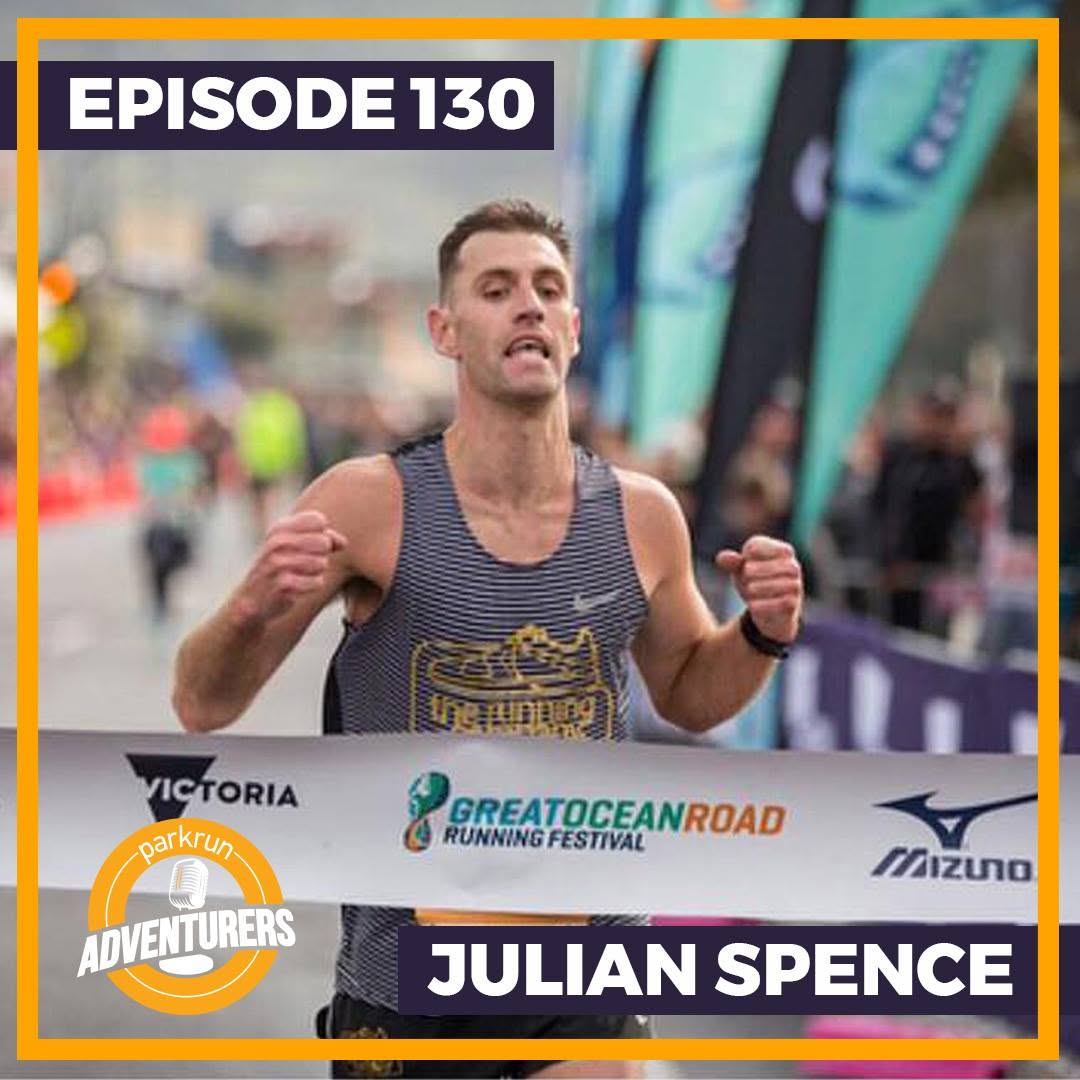
 — open the full-size cover
Episode 130 - Julian Spence
Episode details · · 270 speaker turns · sound cues from context
Enhanced transcript
Speaker names appear where they could be established with confidence. Others are shown as “Unidentified speaker”. Sounds that are not speech — music, laughter, people talking over each other — are written in [square brackets].
Episode 130 - Julian Spence · 2018-09-21
Enhanced transcript — Produced by an automated editing pass — speakers named, sound described, segments marked. NOT yet checked by a person.
Speaker names appear only where they could be established with confidence; others are shown as “Unidentified speaker”. Non-speech sound is in [square brackets].
Source: https://log.5kadventures.net/transcripts/ep130.html · The Adventurers Log · An independent project, not affiliated with or endorsed by parkrun.
Welcome
Melissa Erbacher: Episode 130 of the parkrun adventurers, coming at you from Queensland and Victoria, simultaneously cast around the globe. I am Mel Erbacher. My co-host is Scotty Trickett. Welcome to Episode 130, Scotty.
Scott Trickett: Good to be here. Great to be here, Mel.
Melissa Erbacher: Well, I'm glad that you think it's great to be here. I noticed something happened on the weekend, Scotty, so I want to head straight to that. You've been in my rearview mirror for... for some time now on the most events list. On the weekend, sneaky, sneaky, you didn't tell me that it was going to happen, but you equaled me on the Australian most events list. What's up with that?
Scott Trickett: Well, I'm just an adventurer, Mel. I'm a parkrun adventurer. I like to get out and sample new events, new courses, meet new people. That's just what I like to do.
Melissa Erbacher: Not mention to your co-host who you're in a bit of a competition with that you might be headed somewhere new.
Scott Trickett: That competition ended at the end of last year when you made a very late dash to pip me on the line. Then we were having a competition, but it's taken me nine months to catch you again. Okay, I'm pretty chuffed that I've caught you.
Melissa Erbacher: Do you think you get to stay there very long? I'm glad you noticed.
Scott Trickett: Do you think I'm going to stay there for very long?
Catherine: Yeah, I do, actually. I do.
Scott Trickett: I think I've got a few more adventures planned over the next few weeks. Not this week, but in the future weeks, absolutely. Absolutely. But let me tell you about my parkrun day, shall I?
Melissa Erbacher: Please do.
Scott Trickett: So I went out to Wyndham Vale, which is a long way from home, and I think it would probably now class as my NENDY. Well, it did class as my NENDY.
Melissa Erbacher: Formally it was.
Scott Trickett: Yeah, yeah. And how it came about is that, again, we had a free weekend, and my wife, my beautiful wife, her family lives on that side of town. So I'm in the northeast of Melbourne, and Yvonne's family is over an hour away in the west. And luckily, her mother-in-law, my mother-in-law, her mother, lives near Wyndham Vale. And I thought it would be a good excuse to visit the mother-in-law. How good am I? Visit the mother-in-law. No ulterior motive. No, and get them to come along and join us to her first parkrun. So I've got to tell you, Mel, it was a little bit exciting. I got to register my mother-in-law and my father-in-law during the week. We did that on Friday because this was all a bit last minute. And I haven't registered anybody for five or six years since we started parkrunning. Wow.
Melissa Erbacher: That is exciting.
Scott Trickett: It sounds silly. It's just a nothing thing to do. But there was a sense of joy when I registered a new person.
Melissa Erbacher: That's not a nothing thing to do. That's the start of the venture right there. It was filling out a form.
Scott Trickett: But exactly. The act was just filling out a form. But I was hoping and I was hopeful that it's going to lead to so much more for my family. And so we went out to Wyndham Vale, and I've got to tell you, we had a great time. When we woke up in the morning, because we had to leave pretty early, it was warm in Melbourne, like where we lived, it was warm. By the time we drove the other side of town, the clouds had got black, the wind had started rolling in, and we had this arctic blast sweeping through Melbourne, and we just happened to time it to the start of the parkrun there. But it didn't matter. It didn't matter because it just forced everybody to sort of huddle around. And there was that real sense of community. Everybody was really happy and friendly. And we went out and did the run. It was nice and flat. It was in this open park area. So Wyndham Vale is one of these up-and-coming new housing estate areas, so there's lots of new homes popping up. But the local council has designated this area as an open park area, open space, which is great. One small problem at the moment is that there's no trees there, and the trees that they've planted haven't matured, so it's quite exposed, is one word. And when there's an arctic blast coming through Melbourne at the same time, it provided some challenges. But the course itself then winds down to the river and it gets really pretty as you turn around and then you come back up, back up to the start-finish area. And they've got a local running group there that I imagine is born out of the parkrun called Winfit. They wear great colours, black and green. Not sure if they've pinched them directly from the Westerfoldians, but they are identical.
Melissa Erbacher: Do you have a trademark on those colours for the Westerfoldians?
Scott Trickett: We don't have a trademark, but it's a statement. You see those colours, you think of the Westerfoldians.
Melissa Erbacher: So, but where I'm going with this is that obviously the place that you get your apparel from, they don't give you guys exclusive rights to those colours.
Scott Trickett: No, that'll be in the next negotiations.
Catherine: We will be trademarking the fluoro.
Scott Trickett: I'm just surprised, as our mate Maddy Trent would probably agree. I'm just surprised anybody else would want to wear these colours, but... Winfit crew do.
Melissa Erbacher: Okay. Running shirts and running clubs notwithstanding, what did the outlaws think of the parkrun? What was their first experience like? I'm sure you got the debrief afterwards.
Scott Trickett: I did. I did. And what we did learn is that this was the longest my mother-in-law has ever walked. So she's told us that she goes out for a walk a few times a week, which... We didn't drill her on the information about those few walks a week, but it turns out they're only 20 minutes. Well, I shouldn't say only, but they're about 20, 30 minutes walk around her neighbourhood. So a five kilometre walk works out to be a 60 minute walk. So it was quite a lot longer than anything she'd done before. But I think she enjoyed it, Mel. She said she'd come back. Maybe not every week. And remember, she's a first-time parkrunner. And I don't think she's ready to go by herself. So it would require us to tag along and visit every now and then. But I'm happy to do that. I'm happy to do that once a month or so to get my mother-in-law. And hopefully, my father-in-law didn't come along. He stayed in bed. Hopefully next time he'll join in.
Melissa Erbacher: Well, well done, Mrs. Yvonne's mum.
Scott Trickett: Yeah, this is Yvonne's mum. And as we've discussed on the podcast before, you and I have both failed in our attempts to get our family, like our mothers specifically, to come along to parkrun. In fact, I put the question to my mother again this week. I said, how was parkrun on the weekend? And got silence. Stony silence. Yeah. So I'm moving on to the in-laws and maybe we can convert them to parkrunners.
Melissa Erbacher: Oh, look, I'm willing to convert anyone who's willing to be converted. I don't discriminate. Everyone is welcome to be converted.
Scott Trickett: A massive tick for Wyndham Vale. Like I said, really friendly group of people that I shouldn't be surprised with. But we do compare it to other parkruns. It's just human nature. Every time we go, I've never had a bad time at a parkrun, but I can't help compare it to other parkruns. And I know our friends with me now had a little discussion about our top three, how we do a top three. We've asked our guests, to name their top three, and our old mate Danny doesn't quite agree with it, but I think it's quite...
Melissa Erbacher: Which is hilarious because he gave us a top three when he was on the show.
Scott Trickett: Apparently we forced him into it, or something like that.
Melissa Erbacher: I'm going to have to go back and re-listen to that episode and keep my ear out for the duress that he was obviously under.
Scott Trickett: Yeah. But I think it's a fun exercise and it's never saying that my fourth best parkrun is an awesome parkrun and my 60th parkrun, I still had a great time. But I just think you have some really good experiences and it's got nothing to do with the course so much. Sometimes it's got to do with the people. Other times, it's got everything to do with the course and nothing to do with the people. This is the magic of parkrun and Wyndham Vale. I just had a great time and I am looking forward to going back.
Melissa Erbacher: Well, that's good to hear. It is all very personal, isn't it? You can have your favourite three books, but they're not going to be somebody else's favourite three books. And they might be your favourites for different reasons as well. But you do tend to find somebody who's got similar tastes to you and you can inform your own decisions based on what their likes or dislikes are sometimes. So obviously there's never going to be a scale that everybody can be measured by equally or anything like that. But I think it's nice. I enjoy it.
Scott Trickett: But I think that's the beauty of it, Mel. That's the beauty of it. So when we ask people for a top three or a favourite, that's not definitive in any way, shape or form.
Melissa Erbacher: No, that's their top three. It's nobody else's top three. And there's no expectation that it will be anybody else's top three.
Scott Trickett: And all we want to do is that if you get named in a top three, how good does that make you feel? Like we've never asked anybody for their bottom three. Except for that time we did it on episode 50. I didn't get any pushback about that.
Melissa Erbacher: Did you? About our top three?
Scott Trickett: Our bottom three, I mean.
Melissa Erbacher: Yeah, our bottom three. No. I didn't have anybody make any complaints or write in nasty letters saying they felt poorly about being outed.
Scott Trickett: No. So that was episode 50. So that was... My maths is right, 79 episodes ago. So we've survived. It was, yes.
Melissa Erbacher: Back in the day. Back in the day, Scotty. Well, I'm glad you had a good weekend. I was back at my home parkrun, thanks for asking, and volunteering as I do from time to time. Sorry?
Scott Trickett: I was getting to it.
Melissa Erbacher: Oh, you were getting to it. Okay. However, I am a hotbed of activity coming up in the future, a couple of months with a whole bunch of adventures planned because, you know what, I still have eight events to do to get my New Year's goal accomplished, in for 2018 before the 31st of December. And I am determined not to fall behind. So you're going to want to bring your adventure again if you want to keep up with me. Just saying.
Scott Trickett: It's being brought, bought, brung. It's coming. It's coming. Don't worry about that. Not this week as I said. I'm back at home. This week, milestone celebrations and the like. But after that, have you gone spreadsheet level? Are you mapping it out yet?
Melissa Erbacher: I'm not quite spreadsheet level. You know, that probably would have helped. Because, I mean, I do refer to my diary. However, I do have a spreadsheet for the Run Director roster at Kawana parkrun. And as it turns out, I did not check it before I booked two separate interstate runs, adventures for the rest of the year so awkwardly this roster that I created just a couple of months ago for the Run Directors at Kawana I've had to say hey guys um does anybody want to swap me for my two days in November and December because I'm accidentally double booked myself and I've got flights and accommodation in other states on those weekends so I'm having a shocker with my diaries lately
Scott Trickett: Seriously. It's the Event Director's problem, isn't it? Just let them sort it out.
Melissa Erbacher: At Kawana?
Scott Trickett: Yeah.
Melissa Erbacher: You're hilarious, Scotty.
Scott Trickett: Are you still the Event Director?
Melissa Erbacher: I am still the Event Director. Well, I'm Co-Event Director.
Unidentified speaker: Okay.
Melissa Erbacher: But the way we work it is if somebody on the roster can't do their weekend, then it's their responsibility to find somebody else to replace them.
Scott Trickett: That's a very sensible approach.
Melissa Erbacher: Yeah. And so it was my dumb assery that got me into this and I'll have to get myself out. But that's fine. I've got a great crew, so it'll be all good.
Scott Trickett: So Berlin Marathon was all the rage over the weekend. Some guys were running really fast. Everyone got carried away with world records being broken. But we're Aussies. We're very parochial here at the parkrun adventurers and we're only interested in how the Australians perform.
Interview Julian Spence — Australian marathoner and co-host of the Inside Running podcast; first Australian…
Gary Murphy: So we wanted to speak to the Aussie who finished first at the Berlin Marathon.
Scott Trickett: So welcome to the parkrun adventurers, Julian Spence. Yeah, thank you. Thanks for having me.
Julian Spence: I finished the first Australian, but I didn't know that until quite late on because there was one other Australian running in front of me and I didn't realise that he must have dropped out at some point. So I didn't expect to be in first when I checked the results later.
Scott Trickett: Okay, so tell us about that. So tell us about all the accolades and all the adulation you've received since finishing first Australian at Berlin.
Julian Spence: Well, yeah, it's been overwhelming, mainly because Due to the community that we've built through our Inside Running podcast, we had Andy Allison who is a friend of the podcast. He basically ran our Facebook page while Brady and I were running and he's very good at that. And he had live updates. And so we got a great amount of engagement there. over the course of the morning. And when we checked later on, there was a lot of well wishes on there and it was really, it was quite overwhelming for both Brady and myself to go on and read everyone's messages of support and their predictions and their excitement during the race. And it was the first, I mean, we've been part of the community for a while now, but this was the first time where it really sort of took us by surprise it was so big and we were really feeling the love. So that's primarily where we received most of our support, or at least I did anyway.
Melissa Erbacher: Has that been an important part of the experience for you? Because obviously Berlin Marathon is on the other side of the planet. There's not necessarily a lot of opportunity for people, you know, friends and family to go over and support you. So you've got all the support from your online community. Obviously as well, finishing ahead of the friends that you did travel across with meant that you crossed the finish line perfectly. by yourself and didn't have anyone there that knew you to welcome you. How did that all pan out?
Julian Spence: Yeah, it's really funny that you mention that because it was quite a strange feeling. You're an unknown there, obviously. There's a lot of people that do support the race on the sideline and you're wearing your bib. But no one really knows you. You don't get the familiar faces along the side like you do at the local race. Like say, for instance, Melbourne, you know someone on every corner. So you're running out there and it is a little lonely. So you think about the people that might be watching. So back home, like we know there's timing mats and we know that a lot of people will be following the updates and So each time you run across the mat, your thoughts go to the person, people that are watching back home, and you think, oh, I wonder how they're feeling about that split. And so you're not quite concerned about those that are next to you on the road cheering. For me, like I was thinking about those cheering back home. But you come down, like for instance, you would have seen everyone watched Eliud Kipchoge finish, which has been played so often now, that you see how wide the last finishing straight is. It's like probably about a football field wide, and it's a very open space. So when I was finishing, the hoo-ha of the world record's over. It's 15 minutes later. People have calmed down. They've started to think, oh, wait, there's a women's race going on as well, and she was coming in maybe 90 seconds behind me. At that point in time, there's just a few stragglers rolling through and it's like the calm, the eye of the storm really. So you don't get the excitement maybe like if you had friends and family there because the people on the sideline, they're kind of looking past you to see if there's any ladies coming yet. So I finished. The volunteers, they're not quite like – there's been so much excitement. They're still on the come down. So no one really claps or cheers. No one gives you a towel, takes photos like Eliud Kipchoge or anything. I kind of just finished the race, stopped my watch, wandered off into the tent, and all of a sudden I started thinking, oh, I I wonder if anyone's been watching on Facebook. And so obviously I knew that they were. So I checked my phone, see some messages straight away. Like we have our bags right at the finish line in the elite tent. So for us, like we were on our phones really quickly to talk to people back home, whereas like everyone else is like celebrating with each other. But because we're there on our own, it's like, oh, we were trying to get that connection back home. So Brady and I were sitting on a bench and next to all the other Africans and the whole race coming in, basically just having a little look at seeing what people have written. And when we sat there and we were just like, we were in total shock at the amount of support we were seeing.
Scott Trickett: So you mentioned your running mate and your podcast co-host Brady there. Yeah, yeah. So you finished in around 216, is that right? Yeah, it was 2.16.39. Yep. So Brady was only a few minutes behind you. So did you immediately wait for him or did you get caught up with the women winners finishing?
Julian Spence: Did you get to experience it together? We definitely did. So last year what happened, we both did this race last year together and I had finished in 2.18.40, and and I'd turned basically I'd turned around on the spot I'd spent a lot of time running with Brady during that race and and I'd I'd push forward whereas he struggled a little at the end and so I knew his goal for like the last five years or something has been to break that magical two hour 20 mark for him and so I finished in two hours 40 I knew he was close to me and so I turned around on the spot and just waited to see how close he was and It's such a long straight. You can see like Brady's bright singlet from such a long way away and there's a clock there. And so last year I saw the clock. I saw where he was and I knew that he wouldn't get it. He was so close, but he just missed it. And so there was a certain amount of disappointment at the finish line for him anyway. Whereas this year I finished in the 2.16.39. I had no idea where he was because I hadn't seen him all race. So I said congratulations to the person I was running with and then I turned around and thought, oh, shit, Brady's still out there. And I knew like the women were coming in to 18 low. They finished. So there was a little bit of like confusion, people running around the finish line. I kind of walked around all that, just stood at the finish and stared back and saw Brady Singlet coming down and I saw he had about, 200 metres to run and I looked at the clock and it was going to be pretty tight and I was just hoping that he got there and in the end he snuck under I think it was eight seconds or maybe I think it was about eight seconds that he snuck under by um but yeah he was overwhelmed it's very emotional place the finish line of a marathon in the both the elite section and the the well anywhere from two hours to six hours a lot of emotion um you can see on people's faces. Brady was emotional at the finish. We were both really stoked for each other. It was a pretty good vibe.
Melissa Erbacher: You've known Brady for a while. You did the Road to Berlin podcast series with him last year, which I tuned into avidly, listening to the journey that you guys had. I know what it's like to watch a friend who you know is aiming for a particular time and you've got that long straight and you just think, oh my God, are they going to make it? And your heart really does go with them. So obviously you must be quite close overall this time I know also what it's like to finish a marathon obviously not in the same kind of speed as you however I was destroyed at the end of mine do you do you have any of that kind of physical pain still in mind when you know you've got that focus immediately of a close friend who is that under the wire with achieving their goal yeah I think I think that there's
Julian Spence: quite a shot of adrenaline when you get close to that finish line and that carries you through maybe the first 15 minutes after you cross the line and so the legs feel okay and until you sit down until you calm down and you assess everything and and then all of a sudden you can't stand up again um so when I was waiting for Bray I was I wasn't really thinking about my my soreness so it wasn't too bad this time around um but he was quite sore when he finished he vomited straight away so he was in a worse state than I was he went to a bin and threw up most of his his drinks from the race uh and that obviously made me feel pretty like I wasn't really too concerned about my sore legs when I saw him in such a state so I yeah I Walking back from the race, that's when it starts to really kick in, I think. Like that's when the adrenaline goes down, reality sets in. Hey, all my – like my feet are really sore and crushed and quads are beat up, my calves sore, my lower back sore. And even my upper back, like I get a really – I must carry my arms really strangely because I've got – I always get a really sore upper back. And then – Again, later on, you've got that, I mean, we go out for a few beers, so that kind of takes away the soreness. And then the major reality is the next morning, and that's when you know you've run a marathon, that morning after.
Melissa Erbacher: Oh, I remember that well. I have another question for you about the actual course because obviously, you know, you run under the iconic Brandenburg Gate, but then, yeah, that finish straight, you still have like 400 metres or so to run. Is that a little bit anticlimactic? Do you wish that you could just finish under that Brandenburg Gate or is just sort of spying that in the distance when you get to that point thinking, okay, well, once I get there, then I just have a little bit more to do?
Julian Spence: Yeah, the... The gate signals it for me because I know 400 metres is one lap of an athletics track and anyone can do that pretty much at any time. So 400 metres, that's a time to start to save in a moment, enjoy it a little more. I know once you turn onto the road... that the gate is on one kilometre away and so you've got 600 metres before you hit the gate and then another 400 and it's that 600 metres that really takes it out of you because you're there but you're not quite there and you're trying to push the pace because everyone wants to get that little bit extra off their time. But one kilometre is a long time to start pushing that, whereas 400 metres, I know like one lap around the track, I've done that millions of times in my life, I can get home. And it is a brilliant finish line. So you get a wave of emotion as you go through the gates knowing what you've just done. I don't quite get wrapped up in like the whole history. I'm probably a little young for that to appreciate the significance of it all. But... for the race perspective it's definitely like the signal of the end and so then the crowds do line they cheer um there's a commentator there's people out like there's people let's pump up people on microphones the whole way along um and you see the clock and all of a sudden once you see the clock you you know what your time's going to be and and if you've got a benchmark or like if you want to break a certain time then you've either got to get on the Get on your bike and maybe put in a harder effort, whether it's breaking four hours, five hours, whatever. Or if you know you're comfortably under, then you can enjoy that last finishing straight and lap it up.
Scott Trickett: Julian, we're a few days post-event now. Have you started to reflect on your actual performance? You're the fastest Australian marathoner this year. Like, you've got to be pretty happy with your time. All your preparation paid off? Yeah.
Julian Spence: Yeah, mate, it's... I'm not your typical runner, to be perfectly honest. Like this isn't – for me, it's September and there are a few big races to come. So I won't end up being the fastest Australian for the year. But if you looked at where I was, like I met my partner Bree, I think about coming up six years ago now, and we travelled in 2013 and I was – a mediocre runner up until the last year or so and it's it's never been something that I've considered like being an elite runner I've always just been a runner and I was obviously quite like good at running but I've never considered myself to be like a national level runner and and so it's it's all coming a little bit quick it's it's a bit of a shock really for me to to run this time because three years ago I was I was running two two hours and 25 minutes and that's that's nine minutes off what I'm running now and and that doesn't rate in the top probably 30 in in Australia so it's I've taken a quantum leap maybe the last 12 months and um It's not really sinking in yet. At some point I'm sure it will, but I think runners ourselves, we're pretty greedy creatures. So once we tick off one goal, all of a sudden the next goal just comes up really quickly and you move on quite, not the right word, but you probably don't, celebrate your achievement enough like I'm a I might be a little bit different to others because I've run 216 and and the immediate thought for me is oh well I gotta go faster than that all of a sudden 216 is not my it's not it's not good enough um and and and maybe in 20 years we'll celebrate 216 as my best run that I did but at the moment I yeah I'm feeling like that I I need to run a To make myself satisfied. Do you guys feel like that when you run a PB?
Scott Trickett: Look, you're in your peak form. Yeah, it has been a few years for both of us. But I do get it because you're in peak form. Like you're feeling great. You've just had a great run. But you're probably thinking you can go faster and wouldn't it be cool if you could go faster and you could get higher up those best year best times. Yeah.
Julian Spence: I see it on every level. I see parkrunners coming in to the store in Ballarat and we talk about their running and they tell me, oh, I never thought I'd ever break 25 minutes. And then all of a sudden, 25 minutes turns into 23 minutes and then 22 minutes. And within six months, they're looking back and thinking, oh, what? 25 minutes? How can I consider that a good time? And it's all relative. And it happens like on all different levels. So I've got a feeling that is one of the things that keep us running is that we're never quite satisfied with what we've achieved.
Scott Trickett: So have you worked on your next goal? I'm actually curious, you don't have a coach or do you coach yourself? Yeah, I coach myself. Yeah, you coach yourself. So who's going to drive you for your next goal? Are you going to look for a coach or are you going to stick with what's working?
Julian Spence: I've considered... I considered... Getting a coach, and I said it, we've got a message with the boys on the podcast. It would actually be quite entertaining to one day read through these conversations. But I think I said to them, I've decided I'm going to get a coach to help me, to help guide my running. And then within probably 10 minutes, I wrote back and said, no, no, I know my body better than anyone. I don't think I could listen to someone. I love the fact that I can wake up and every morning I can assess how I feel and change the days running based on how I'm feeling, whether I've recovered from the previous days running, whether the weather is terrible, whether I've got a lot of work on that day. I can be as flexible as possible and not have to bother someone else or not have to be totally in contact with someone else. And And what I feel, I do a little bit of coaching and I've developed a bit of my own philosophy on training over probably the last sort of 10 years of being in the sport. So I like where I'm at with my training. It probably doesn't work for everyone, obviously, but in my mind, like I know what I need and I love being able to fine-tune myself. That could sound weird.
Melissa Erbacher: Doesn't sound weird at all. You're very fortunate to be in the position where you are that self-aware, I think. If I tried to coach myself, it would not go well. Now, Julian, obviously looking at potential new goals and things like that, is marathon the only distance where you have goals or can we see perhaps in the future the parkrun Australia course record, the national record might go down to Julian Spence?
Julian Spence: Who has that record?
Scott Trickett: Liam Adams holds our men's national record.
Julian Spence: Heard of him? Yes. So he, last year at Berlin, he was in the race and he came back to it. We had a big Australian party afterwards and he was one of the best on ground at that party. But I would never – no, I can't compete over those shorter distances. It's quite – the longer it gets, the better I get. So I, if anything, I would be going longer in order to, um, become more of a competitor. Uh, the short, the shorter distance events that they help with my longer running, but I was like, I'm miles off being anywhere near a competitive runner over the 5,000 metres. I've never, I've never qualified or never, um, been selected to run at Zatopek 10,000 metres where they pick like 25 runners um I've never been selected for that but and I've never run a half marathon that um rates anywhere near the sort of top 20 or 30 for the year so the the marathon for me is is my distance at the moment um otherwise I I mean I have aspirations to run maybe ultra marathons when I get a little past or over the road running I I love the the idea of being on a trail all day and you know I've done a few ultra marathons but I I feel like that's where I would perform even better as you get slower I can get slower and go longer maybe that's the best way to put it
Scott Trickett: And so this would explain why you haven't done a parkrun, officially done a parkrun since 2013, I think it is. But you tell me that you incorporate Ballarat parkrun into some of your Saturday sessions without scanning in?
Julian Spence: Yeah, that surprises me. It's been that long since I've officially scanned in. Over there, we certainly, the Ballarat group, my training group, friends, We normally go to the – have you guys done Ballarat parkrun?
Melissa Erbacher: Not yet.
Scott Trickett: I have. I've done it a few times, yeah.
Julian Spence: You have? Yeah, okay. So Vic Park, the park down there, great place to do your tempo workouts, intervals, that kind of thing. So we meet down there on a Saturday morning a lot of the time and it just normally clashes with – well, it doesn't clash with parkrun. We just – We park at the same spot where parkrun starts the race. And a lot of the time we go, oh, well, let's just jump in and do some of our reps during the race. And it's fun because we get to – I know probably 99% of the runners that are there at parkrun each Saturday morning. So I get to talk to those guys and you get to be involved in the race atmosphere, which is always fun. I mean, you guys know it's changing the way that we know running, parkrun, and the running industry, that's for sure. Um, and so, yeah, I, we just don't bring our barcodes. Uh, I think if I hadn't printed in the car, then it would be a lot easier, but we just leave it too late. And sometimes it doesn't work out where if we have like a 15 kilometre workout or a 10 kilometre workout and you don't want to, um, You don't want to disrupt things. Like if we have to keep running during the race, you don't want to have to confuse everyone at the finish and you don't want to get in people's way. So we normally maybe pull out around the four. Oh, we've done it a couple of times anyway. Pull out around maybe the 4.8K mark and just drift off to the side so we don't create a hassle at the finish.
Scott Trickett: I want to bring it back to the podcast, Julian. We've mentioned it already. Inside Running is the podcast. It's the preeminent running podcast in Australia now. I think you guys have done a great service to the running community in Australia that's desperate for it. Mel and I often say that we're a parkrun podcast. We like to have chats with runners from time to time, but we understand that there's a real hardcore running community, and you guys have really tapped into that. How have you enjoyed it? You've become a bit of a character on the show with Moose on the Loose and likewise. Have you enjoyed the experience over the past couple of years doing a podcast with two mates talking running?
Julian Spence: Yeah, well, I think you just nailed it. That's exactly what it is. We treat it like, and whether this is a good thing or a bad thing or a dangerous thing, we treat it like it's our Sunday long run and what we would discuss if we were just rolling along out in the bushes. And like a lot of people are interested in those conversations. They want to be part of that conversation. And there was really no discussion point. Like there were a few websites around where Australian running would get discussed. There was a few forums that seemed to kind of faded away on the internet where we would discuss running or where some people would discuss running. And Facebook's a little bit, like the forums on Facebook turn nasty and they can be a bit of a rabbit hole chatting on Facebook about this stuff. And so Brady, this is like we have to pay credit to Brady because he had Tell Me Your Tales. And Tell Me Your Tales, in the beginning, it seemed to focus on telling the runners of Australia's, The runners of Australia, their stories. And it was fantastic. I loved it. I would listen to people talk about where they grew up, how they got into running, what their training is, their different thoughts on different races, their experiences throughout the Australia running. And it would just cover you. You got to know people. And then... It turned into a little bit more running focus with the road to Berlin where we discussed our training leading into Berlin and we started to pick up a few more fans around the world. And I kept thinking, I kept even telling other people, I'm like, I'm a little embarrassed this is getting big because all it is is us talking about our training and really who wants to listen to that? It seems quite self-obsessed to just come on and record you talking about your training. But... people have enjoyed it and they've really they've reached out to us they say they take a lot from it a lot of learning we learn from each other uh especially with the guests that we have on now and and and Brady he he's a real thinker he's a very creative guy and he is constantly working out ways to engage the running community and how what can we offer to the running community that's not there at the moment and so when he came up with um Oh, well, we decided on the name Inside Running and his plan for it was exactly what it is right now. Like we sort of spitballed a few ideas for different segments we wanted. Initially, I was... Very focused. Oh, well, I really enjoyed the guest component. I thought that was what would make the podcast because when I go out and listen to podcasts, I kind of cherry pick based on the guests that are appearing and listen to their interviews. And I thought in order to make it... legit and people would listen to it, you would need high-caliber guests or guests with great stories. And we certainly have found that. I mean, one of the benefits of being in the – like I'm in the running industry, work in the industry as well as run at different races, so I kind of link up with a few people, get good contacts. We can get good interviews. But what surprised me a lot is people – reaching out to us and saying, oh, I just love the section where you talk about your training again. And so it comes back to us just discussing what we do on a Monday, where we run, how our foot was feeling, the shoes we ran in, the group that we were in, what did we talk about. It's like this stuff – is and and and if I listen to a podcast they're the kind of things that I really want to know I listen to a lot of interviews where I think that the interviewer he doesn't ask the nitty gritty running stuff that we're interested in um and and and they're the ones that I really like so uh the podcast is is a brilliant I mean I sometimes it gets a bit much you know like It's on a Monday night and we all work and we all train and we all have partners. And Brad, he had like a little girl yesterday with his partner or his wife Viv. So we're all quite busy and sometimes on a Monday night, and it reflects in some of the podcasts, we might not prepare as well as we should and we might feel uncomfortable. Like a little bit – like we can't be bothered. And sometimes it comes off a little sloppy like that because maybe we haven't put as much effort into the week. But we probably should stick to what we know best, which is just purely talking about running and not getting into the – not getting into the real controversial stuff, which has got me into trouble a few times. And even a couple of weeks ago, I offended someone on the show and I thought, you know, I didn't get into this. I didn't start talking on this podcast to offend people. I don't want to upset people. And so it's been a real learning experience for us to have a recorder on us for like 90 minutes every week because you learn – you learn about what can upset people and, and, and I, I felt good. Like after that, after I felt bad about upsetting someone, I thought, Oh, like maybe I'm, maybe I'm actually an all right guy if I'm feeling bad cause I offended someone. Um, So it's been a whirlwind, actually, the podcast. It's been something so different, and I wouldn't be able to do it if it was a camera. It's easy to sit behind this computer here and just chat away running, but it feels like there's no pressure. And, you know, at the very end of the day, Brady can go back and cut all the stuff I say that's probably not appropriate. He can cut all that out, like I hope you will if I say something bad.
Scott Trickett: Well, so far, so good. We're not going to cut anything out. But we can completely relate to that. And I think the idea of the guests, so we do it here too. We know that people cherry pick and we know we had Rob de Castella a couple of weeks ago and our numbers went through the roof. But I reckon you guys will find your latest episode where you just recapped Berlin, your numbers will be really good there because people have really invested in your journey so far and they'll want to hear that. So it's a real fine balance. We can definitely relate.
Julian Spence: Yeah, and I get embarrassed when we run with the boys back here because they all make fun of the podcast and it's just a bit of banter on the run. But you're running like your profile grows a little bit and all of a sudden like people are interested in what you're doing and I run with some runners that are a lot better than I am and it feels a little embarrassing sometimes to – to run along knowing that you've got this podcast going and people know who you are and then you're running next to someone who's been in the Olympics and maybe won't be as well recognised. It's just a little bit – you've got to be – yeah, you've got to take it with a grain of salt. We're good at talking about running, but there's a lot of great runners out there that maybe we're helping to give a platform to. It's the running – The running community in Australia is underappreciated. Like we always use the example like the 500 – we probably know who the 500 best AFL player is in Australia. People would – kids would wear that guy's jersey around. He would make maybe $200,000 to $300,000. He could get into – he could walk into a nightclub and the whole place knows who he is, right? That's the 500 best player in the country, whereas – Michael Shelley, let's just use Michael Shelley, he won the Commonwealth Games. I don't think he has a contract where he earns a single dollar from a company. He's almost unrecognisable to anyone outside the real hardcore running community. He's won two Commonwealth Games gold medals and a silver medal in the marathon and he, let's just say he's our best marathoner at the moment and he doesn't make really any money from this sport and Hopefully, we can help build profiles that might get some exposure for these runners and they can actually start to make a living out of it.
Melissa Erbacher: Obviously, you don't do it for the glory or the fame of being a runner. Are there plans in your future, Julian, that involve the five rainbow rings?
Julian Spence: It's not – well – we all dream. I don't think anyone's not dreamt about running in the Olympics or playing their sport in the Olympics, but I'm a pretty real type of character. So I know the limits to getting to the Olympics and I know the talent of runner around me. So where I sit at the moment, like it's a little bit of a false fact, like the fact that I'm, the fastest marathoner in 2018, right? The Olympic qualifying period hasn't opened yet. So the times that are run at the moment, they don't count towards Olympic qualifying. There is a world championships next year in Doha, and that's not the most attractive place to go and run a marathon. And so the level of runner that I am, I have to kind of, be a little bit sly and sneaky to get myself onto teams if I want to get on a team. I have to pick the years where it's not going to be ideal to be on the marathon team. So when Tokyo qualifying comes around, you'll find that all the best runners go out and run amazing times. And my 2.16.39, that year might be the 10th fastest time. Whereas this year, because there's not a lot going on, the Commonwealth Games was on and it was a slow, like a hot crack. Obviously, we all saw what happened there. It wasn't a place to run fast and the qualifying period for Tokyo hasn't opened yet. So it's fallen in my favour that this run looks good on paper, but it certainly won't get me anywhere near the Olympics. I think if you're going to get to the Olympics in Tokyo, you'll need to run around 2.12 as an Australian. Yeah.
Scott Trickett: I think you're focusing too much on detail there, Julian. Just live in the moment. Live in the glory for a few more months anyway. Before we let you go this week, I just want to go back to Berlin and the carry-on with the world record because it's a remarkable achievement. Everyone in the running world is talking about it. And you were there. You experienced it. You rubbed shoulders with Kipchoge. Can you just – can you – pinch yourself and sort of relive that moment. What was it like to be there as it happened?
Julian Spence: Yeah, well, it's interesting because I was focused more on the ladies. So because I was going to be running around about the ladies' pack and Tirunesh Dibaba, she had mentioned that she wanted to break the world record and she You don't know exactly what their plans are. Like it seems like everyone's super confident when they come into these meets and they always want to break the world record. So I was more focused on, well, if she's going to break the world record, she needs to run at a certain pace and I might be able to sit with that pace and it'd probably be a little fast for me, but who knows? Let's see what happens. And so after the gents went off, we like really, you saw the splits there run. You don't even know – you can't see them after 30 seconds. They're just gone. And so you don't really – I wasn't really considering what was happening along the course up ahead anyway, but I was more focused on the ladies, whether they would break the world record, and it was clear very early on that it wasn't going to happen. So when I crossed the finish line, I said to one volunteer who was just standing around quite – unimpressed with it all. I said, oh, did the world record get broken? And she said, oh, no, no. I thought, oh, okay, damn, pretty good day for it. I wonder what happened. And then the next volunteer said, no, no, no, no, world record, yes, 201. And then I spoke to Brady afterwards and Brady said that he saw someone hold up a sign about two kilometres from the finish and the sign said Kipchoge just ran 201, whatever it was, 30. And so he's a bit more of a frother athletics fan than I am. And so he said it gave him a real lift and he was talking to the guy next to him about it. It was real buzz for him. And then afterwards I was sitting in the ladies' tent because not many ladies had finished. There's an elite tent at the end and men's was filled with like every pacer from the race and all the finishes and it was quite smelly and gross. So I walked into the ladies' tent and sat down.
Ben Jozefiak: And they ushered –
Julian Spence: Eliud in like they wanted to get him away from all the attention. And so he came in and he was just smiling and I said, Oh, well done, mate. Like great, great work. And he smiled back and said, Oh, thank you. And then the guy next to me shook his hand and he was, he was just like genuinely over the moon. And you could see at the end, the emotion, like you just don't see that from, from those guys very often. And that was, that was a real buzz. But for us, we were a little bit away from it all happening. So 15 minutes back, all the celebrations are done. I watched it the next day, the race with Bree, and we were more excited watching the race the next day because we could see it all unfold. But on the day, I didn't really see much of it.
Melissa Erbacher: Well, world record falling or not, I'm sure it will be a memorable marathon for you anyway, Julian. Thank you very much for joining us on the podcast this week. It's been lovely having your insight into what it's like to be a bit of an elite running around really fast in European countries. Good luck for your future endeavours and we'll keep listening to the podcast. Say hi to Brady for us.
Julian Spence: I will do. Thanks, Mel. Thanks, Scott. And I should mention, yes, I listened to your interview with Deek as well, and it was quite good. It really opened my eyes up to the Indigenous Marathon Project, more than I knew before. So well done on that.
Roving reports & the Channel 5 News crew
Roving report Gary Murphy — Railton parkrun
Gary Murphy: We are at the finish line of Railton parkrun in Tasmania, and I'm with Ben, Jeff, oh, Ben. Jozefiak. You knew I was always going to stuff that up, wasn't it?
Ben Jozefiak: Everyone struggles.
Gary Murphy: Ben has just entered the Half Cowellell Club. Ben, congratulations, man.
Ben Jozefiak: Thank you very much. It's a pleasure.
Gary Murphy: So do you have a home parkrun?
Ben Jozefiak: Well, I've kind of done a few volunteer spots at one particular parkrun in Wrexham called Erddig parkrun. That's in Wales. Yeah. And yeah, that was pretty much our home for a long time when we were in the UK. So yeah, yeah. But other than that, no, no, 50 and 50 different places. So it's kind of, you know, merging two of my passions, running and travel. So yeah, it's been great.
Gary Murphy: Awesome, mate. And so you're based here in Tassie now?
Ben Jozefiak: Yeah, we're in Launceston. Been there for about four months and we moved down from Sydney when we got back from the UK.
Gary Murphy: Ah, terrific. And so Railton's a trail parkrun and I know, are they trail shoes? Yes, yes they are. It's the first outing today actually and I think they're a bit too small.
Ben Jozefiak: Yeah, I've got a bit of a blister forming I think.
Gary Murphy: Ah, well that's a good way to trial out the new shoes. Yeah. Athletes foot are pretty good apparently. Okay.
Ben Jozefiak: So what did you think about the Railton course here today? It was great. Yeah, it's good to do something a bit more trail. You know, I was just speaking to the guys here before. I've done a few parkruns where, you know, you're just kind of running around a pavement kind of, you know, park. That's really some laps. So it's good to get out there and do some kind of, you know, underfoots a bit, you know, sketchy at times. And yeah, it's great running through puddles and getting a bit dirty. Any highlights, Ben? Oh, yeah, there's been a couple. I mean, we did a fair few parkruns in Wales, but I'd have to say, like, we went to Poland for a holiday, and we ran one parkrun in Cieszyn, which went into two countries. So, it's the only parkrun, I think, don't get me wrong, that's in two countries that goes over the border into the Czech Republic. And then there was one in Northern Ireland as well, which was run entirely on the beach. Wow. And that was incredible and very hard because you ran two and a half k's down the beach, turned around, and then there was just this strong wind right in your face all the way back, and that was a nightmare.
Gary Murphy: Wow.
Ben Jozefiak: But yeah, yeah, it's definitely been, there's been some amazing highlights, and yeah, it's just, parkrun's incredible.
Gary Murphy: Well, thanks for talking to the parkrun adventurers. Well done today. No worries. Thank you. Congratulations on the half Cowell. Oh, thanks very much. Good luck on the full Cowell.
Ben Jozefiak: Awesome. Yeah, yeah. That's next, I guess. Good on you, mate. Thanks, Ben. No worries.
Gary Murphy: We're still at the finish line. I'm here now with Catherine, the ED of Railton parkrun and the RD for today. Catherine, hello. Hello. I come through in 2016 and Railton parkrun wasn't here. And I know that TOC's been here and he gives rave reviews and I can see what he's talking about now. How's it all been going since Toc was down here?
Catherine: TOC turned up to our first event which was the 250th Australian parkrun to launch He actually did a parkrun plus that day because he wasn't listening to directions when we were doing the briefing So that was our first joke of our parkrun We've had lots of stories since then We've had quite a really good core group of regular runners as well as lots of visitors coming through I don't know if Toc told the story at the time but our Mayor really was a little bit of a non-believer. He didn't think that a parkrun would bring visitors to town but it certainly proved to be the case that we've had people like yourself from interstate but we've had people from all over the world. It's been fantastic. Just watching John come in. He's one of our volunteers but he's running today. Well done John. Good job mate.
Gary Murphy: And I can see why Toc loves the course, it's a beautiful trail run out into, what Tasman Trail you said it was called?
Catherine: Tasmanian Trail for the first one and a half kilometres and the last one and a half kilometres and then we have a couple of loops in what we call Sykes Reserve or Sykes Sanctuary which was donated to the community by a gentleman who owned it and lived there as a bit of a hermit many years ago
Gary Murphy: So my wife and I were off the boat this morning and straight down here to Railton. So it's good for the adventurers to get straight off the boat and straight into some adventure.
Catherine: Yes.
Gary Murphy: And we had a tour of the topiary, all the bushes and shrubs that are shaped into different things around town. Like there's some elephants and cows and all different things. And I've decided we have to get a parkrun topiary. Who do I have to speak to about that?
Catherine: Well, if you... Perhaps go down to the little community information centre I'm not sure if there's anyone in there today But we do have a community information centre and that would be the place to make that suggestion I'm sure they'd love to hear from you But we do have a topiary group that's actively involved in making the frames as well So in fact one of them ran today, but he's already left Oh no, we've got to talk to him We may catch him at breakfast at the cafe But he usually goes back to work pretty quickly He's the local mechanic Oh there you go
Gary Murphy: Well we don't want to upset him in case we've got a flat battery we'll get back to it. Kath, thanks for getting this going. It's a beautiful parkrun and your awesome team of volunteers. Plenty of high fives out there and run fees on the course this morning. So all the best with your upcoming birthday and ongoing success with parkrun. Thanks very much for visiting. Thanks Kath.
Melissa Erbacher: Thanks to Gary, my propeller hat twin, for your roving report from Railton parkrun. Railton was the 250th parkrun event in Australia, so it's a bit special. But it also sounds like it's very special for things such as topiary. Didn't know anything about that before, Scotty, did you?
Scott Trickett: Yes, I did know that Railton was the...
Catherine: What is it? Topiary?
Scott Trickett: Whatever. Topiary? Topiary capital of Australia. I did know that. Oh, okay. And good work to the team there. It sounded like it was windy and miserable and raining, but they soldiered on. Well done.
Melissa Erbacher: I will divulge, Scotty, one of my adventures planned for this year is to go back to Tassie. I'm very excited.
Scott Trickett: Are you going to go to Railton?
Melissa Erbacher: I'm not ruling it out. It's not going to be my parkrun day parkrun of choice. However, that doesn't mean there won't be a freedom run. It looks beautiful from the little video clip I've seen of it.
Launches and anniversaries"Where is the cake?"
Scott Trickett: It does, yep.
Melissa Erbacher: But you know what's happening this weekend, Scotty?
Scott Trickett: We're launching more new events.
Melissa Erbacher: We are, after having a couple of weeks with zero launches. We're coming back strong.
Scott Trickett: We saved them all up for one weekend. We got four in one weekend. It's crazy.
Melissa Erbacher: Yeah, it is. Crazy and great all at the same time.
Scott Trickett: Yeah, and one of them is in Tassie, but we'll get to that because it starts with M and we always do it in alphabetical order. So first off is Braidwood Showground in New South Wales.
Melissa Erbacher: Ah, you know, I didn't realise we do this in alphabetical order, but that's great now that I know that. I just always assumed it was the oldest event first.
Scott Trickett: No, no.
Melissa Erbacher: Well, there you go. Learn something new every day. Braidwood Showground in New South Wales. And that is going to be joined by a fellow New South Walian event at Cowpasture Reserve, Camden.
Scott Trickett: The event launching in Tasmania is Montrose Foreshore.
Melissa Erbacher: And then we've got a new one for South Australia at Stebonheath.
Scott Trickett: Stebonheath. Now, before we get to the anniversaries, Mel, I have a question. I have a question for parkrun Australia. Okay. I've noticed.
Melissa Erbacher: Okay.
Scott Trickett: I've noticed. I want you to put your official operations hat on here. I've noticed lately that the names of our events are starting to look a bit different. They're like Cowpasture Reserve Camden. Now, in the past, that would be called Camden parkrun. Why are we calling it Cowpasture Reserve? And the same, I'm guessing, for Braidwood Showground, maybe? I'm not sure. Tell me the reason why. We've got some different looking event names.
Melissa Erbacher: Okay, to get a little bit official on the listeners. It's a good question, however. There has been a global policy, a global naming policy put in place in recent months which obviously has impacted everywhere in the world, about how we name our events. And basically the policy is the culmination of years and years and years of experience and learnings from the UK and it's keeping scalability in mind. So, for example, something like Cowpasture Reserve in Camden Previously would have been known as Camden, which is the name of the town. However, that doesn't really allow for the potential in future for an additional event to be in Camden. So if you name the first one Camden parkrun and then they get another event, well, you know. Do you call that Camden parkrun too? Or, you know, it just gets a bit awkward. And that also doesn't factor in that there might be another township or another place in the world called Camden, which may already have a parkrun. So we've got the legacy of those sorts of events elsewhere in the world. And in Australia, you know, Albert Melbourne parkrun is called Albert Melbourne because there was already an Albert parkrun somewhere else. And we've got Ipswich, Queensland for the same reason because in the UK there's already an event called Ipswich. So it's primarily to... Future proof, I guess, is the way you would put it. And the way the names get determined now is basically we just have to identify the smallest geographical, like identifiable geographical reference points. So if an event starts and finishes in a park, such as a park named Cowpasture Reserve, for example, that's what the event's going to get called pretty much. Does that answer your question?
Scott Trickett: It does. Thank you for the clarification. I already knew. But I thought it was a good question to ask. And I really like it, so I'm going to rely on my own personal experience here. And I'm pretty sure this was explained to me when I started Westerfolds parkrun. And I've had this debate with my wife ever since day one. In fact, before Westerfolds started, she wanted to call it Templestowe parkrun, which is the suburb it's located in. And I was adamant. I was adamant. I was pounding the table again. No, we're going to call it Westerfolds because that's where it is. And it's the same with Studley because it's in Studley Park, Westerfolds Park. I really like that naming convention because if it was named in the suburb, it could be anywhere. And I want people to associate. I want that park to be famous. That's the one that people are going to and running in every week. So I like the idea.
Melissa Erbacher: And you know another reason that it works is, for example, you also now have a junior parkrun event in Westerfolds. So that's Westerfolds Juniors. And they use an example in the UK with Harrogate parkrun. They also have Harrogate Junior parkrun. However, the two events are in different parks. So the fact that, you know, one is in one place and the other one is somewhere else, they've had people showing up for juniors on a Sunday and where they have the 5k event on the Saturday, but that's not correct because they actually have the event somewhere else. So if this naming policy had been in place prior to those events being named, then there wouldn't be that kind of confusion. And Westerfolds and Westerfolds Juniors are a perfect example of They're both in the same park, so that's accurate. Whereas you might have had another place in Templestowe where you could have had your junior parkrun, and one of them might have been in Westerfolds Park and the other one somewhere else. So, yeah, it's just another level of helping reduce the confusion potentially for parkrunners.
Scott Trickett: Yeah, look, it's very possible. So then my next question is, are we going to start changing names of existing parkruns to avoid future confusion?
Melissa Erbacher: Not as far as I'm aware. The events that we've currently got in place, they'll all be retaining their same names. We have actually changed a couple of event names in the past when another event or a prospect has come up in the same sort of area and it's been realised that the original event wasn't actually named. appropriately. It was just sort of referenced too broad of an area or it wasn't even quite specifically that location as such. So it was going to cause confusion. But yeah, in terms of the events that we already have existing, no, they won't be changing unless we come up against a particular problem someplace.
Scott Trickett: Okay, so with all that information in your brains now, let's go through the anniversaries and have a think about the names of some of these parkruns. Because we are celebrating anniversaries at Ashgrove in Queensland.
Melissa Erbacher: At Bowral in New South Wales.
Scott Trickett: Merimbula and Moree, both in New South Wales as well.
Melissa Erbacher: And we've got New Farm in Queensland.
Scott Trickett: Tamworth, New South Wales.
Melissa Erbacher: And You Yangs in Victoria.
Scott Trickett: So thinking about all those events, there's potential there. There's a good chance we might have another event in Tamworth one day. You'd hope so.
Melissa Erbacher: It's possible. I mean, it's not always just based on the size of the town either. And you do need to consider the fact that... You know, some towns have twin towns elsewhere. We've got a prospect in Scone at the moment, for example, but there's already a Scone parkrun. Well, there's already a Scone in the UK, I should say. So, yeah, Scone here in Australia is not a large place, but we certainly won't be calling the event Scone parkrun because that doesn't fit with the naming convention now. I feel all weird being official on the podcast, Scotty.
Scott Trickett: I like it. I like it.
Hotline
Scott Trickett: But I've had enough of it, so let's go to the hotline. Hotline.
[other]
Unidentified speaker: Hotline.
Streaky September
Scott Trickett: And we've got a couple of questions as we've sneakily added them to the bingo challenge for Streaky September. So we love it that a lot of our regular listeners and those doing Streaky September are sending in the questions.
Melissa Erbacher: Stroke of brilliance on your behalf, Scotty, to do this because what better way to get content for the podcast than make it a challenge on Streaky Bingo? We know people love ticking off checklists and Streaky Bingo is no exception.
Scott Trickett: And let's go to our first one. Scotty and Mel, what's your favourite training session and your least favourite training session?
Melissa Erbacher: Well, Scotty, do you want to take that one first this time? I'm pretty sure you made me answer first last week.
Scott Trickett: Did I? You were paying attention to that sort of stuff. Okay, favourite and least favourite training sessions. You know what my favourite training sessions are, Mel? They're really short ones. I actually like the ones. I do. I like the ones with a nice cruisy warm-up. So you can do a warm-up for about 3 to 5K, just get nice and loose, chat to your mates, and then just some really short, sharp sprint work. So whether it's straights and bends on an athletics track or something I did last night with my mate Rob, we just ran up and down a footy oval. So it's just 150-metre sprints, and you do about eight of them, And then that's the session done. You got a good speed workout, and then you can go and have your cool down, which is nice cruisy jog chat again.
Catherine: That's my favourite type of workout.
Scott Trickett: My least favourite. My least favourite. I've got to admit, right at the moment, is a long run a workout?
Melissa Erbacher: Yeah, it's a training session. It's part of a training program.
Scott Trickett: I'm going to go with that because I've skipped my Sunday long run for about three or four months in a row now. I'm trying to stretch it out to six-month break of skipping the long run because it's just the idea at the moment of going for a two-hour run. Not for me at the moment.
Melissa Erbacher: Okay. Do you feel like that's because it's boring or you're just not feeling inspired by the idea of it?
Scott Trickett: I tell you what, Julian's got me inspired and I think the warmer weather is getting a bit more inspired to lift my running. But I think it's just the fact of running for a long period of time.
Melissa Erbacher: Okay, fair enough. Well, my favourite training session, it's kind of in the same vein as yours when you say the short ones. I actually really love interval training. So, you know, you do your repeats, let's say six intervals You have a warm-up for a couple of minutes and then you do one minute fast and then two minute sort of gentle and then one minute fast and then two minute gentle. And you do that six times and then you have a cool down. And it can be over in like 20 minutes but you still get a lot of benefit out of it because you do the hard push for like a minute and then you can ease off. So you still get the breaks in there as well. So that's my favourite. So we're kind of the same. Yeah, kind of. But you know what? It's also my least favourite. It's the one that I look forward to. And it's the one that I find the hardest because of that, oh, my God, can I possibly have the lung capacity to run faster? for this full minute as fast. Do you ever get the feeling like when you're sprinting, you look stupid? I wouldn't say that I'm a vain runner by any means, but I don't think I'm one of those weird-looking runners who has this gait where you think, well, honey, you're just using a lot of energy there. You do not need to be flapping those arms around or doing what you're doing with those legs. I think when I sprint, I probably just look really stupid.
Scott Trickett: Well, I've got the advantage if I look stupid. Sprinting, walking, jogging. I just look silly anyway. So I don't tend to worry about it too much. Although last night, like I said, I did this session, with my mate Rob, and he's faster than me. And I noticed on a couple of run-throughs, like, he started behind me, and I know he was shouting, lift your cadence, check your form, because I'm a mess. And he felt the need to correct me.
Catherine: Yep.
Scott Trickett: So, yeah, I'm with you. I'm with you. I do get a bit conscious. You've got to look like you're supposed to be doing the right things when you're doing these sessions.
Melissa Erbacher: Yeah. Okay. Good question, Simon. Thanks for that.
Scott Trickett: Great question. And we've got another one. We just heard from Gary. Should we hear from him again? Yeah, let's hear from him again because he's got a friend with us.
Melissa Erbacher: Well, technically this question isn't from Gary. He is just the person who is in charge of the technology for his mate Flynn.
Roving report Gary Murphy — Sunbury parkrun
Gary Murphy: G'day Mel and Scott, parkrunners, adventurers, everybody that's listening to the pod. I hope you're having a happy streak month. And it's Gary Murphy reporting in live from the Sunbury parkrun finish line, an 1880s historic bluestone bridge. And I've found a special guest here who's got a question for Mel and Scott. Okay, so translated, that is, Mel and Scott, where is the strangest, weirdest, or most interesting place that you've ever had a walk or run? Happy streaking, everybody. See you at palm19.
Melissa Erbacher: I'll jump in and take this one first, Scotty, because it's a bit of an odd question, weirdest and strangest place. I guess it really depends on what you classify as weird. And if you're a bit of an oddball person in general, I reckon the scale of weirdness is is probably a little bit skewed to what somebody who is perhaps a little bit more conservative mainstream has. But anyway, for me, I think I'm going to take it to my marathon, my one and only marathon yet since, you know, we've been talking about marathons this episode. And there was a moment, oh, there were lots of moments in that marathon that were bizarre, you know, running in a fancy dress marathon across 42.2 kilometres of rolling hills with vineyards and having wine stations every two kilometres and then, you know, oysters and all sorts of degustation things offered in the last 10K. There are lots of moments there that you would not experience in any other marathon. But because it was all so fancy dress and they go all out, the participants in this particular marathon, Marathon du Medoc, and the year I did it was a sci-fi thing and there were literally people running with like life-sized, alien spaceships so they were all dressed as aliens and they had these things on wheels and they had little um things sticking out the sides um what do you call handles I guess so that at any given time they could have six different runners pushing the alien spaceship and I've had people yelling at me in french to please get out of the way we want to overtake you with our spaceship um So the marathon offered a lot of opportunities for some weird, never-to-be-repeated moments, but possibly the one that eclipses all of them happened, I think it was fairly early into the event, maybe in the first 10K even, and running along this path that you've got to both sides of you just acres and acres of vines, of grapevines. Yeah. And to the right of us, and I kid you not, there were about 10 people lined up at the end of the grapevines, relieving themselves because I guess, you know, 8,000 participants, there weren't enough portaloos at previous stations and when you've got to go, you've got to go. But they're all dressed as Superman or an alien or just the most random sci-fi costumes. And they're all lined up at the end of these things individually. That I think was the strangest and weirdest, well, I'll say place, but it was kind of experience in my running career thus far.
Scott Trickett: Okay, I'll pay that. This event, you've talked about it before, it just sounds like one big party. It doesn't really sound like a marathon as such.
Melissa Erbacher: Yeah, one day I might do a serious marathon. But I've got to go back and do this not so serious one first so I can undo my DNF, my official DNF, even though I did the distance.
Scott Trickett: So what about you, Scotty? Yeah, my weirdest one is... So I went out for a run. This was a couple of years ago. I went near where I live in Warrandyte. There's a state forest and lots of little single track trail running. This was back in the days when I enjoyed that stuff. And could stay upright. And I was just running along and I was running along a fire track and I noticed in the bush there was a little path. There was another little single track going into the bush. So I thought, okay, I'll go and explore that because I'd never run in this area before. Anyway, you're fighting your way through some trees, but I was determined to see where the track goes. And at the end of it just appears this altar, this like something out of the movies, old neglected altar. With some pews.
Melissa Erbacher: Like a big table slab sort of altar?
Scott Trickett: Yeah, it was just a concrete slab with some church stuff. And then there was concrete pews. Is that what they're called? Like chairs?
Melissa Erbacher: Yeah, yeah.
Scott Trickett: Yeah, sort of aligned so you could sit down and watch whoever does their thing up on this stage altar. And it was really weird. In the middle of nowhere?
Melissa Erbacher: In the middle of nowhere.
Scott Trickett: There was just this thing. And I dusted off some dirt and some leaves and rocks and stuff. And I think it's somehow linked to the Scouts because there was some Scout symbols in there. But it's in the Warrandyte State Forest area, Jumping Creek. If you're in Melbourne and you want to check it out, Go down to jumping.
Melissa Erbacher: State forests are always just a bit creepy, aren't they?
Scott Trickett: Yeah, it was very, very creepy. And I've been back there and I've taken a few people back there without warning them. And everybody who comes with me is just like, this is weird.
Melissa Erbacher: They feel like they're going to be sacrificed. Where have you taken us, Scotty? to some Aslan, Lion, the Witch and the Wardrobe kind of bollocks.
Scott Trickett: Very much so. And it's in a really nice part of Melbourne. You're just not expecting it. But it's in a part of Melbourne where you kind of would expect maybe some sacrifices or something like that going on, some weird cult behaviour. Yeah.
Melissa Erbacher: You know, I think you've probably just found the next hot spot that everyone's going to want to go check out.
Scott Trickett: Yeah.
Melissa Erbacher: You'll be getting a lot of messages. Where is this place? I want to go see it.
Scott Trickett: Yeah. I'm happy to take people for a run. Anytime you want to come for a run, I'll gladly revisit this spot. But that was definitely a weird moment. And to find it by myself.
Unidentified speaker: Yeah.
Scott Trickett: And can I just tell you another time, another time, very, very similar location. This was back in the days when I didn't have any mates to run with and I'd go out and explore these trails by myself. And I went down to the local, our local dam. And this was, again, a few years ago. And as you go, there's a walking track all the way around it. But as you start the walking track, there's all these warning signs. You need to check in with the local ranger, allow... 10 hours or whatever to do the 10k or 14k circuit. I ignored all those signs and just kept running. And I'd left it late in the Sunday afternoon, and I'd started running. And I'd got to about 7 or 8 km, and everything was fine. I'd found some great trails. I was by myself, absolutely nobody around. I'd seen some wild deer, heaps of kangaroo everywhere. But then it got to this point where sort of the track ran out. And... so obviously some trees had fallen down and nobody had sort of walked through this track for a long period of time and I was 7k in it was getting dark I didn't have my phone and then all of a sudden like more wild deer started making noises in the bush and I started freaking out and I was also probably less fit than I am now because it was in the early days, and I'm thinking, shit, I've run 7k, I'm stuck. I've actually got to run 7k back out, back up and over a massive hill. I started to panic.
Melissa Erbacher: In the dark, more than likely.
Scott Trickett: It was getting dark. I panicked. Anyway, what I did is I bush bashed and sort of tried to...
Melissa Erbacher: Looking for the trail on the other side.
Scott Trickett: Yeah, and estimated, and I sort of followed the river's, water's edge, and eventually re-found the track. It was, again, it was one of those creepy, I'm in the middle of nowhere, no one's around. If I disappeared, if I was eaten by a wild deer. Nobody would find you. Nobody would find me. No. I'd be one of those news item stories. Local man. Yeah. Went for a run. Never to be heard of again.
Melissa Erbacher: Yep. I had one of those experiences on a ski piste in France. I was like, this is how those stories start with a dumb tourist, you know. They go missing and then they get found later completely frozen to death. That was me.
Scott Trickett: Yeah, and the new story would be happening in front of the sign that says, check in with your local ranger. Do not enter without a permit.
Melissa Erbacher: Warnings ignored.
Scott Trickett: But it's funny now because now they've removed all those limitations. Anyone can walk around this dam. We've done it as a running group plenty of times. The track is completely clear now. Yeah, I'm here to tell the tale. I didn't get lost.
Melissa Erbacher: You're lucky. It could have gone badly for you, Scotty.
Scott Trickett: Great questions. Thanks, guys. We're loving the hotline.
Melissa Erbacher: Yeah, lots of different stuff coming from different minds. That's what we love, the power of brains that are not our own.
Scott Trickett: Now let's address a couple of other issues that have come up during the week. The poll, you've been asking a poll on Facebook, or we've been asking.
Melissa Erbacher: Yes, we did pop that up as promised, probably a little bit later than people were expecting. We were going to do it on the day we released the podcast and then we promptly forgot about it because we're always making promises that we don't keep in our podcasts. But we did remember it before the week was out and posted it earlier this week. Some interesting results there, Scotty. The poll itself, and this isn't something that we set. I think it's a Facebook thing, but it runs for seven days. So I don't know. Do we want to wait until those seven days are up and give the results next week? Do we want to give some prelim results? No.
The Perlustrationannual listener survey
Scott Trickett: We'll do it next week because it will be a nice lead into our perlustration because we're going to be asking you a lot more questions and we'll talk a bit more about that. on next week's pod. So let's wait.
Melissa Erbacher: It's almost Perlustration time of year. We love this time of year.
Scott Trickett: This is a preview to the Perlustration. So that's coming back in October. We're giving away another prize, Mel.
Melissa Erbacher: Ooh, we gave away a watch last year, Scotty. How much better could it be than that? It's exactly the same. Well, that's still pretty cool.
Scott Trickett: It's pretty cool. A GPS watch. We're giving away another watch. Yeah, maybe you could win it, Mel, and actually wear a watch. Oh, no, no, it's okay. I've already got one for you. That's okay.
Melissa Erbacher: It would have to be sunk to my Strava and all my things. And you know what? I was thinking about this the other day. I've been doing Run Down Under all year, or at least I've been logging my… all my activities, yet nothing, as far as Run Down Under is concerned, I'm still in Canberra. So I really need to sort out why my Strava says that this week I've done zero kilometres, even though I've done X amount of activities with this many kilometres in them. Some things are right. If there are any Strava tech wizards out there, please reach out and let me know because I'm at a loss and Adam's even had a look at it. I think you had a look at it at one point, Scotty. Can't sort my Strava out. So help would be much appreciated.
Double Barrel Clubnew unofficial club proposal
Scott Trickett: Good. And one thing we touched on last week was I quickly mentioned the Daryl – the Daryl. The double barrel.
Melissa Erbacher: The Daryl barrel.
Unidentified speaker: Yeah.
Scott Trickett: The Darryl Barrel Club, that sounds all right. But no, the Double Barrel Club. So this was suggested to me on a Freedom Run around Centennial Park a couple of weeks ago.
Melissa Erbacher: Okay, so it's a new club for creation.
Scott Trickett: It's been suggested as a new club, but I'm, you know, Mel, I'm not really up to it with the unofficial clubs. I like the ones that I'm interested in, but there are so many there that I can't keep track of them all. But this one was, so the Double Barrel Club would be like Woy Woy.
Melissa Erbacher: Ah, so Woy Woy Curl Curl, where they have a name repeated?
Scott Trickett: Exactly. So you've got to do the Curl Curl, you've got to do Woy Woy. There is a campaign to change Wagga to Wagga Wagga.
Melissa Erbacher: To Wagga Wagga?
Scott Trickett: To be included in the club.
Melissa Erbacher: Okay. So it's based on the name.
Scott Trickett: Yep. Mullum Mullum.
Melissa Erbacher: Okay. We've got a place on the Sunshine Coast called Bli Bli. We should get an event going in Bli Bli so we can have a Double Barrel Club entrant.
Scott Trickett: So I think, without doing any research, off the top of my head, it currently stands as Mullum Mullum, Woy Woy, Curl Curl. In Australia. Do those three in Australia and you're in the Double Barrel Club. Now, I'm sure there are more overseas, but let's make it achievable for now.
Melissa Erbacher: Okay, so there's a double barrel club. Interesting. And it crosses states, so you've got to be a bit adventurous to get there. But it's not, yeah, it's not by any means out of the question.
Scott Trickett: Yeah, very doable. Very, very doable. So we'll throw that out there.
Melissa Erbacher: And who suggested this to you at your Freedom Run then, Scotty?
Scott Trickett: So we've got to credit that one to Glen Moore from Curl Curl parkrun. So he's obviously got a vested interest because he's already done Curl Curl.
Melissa Erbacher: He's got the home parkrun advantage. But I like it. Very cool.
Scott Trickett: You had another idea because you've got concerns about my last minute streak challenge.
Melissa Erbacher: Yeah, just a little bit. It's been raised in the group that, you know, streaking after 11 p.m. might pose some difficulties for people who don't feel safe running at that time of night. You know what? It actually poses difficulties as well, probably for parents of small children who can't necessarily get out at night. So I thought we should be a little bit, not lenient, but creative. And obviously we don't want to put anyone at risk or we don't want anyone to feel like they have to put themselves at risk if they don't feel safe. to be heading out. But it is a challenge, you know. People need to step up for a challenge. And like we have with the running with a pooch, there's a little bit of an asterisk and people can instead choose to run with a person with a popular dog name, kind of name. So we thought, how could we... Still make this a challenge without detracting too much from the last-minute-ness of it, which I'm still yet to do, by the way, Scotty. I don't know how you're going on bingo, but I'm still yet to figure out how I'm going to approach this one. I think I might go the asterisk version for this myself. The idea is Cinderella had to be home by midnight. Otherwise, everything that her fairy godmother had done would be undone and go back to normal and she would be exposed. So what we're thinking is you have to run with a pumpkin because you can't do the by midnight thing so effectively. Your coach is no longer a coach. It's a pumpkin. That's the challenge, people. What do you think, Scotty? Would you prefer to do that?
Scott Trickett: No, I'm going to do the last-minute challenge, but I do like this idea. I'd probably earmark it for one of your short 2K walks. Probably don't carry the pumpkin on your 20K long run.
Melissa Erbacher: think that depends on the size of the pumpkin but I like this because you know people can get some nice natural produce and I'm not talking about buying one of those pumpkins that's been split in half down the middle you need a full pumpkin people okay there was no half a carriage with only two wheels You need a full pumpkin. And you can either do this toward the end of the month and perhaps keep it to carve up for Halloween if you celebrate Halloween. Or, you know, make yourself a good batch of pumpkin soup or roast pumpkin. Yum. Yum. There's like multiple benefits to this challenge.
Scott Trickett: There are. I'm not a big fan of pumpkin.
Melissa Erbacher: Oh, I'm partial to roast pumpkin.
Scott Trickett: I like pumpkin pie, but everything else, bleh.
Melissa Erbacher: Okay. So no pumpkin soup for Scotty?
Scott Trickett: No.
Melissa Erbacher: That's all right. So this is the challenge. Now, we also have our first person. Number one parkrun adventurers Podcast fan, Melissa Ellis, claiming to have completed her bingo this week and is looking for level-up challenges. She's creating her own level-up challenges. Scotty, did you see this?
Scott Trickett: This was remarkable. So, Melissa, if you're not in there, there's a group for Streaky September. If you're not in it, what are you doing? Get in it. So, Melissa posted… Melissa posted a video of herself running the gauntlet to avoid getting swooped by a magpie. And I thought, I started out watching the video, and I thought, oh, Melissa's just being a bit silly. She's going to run with a helmet on, and she's got that silly jumper on. Why would you wear that in public? The Collingwood jersey. Yeah. And then she starts running, and bang. I won't spoil it if you haven't seen it, but it's definitely, definitely worth a watch. So well done, Melissa. You are definitely our number one fan.
Melissa Erbacher: I do love her commitment to Streaky Bingo. However, Scotty, I do also feel perhaps we need to step in here and create some level-up challenges that are not going to cause physical harm or the potential for injury to people.
Scott Trickett: I'm not doing that one, by the way.
Melissa Erbacher: She doesn't have any more of these wonderfully crazy ideas. Have you got any thoughts on some level up challenges? We haven't discussed this off the podcast yet.
Scott Trickett: No, we haven't discussed this yet, Mel. So let's put it on the Facebook page. Yep, it could end badly. So let's not start. Let's workshop a couple for the end of the month. We've only got a few days. We've got a bit over a week to go. I'm in for a challenge because my girls are out. They skipped a day. I know. Yep. The streak's broken. The streak got broken. So I'm on my own for the rest of the month, which could go either way. Could go either way.
Melissa Erbacher: And how are you going with it all? I mean, you haven't missed any yet, but have you had any close shaves?
Scott Trickett: No, I haven't even had any close shaves this month. It's been good.
Melissa Erbacher: Well, that's awesome. I'm loving, once again, you know, everybody sharing on Strava and Facebook. in the group and stuff where they've been streaking. And I'm loving seeing the ones where people are going that they have never, like places they've never been before, but local places that they've lived in an area for a long time. Chris Fraser, I'm talking about you. It's just awesome. It's what Streaky September is about, people getting out there and doing things they haven't done before. And lots of people streaking. This is the longest streak they've ever done as well, which is awesome. And... Yeah, there's just so much joy given to us in that group and on Strava, seeing all these things happening and some great Strava art coming in too, Scotty. I love the ones where people are amalgamating multiple activities. They're just like superimposing them all together to create words. and other pictures and stuff. That's very creative.
Scott Trickett: Yeah, I'm loving the creativity of the Strava Rata. I've got to be honest with you, Mel. I don't think I'm going to do – I'm not going to do the bingo challenge myself this month.
Melissa Erbacher: No, you're not going to get the whole card, you don't think?
Scott Trickett: I don't think so because I haven't really paid that much attention to it in completing it and we've only got a few days left to go.
Melissa Erbacher: Oh, there's plenty of days, plenty of days. You've got more than a week and there's only eight challenges on the card. You can do it, Scotty.
Scott Trickett: You can do it. I'll try.
Sign-off
Melissa Erbacher: You can do it.
Scott Trickett: I'll try. But on that note, Mel, we're going to say goodbye.
Melissa Erbacher: We are. And shall we release a couple of level up challenges, let's say three level up challenges dedicated on Facebook in the group?
Scott Trickett: Yes, we shall.
Melissa Erbacher: In a couple of days, just to give people a few more days to actually do them.
Scott Trickett: Yep. So get in that group if you want to be in the know and know what we're talking about. Otherwise, just tune in. to next week's episode and find out what you missed out on. Or if you're listening to this in December 2019. You really missed out.
Melissa Erbacher: If you want to do a slightly delayed streaky bingo, that's completely okay too.
Scott Trickett: Yeah, it is. It is. But thank you, Mel. Let's wrap it up. Say goodbye.
Melissa Erbacher: All right. I'll chat to you next week, Scotty. Bye.